Change log¶
What the wiki gained, lost or corrected, arranged to be reviewed. This is not a commit history: it is the list of what deserves checking, with the value before, the value after and the document that settles it.
How to review this quickly
Sections are ordered by decreasing risk: first what can do damage, then what is doubtful, last what is new.
- Corrected values — this is where an error is expensive. Each row gives the old value, the new one and the document; open the document, it is archived in the wiki.
- Withdrawn claims — things that were published and then removed for want of proof. Worth reading if you remember relying on one of them.
- Still open — the values that are not settled, and the divergences between documents from the same manufacturer. It is the riskiest section after the first two, and the easiest to forget: hence its place here rather than at the end.
- New content — pages and sections created.
- Archived documents and tooling — for information.
- Daily log — the dated entries for 13, 14 and 15 August, in the order the work happened. ⚠️ The summary below does not count them: it stops at 12 August.
- How these figures are counted — the basis of every counter in the summary, and the trap that falsified one of them across three versions. Read it if you want to recount for yourself.
⚠️ A value with no link to a document is not verified. If you find one in this log, that is worth reporting.
Summary — 5 to 12 August 2026¶
⚠️ This table covers the first period only. The work of 13, 14 and 15 August is in the daily log further down — 44 dated entries this summary does not count.
| Manufacturer values corrected | 42 |
| Of which width/depth inversions | 8 |
| Claims withdrawn for want of proof | 11 — including 1 reinstated on 12 August |
| Pages created (FR, each with its EN version) | 47 |
| Archived manufacturer documents | 1,335 in total, 227 added over the period |
Size of content/ |
5.5 GB |
ⓘ Those last two lines are dated 12 August. As of 15 August the wiki holds 1,365 PDFs and
content/ weighs 5.9 GB — the difference is the following three days' work, detailed in the
daily log.
Corrected values¶
Cabinet dimensions — eight width/depth inversions¶
All share one cause: Arcade Otaku publishes its figures depth-first without declaring it, and the wiki had copied the order. Full account on Cabinet types.
| Cabinet | Published before | Corrected to | Document that settles it |
|---|---|---|---|
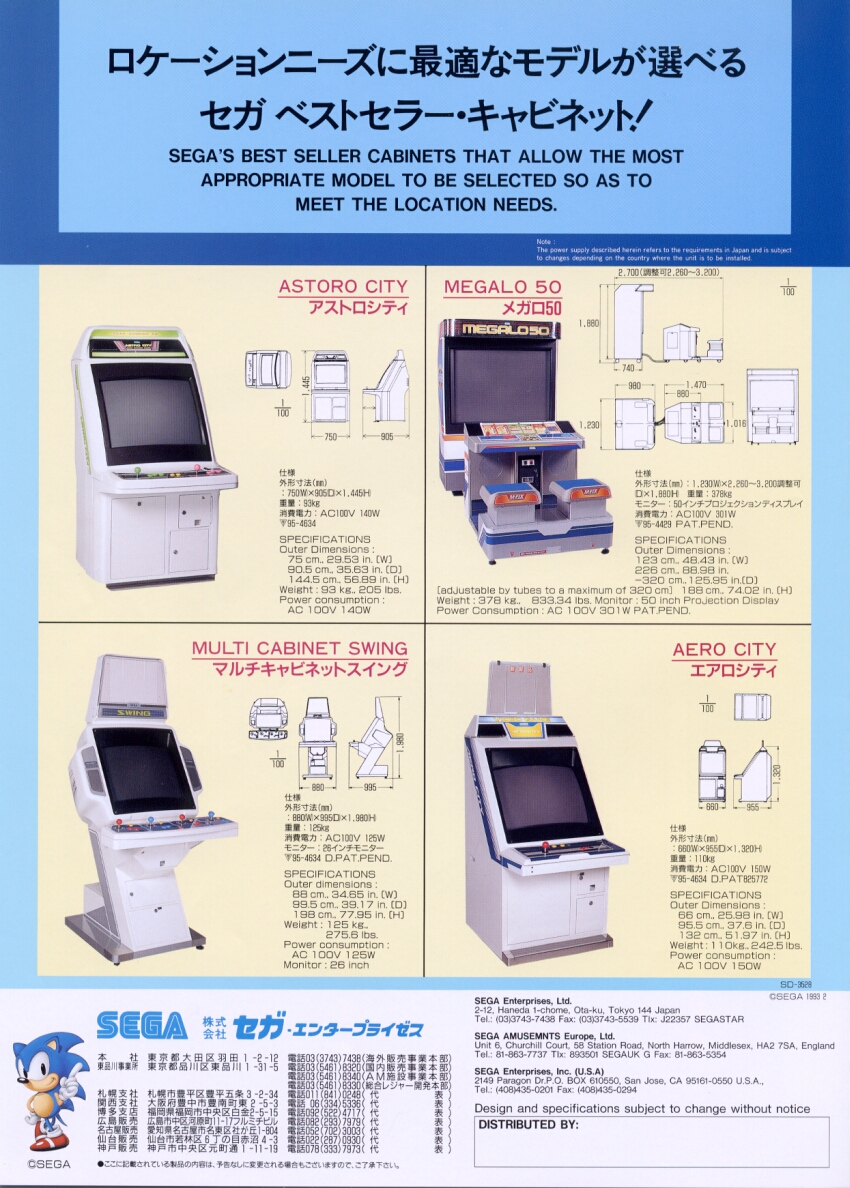
| Astro City | 905 × 750 | 750 × 905 × 1445 | Sega manual p. 3 · 1993 flyer |
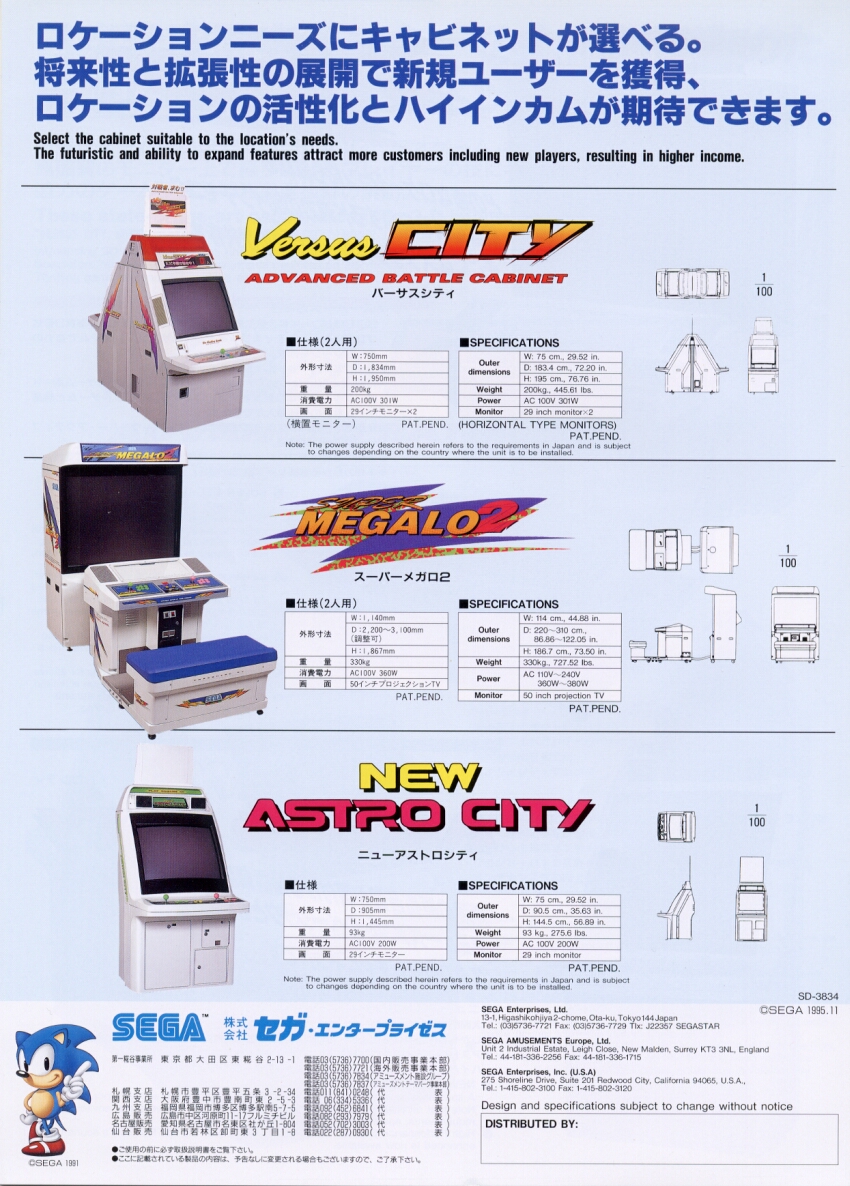
| New Astro City | 905 × 750 | 750 × 905 × 1445 | Sega manual p. 3 |
| New Versus City | 1834 × 750 | 750 × 1834 × 1678 | Via the Versus City ⚠️ inferred, see the page |
| Versus City | 1834 × 750 × 1950 | 750 × 1834 × 1950 | Sega manual p. 5 · 1995 flyer |
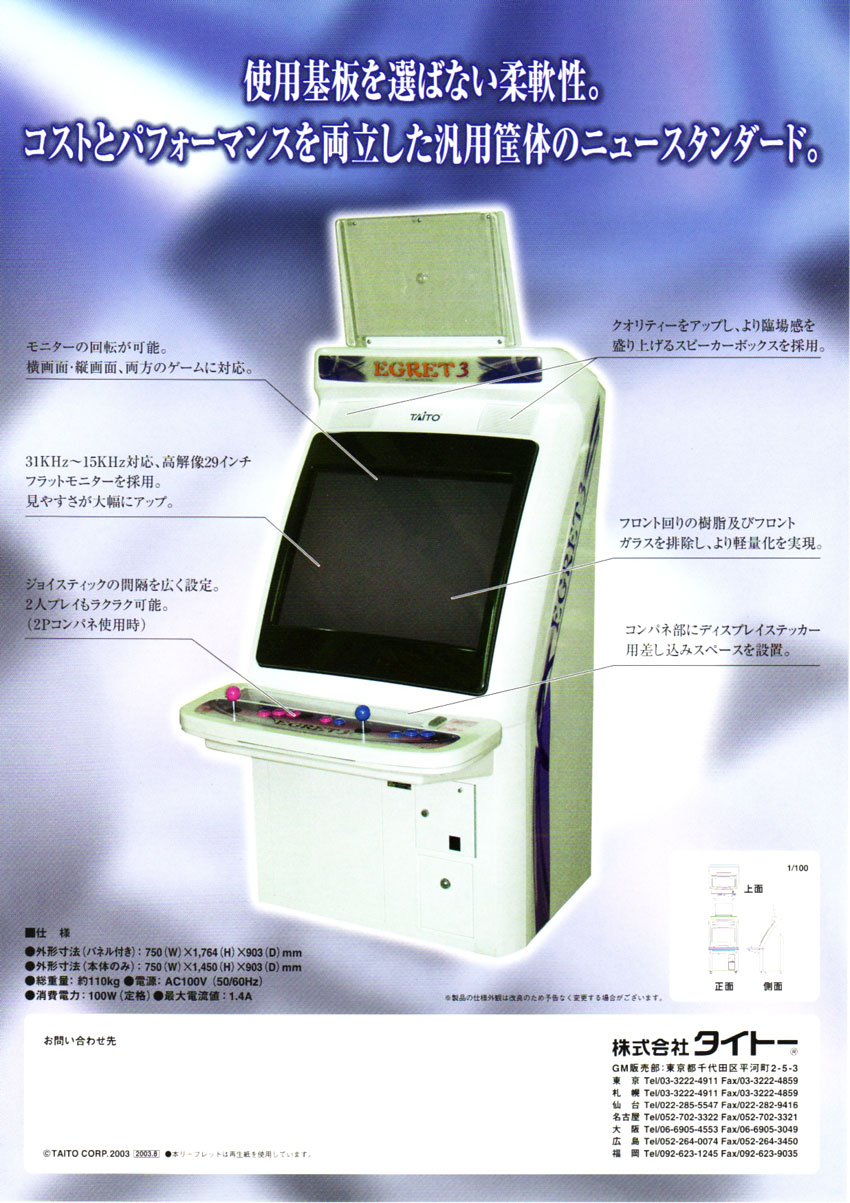
| Egret 3 | 903 × 750 | 750 × 903 × 1450 | Taito 2003 flyer |
| Atomiswave SD | 903 × 750 | 750 × 903 × 1450 | ✅ Sammy document found on 12 August: the manual labels 幅750 / 奥行き903 itself |
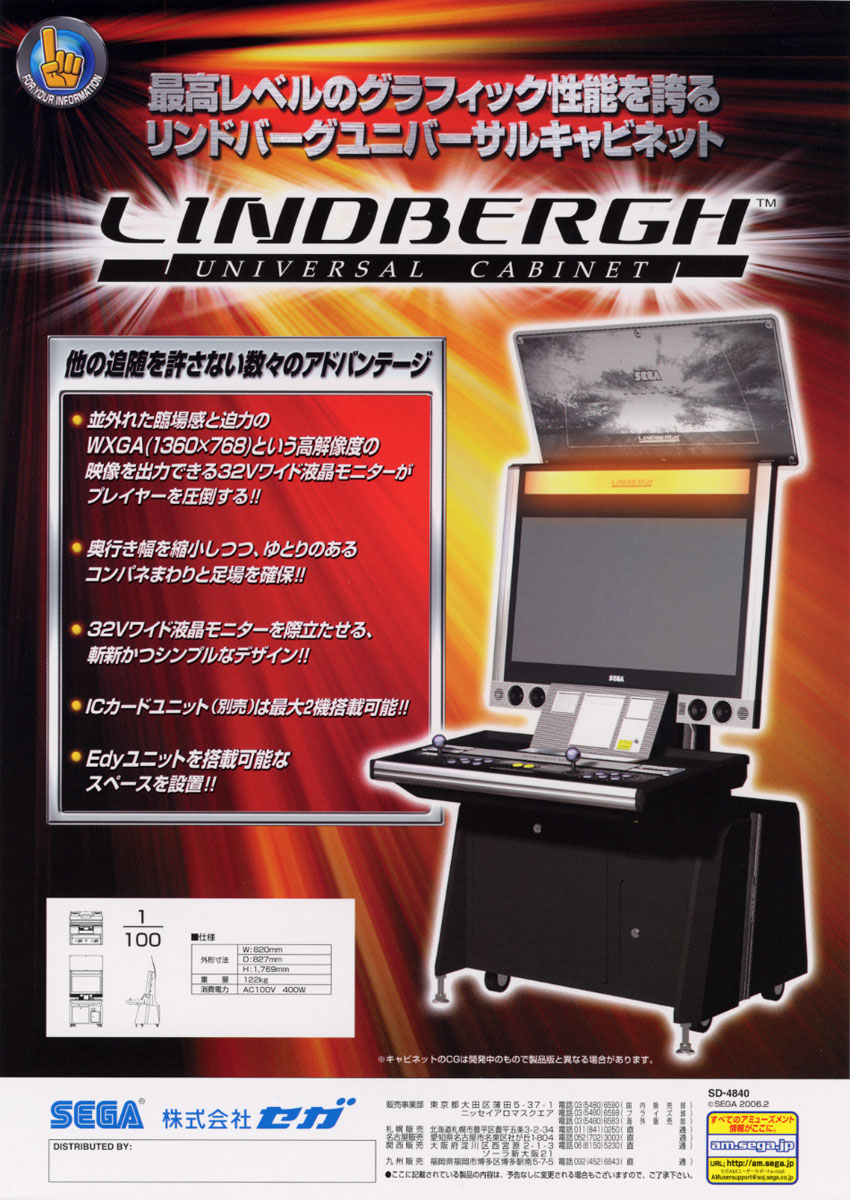
| Lindbergh | 827 × 820 | 820 × 827 — only the inversion was real, ⚠️ see below | Sega 2006 flyer · Sega manual 420-6942UK |
| Grigio | 800 × 820 | 820 × 800 × 1750 | Namco manual §2, folio 7 |
The trap is not Arcade Otaku alone
On the Grigio, Arcade Otaku writes "800 x 820" and Hard*Candy "820 x 800" — the same numbers, the opposite order, neither saying which is which. Two databases contradicting each other is the signal that neither knows.
And there are four notations for three numbers: 所要面積 at Sega (width × depth), 縦 × 横 × 奥行 on the Aero City (height × width × depth), (W) × (H) × (D) at Taito, and height → width → depth at Capcom on the Status 25.
Heights — "bare cabinet" is not "panel included"¶
| Cabinet | Published before | Corrected to | Document |
|---|---|---|---|
| Egret II | 1764 as a cabinet height | 1450 cabinet · 1765 panel included | Taito 1996 flyer, SPC. table |
| Dragon Ball Zenkai | 2200 as a cabinet height | 1480 cabinet · 2200 sign board included | Namco manual §2, folio 11 |
| Egret 3 | "1765 with marquee" | 1764 instruction panel included | Taito 2003 flyer |
| Canary | "1710 with marquee" | 1710 instruction stand included | Taito manual p. 2 |
| Grigio | "1270/1750, adjustable height" | 1750 installed · 1270 as shipped | Namco manual §5-2, folio 13 |
| Atomiswave SD | 1764, borrowed from the Egret 3 flyer | 1765 panel included · 1450 cabinet only | Sammy manual folio 1 ⚠️ see "still open" |
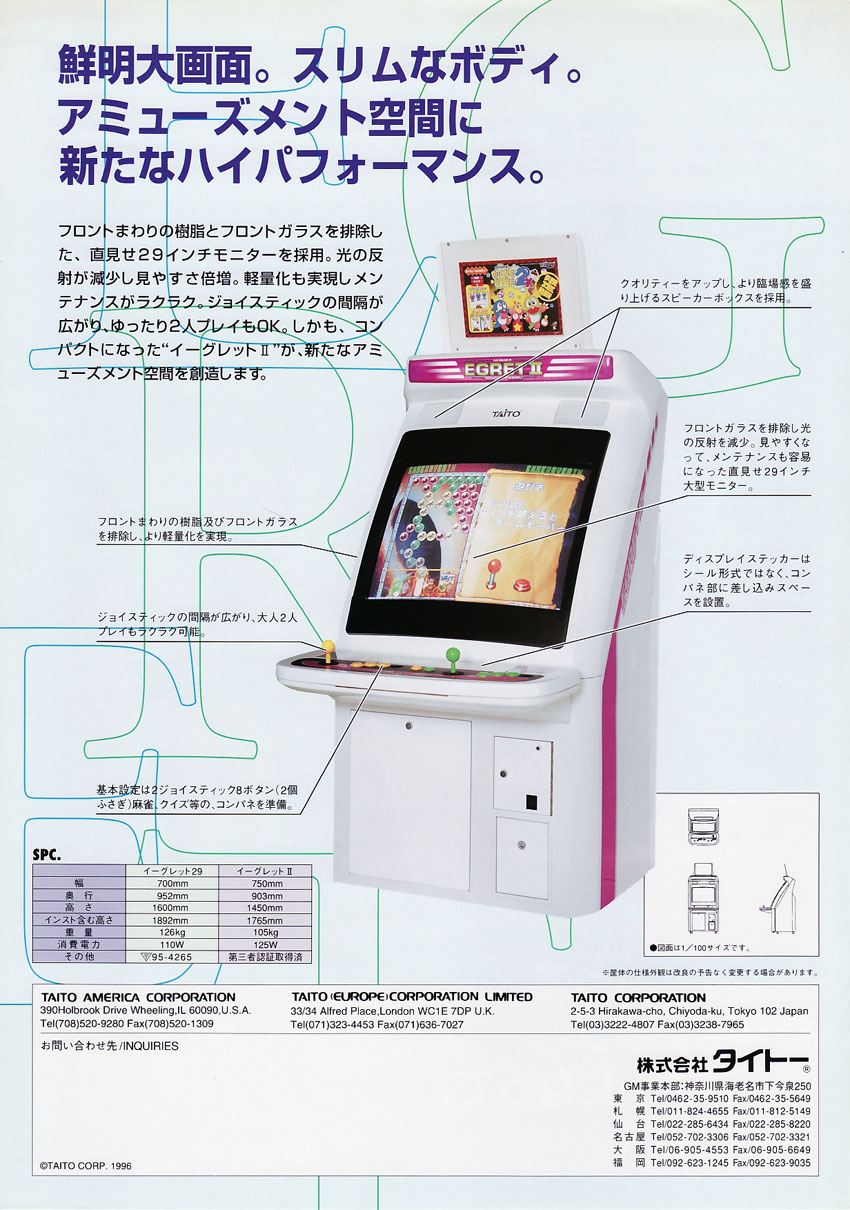
Consequence for the footprint comparison: the Egret II was drawn 31 cm too tall next to an Egret 3 measured bare — when the two machines have exactly the same envelope.
Consumption, voltage and weight¶
| Cabinet / page | Before | After | Document |
|---|---|---|---|
| Windy | height 1339, no consumption | 1399, 180 W | Konami manual folio 9 |
| Vewlix | "draws less than a CRT candy cab" | 270 W against 140 W for the Astro City | Vewlix L manual folio 7 |
| Lindbergh | 460 W | Japanese manual 420-6942 · manual 420-6942UK | |
| Exceleena | "~140 W" estimated | 110 W | Namco manual p. 3 |
| Grigio | "49 W without a board", no more | 49 W empty · 200 W with the EXVS.2 board | Namco manual §2 |
| Versus City | consumption "see the manual" | 301 W, plus the board power ceiling (+5 V 12 A) | Sega manual p. 5 and folio 1 |
| Atomiswave SD | 102 kg (Arcade Otaku), no draw given | 110 kg, 140 W, 2.0 A | Sammy manual folio 1 |
| Sega City 1986 | 19″ screen (Wikipedia), no figures | 18″, 1000 × 580 × 715 mm, 150 W, 60 kg | Sega manual folio 2 |
| Capcom Cute | monitor "Nanao (dual-frequency) chassis" | SANWA 18V21CP-2 ⚠️ and no documented scan rate | Capcom manual folio 8, 全体結線図 |
| Naomi Deluxe Universal | cabinet height 1,882, read off the flyer | 1,862 ⚠️ the middle digit is a 6, verified at ×10 on the flyer | UK manual §3.3, folio 8 |
| SNK cabinets — Neo 29 | screen "15/25 kHz", rounded | 15.75 / 24.8 kHz | Super Neo 29 Candy manual folio 4 |
| Q-GrandAm 25 | 1435 tall (community entry), second height absent | 1425 bare · 1700 with title plate A | Capcom manual folio 2 |
| Delta 32 | 875 × 880 × 1503 / 1610 (community entry) | 875 × 900 × 1530 · overall 1780 | River Service manual §3 |
| G-Balance | "820 × 781 × 1490, topper 1870" — two rows crossed | 820 × 781 × 1870 panel included · 820 × 530 × 1490 as shipped | GFI manual folio 11 |
A safety correction — New Astro City
The page warned: "cabinet documented as 100 V, feeding it 230 V destroys the supply". Its own archived manual is the European edition: Power 142W (AC 230V 50 Hz)**.
Both voltages exist. The warning was false for the very unit the manual describes. Only the label on the machine is authoritative.
Safety correction — Astro City II
The same trap as above, found on 12 August. The page warned that the cabinet is "documented at 100 V". Its owner's manual, archived since, is the English export edition and publishes power draw by region: 202 W / 2.7 A at AC 110 V, 205 W / 1.3 A at AC 220 V, 206 W / 1.1 A at AC 240 V, plus two Taiwan lines.
The 220 and 240 V versions officially exist. The warning still holds for a Japanese unit — which is what almost every imported Astro City II is — but it can no longer be stated without reservation. Only the machine's label is authoritative, and a step-down transformer on a cabinet already wired for 240 V is as destructive as the reverse.
Panel hole patterns¶
| Page | Before | After |
|---|---|---|
| Control panels | Vewlix layout: 8 buttons | 7 button holes (4 top, 3 bottom) + 1 start hole = 8 drillings |
| Vewlix | "its panel has 7 holes", with 1J7B presented as a count of holes | 8 holes: 7 for buttons + 1 for start. 1J7B counts the buttons supplied, start included |
| Control panels | the Namco Noir listed under the "Vewlix layout" row | Removed: it has 6 button holes, not 7 — its own row already said so |
| Namco Noir | pins 5/6 = "buttons 7 and 8 of the Vewlix" | 6 holes per player + start — counted on an original panel |
The Vewlix's two \"sevens\" — corrected on 12 August
This journal published "7 holes" for several versions, and the Vewlix page presented the designation 1J7B as though it counted drillings. Two different numbers were being conflated:
| The "7" of | Counts | Start? |
|---|---|---|
| The L's flyer — ボタン穴は上段4、下段3の計7個 | button holes | excluded |
| Taito's 1J7B — the C's manual: 6ボタン・スタートボタン** | buttons supplied | included |
So the real panel has 8 drillings: 7 for buttons, 1 for start. Six game buttons are fitted, the seventh hole is blanked off with the supplied ボタンカバー.
The 各部の名称 drawing in the F's manual, archived on 12 August, draws it unambiguously: six buttons with their bodies, a seventh circle left flat, and the start on its own further down and to the right. A bare original panel shows those same eight.
⚠️ And that same F manual writes 1J6B where the L, the C and the Diamond write 1J7B, for an identical Japanese line — it simply does not count the start. No Taito document announces eight buttons, and yet eight drillings there are.
What these two rows rest on
Vewlix — 7 holes. The L's flyer writes it out: ボタン穴は上段4、下段3の計7個. The L's manual corroborates it through the name of its panel option — 2J14B, 2 joysticks・14 buttons, i.e. 7 per player (§4-3) — and its §4-4-2 draws the cluster with 7 holes, 6 of them fitted. The separately counted start comes from the C's manual: 1ジョイスティック・6ボタン・**スタートボタン.
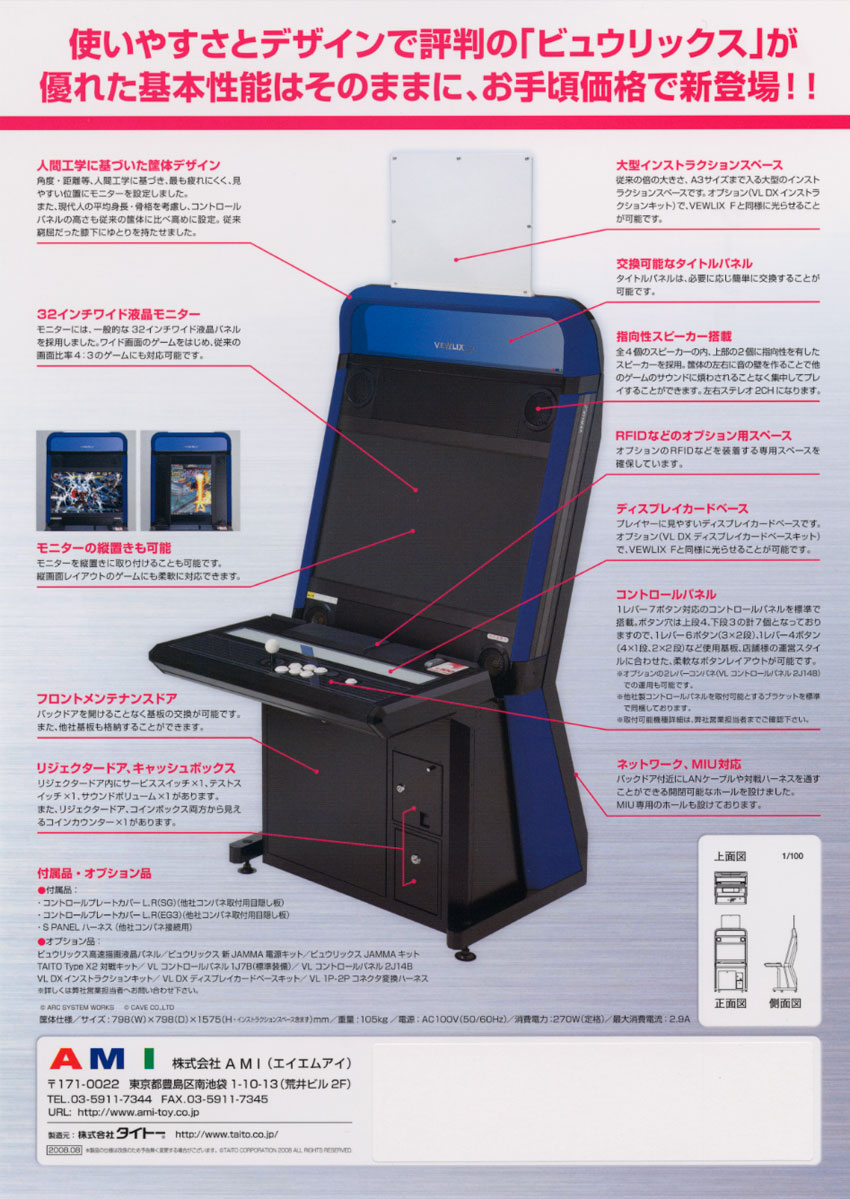
The "8" had no source at all: Slagcoin, which the page credited for it, publishes dimensioned templates and gives no button count.
Noir — nothing is established. The original reading (Arcade Otaku) annotates the free pins "expected Button 7 / 8": an assumption by its author. The Tekken 6 SD-S manual, archived since, cannot settle it — it defers fifteen times to the separate CABINET Operation Manual, including at §3 (package contents), §4 and §10-2, and that cabinet manual is not public.
Consoles, computers and boards¶
| Page | Before | After | Source |
|---|---|---|---|
| Apple Lisa | VIA clock as a single value | two values by model (÷40 / ÷16) | MAME driver |
| Tatung Einstein | interrupt chain reversed | keyboard → CTC → ADC → PIO | MAME driver |
| Arcadia 2001 | NTSC clock only | NTSC and PAL | MAME driver |
| Gamate | "AY-3-8910 replaceable" | no actual AY chip — advice was backwards | MAME driver |
| Supervision | "65C02 easily replaced" | glob-top board, no packaged ICs | MAME driver |
| Videopac / G7400 | timings from a generic worked example | real figures, folio 34 | Archived Philips manual |
| Videopac / G7400 | "no background → EF9340" | completely black screen (§ VI-1) — ⚠️ and the manual adds the converse (§ VI-2, folio 74): with no HSY from the VDOP the VIN is stalled. A black screen therefore points at neither of them | Archived Philips manual |
| Mega Drive — Triple Bypass | "designed by Tim Worthington" | db Electronics, v2 by Tianfeng | ConsoleMods + the project repository |
Withdrawn claims¶
Published for a while, then removed for want of proof. If you relied on one of these, this is where to look.
Claims put under reservation on 12 August — and what became of them that same evening
Two reservations were placed on the Capcom Cute on the strength of its manual alone. The sales flyer, found a few hours later, settled both — one of them against what this changelog had written.
| Claim | The morning's reservation | What the flyer showed |
|---|---|---|
| 18″ monitor | "the 仕様 block mentions no tube size at all, the 18″ comes from Wikipedia" | ✅ Resolved. The 仕様表 box writes 画面寸法:18インチ, and the flyer's copy speaks of the 美しい18インチ画面 |
| the name "Mini Cute" | "a community designation […] no Capcom document archived here carries it" | ⚠️ Overstated. The front prints CAPCOM・MINI™ above the CUTE logo. The "Mini" is a Capcom word |
On the name, the exact wording matters: the ™ sits on "CAPCOM・MINI", not on "Mini Cute". Capcom Mini reads as a range name and Cute as the model; the common contraction is printed as such in neither document, but it joins two of the manufacturer's own words. It is not a collectors' invention, and this changelog was wrong to say so.
One newly placed reservation
| Where | Claim | Reservation |
|---|---|---|
| Capcom Cute | released "at the same time as Street Fighter II: Champion Edition" | CE is from 1992. The flyer is © CAPCOM 1991 and its demo screen shows the original SF2. The flyer does not date the cabinet's release, only its copyright — but no document archived here supports the Champion Edition mention |

One withdrawn claim was reinstated on 12 August
The Atomiswave SD published "1765 mm with marquee". This page dismissed it for want of a source and substituted the 1764 from Taito's Egret 3 flyer, noting that no Sammy document had been found and that if one were, it is what should settle the matter.
It has been. Its manual writes 高さ1765mm. The 1765 was right, and it was the withdrawal that was the error.
⚠️ This does not invalidate the Egret 3 row in the heights table: Taito's flyer does say 1764 for the Egret 3. Two machines, two manufacturers, one shared shell and 1 mm apart — now in what is still open.
| Where | Claim withdrawn | Why |
|---|---|---|
| Vewlix | "798 × 798 × 1575, cabinet only" — withdrawn then restored | Now publishes 800 × 800 × 1575, ⚠️ recomposed — see below |
| Vewlix | "2007 manual", then "undated manual" | Both were wrong: the manual carries © TAITO CORP. 2008 on its back cover |
| Vewlix | "2 players side by side" | The L and the C are 1-player cabinets (1J7B panel, a single joystick); versus is played by pairing two cabinets. The two-joystick photo is the 2006 flyer's |
| Vewlix | "JVS and JAMMA with no option" | True of the 2006 Vewlix; on the L these are two optional kits, JAMMA requiring the JVS power kit |
| Vewlix | "no native JAMMA" | The Taito flyer says the opposite |
| Vewlix | "2 players face to face" | Side by side; the back-to-back one is the VS |
| Grigio | "adjustable height, goes from seated to standing play" | No adjustment section in the manual. 1270 = height as shipped |
| Lindbergh | "2100 mm with marquee" | ✅ restored — it is the Complete cabinet row of table 4 in the Sega manual 420-6942UK |
| Canary | "rotatable with no mechanism" | Two variants, with or without (95 / 93 kg) |
| Canary | chassis fixed to "Nanao MS8" | Taito documents Toei and Nanao |
| Amstrad CPC | a "belt" cross-reference | The TEAC FD-30A drive is direct drive |
The Vewlix's cabinet figure, in three acts
It was published, withdrawn, then restored — and in a different form each time. First published on an illegible flyer parenthesis; withdrawn for that reason; then restored on the manual, which does give 1,575 as a height (folio 7 table, 外形寸法(搬入時), redrawn on folio 8).
But the figure published today, 800 × 800 × 1,575, is ⚠️ recomposed: the manual publishes that triplet nowhere. It gives 800 × 800 × 1,890 (instruction panel included) and 800 × 525 × 1,575 (as shipped). The footprint comes from the first, the height from the second. The inference is supported — the instruction panel is a stick-on accessory, the control panel ships unmounted — but an inference it remains. Details on its page.
What is not carried over, and why the page says so
The Triple Bypass contains no Model 1 solder points: ConsoleMods hosts none, and an invented solder point tears a trace. The page says so instead of filling the gap.
Same logic for the preamp fix: the source documents it only through annotated photographs, which cannot be archived — so it is not transcribed.
Still open¶
203101 pages without an image, after 91 photographs placed on 11, 12 and 13 August (Sega Retro and Wikimedia Commons for boards and machines, Hard*Candy for the cabinets). Split as: 62 board pages (see below), 15 conversions, 11 repairs, 5 mods, 5 cabinets, 2 consoles, 1 computer. ⚠️ The board counter has not moved a single notch since the first pass: everything gained was gained elsewhere.- ⚠️ 116 yesterday, 101 today — and not one photograph was taken in between. This journal
counted every
.mdpage; the Photographs to take page, now that a script regenerates it, leaves out section contents pages and service pages (index.md,symptomes.md,relecture.md…), which have no subject to photograph. Both counts were correct and contradicted each other on the same wiki. The generated page is the one that stands, and this journal falls in behind it. Under the old rule today's figure would still be 116: the drop is a change of rule, not work done. - ⚠️ The arcade-board seam and the consumer-hardware seam are not the same one. Commons is poor in arcade system boards and rich in console motherboards — the Evan-Amos collection, public domain, covers NES, Super Nintendo, Saturn, Dreamcast and Neo-Geo AES at very high resolution. Hence 10 photographs placed on 13 August on the mods pages.
- ✅ And a third seam: GAME boards. Commons is poor in system boards but decent in game
boards — useless on a "Konami GX" page, but exactly right on a conversion page, which
is about one precise hardware family. 10 more photographs on 13 August: DonPachi (Cave
68000), Batsugun (Toaplan), an MVS cartridge, Demon Front (PGM), System C2, Puzzle Bobble
2 on its F3 motherboard, Fantasy Zone (System 16), Street Fighter II on CPS-1, and a
System 11 with its Tekken ROM board — that one literally illustrates the KEYCUS page's
subject. What remains is mostly board
pages and overview pages. (Same count as on 11 August:
.mdpages excluding.en.mdcontaining no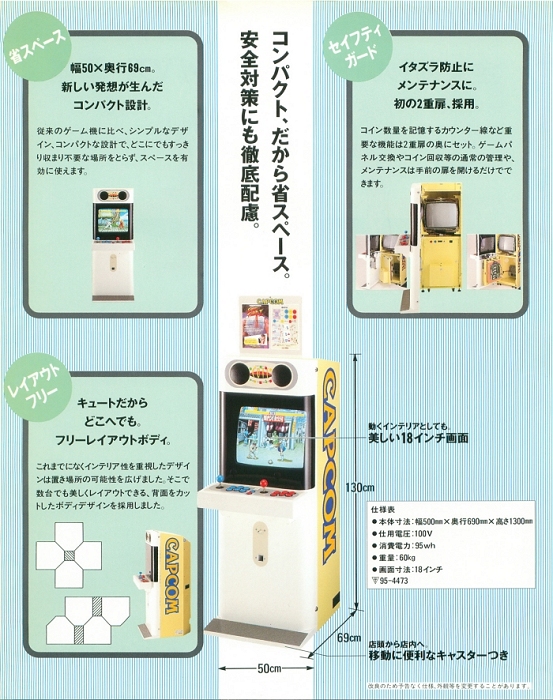
Divergences between documents from the same manufacturer — not arbitrated¶
Two documents from the same manufacturer give two values. None has been arbitrated: both are published as they stand, with their source. They are therefore not corrections but open questions — hence their place here.
| Cabinet | Value A | Value B |
|---|---|---|
| Aero City | 125 W (manual) | 150 W (1993 flyer) |
| New Astro City | 142 W (EU manual, 230 V) | 200 W (1995 JP flyer) |
| Canary | 110 W / 1.5 A (manual) | ~120 W / 1.4 A (1991 flyer) |
| Egret II | ~110 kg (manual) | 105 kg (flyer) |
| Versus City | ~198 kg (manual) | 200 kg (flyer) |
| Vewlix — C against F | 4.28 A (C manual) | 3.8 A (F manual) — the same 125 kg and 290 W on both sides |
| Atomiswave SD / Egret 3 — shared shell | 1765 mm (Sammy manual) | 1764 mm (Taito Egret 3 flyer) |
For sizing an installation, each page recommends the higher value.
⚠️ The last two rows are from 12 August. The Vewlix one is the more troubling: two Taito manuals, the same weight, the same power, half an amp apart. Nothing in either document explains the difference.
New content¶
Pages created¶
Consoles — Arcadia 2001 · Gamate · Supervision · Playdia · Pippin · Videopac / G7400 · Intellivision · Super Cassette Vision · VC 4000 · Game & Watch
Computers — Apple Lisa · Tatung Einstein · Sanyo PHC-25 · Mattel Aquarius · Philips VG-5000 · Matra Alice · Micronique Hector
Arcade boards — 28 new pages: Alpha 68K, Atari CoJag, Bally Astrocade and Sente, Data East MLC, Deniam, Dynax, Eolith, Gaelco, IGS011 and PGM2, Jaleco MS32, Konami Firebeat, Konami GV / M2 / Twinkle, Midway MCR, Namco ND-1, Nintendo Aleck64, NMK16, Playmark, Seta, Taito JC System and Wolf System, Tecfri, Technos, V-System, Zaccaria.
(Six of them — in bold — were missing from this list, which claimed "22". They were indeed
created during the period, commits 98296f8 and a396c94 of 5 August.)
Major sections added¶
- Mega Drive Triple Bypass — rewritten from scratch: signal reference, transcribed BOM, Gerber and KiCad archived under the CERN OHL licence, installation procedures by revision (Model 2 VA0, Model 3 VA1 and VA2, Sega CDX), 28 annotated plates hosted locally.
- Manufacturer figures published for cabinets that had none: Madonna, Pony 40, Status 25 and 18, New Candy 25, Exceleena and Cyber Lead (Namco), Egret II, Aero City, Naomi Deluxe Universal (other candy cabs).
- 12 August — four more, from manuals: Impress 29 (730 × 920 × 1460, 1735 with the eye-catch panel), Pony Mark IV (730 × 869 × 1362, 1640 with the acrylic fitted), Astro City II and Super Megalo 2 — the last two as installation space, not cabinet figures.
- Vewlix — the four manuals in columns. L, C, F and Diamond compared folio by folio: the same geometry for all four (same two triplets, same 710), only weight and power draw change. And none of the four writes the 800 × 800 × 1,575 the comparison uses: this cabinet's most useful figure remains recomposed.
-
12 August — a new page, and a region this wiki ignored. Korean and Taiwanese candy cabs: the Andamiro Joy-Ro 21/29 (Korea) and the WeChe OK Baby (Taiwan). The wiki covered Japan and the West, nothing in between.
Two things no Japanese candy archived here offers: dual 110/220 V stated on the same line, and a Coin field reading
ticket, coin— the cabinet is built for redemption.And the WeChe manual's title explains the whole range: OK Baby Cabinet + Upright Base. The OK-L is the OK-S on a base — +215 mm, +10 kg, same width, same depth, same tube. The same principle as the Neo 19's stand.
⚠️ Neither Joy-Ro has a single figure published here. Their manuals are archived, but they are parts catalogues — 21 and 24 pages swept one by one, no specifications block. The inch values in circulation for Korean cabinets come from a community entry and smell of conversion; they are not repeated.
-
12 August — three community-entry figures contradicted by their own manual. Beyond their numbers, the page-less cabinets produced three clear disagreements with the matching Hard*Candy entry:
Cabinet The entry said The manual writes Q-GrandAm 25 (Capcom) 1435 tall, no second height 1425 bare, 1700 with the title plate Delta 32 (River Service) 875 × 880 × 1503 / 1610 875 × 900 × 1530, overall 1780 G-Balance (GFI) "820 × 781 × 1490, topper 1870" 781 goes with 1870, 530 with 1490 The G-Balance case is the most instructive: the entry crossed two rows of the 仕様 block, marrying the panel-included depth to the as-shipped height. Yet this 2008 manual, from an independent maker, uses the Vewlix's two exact labels — 外形寸法(インストラクションパネル含む)and 外形寸法(搬入時). Taito's convention had spread.
-
12 August — two cabinets the wiki named without knowing anything about them. The Namco Blanc (a 184-page manual): 890 × 800 × 2,200 mm, 150 kg installed, and a teardown weighed piece by piece — cabinet 135 / 125 kg depending on the rack, curved side panels 4 kg each, sign box 6 kg. Draw 200 W without the game board, 330 W with: the Namco convention, already seen on the Grigio and the Noir.
And the Delta 32, a two-screen cabinet — 32″ main + 20.1″ sub driven by a media-player board on a CF card, with a motion sensor. Its manual is the only one in this wiki to give a figure for the doorway: "Make sure door must be over W 0.9 m × H 1.6 m".
-
Evening of 12 August — the SNK cabinets, four at once. The Neo-Geo MVS page had no figures and no cabinet manual — only board manuals. Five archived SNK manuals give it four: Neo 19 (520 × 646 × 1340, 60 kg), MVS-U/33 (780 × 980 × 1473, 146 kg), Super Neo 29 Candy (710 × 890 × 1717, 94 kg) and Super Neo 29 Type Ⅱ (710 × 890 × 1927, 99 kg).
Three things came out of them that no community source carried:
- ⚠️ The Super Neo 29 Candy destroys its monitor if you get the frequency wrong. The manual says so: the tube ships at 15.75 kHz, a 24.8 kHz PCB requires switching it, "otherwise the picture will not display correctly and it will cause monitor failure". Elsewhere in this wiki a wrong frequency gives no picture; here it breaks things.
- ⚠️ That same cabinet accepts only a 1-slot Neo-Geo board. "Using a 2-slot or 4-slot board will cause failure." It is the exception to MVS's multi-cartridge reflex.
- The U1 / U2 / U4 suffix names the motherboard, not the cabinet: the MVS-U/33 manual prints the same 仕様 block twice, folios 26 and 38, with one line of difference (MV20 against MV1).
And one identity corrected: the Super Neo 29 Type Ⅱ runs on HYPER NEOGEO 64, not MVS. ⚠️ Hard*Candy serves its PDF under two cabinet names — same MD5, and the document names itself TYPE Ⅱ. So this wiki has nothing on the base Super Neo 29.
-
12 August, second batch — two more: Cute (500 × 690 × 1300, 95 W, 60 kg, and the power ceiling: +5 V 10 A, +12 V 3 A, −5 V 1 A, −12 V 1 A) and Sega City 1986 (1000 × 580 × 715, 150 W, 60 kg, 18″ tube). The Cute, at 500 mm wide, is now the narrowest cabinet documented from a source in this wiki — ahead of the City (580), the Status 25 (598), the Madonna (620) and the Canary (660).
- Atomiswave SD — the manufacturer is named. Folio 1 of the Sammy manual carries 製造元 株式会社タイトー. This wiki wrote "licensed Egret 3 shell" by inference; the Taito half is now documented, the rest remains an inference and says so.
A regularity, published on every page concerned
Four manufacturers, four manuals read on 12 August, the same construction: a cabinet height and a panel-fitted height — and never the same word for it.
| Cabinet | Bare | Panel fitted | The manual's term |
|---|---|---|---|
| Vewlix (Taito) | 1,575 | 1,890 | インストラクションパネル含む |
| Madonna (Irem) | 1,320 | not published | インストラクションパネルを除く |
| Impress 29 (Capcom) | 1,460 | 1,735 | アイキャッチパネル取付時 |
| Pony Mark IV (Jaleco) | 1,362 | 1,640 | ゲームエクスプレネーションアクリル取付け時 |
| Atomiswave SD (Sammy) | 1,450 | 1,765 | インストラクションパネル無し |
Copying the wrong one of the two means being 275 to 315 mm out — the difference between a cabinet that clears the door and one that does not.
Archived documents¶
1,335 manufacturer documents in the repository: 1,309 PDFs and 26 flyer scans. 227 added over the period. The actual breakdown, by commit:
| Origin | PDFs | Scans |
|---|---|---|
| Three batches of game manuals | 107 | — |
| Large scans | 36 | — |
| "Other" and orphan pages | 26 | — |
| Sales flyers | — | 24 |
| Seven single manuals (Canary, Videopac, Grigio, Vewlix C, Tekken 6, CDX, peripherals) | 7 | — |
| Cabinet manuals from 12 August (see below) | 12 | — |
| Capcom Cute flyer (front + back), 12 August | — | 2 |
| Naomi Deluxe Universal manual (UK), 12 August | 1 | — |
| Five SNK cabinet manuals, 12 August | 5 | — |
| Seven manuals for cabinets outside the known range, 12 August | 7 | — |
| Total | 201 | 26 |
The twelve cabinet manuals of 12 August, all found on Hard*Candy except the first two:
| Manual | Pages | What it brings |
|---|---|---|
| Noir キャビネット | 90 | the 1P/2P panel parts lists |
| Lindbergh Universal SD (JP) | — | the Japanese variant, 1,770 mm |
| Vewlix F | 122 | 125 kg, 290 W, 3.8 A, panel written 1J6B |
| Vewlix Diamond | 116 | 105 kg, 230 W ⚠️ with NESiCAxLive fitted, ships without an I/O board |
| Atomiswave SD | 63 | 1765 / 1450, 110 kg, 製造元 タイトー |
| Astro City II | 60 | EN export, power by region including 220-240 V |
| Super Megalo 2 | 65 | EN export, 330 kg, Hitachi / Mitsubishi projectors |
| Impress 29 | 32 | the first Capcom figures for this cabinet |
| Pony Mark IV | 34 | the first Jaleco figures for this cabinet |
| Madonna | 36 | repeats the flyer's 仕様 block identically |
| Capcom Cute | 10 | 500 mm wide, supply rails ⚠️ no tube size — the flyer is what gives it |
| Sega City | 29 | 18″ and not 19″, figures in 縦×横×奥行 ⚠️ depth printed "71.5 m" |
⚠️ None of these twelve PDFs has a usable text layer — except the Diamond, whose layer is scrambled by a font shift. Everything the wiki quotes from them was read off the rendered pages, and for the Diamond decoded and then cross-checked against the rendered page. Every source entry says so.
⚠️ The schematic plates are not part of this total: they are images outside
manuals/. This page used to say "in three batches plus the schematic plates" — the three
batches cover only 107 of the 200, and the plates cover none.
(How these are counted: see How these figures are counted.)
The largest batch is the sales flyers, found through The Arcade Flyer Archive: Sega (1993 and 1995), Taito (Egret II, Egret 3, Canary, Vewlix, Vewlix L), Irem Madonna, Jaleco Pony 40, Capcom Status, SNK New Candy 25, Sega Lindbergh and Naomi Deluxe.
Why a flyer sometimes beats a manual
Sega and Taito published bilingual leaflets in which the figures are labelled (W) (D) (H) in English. That is the clearest source there is on the order of the numbers — and often easier to find than a service manual.
The full catalogue is on Documentation & manuals.
Tooling¶
The repository's six checks. This table is regenerated by scripts/tableau-controles.py: the list comes from the scripts/verifie-*.py files actually on disk, and the Publication column is read out of publish.sh. Adding a check without documenting it fails the script — and publication with it.
| Check | What it catches | Publication |
|---|---|---|
verifie-ancres.py |
An internal link pointing at an anchor that does not exist — the link works, it goes nowhere. | blocks |
verifie-documents.py |
An archived manual no page cites any more, and a link to a missing document. Resolved by path, not by filename. | blocks |
verifie-doublons.py |
The same archived document stored twice under two names — the reader believes there are two documents, and one of the titles may mislead. | blocks |
verifie-generateurs.py |
A generator that reads back its own output: run on two copies, blocks kept and blocks stripped, it must write the same thing. | blocks |
verifie-journal.py |
A journal entry filed under the wrong day — the content is published, but the reader sees the wrong date and thinks the wiki has stalled. | blocks |
verifie-non-regression.py |
What a change makes a page lose — headings, document links, sources, values with units. ⚠️ Advisory: disappearances are often deliberate. | prints only |
verifie-parite.py |
An English version with one danger box fewer than the French one, one table fewer, one document fewer. |
blocks |
verifie-rendu.py |
The --strict build judged on its exit code, plus <figure> elements swallowed by the renderer or placed inside an admonition. |
blocks |
The wiki's diagrams are regenerated from the pages on every run, never hard-coded. Four guardrails were added to the footprint comparison:
- The order of the figures must be declared by the page, otherwise the cabinet is left out and listed.
- A "panel included" or "sign board included" height is not a cabinet height — the page is left out rather than mixed in.
-
The qualifier only counts if it applies to the triple actually read: a first version wrongly excluded pages that give both heights in the same cell.
-
The left-hand label is checked, not just the value. This guard was missing, and it showed: renaming a row from "panel included" to "panel fitted" let the Vewlix's 1,890 through, and the chart drew the cabinet 315 mm too tall — precisely the Egret II error guard no. 2 exists to prevent. Two causes: the pattern only knew compris/inclus/included, and above all the left-hand column was never examined. So it was not the check that had been protecting the chart, it was the order of the table's rows.
-
Nothing may disappear without being declared.
verifie-non-regression.pycompares what a change makes a page lose — headings, document links, sources, values with units — rather than its line count. Volume is a poor signal: the Vewlix page lost 100 lines on purpose, the SNES only 72 out of 406 and that one was a real loss. - Every document must be reachable.
verifie-documents.pyresolves each link by its path and reports documents no page cites any more. It found the SNES regression above, and four duplicates.
The script stops rather than draw from memory if a page becomes unreadable.
13 August — a build check that reported \"clean\" without building anything
For a whole session, the check run after every change was:
mkdocs build --strict 2>&1 | grep -icE "error|warning"
It returned 0 — so "clean" — for hours, while mkdocs was not on the PATH. The
shell was answering command not found: mkdocs, which contains neither "error" nor
"warning". The grep saw nothing, so everything was fine.
What was published did not suffer: scripts/publish.sh calls
./.venv/bin/mkdocs build --strict by its path, without a pipe, and stops if the build
fails. It was the intermediate check that was hollow, not the publication.
Hence scripts/verifie-rendu.py, which applies two rules:
- Judge a return code, not text output. A missing tool, a killed one, or one logging in another language will always slip through a grep.
- Call the repository's own interpreter (
./.venv/bin/mkdocs), never the bare name — the PATH depends on the shell, and the shell depends on who runs the command.
The script also checks two rendering faults --strict cannot see:
- a swallowed
<figure>— a badly surrounded raw HTML block is silently dropped from the generated HTML; the page builds, strict is happy, and the image exists nowhere. The script compares<figurecounts, page by page, source against output; - a
<figure>placed inside an admonition — written right after the!!! danger "…"line and before its indented body, it breaks the admonition: empty title, figure outside, indented text rendered as a code block. Valid Markdown, so--strictsays nothing. The pattern is refused at source.
⚠️ That second case is not theoretical: two figures placed on 13 August were in it, on the SNK cabinets page. They were moved above their admonitions.
13 August — two photographs written to disk and never placed
The placement script tested "is this figure already here?" by looking for the image's bare name in the page. Two collisions:
| Image | The page already contained… |
|---|---|
mega-cd.jpg |
a link [Mega-CD](../../consoles/sega/mega-cd.md) |
osborne-1.jpg |
a manual line pointing at manuels/autres-osborne-1.pdf |
The script concluded "already placed", skipped the insertion — and wrote the file to disk anyway. Two orphaned images, invisible to the build.
verifie-documents.py is what caught them, because it compares paths, not names —
exactly the trap it was written for, and the one the placement script was recreating from
the other side. The test is now img/{name}.jpg in text.
13 August — the Atomiswave SD dropped from the comparison, then drawn 315 mm too tall
Rewriting its page on the morning of 13 August, I replaced its | Dimensions | row with a
better-sourced version carrying the manual's own kanji labels:
750 (幅) × 903 (奥行き) × 1765 (高さ). Two failures, neither reported:
- It dropped out of the comparison.
svg-bornes-encombrement.py's parser accepted(l),(w),(p),(d)between the numbers — not kanji. A better-sourced page became unreadable to the tool. - Then, once the parser was extended, it came back at 1,765 — the panel-included height taken for the cabinet height. 315 mm too much, the exact fault this script exists to prevent and which had already hit the Egret II.
Nothing said so. verifie-non-regression.py could not: the value 1450 mm was still on the
page. The build was clean. The cabinet was simply wrong in the chart.
Three fixes, all durable:
- The parser reads kanji. 幅 / 横幅, 奥行 / 奥行き, 高さ are now accepted order markers — and they are the most reliable in this wiki, coming straight from the manuals.
- The page follows the Vewlix convention: one row per state, panel included and cabinet only, each labelled. The guard then does its job and picks the right one.
- The comparison keeps a fingerprint (
scripts/.encombrement-reference.json). Every run compares against it and fails with exit code 1 if a cabinet disappears or changes figures unannounced. Verified by tampering with the reference: both the disappearance and the change were caught.
One imprecision fixed along the way: the chart displayed "Jaleco — Pony cabinets" for a figure that belongs to the Pony 40 alone, a 42″ projection cabinet 1,140 mm wide where the Mark IV is 730. When a range page names its model in bold, that is what gets shown.
Daily log — since 13 August 2026¶
28 September 2026¶
✅ 28 September — Konami: nine manuals, one template, and four players over JAMMA
ⓘ The Konami beat'em up page listed its games with no original document at all. Nine manuals are now archived: Sunset Riders, Vendetta, Turtles in Time, 4-player T.M.N.T., Wild West C.O.W. Boys of Moo Mesa, Martial Champion, Bells & Whistles, Bottom of the 9th, Open Golf Championship.
✅ All carry the same TECHNICAL INFORMATION box, word for word: required supply, analogue positive RGB video with composite negative sync, monitor orientation, and sound set on the board — not in the cabinet.
ⓘ Five stated figures join Power supplies: 4 A for Sunset Riders, Vendetta and Turtles in Time, ⚠️ 5 A for Bottom of the 9th and Open Golf. ⚠️ Konami names the +12 V without ever giving a current, and states the +5 V as a minimum — where Tekken 3 bounded the voltage itself at +5 % −1 %. Two makers, two ways of specifying the same supply.
⚠️ 28 September — four players on an edge that wires only two
The 56-pin JAMMA edge carries two players only. For four, Konami adds CN3 and CN4, two 15-pin JST B15P-SHF-1AA connectors: coin slot, four directions, two buttons, ground. ⚠️ Neither +5 V nor video runs through them.
ⓘ So a Konami four-player cabinet is not "JAMMA with more wires": it is JAMMA plus two proprietary connectors, and they carry the two extra coin slots — the manual requires "four independent coin slots". ⚠️ And there is no start button: "Start buttons are substituted by the function buttons for each player".
✅ One colour per player — red, blue, yellow, violet, down to the wires (3P white/…, 4P yellow/…). ⓘ A whole player gone silent therefore reads off the colour code: one dead direction points at a switch, a whole player at its extension connector or its ground.
⚠️ 28 September — two corrections made along the way
⚠️ I had attributed the "4 A" to the 1989 Turtles. It comes from the Turtles in Time manual; the 1989 four-player manual does not state its supply, and the table says so rather than filling the gap.
⚠️ And I had left an empty ](#) link in the Power supplies page — the defect this wiki has
met before, and which the anchor check does not catch. Removed, and verified: none remain
anywhere in the content.
✅ 28 September — Triforce: four manufacturer manuals, and a cell that accuses the board
ⓘ The Triforce page described the platform without a single dimension. Four manuals are now archived: F-Zero AX Standard (Sega Amusements USA, 999-1930, 174 pp.), the Virtua Striker 4 kit, and Mario Kart Arcade GP and GP 2 from Namco Europe.
- Three cabinets compared: F-Zero AX 991 × 1,740 × 1,956 mm, 263 kg (580 lbs converted here), 600 W at 120 V; Mario Kart GP 1,760 × 1,750 × 2,050 mm, 495 kg, 500 W at 230 V; GP 2 870 × 1,620 × 1,943 mm, 260 kg, 340 W.
- ✅ The GP's breakdown adds up: 369 kg (monitor cabinet) + 2 × 53 kg (seats) + 20 kg (header) = 495 kg, the stated total. ⓘ The GP is a two-seater, the GP 2 a single — hence 890 mm less width and 160 W less.
- ⚠️ F-Zero AX and GP 2 match to the kilo (263 against 260), one stated in pounds, the other in kilos.
- ⓘ The Sanwa 29E31S chassis of the F-Zero AX is the one already recorded on the NAOMI Universal.
⚠️ 28 September — \"battery low\" in the first year: it is the board to inspect
The F-Zero AX manual gives the Triforce's cell — CR2032, Sega part 401-0065 — then warns: "If an error appears indicating that the battery power is very low within the first year of use, it is usually an indication of a problem or abnormality with something other than the battery".
ⓘ Replacing the cell without looking further means doing it again a year later. ⚠️ It is the same lesson as the SCR crowbar and the targeting sensor fuse published in September: a protection that trips names a cause, not a part to swap.
ⓘ The key chip, for its part, "becomes a proprietary game board for this product": it is what ties a Triforce to a given game.
ⓘ 28 September — what the Triforce requires, and what the card reader demands
The Virtua Striker 4 kit sets three conditions: a JVS cabinet, a 15 or 31 kHz monitor ("Cabinets using monitors and projectors not compatible with 15/31 kHz cannot be used"), and the original shield case.
⚠️ And one maintenance line with no equivalent elsewhere on this wiki: the F-Zero AX magnetic card reader needs head cleaning "Every 151 counts of the card reader/writer or Daily". ⓘ Every 151 cards, the figure reproduced as printed. The cards (601-11334-01, per 200) and the cleaning cards (601-11050, per 30) are consumables sold separately.
ⓘ Network: up to 4 cabinets, with more than 70 cm required between machines.
13 September 2026¶
⚠️ 13 September — NAOMI: the DIMM battery is a rechargeable pack, and the \"key\" does not depend on it
ⓘ The Sega NAOMI page was reworked from the Sega NAOMI GD-ROM System service manual (420-6620-02), archived for a long time but wrongly presented as a plain owner's manual.
- ⚠️ The DIMM board battery is a rechargeable pack (CGR-B/241A, 401-0076) that wears out: "about 500 times", 70 to 80 % of its charge, about 16 months in daily use. Symptom per Sega: longer loading. ⚠️ The page said it also kept the game's "key": the key is a removable chip, withdrawn.
- ✅ The main board has its own CR2032 (401-0054), to be changed only when flat.
- ✅ ERROR 01 to 27 and CAUTION 51 to 53 are published, with the maker's causes and remedies — replacing a generic fault table.
- ✅ Filter board: DIP 1 OFF = 31 kHz, ON = 15 kHz; I/O connected to CN5 by USB cable; TORX194/TOTX195 optical fibre between NAOMIs; +3.3 / +5 / +12 V power on CN1.
- ⚠️ Withdrawn for lack of a source: the "key battery" on some cartridges — the manual does not mention it, the point is marked as to be sourced.
⚠️ 13 September — NAOMI Universal: photo, faults and voltage corrected from the manual
⚠️ Three defects spotted by the wiki's owner on NAOMI Universal:
- The photo showed a modified cabinet. Replaced by the front/rear drawing from the archived manual's Name of parts chapter.
- The "common faults" were NAOMI board faults (DIMM, GD-ROM, battery), not cabinet faults. Replaced by the manual's troubleshooting table, which covers the cabinet only: mains and protection, colours, shrinking picture, sound, fluorescent lamp. The board is referred to its own page.
- The voltage was given as 110 V (Hard*Candy). The archived manual says 230 VAC, 1.4 A; that is now the leading value, Hard*Candy still cited.
✅ What the manual adds, re-read from the image: 76 × 98 cm, ~117 kg, 322 W max., 5–40 °C; ⚠️ two heights in the same document — 175 cm in the box, 180 cm cabinet and 210 cm assembled in the parts chapter; the fuses (3.15 A ×2, 4 A, 5 A ×2); the 5V ADJ / 3.3V ADJ adjustments "as set at time of shipment"; maintenance, from the daily adjuster check to the annual interior clean.
ⓘ And a link: the document is an assembly — Japanese cover 420-6460-01, 420-6455-C220 inserts, UK manual — whose kit, a Zombie Revenge kit, cites the "SERVICE MANUAL NAOMI UPRIGHT 420-6455-01UK", the reference the Marine Fishing manual calls the "Naomi Cabinet manual".
✅ 13 September — Sega Marine Fishing: a rod without a rod, and a reel that resists
ⓘ A new page: Sega Marine Fishing, from service manual 420-6574-01UK by Sega Manufacturing Division (UK), "Naomi cabinet" version. ⓘ The scan's text layer is unusable: everything was re-read from the image.
- ✅ The rod on screen does not exist: "Although not actually attached, this appears in the game mode". The player holds a tilting grip (ROD X / ROD Y), a reel read by an encoder (REEL SPEED), a mini stick, a red CAST button and a yellow LURE button.
- ✅ The reel has force feedback: the output test drives MOTOR, CLUTCH and REEL BRAKE, and "Reel handle receives no load" points to the brake.
- ⚠️ Monthly greasing — after three months (Sega Rally, F355) and six months (Out Runners), a third interval at Sega, with an unnamed "proprietary synthetic lubricant".
- ⚠️ Rod not returning to centre → extension (HOT-3107X) and torsion springs. Machine freezes → voltage dip: turn off, wait at least 30 seconds, turn on.
⚠️ And a stated limit: for the cabinet, the manual refers to the "Naomi Cabinet manual, 420-6455-01UK", which this wiki does not have. So the page does not state which NAOMI cabinet it is.
⚠️ 13 September — duplicate audit: twelve surplus files, and one wrong value on the Blanc
ⓘ Two passes over the wiki's 1,599 PDFs: exact hashes, then a visual hash of the first page and a middle page, confirmed page by page and by eye.
Exact duplicates (three pairs): a one-page Atari Field Service bulletin was published twice, as "Trak 20" and as "Twin Racer". ⓘ The bulletin actually covers both games — it is kept once, under a name that says so. The VS UniSystem kit and an Alpha Denshi schematic were also archived twice.
Same scan under two names: Namco Classic Collection vol. 1 and vol. 2, Rygar, the 4-Player Football DP-139 "02a/02b" sheet ⚠️ (both files carry the same side: the other sheet is not archived), the US Out Runners manual archived here this very morning as a duplicate of a text-less copy, Touch Me ⚠️ (pages 7 and 8 swapped in one of the two — the TM-002 copy, in folio order, is kept), the 32X manual listed a second time as "32X + Mega-CD" (it is the same document, which also covers the Sega CD), and the Macintosh IIcx / IIci / Quadra 700 Service Source listed as two manuals.
⚠️ The Blanc Cabinet: its manual — printed under the game's title, ドラゴンボール ZENKAI バトルロイヤル 取扱説明書 — was archived twice, once under the cabinet's name and once under the game's. A single copy is kept, cited by both pages. ⚠️ And re-reading it from the image, one wrong value on Namco cabs: the draw without the game board is 220 W, not 200 W (chapter 2 "仕様").
✅ And one more blocking check: verifie-doublons.py now refuses publication when two
archived documents are byte-identical. ⚠️ It does not see the same scan re-encoded: those remain a
matter for the eye. The byte-identical Atari 8-bit photos under different model names are
being checked separately.
✅ 13 September — Out Runners: three editions of one manual, cross-checked
ⓘ Three copies of the Out Runners manual are archived, and they are not copies: the export edition (Sega Enterprises Ltd., 420-6079-01), the US edition (4201-6079.01, "1ST US PRINTING") and the Operator's Manual of the Australian distributor Leisure & Allied Industries. ✅ Every published value was re-read from the image and compared from one edition to another → Deluxe cabinets.
- Complete cabinet: 1,254 × 1,710 × 1,960 mm, ~329 kg, identical in both Sega editions; 450 W, 3.99 A at 120 V; two 26″ monitors.
- ✅ The shipping table adds up: 265 + 2 × 28 + 4 + 4 = 329 kg, counting the rear section "one side only" on both sides (this wiki's calculation).
- ⚠️ A fifth axis convention: the US edition writes (D) × (W), depth first, where the export edition of the same manual writes Width × Depth.
- ⚠️ Greasing every six months, not three: "Biannually" is ambiguous, but all three editions state "once every 6 months as a standard". Sega has no single interval.
- ✅ Up to four cabinets over optical fibre, one MASTER and SLAVEs, IDs 1 to 4 "starting from the extreme left", difficulty set on the MASTER, network check on all machines at once.
- ⓘ Power provision for linked play: 10 A per cabinet at 100–120 V, against 3.99 A declared — two different quantities, published without arbitration.
⚠️ And one of this wiki's explanations is now flagged as such: the page said a petroleum grease attacks plastic gears. The F355 manual gives no reason; the sentence is kept, marked as an explanation not taken from the manual.
⚠️ 13 September — image re-reading of yesterday's figures: two wrong values, three wordings corrected
ⓘ After the Power Drift correction, every figure published on 12 September without re-reading the scan was re-read: some twenty values across twelve documents.
✅ Confirmed on the image: Taito crowbars (5 V ± 0.25 V at 7 A, Q8/D3/R20 above 5.8 V; 12 V ± 0.25 V at 4 A, D7/Q9/R31 at 13 V), Pit Fighter, Aero Fighters, Johnny Nero, the Vewlix ceiling, the Naomi JVS screen, the Namco 30 A and 32 A units, and the 177 kg of the House of the Dead 4 DLP.
⚠️ Two wrong values, removed from Power supplies:
- Fire Escape "+5 V @ 1 A" was the "IC Volt Reg. + 5V @ 1A" row of a parts list — a regulator on the board, not the game's requirement.
- Grand Champion "+5 V 1 A" was a pinout row — pin 1, pin A, +5 V. Not a current.
⚠️ They carried the claim "from 1 A to 32 A, a factor of thirty-two", withdrawn. ⓘ The table also mixed a board's requirement (3 to 6 A documented) with the capacity of a unit fitted in a cabinet (12 to 32 A): it is split in two.
⚠️ Three wordings corrected:
- SCR crowbar: I had written "a blown fuse". ⓘ The manuals say no such thing — "Once the SCR fires, the Power Supply has to be turned off to reset the device" (Qix) and "causes supply to go into current foldback" (Zookeeper).
- HOTD4 targeting sensor: the "word for word the crowbar lesson" link falls with the fuse. ✅ The exact row is published, with the 200 mA 250 V slow-blow fuse and a forgotten cause: "LED board and LED board cover are contaminated".
- HOTD4 DLP: "the projector alone weighs 177 kg" — ⓘ the table reads "DLP + DLP BASE". ⚠️ And that table does not add up: 177 + 23 + 113 = 313 kg for the three packages, against 320 kg assembled. Published as it stands.
ⓘ Yesterday's entries stay in place, amended and marked "corrected on 13 September".
⚠️ 13 September — correction: the Power Drift manual contradicts itself, and this wiki had copied the sentence
⚠️ Yesterday, Deluxe cabinets gave the Power Drift's two banking motors as "350-5108 and 350-5134", from the sentence opening chapter 25 of the manual.
✅ Re-read from the image today: right below that sentence, the DIP table reads 350-5133, and the brush table in chapter 16 reads 350-5133 too. ⓘ One sentence against two tables.
⚠️ This wiki does not arbitrate: both are published, with the manual's own instruction — read the part number printed on the motor. The page now carries the full table: 350-5133 → DIP 1 OFF, brushes 601-5910; 350-5134 → DIP 1 ON, brushes 601-6150.
✅ 13 September — a motion cabinet with no actuator at all
ⓘ The page described motion cabinets as "on hydraulic/electric actuators", and warned of "pressurised actuators", unsourced. ⚠️ The only motion cabinet manual archived here describes nothing of the kind.
✅ The Power Drift banks with a brushed electric motor, a V belt and a tyre, plus a vibration unit under the monocoque. ⓘ No fluid and no pressure in the removal chapters. ⚠️ This wiki does not conclude that actuators do not exist elsewhere: it bounds the claim with a documented counter-example.
ⓘ Three adjustment values published: belt at approximately 10 mm of slack, brushes replaced as a pair, roll at 80H ± 2H. ⚠️ And an unexpected consequence: a badly set roll leaves the cabinet leaning and "cause[s] the coins to become stuck" — ⓘ a jamming coin mech on this cabinet may come from the rolling adjustment.
⚠️ And a removal warning: with the tyre lifted 7 to 8 mm, "the cabinet will, by its dead load, incline to the right" — 350 kg leaning by themselves.
12 September 2026¶
12 September — a thermal printer in a cabinet, and what it costs today
ⓘ The F355 Challenge offered an optional printer kit — XKT-0440-EX1 — that printed lap times, and to which the manual devotes a whole chapter. ⚠️ Without the kit the machine displays "Printer unavailable": ⓘ so that message is not a fault.
⚠️ The consumable is proprietary for a functional reason: the roll carries printed marks that "the Printer's Sensor detects" for registration and end-of-roll detection. ⓘ They are not decorative. ⚠️ A plain thermal roll has none — ⓘ this wiki has tested none and does not claim it would fail, but that is where the difficulty lies in returning one of these cabinets to service.
⚠️ And the paper degrades once unwrapped — "deterioration resulted from humidity" — ⓘ so a stock of opened rolls is not a stock.
⚠️ 12 September — clearing the paper is not enough
ⓘ To clear this printer's jam error, the power must be turned off. The manual gives both reasons: the mechanical hazard of the cutter and the motor, and the fact that the error does not clear otherwise.
⚠️ Until the machine has been switched off the error stays — paper cleared or not. ⓘ The head is also hot and the cutter cuts: both warnings are in the manual and reproduced on the page.
ⓘ 12 September — a cabinet's counter, and what it does not prove
The Sega Rally BOOKKEEPING screen shows COIN CHUTE #1/#2, TOTAL COINS, COIN and
SERVICE CREDITS, NUMBER OF GAMES, and ⚠️ TOTAL TIME XXXD XXH XXM XXS — ⓘ an
operating counter in days.
⚠️ On a second-hand machine that is the equivalent of an odometer: it says how much the cabinet ran, where cosmetic condition says nothing.
⚠️ With the necessary caveat: the same menu carries a BACKUP DATA CLEAR. ⓘ A reset counter is indistinguishable from one never used. This wiki points at the tool, not at a guarantee.
12 September — the mechanical maintenance of a driving cabinet, absent from the wiki
⚠️ Before today, the word "greasing" appeared once in this entire wiki — on a Macintosh page — and "periodic maintenance" nowhere. ⓘ Yet on a thirty-year-old driving cabinet it is the mechanics that wear out, not the electronics.
✅ The Sega Rally PERIODIC CHECK is published, re-read from the image. ⓘ The rhythm is plain: monthly = electrical (volume values, switches, lamps), trimonthly = mechanical (gear engagement, greasing, selector cleaning). ⚠️ And one item alone is bimonthly: the seat, for "antistatic measures".
⚠️ Its cross-reference leads to no procedure in the archived copy, and the accessories list contains no antistatic product. ⓘ The requirement is published, the method is not — this wiki does not guess it.
⚠️ 12 September — a pedal is not meant to sweep the whole scale
ⓘ The F355 Challenge gives the expected value, and it is surprising: "The appropriate value for both ACCEL. Volume and Brake Volume is under 30H when released and over C0H when stepped on".
ⓘ Converted here: under 48 at rest, over 192 fully pressed, out of 255. ⚠️ The guaranteed working travel covers only about 56 % of the 8-bit range, with deliberate margin at both ends. ⚠️ Anyone "correcting" a pedal so it reaches 00H and FFH would be setting it wrong.
ⓘ The steering wheel has no numeric target — it is set by its centre value. ⚠️ This wiki invents none.
⚠️ And the grease is named: "For spray greasing, use GREASE MATE (PART No. 090-0066)", with the warning that "using undesignated grease can cause part" [damage]. ⓘ On plastic gears, a petroleum grease attacks the material. Both manuals, four years apart, give the same three-month interval.
✅ 12 September — the link between two cabinets runs on optical fibre
ⓘ The same cable family on both cabinets: 600-6275-0500 (5 m) on the 1995 Sega Rally, 600-6275-0150 (1.5 m) on the F355, which also ships a "STICKER FIBER CABLE TX/RX".
⚠️ Crossing is mandatory — "connect the 'TX' connector of one cabinet to [the] 'RX' connector of the other" — and fibre breaks by bending: "ensure not to cause breakage [by] excessive bending". ⓘ A silent twin link is therefore checked at the cable and its direction before the board.
ⓘ Two further findings: the Sega Rally's force feedback adjusts in 8 steps, and its reaction mecha contains a clutch — ⚠️ not to be confused with the F355's clutch pedal, that cabinet offering three ways to change gear: a 6-speed gate, paddle shifters, and a foot clutch.
12 September — a third display type, absent from the wiki until now
ⓘ Large format announced "two display types = two repairs": a direct big tube, and a three-CRT projector. ⚠️ One was missing, and the word "DLP" appeared nowhere on this wiki.
House of the Dead 4 projects onto a 62-inch DLP. ⚠️ The projector and its base weigh 177 kg ("the projector alone", corrected on 13 September) — "DLP + DLP BASE: 1,503 × 635 × 1,869 mm, 177 kg" — on a 320 kg machine: ⓘ 55 % of the mass in the display (this wiki's calculation).
ⓘ No convergence, no coupling fluid, no EHT discharge: none of the tube projector's
gestures apply. ⚠️ But a wear part the CRTs do not have — the lamp, whose hours the
projector counts (LAMP TIMER) and whose counter is reset by hand after a change.
⚠️ 12 September — an out-of-sync image that does not come from the board
The manual requires: "You must set FORCE Mode to OFF for this product." ⓘ FORCE ON fixes the reception timing, OFF locks it to the signal — and the manual warns that "the image may fall out of sync" if the timings do not match.
✅ On this kind of cabinet, the projector's setting is checked before blaming the video board.
⚠️ And what this changes for preservation: a fading tube is replaced by a tube, and those still exist. ⓘ A projector lamp is a proprietary consumable with a finite life. ⚠️ This wiki has neither the stated life nor the lamp part number — the chapter describes the removal, not the part. The gap is written down rather than filled.
12 September — a gun that does not care what the screen is, and a claim qualified
ⓘ Deluxe cabinets claimed, unsourced, that "many optical guns don't work on LCD without adaptation". ⚠️ That is true of video-synchronised guns — and the House of the Dead 4 manual archived today shows Sega already had something else.
ⓘ That game has neither CRT nor LCD: its screen is a 62-inch wide DLP projector. ⚠️ A gun counting the lines of a scan would not work there. Its parts list says how it does without:
- 838-13145R02 LED BD GUN SENSE HOD — ⓘ "The mask has the LED boards attached": LEDs around the screen
- 838-13144R SENSOR BD GUN SENSE, in the SENSOR UNIT (JPT-2030)
- ⚠️ 515-30-322 XY ACCELERATION BD — an accelerometer, in the same unit
ⓘ The manual names the assembly by its function: "Player 1 Control Unit (Gun) targeting sensor unit". ✅ The page's claim is therefore kept but bounded, with the counter-example beside it.
⚠️ This wiki does not describe the aiming algorithm: the manual gives the boards and where they mount, not the computation. ⓘ The gap is written down.
⚠️ 12 September — two reassembly traps, written by Sega
ⓘ The LED board fits backwards without breaking anything visible: "pay attention to the facing/direction of the LED board when inserting it".
⚠️ And the targeting sensor has its own fuse, handled by the manual: "Fuse on the sensor unit has blown due to a momentary electrical overload" → "Fix the source of the overload, then replace the fuse" — 200 mA 250 V slow-blow.
ⓘ Replacing the fuse without finding the overload just blows it again. (The link to the SCR crowbar was withdrawn on 13 September: the Taito manuals do not mention a fuse.)
12 September — the JVS I/O page knew every pin, and nothing of the mechanism
ⓘ JVS I/O boards documented seven models pin by pin — 357 lines of pinouts. ⚠️ But nothing on what makes JVS different from JAMMA: the board describes itself. Its troubleshooting did say "check that the game sees the board (JVS test menu)", without ever saying what you read there.
✅ The Naomi GD-ROM manual gives that screen fully populated: NODE 1/1, CMD VER 1.1,
JVS VER 2.0, COM VER 1.0, SWITCH 2PLAYER(S) 11BITS, COIN 2SLOT, ANALOG 8CH,
ROTARY 0CH, SCREEN X:0 Y:0 CH:0, DRIVER OUT 8SLOT…
⚠️ Three version numbers, and they are independent: "JVS 2.0" says nothing about the command format, which is 1.1 on that same board.
⚠️ 12 September — the diagnostic rule this screen gives you
ⓘ This board declares 8 analog channels and 8 outputs, but zeros everywhere else. ⚠️ A
gun game needs a non-zero SCREEN; a trackball game needs a non-zero ROTARY. Hence the
rule, now published:
- ⓘ Field at zero → this is not a wiring problem: the board does not have that function, you need another one.
- ⓘ Field non-zero but nothing moves → only then: wiring, connector or sensor.
⚠️ And the manual warns that the screen itself depends on the board: "If you use an I/O board of another version, a different screen than this one is displayed." ⓘ A screen that does not look like the manual's is therefore not a fault in itself.
ⓘ Finally, NODE gives the current board AND the total. ⚠️ A two-board cabinet showing
1/1 has lost the second — the defect is in the chain, not in the controls.
ⓘ 12 September — one more I/O board part number, and what is not known about it
The F355 Challenge manual names a board this wiki did not list: 837-13844, "I/O CONTROL BD 2 FOR JVS FRI", flanked by two solid-state relay boards (839-1148, 839-1011) that switch the cabinet's power, not its inputs.
⚠️ This wiki does not have that board's pinout. ⓘ It is listed so the part number can be identified, with the gap written down — not described as though it were known.
12 September — the power-supply page had written that it would carry no figures
ⓘ Power supplies in cabinets carried the admission in a comment: "exact specifications = the cabinet's manual, not invented". 177 lines on power supplies, and not one ampere. ✅ The manuals archived here give them.
⚠️ From 1 A to 32 A, a factor of thirty-two — withdrawn on 13 September: the two 1 A values
were a parts-list row (Fire Escape) and a pinout row (Grand Champion), and the table mixed a
board's requirement (3 to 6 A documented) with a cabinet unit's capacity (12 to 32 A). See the
13 September entry.
⚠️ 12 September — Namco tightened its tolerance between Tekken 2 and Tekken 3
ⓘ Two consecutive kits, same box, same 150 W unit, same 5 A, same +12 V ± 5 %. ⚠️ One line changes: +5 V goes from ± 5 % to +5 % −1 %.
⚠️ The tolerance becomes asymmetric, and it bites downwards: Tekken 3 still accepts 5.25 V but nothing below 4.95 V, where Tekken 2 went down to 4.75 V. ⓘ That is exactly what a long loom eats — the reason you set the voltage at the board edge and not at the supply output.
ⓘ Three characters separate the two manuals: both values were re-read from the scan image, a text layer not being enough to settle it.
⚠️ 12 September — the SCR crowbar, or the fuse that blows for good reasons
Taito linear supplies carry an SCR crowbar that short-circuits the rail as soon as the voltage rises too far. ⓘ The manuals give both thresholds, and they are not the same rails: +5 V set to 5 V ± 0.25 V at 7 A, crowbar Q8/D3/R20 above 5.8 V (Qix); +12 V set to 12 V ± 0.25 V at 4 A, crowbar D7/Q9/R31 at 13 V (Zookeeper).
⚠️ On these units, an output that collapses and only returns after a power-off is not necessarily the fault — it may be the protection having worked. ("A blown fuse", corrected on 13 September: the manuals describe a power-off to reset and a foldback, not a fuse.)
ⓘ And a cabinet can set a ceiling: the Taito Vewlix declares DC 12 V 4 A, 5 V 10 A, 3.3 V 12 A, then writes that a board demanding more is "絶対に使用しないでください" — to be absolutely not used. ⚠️ Its 3.3 V is rated above its 5 V (12 A against 10 A): on a JVS cabinet, the historic rail is no longer the main rail.
12 September — five Sega deluxe cabinets, and what really costs the power
The deluxe / sit-down cabinets page described bulk in words — "far heavier and more voluminous" — and carried not a single figure. ✅ It now carries five sets, from the manufacturer manuals archived here: Power Drift Deluxe, Sega Rally (twin), F355 Challenge, House of the Dead 4, Virtua Cop 2.
ⓘ And the result is not the expected one. The Power Drift is the only motion cabinet of the batch — vibration unit, motor unit, V belt, brushes, rolling adjustment. ⚠️ At 350 W it draws less than every other cabinet of its size, none of which move — up to 861 W for the Sega Rally. ⓘ Only the Virtua Cop 2 draws less (288 W), and that is a 165 kg upright. ⓘ It is the tubes and the number of seats that cost: a twin with two 29″ against a single with one 26″. The banking motor is almost nothing on the meter.
⚠️ 12 September — four ways to label two axes, from one manufacturer
⚠️ The five SPECIFICATIONS blocks come out of the same Sega department and do not label
their axes the same way: Power Drift (L) × (W) — length first — Sega Rally and F355
(W) × (D), House of the Dead 4 [Width] × [Depth] spelled out, and ⚠️ Virtua Cop 2
nothing at all: "800mm x 1,120mm", not a word about which axis.
⚠️ Carry the habit "the first figure is the width" and Power Drift comes out inverted: 2.05 m wide by 1.23 m deep, for a cabinet that is exactly the other way round. ⓘ Inverted by 82 cm on each axis — about the width of a door.
ⓘ And for Virtua Cop 2, its own manual does not settle it. The others make it likely that 800 mm is the width; ⚠️ this wiki does not fill the gap.
ⓘ The real obstacle, incidentally, is height and not footprint: ⚠️ the F355 Challenge is 2,660 mm tall — taller than it is wide (1,310 mm) — and 2,830 mm deep.
ⓘ 12 September — the double conversion as an OCR check
ⓘ These manuals give every dimension twice — millimetres and inches, kilos and pounds. ✅ That redundancy works as a check: a misread value no longer converts correctly.
⚠️ And the check earned its keep. The Sega Rally text layer rendered "nov 60 flz" for AC 220V 60 Hz and "0,058 Ibs" for 1,058 lbs. ⓘ Every published value was re-read from the image at 300 dpi.
ⓘ One discrepancy survives the check, and it belongs to the manufacturer: Virtua Cop 2 writes 165 kg (363.3 lbs), yet 165 kg is 363.8 lbs. ⚠️ Verified on the image: that is what is printed. The same box carries two typos — "Insallatin Space", "Powre, Current" — and leaves "N/A" on the Monitor and Taiwan lines. ✅ Published as it stands.
12 September — the leakage current divergence is settled, by Sony
Since August this wiki had kept open a contradiction between two leakage current limits: 7.5 V at Motorola and 0.3 V at Electrohome — a factor of twenty-five, with no way to reduce one to the other.
✅ The Sony PVM-1341/1342Q/1343MD manual gives the key: "The AC leakage […] must not exceed 0.5 mA (500 microamperes)". ⓘ The limit is a CURRENT. Voltage is only one of three measurement methods offered — a commercial tester, a battery AC milliammeter, or the voltage drop across a resistor, where "the 'limit' indication is 0.75 V".
⚠️ And this page claimed that "the 0.15 µF capacitor exists only at Electrohome". That is wrong: Sony uses exactly the same network, 1.5 kΩ ∥ 0.15 µF. ⓘ The claim is withdrawn.
ⓘ The calculation, done here and flagged as such, on the resistor each document states: Sony 0.5 mA × 1.5 kΩ = 0.75 V, exactly its stated indication; ⚠️ Electrohome announces 0.3 V AND "0.5 milliamp", which across 1500 Ω is 0.2 mA — its two figures do not reconcile. Motorola, at 7.5 V across 1500 Ω, is ten times above the other two's limit.
✅ This wiki corrects no manufacturer — it shows the arithmetic and lets you see where it sticks. → CRT safety
⚠️ 12 September — a hypothesis that only half holds, and that is better
ⓘ I had announced that the "Safety Related Adjustment" chapter should recur from one PVM series to the next with different thresholds, and that a comparative table would follow. ⚠️ Checked across five manuals: the title recurs, the content changes in kind.
| Series | What the chapter actually contains |
|---|---|
| PVM-14L5/20L5 | confirmation of the EHT and the protectors, thresholds both ways |
| PVM-1450QM/1454QM/1354 | adjustment of a +B hold-down circuit: at IABL = 600 ± 50 µA, raster out below 130.5 V (TP502) |
| PVM-1341/1342Q/1343MD | leakage current check, limit 0.5 mA |
| PVM-2010QM | ⓘ no chapter of that name |
⚠️ And the nuance that matters: the 20L5 has you confirm a safeguard — checkable whenever. The 1450QM describes an adjustment to redo "when replacing the following components": ⓘ a post-repair obligation, not a routine check.
⚠️ 12 September — a PVM's \"MD\" suffix means medical equipment
The PVM-1343MD manual writes it: "This model is for patient care equipment which corresponds to UL 544", and its leakage measurement "should be done only by B.E.D. (Biomedical Engineering Department) technician in a hospital", with the SA 1116 input circuit of UL 544 § 27.5.
ⓘ This is not a cosmetic variant. ⚠️ A second-hand PVM-xxxxMD is a set whose documentation assumes a check its new owner will not perform. ⓘ This wiki notes it, without claiming the check is required outside a hospital setting.
ⓘ Five PVM service manuals are now archived — 14L5/20L5, 1450QM/1454QM/1354, 1341/1342Q/1343MD, 2010QM, 20M2/20M4. ⚠️ The last is a scan with no text layer, not examined: that is said rather than passed over.
12 September — the PVM enters the wiki, and it is a hot chassis
This wiki mentioned "BVM" exactly once, in passing, on the PlayStation page. A new page starts from two documents: Sony's PVM-14L5/20L5 service manual (184 pp., four models, chassis SCC-G61K-A/G61L-A/H03D-A/H03E-A) and a PVM-20L2 capacitor map.
⚠️ And the first thing to take away is a safety matter. Sony writes it in three languages on its title page: "AN INSULATED TRANSFORMER SHOULD BE USED DURING ANY SERVICE […] BECAUSE OF LIVE CHASSIS. THE CHASSIS OF THIS RECEIVER IS DIRECTLY CONNECTED TO THE AC POWER LINE."
ⓘ The "hot chassis" is therefore not an arcade curiosity: it is also the monitor people keep on a desk and open readily. → CRT safety
12 September — confirming that the protection works, both ways
ⓘ No arcade manual archived here does this. They warn of the hazard; this one gives a whole chapter — Safety Related Adjustment — to confirming the safeguard.
✅ High tension regulator confirmation: an electrostatic voltmeter of 2 × 10⁹ Ω input impedance, calibrated, on the anode cap; ⚠️ supplied at 130 VAC, deliberately above nominal; expected 22.0 ± 1.0 kV on the 14″, 26.5 ± 1.0 kV on the 20″.
⚠️ And the protector confirmation runs both ways — measured on D501, G board: at 23.0 V (14″) the protector must not trip; at 25.5 V it must trip and the raster disappear. ⓘ A protector that never trips is as defective as one that trips for nothing — and only the second gets noticed in use.
ⓘ The beam current protector is checked the same way: 1,500 µA fed into the midpoint between R527 and R528.
12 September — 177 PVM-20L2 capacitors, and a document that does not reconcile
The PVM-20L2 / 20L2MD cap map is released under Public Domain Mark 1.0 — ⓘ the cleanest rights situation on this whole wiki. It covers six boards (A, C, G, GA, M, Q) and states the parts' class: "105C / 20% rated caps" — ⓘ a temperature and tolerance specification this wiki's cap maps carried nowhere.
⚠️ The document does not quite reconcile with itself: its per-location list gives 177 capacitors, its own quantity summary totals 176 — one 10 µF 50 V apart. ⓘ Both figures are published, unarbitrated.
12 September — the manual is archived, and that is a preservation decision
ⓘ I first chose not to host it: service documentation from a manufacturer still trading, source item with no declared licence. ⚠️ The objection does not survive examination: the PVM-14L5/20L5 is no longer made or sold, and its service documentation is exactly what still makes it repairable — ⓘ that is this wiki's remit, not an exception to it.
✅ The 184 pages are therefore archived, with Sony's own reservations reproduced rather than smoothed away, and the Public Domain Mark capacitor list beside them.
⚠️ And a catalogue warning, the sixth on this project: five Internet Archive items titled "Sony PVM … service manual" are in fact one- or two-page sales leaflets. ⓘ An item's title does not say what it contains — it has become this harvest's most regular defect.
12 September — the document I was looking for this morning arrived the same evening
ⓘ This morning I wrote: "none of the Atari archives this wiki holds is field-service literature". ⚠️ That was true of what it held then. The Tempest™ Troubleshooting Guide, TM-195, © 1981, is now archived — subtitled ⓘ "Complete with Signatures and Memory Map".
✅ It bears out the conclusion while sharpening it: the signatures are neither in the game's technical manual nor on the schematics. They are in a third document, which did not ship with the cabinet. ⓘ Atari itself names the four parts of a complete set in its copyright notice: "this troubleshooting guide, the technical manual, its accompanying schematic diagrams, and the monitor manual".
⚠️ My "operator / technician" split was therefore too coarse: there are four tiers.
⚠️ 12 September — and the signatures are not hexadecimal
The third-party document I started from speaks of "4-hexdigit signatures". ⚠️ That is wrong, and TM-195 shows it.
ⓘ Measured across its 27 table rows: the alphabet is exactly
0 1 2 3 4 5 6 7 8 9 A C F H P U — the sixteen symbols of Hewlett-Packard signature
analysis, shown on the CAT Box's seven-segment displays. ⚠️ No character outside it, and
18 of the 27 values cannot be written in hexadecimal: 0PC5, 270P, HPP0, HAP7,
755P…
ⓘ This is not a notation quibble: anyone expecting hex will read 0PC5 as an instrument
fault.
12 September — and what the guide gives, that no explanation replaces
Where the three probes go test by test, the expected signature pin by pin (J5-10 WDCLR → 0PC5), and two sanity checks on the set-up: probe on ground → 0000, probe on +5 V → 0001.
⚠️ But +5 V does not always give 0001: in the ROM test set-up it must give 7A70. ⓘ A signature means nothing outside its set-up — which is why the guide restates the settings before every table, and why the +5 V check is the part people skip and must not.
ⓘ 38 documents of the vector range are archived with it — Asteroids, Battlezone, Tempest, Space Duel, Gravitar, Liberator, Quantum, Star Wars, Black Widow, Major Havoc → Atari vector games.
12 September — Atari before the microprocessor: 44 manuals, and a numbering that orders
This wiki had only three Atari pages — System, vector, Cojag — and nothing at all on the decade before them. A new page archives and indexes 44 original manuals from Atari and Kee Games, from TM-004 to TM-149.
⚠️ The page does not sort the games by architecture. Some are hardwired logic, others already carry a microprocessor — ⓘ and this wiki has no way to settle it game by game without reading all 44 parts lists. It indexes, and records what the documents share.
ⓘ The TM numbering is the spine, and it covers games AND monitors: the Matsushita is TM-220, the Amplifone TM-222, the Sharp TM-304, the Sanyo EZV TM-311 — published this morning. ⚠️ A TM number therefore does not tell you whether you hold a game or a display.
12 September — at Atari, the address orders things (bar two documents)
This wiki has twice run into a maker's address: at Bally/Midway and at Taito America, it places without dating. ⓘ At Atari, it orders. Read on the title page only, across the 23 numbered manuals:
- 14600 Winchester Blvd, Los Gatos → TM-004 to TM-060
- 1265 Borregas Avenue, Sunnyvale → TM-061 to TM-149
⚠️ Except two: TM-075 (Flyball) and TM-077 (Le Mans) still carry Los Gatos above the switch. ⓘ This wiki makes no thwarted rule of it — an address does not change on a date, it changes at the rate letterhead runs out.
12 September — a gutted General Electric television, and a doorway dimension
The Tank 8 manual (TM-063, © 1976, 55 pp.) has a SPECIFICATIONS chapter that later manuals no longer carry. On the display it writes: "General Electric Model 25MB color monitor with tuner, IF, and audio modules removed, and with chroma module replaced by Atari unit."
⚠️ This is not an arcade monitor: it is a consumer television, stripped of its reception stages. ⓘ None of the makers in this wiki's chassis table covers that case — servicing it belongs to the television's manual → Other CRT chassis.
✅ And a dimension manuals almost never give: "When disassembled, narrowest dimension of cabinet frame is 28 inches." ⓘ Most give the assembled cabinet's footprint; this one gives the dimension that decides whether it gets through the door once taken apart.
ⓘ With the rest: 110 V 60 Hz, ≈ 330 W, four interlocks — one behind each of the four side panels —, eight coin mechanisms, and 16 game-time settings from 60 to 210 s.
⚠️ 12 September — the word \"service\" leaves the titles, and the content with it
ⓘ The manuals on this page are technician documents: theory of operation, schematics, troubleshooting. ⚠️ That stops being true later — the Battlezone Cabaret TM-166 (© 1980) has only three chapters and speaks of "Printed-Circuit Board Replacement".
ⓘ The shift reads in the titles: Service Manual (TM-008), Operation · Maintenance · Service Manual (TM-063), then Operator Information and Illustrated Parts Catalog (TM-104). ⓘ It is the same observation as this morning's signature analysis, taken from the other end: what Atari stopped putting in the manuals shipped with the cabinet.
12 September — signature analysis, and where Atari had filed it
Some Atari schematics carry four-digit numbers that are neither a part reference nor a component value. They are signatures — a CRC computed in hardware — and they are read with the CAT Box (Computer Assisted Troubleshooter), sold by Atari from 1981. The method enters the wiki on PCB fault-finding.
ⓘ The principle: you remove the board's processor, the CAT Box takes its place, a known data stream ripples through, and what you read at a point is compared with the value published for that point. ✅ Four probes: Start and Stop on the package's chip enable, Clock on its clock, Data on one data line. ⚠️ One at a time — an eight-bit ROM takes eight passes and eight signatures.
ⓘ The detail that explains the design: the CAT Box has its own 6502, and does not use it to sweep the address space — a hardwired 16-bit counter (two 74LS393, 74LS244 buffers) does that instead. ⚠️ Because an instruction fetch would also use the buses and reset the Start/Stop stage: the signature would be scrambled by the instrument measuring it.
⚠️ 12 September — and what this wiki looked for without finding it
The description above comes from a third-party document — How Atari Signature Analysis Works, by Phillip Eaton (rev. 1.1, 2001) — not from an Atari one. ⓘ So this wiki went to check its own holdings.
⚠️ No signature found: not on the 11 Battlezone schematic sheets (six sampled), nor on Cyberball's 19*. ⓘ And the Battlezone Cabaret *TM-166 manual (© 1980, 64 pp.) has only three chapters — setup, maintenance, parts lists.
✅ It is TM-166 that explains the rest. Its maintenance chapter is headed "Printed-Circuit Board Replacement": it teaches you to pull a board, never to repair it. ⓘ It is an operator's manual, not a technician's — signatures have no place in it by design.
ⓘ This wiki therefore does not conclude that Atari published no signatures — the source document's author says he saw some, and none of the Atari archives here is field-service literature. ⚠️ It concludes only what is verified: whoever owns the manuals shipped with the cabinet will not find them in there.
ⓘ The source document is not hosted: it carries its author's personal contact details. The method is taken up, the author is credited.
12 September — two monitor makes, one specification: Atari's
Atari published, under its own TM numbering, the service manuals of monitors it bought elsewhere. Two of them enter the wiki, both © 1987: the Sharp XM-2001N (TM-304) and the Sanyo EZV 19″ (TM-311).
ⓘ "Sharp" was named nowhere on this wiki before today.
✅ And their spec sheets are identical line for line: 100 VAC +10/−15 %, 47-63 Hz, 74 W max, 24 kV ± 1.5 kV, anode current < 650 µA, 15.75 kHz ± 500 Hz, convergence 0.010″ at centre and 0.020″ at the edges, yoke declination < 0.10″. ⚠️ One line differs across the whole sheet: the tube — V13510YWB22 on the Sharp, 510UTB22 on the Sanyo.
ⓘ So this is not a maker's data sheet: it is Atari's requirement, which two suppliers had to meet. ✅ Practical consequence: the same 6-pin video connector and the same 3-pin mains connector. → Other CRT chassis
12 September — the 13″ colour Amplifone: named from the start, given figures only today
The Atari vector games page has always named the Amplifone without giving a single figure. Its manufacturer's manual has arrived: ATARI 13-Inch Color X-Y Display, TM-222, 42 pp., part A200003 — ⓘ "built to Atari specifications by Amplifone, Inc.".
⚠️ And it has no chassis: "the printed-circuit board and the cathode-ray tube assembly are separately mounted inside the game cabinet". ⓘ You do not pull this monitor the way you pull a Wells-Gardner — board and tube come out separately, signals on a 15-pin harness.
✅ Mains input 50 VAC centre tapped (25-0-25), X amplifier 16 Vpp for 10.5″ of deflection, Y amplifier 12 Vpp for 8″, Z +3.5 V / 1.0 V, Z bandwidth 8 MHz at −3 dB, EHT 19.5 kV at zero beam current. ⓘ Deflection is specified in inches, not output volts — a way of specifying you do not see on a raster set, and it states the tube's useful format in passing: 10.5″ × 8″.
⚠️ Operator adjustable: focus, and nothing else. Everything else is set at the factory.
⚠️ 12 September — \"Quadrascan\": this wiki wrote it of the Amplifone, its manual does not
The vector page asserted that colour XY is "Wells-Gardner WG6100 or Amplifone — Atari sells them under the name Quadrascan".
⚠️ The word does not appear once in the Amplifone manual. It is, however, in the very title of the two other XY monitors archived here: the Wells-Gardner Quadrascan Color X-Y Display and the Electrohome G05 "Quadrascan".
ⓘ This wiki does not conclude that Atari never used the name for the Amplifone — an absence in one document proves no absence everywhere. ⚠️ But it stops asserting it.
12 September — the two-minute rule is not Matsushita's, it is Atari's
The CRT safety page credited the Matsushita manual (TM-220) with the only figure it has on the wait between two discharges: two minutes.
ⓘ The Amplifone manual (TM-222) gives the same sentence — a vector monitor, from a different maker, published by the same publisher. ⚠️ But the two do not name the same tool: TM-220 specifies a voltage rating (well-insulated 20-kV jumper), TM-222 a conductor size (well-insulated 18-guage jumper wire).
ⓘ Those are two different properties of the same wire, and neither is sufficient alone: 18 AWG says nothing about its insulation, "20 kV" says nothing about its gauge.
12 September — all eight documents my harvest lost are back
On 17 August I measured that my harvest script had lost 8 documents out of 4,449 by flattening Internet Archive's paths — and that six remained to be fetched, the archive answering 500/502 that day.
✅ Retried today: all eight recovered, first time. ⓘ The failure was theirs, not the method's — concluding nothing from a 502 and recording it as a debt was the right reading.
ⓘ The four missing Fisco 400 drawings join the
Taito before Space Invaders page, which goes from 84 to
88 drawings. ⚠️ The two scans of the same sheet set are now distinguished (set1 /
set2), and four byte-identical duplicates were discarded.
Each entry carries its date, what was found and the document that settles it. The most recent are at the bottom.
21 August 2026¶
⚠️ The journal said \"15 August\" when eleven publications had happened since
You had already told me on 12 August: "I only have changes up to 12 August in the changelog". The content was published; what was missing were the day headings. I added them — and thought the problem solved.
⚠️ It was not. Later entries kept inserting themselves just before "How these figures are counted", that is, at the end of the last existing day. By 21 August, twenty entries from 16, 17 and 21 August were filed under "15 August". ⓘ Worse than "not updated": mis-dated.
✅ Fixed: entries are refiled under their real day, and the daily log now runs newest to oldest — today's date is at the top, not a hundred entries down.
✅ And above all, a check: verifie-journal.py refuses an entry whose date does not match
the day heading above it, a duplicated heading, or days out of order. It blocks publication,
and the control catalogue lists it.
⚠️ The lesson, and this is the second time it has come up: adding a heading is not enough
if nothing checks that you write underneath it. ⓘ A convention held up by diligence alone
does not hold — which is what 13 August already said about the six checks publish.sh was not
running.
21 August — 3,158 capacitors, location by location
This wiki has cited "cap kits" since day one without carrying a single one. It now carries 130, that is 3,158 capacitors with their location, value and voltage: Nanao and Sanwa chassis, eleven Sun power supplies, NAOMI, CPS-1/CPS-2, System 16B/18/24/32, Neo Geo, Namco, Irem, Taito, and 31 consoles. → Cap maps
ⓘ A collective survey by 41 named contributors, credited sheet by sheet. ⚠️ The origin of the collection as a whole is not established, and this wiki does not invent one.
⚠️ These are not manufacturer specifications. A revision changes the list: the page says so at the top, and repeats that where they disagree the board in front of you is right.
✅ And a voltage the sheet does not give shows as "—", never a plausible number. ⓘ 114 rows could not be read and are counted as such, five sheets are excluded outright — including a Digi-Key order export whose values live only in Nichicon part numbers: ⚠️ deriving µF from a part number would be inventing them.
21 August — what the import nearly published
The 135 source workbooks carry 47 different headers. Writing the importer was therefore mostly writing its guards — and each one comes from an observed error, not an imagined one:
- ⚠️ One sheet has its columns swapped relative to its own titles (Konami Lethal Enforcers: locations sit under "Capacitor", values under "Location"). ⓘ Content therefore beats the label: a "C25" is a location whatever the title says.
- ⚠️ The notes column once won the "capacitance column" contest: on the Outrun sheet it holds a single cell — "schematic has this at 22000uf but I replaced with what I saw" — and so scored 100 %. ⓘ The published value would have come out of a sentence. Sample size now counts as much as the rate.
- ⚠️ "X1 | 640 KHZA": two Murata resonators were heading out as 640 µF capacitors. A cell carrying a unit foreign to capacitance is refused.
- ⚠️ "x4" passed for a designator (letter + digits): 382 quantity-summary rows came in through the locations door and manufactured places that do not exist.
- ⚠️ An over-eager cut threw away a whole board: the Sanwa PFX KW0606A puts the chassis and the neck board side by side, and the second went out silently — precisely the capacitors people forget.
- ⚠️ With no voltage column, "1000uF" became "1000 V": 82 fabricated voltages, every one of them plausible at a glance.
ⓘ The generator was not deterministic either — "ekorz", "EKorz" and "Ekorz" share a
lowercase key, and the order changed on every run. ⚠️ A non-deterministic generator can never
pass a verification gate: the sort became total, and cap-kits --verifie joined publish.sh's
blocking checks.
17 August 2026¶
17 August — Sega G-80: two factory modifications that may be missing from your machine
The Sega seam (116 documents) opens with the same trap as Taito's: the item "Gremlin / Sega service notes" in fact holds 27 separate files, one per game — plus two that hold for the whole range. Those are the ones absorbed, on the Sega G80 page.
⚠️ CPU note no. 001 — spurious resets on any G-80 game: replace the 0.22 µF C45 capacitor on the CPU board with a 1.0 µF 25 V. ⓘ And the note corrects the schematic: "correct the stated schematic value". A period schematic showing 0.22 µF is therefore not a reference — it is the earlier value.
⚠️ Power supply note no. 001 — an "in-house" modification that "may not have been accomplished on all units in the field". It is checked in a minute: is P4 pin 4 tied to ground, by solder bridge or wire, to pin 6 of the same connector? If not, a 14 AWG minimum wire between the two.
⚠️ Power supply note no. 003, marked Urgent — on games with lighted coin mechs, a modification "designed to relieve the +5 VDC supply of the load from the coin mech. lights". ⓘ Coin-mech lamps on the logic +5 V: enough to explain many a marginal +5 V.
✅ And a table this wiki had in no form: for each Sega/Gremlin game and each cabinet variant, the part numbers of cabinet, coin system, cash box, monitor and manual.
⚠️ It shows two things. First that the monitor changes with the cabinet for the same game — Space Fury upright and cocktail do not share one. Second, and more unsettling, that Sega did not fix one monitor per game: six uprights point to a note reading "uses either assembly, 200-0019-00, 200-0022-00 or 200-0091-00". ⓘ So "which monitor should be in my cabinet?" does not always have a single answer — and it is the manufacturer saying so.
17 August — the Sega catalogues: a corroboration, a new dimension, and a qualification on \"installation space\"
The Sega '93 and '94 Amusement Machine Guides (600 dpi) are read on Large format. ⓘ They are sales catalogues, not service manuals — but their CABINETS page gives each cabinet's 外形寸法, weight and consumption.
⚠️ The dimensions were not read from the OCR. It renders l.350, 2.6CO, (0) for (D):
unusable for dimensions, where an error means a cabinet that will not go through the door.
Everything was re-read from the pages rendered at 320 dpi.
✅ A corroboration. A year apart, both catalogues give Astro City 750 × 905 × 1,445 / 93 kg and Aero City 660 × 955 × 1,320 / 110 kg — exactly what this wiki published from the service manuals. Two independent sources, agreeing to the millimetre.
✅ A new dimension. The Megalo 50 had no dimensions here at all: the catalogue gives 1,230 × 2,260〜3,200 × 1,880 mm, 356 kg, 305 W, 50″ projector.
ⓘ And it finally explains the "range" depths this wiki had recorded without understanding: the word 調節可 beside the figure means adjustable. It is not an installation allowance, it is the cabinet extending — from 2.26 m to 3.20 m on the Megalo 50.
⚠️ And a qualification on something this wiki repeats. For the Super Megalo 2, the catalogue gives 1,140 × 2,200〜3,100 × 1,867, 330 kg — the same numbers as the service manual, but labelled 外形寸法 / Outer Dimensions where the manual says "Installation space".
ⓘ On other Sega machines the two notions do not coincide — the trap recorded four times here. On this one they do. ⚠️ Which does not reconcile the two notions: it shows the label alone does not let you conclude, and that it takes two documents to know.
17 August — Midway: on what conditions a troubleshooting procedure holds
The Midway seam (99 documents) holds a document I was not expecting: the Standardized Test Procedure for Midway's Processor Boards (MM 1700-1, Franklin Park, 55 pp.), one of the oldest board-troubleshooting manuals this wiki holds.
ⓘ It covers the 8080 boards of Gunfight and Sea Wolf (1975-76) — a platform this wiki covers on no page. So it was not filed under Midway but on the method page, for what it teaches, not for its designators.
⚠️ Its first chapter is not a procedure: it is a list of assumptions. And that is exactly what procedures leave out:
- ⚠️ "It is assumed that the Mother Board was working once and has gone bad during use". The whole method presupposes a board that worked and then failed. A board that never worked — bad repair, wrong part — is not covered.
- ⚠️ "It is assumed that the Power Supply, the Game Board, and the Tester are all in good working condition. Also the Monitor is synchronized." A "bad board" verdict is only valid once those four have been cleared first.
✅ And it says frankly what it is not: "It does not in any way try to explain how the board works […] the major emphasis has been on "How to Fix the Board"". ⓘ A repair manual is not an architecture manual, and conflating the two sends you looking in the wrong place.
ⓘ Its structure by "case" is transposable: good picture/bad program, bad picture with good, bad or absent vertical lines, dead board, corrupted sprite. Case D is called "Bad Cowboy" — the Gunfight character — and the manual gives its transposition key: "substituting "Ship" for "Cowboy" […] should enable fixing the Sea Wolf games as well".
⚠️ An inventory correction, again. Three documents counted as Midway are pinball machines — Blackwater 100, Supersonic, Flash Gordon. My "out of scope" filter looked for the word pinball in titles; those do not carry it. ⓘ Third defect of the same family this week: metadata inferred from a name.
17 August — Zenith, a monitor make this wiki did not know
More from the Midway seam. Bally/Midway's Standardized General Instructions are not game manuals: they are platform manuals, and the monitor chapter of the MCR II edition (© 1983) does what no manufacturer's manual can — it describes the three makes Midway fitted, in the same text, saying where they differ.
ⓘ Zenith was named nowhere on this wiki before this document. It is now, with the CD19MXRF06, in a three-make table: sync IC (HA11423 / HA11244 / 221-175 — ⚠️ "These ARE NOT interchangeable!"), the number of colour drive controls (⚠️ two on Wells-Gardner and Electrohome, three on Zenith), where the cutoff controls sit, and the picture signal's path.
⚠️ And a picture-tube interchangeability chart that reads against intuition. At 13″, the wrong tube will not fit — the neck pins do not go into the socket. At 19″, they all fit: "All of the picture tubes will fit no matter which is used. But if you use the wrong one, you will have problems with purity and/or dynamic convergence." ⓘ It is the same lesson as the Taito yoke bulletin, one part further along: what fits mechanically is not thereby right.
ⓘ Wells-Gardner and Zenith accept the same three tubes, in a different order of preference; Electrohome shares none. And the manual warns about itself: "caveat emptor — let the buyer beware".
17 August — low mains does not crash the cabinet: it makes it refuse the coin
The same manual — and all five of that family, word for word — carries a numeric threshold this wiki had nowhere: "no game will work on line voltage that drops below 105 VAC".
⚠️ But it is the symptom that matters. "If the line voltage drops too low, a circuit in the computer will disable game credit." ⓘ A coin mech that stops crediting is therefore not necessarily a coin mech problem — and the manual lists the clues that give the mains away: a fault that tracks the time of day, a fault that follows a large motor starting, a lighting dimmer on the same line ("especially in bars"), or — permanent this time — cold solder joints at the transformer, the interlock or the fuse block. → mains chain
⚠️ These figures are those of a 1983 North American 117 V grid, and the page says so: what transposes is the reasoning, not the value.
17 August — the footprint of all three formats, and a metric column that does not follow
The western cabinets page had nothing but second-hand orders of magnitude. It now carries a manufacturer's standard envelope, identical in all five manuals: upright 32″ × 25″ on the floor and 70″ tall, mini 20″ × 24″ and 61″, cocktail 32″ × 22″ and 29″ — plus mains, temperature (0 to 38 °C) and humidity (not over 95 %).
⚠️ The metric column of the heights does not follow the inch column. 70″ is 177.8 cm, the manual prints 175; 61″ is 154.9, it prints 153. The floor-space figures convert correctly. ⓘ For a doorway, trust the converted inch figure: the manufacturer states its own cabinet 3 cm shorter than it is.
⚠️ And the manual never says which of the two figures is the width — two of the five in fact print the upright in the opposite order. This wiki does not arbitrate.
17 August — you cannot cite a Bally/Midway manual by its reference
M051-00986-A025 is printed at the foot of three different covers: MCR System Games (105 pp., 10601 W. Belmont Avenue) and two MCR II System Games (65 and 60 pp., 10750 W. Grand Avenue). ⓘ Two other manuals in the batch share M051-00132-0000 the same way (99 and 55 pp.).
⚠️ A form number therefore does not identify a document at this manufacturer — you need the title and the pagination. ⓘ And the address moves inside a single manual: MCR System Games carries 10601 W. Belmont on its cover and 10750 W. Grand in its copyright notice, three pages apart. → Bally / Midway MCR
17 August — two halves of one chapter, catalogued separately
The document titled "Midway T-Unit Schematics" (33 sheets) names no game. ⓘ It is section 3, pages 3-5 to 3-38, of the Mortal Kombat II — Operations Manual (16-40029-101, October 1993) — of which this wiki already held pages 3-1 to 3-4 since 13 August, under a completely different title.
✅ The join is proven, not inferred: the last page of one and the last sheet of the other are the same assembly drawing — CPU (T-UNIT) ASSEMBLY A-17266-40029, the same cable references character for character.
ⓘ The 22 CPU board sheets carry no contents list. The T-Unit page now publishes them one by one — and two titles there say something the usual description of the T-Unit does not: an FPGA sheet (7) and an A/D sheet (18). ⓘ And sheet 17 wires a player 3 and a player 4, while the same manual's JAMMA Chart assigns only two.
17 August — one schematic under two drawing numbers
The Mortal Kombat Kit manual (February 1993, 16-43725-101-B, 74 pp., archived today as well) contains the same CPU board drawing: the same 22 sheets, the same titles, the same first usage A-14816 09DEC92, the same engineer REM.
⚠️ But not the same reference: 16-9423 with no revision in February, 16-9470 revision 5 in October. ⓘ Believing you hold two different boards is the trap; it is one drawing, eight months and three changes apart.
✅ The three changes are printed on the sheets: "19 AUG. 1993 REM — CHANGED UG7 74LS32 TO 74F32.", "25 MAY 1993 REM — ADDED C1001, C1002, C1003", and "25 MAY 1993 REM — ADDED PWR, GND, IROMSEL~, & IBANKSEL TO P14 & P15."
⚠️ UG7 is a single chip, and its note is repeated on four sheets (4, 13, 19, 20) — looking for it on one is a way to miss it. ⓘ 74LS32 → 74F32 is a speed change: fitting a 74LS32 back on a late board undoes a factory change. ⓘ The same lesson as the Wells-Gardner yokes, one platform further along.
⚠️ And these sheets carry a reservation this wiki reproduces rather than smoothing away: "INFORMATION CONTAINED HEREIN IS CONFIDENTIAL PROPERTY AND MAY NOT BE USED OR DISCLOSED WITHOUT EXPRESS WRITTEN CONSENT FROM THE COMPANY."
17 August — seven transformer taps, and two parts you forget to change with them
Mortal Kombat II's Transformer Chart gives the voltage selection table of transformer 5610-13326-00: 103.5 · 115 · 132 · 207 · 218.5 · 230 · 247 V, each by a pin jumper, the factory shipping at 115 V.
ⓘ The lowest tap is 103.5 V — just under the 105 VAC below which Bally/Midway writes that no game will work (published this morning).
⚠️ And moving to 230 V is not just the transformer: "FOR 230VAC OPERATION: 1. FUSE IS 2.0A SLOW BLOW. 2. VARISTOR IS 250V." — against 3 A slow-blow and a 130 V varistor at 115 V. ⓘ Changing the tap without changing those two parts leaves two wrong ratings.
✅ And the kit manual says what the host cabinet must provide: +5 V at 5 A, +12 V at 2 A, an FCC approved supply, and a raster monitor with separate R, G, B inputs and composite negative sync — ⚠️ "This kit is not intended for use with X-Y monitors."
17 August — a second Midway compilation, and the self-test of thirty games
Midway Mfg. Co.'s Service Bulletin (86 scanned sheets) is not another copy of the already indexed Service Notes: it is a second, older compilation. Its range stops at Gorf, Rally-X and Pac-Man (1980-81) where the first goes on to Tron (1982). ⓘ Its 63 entries are now indexed on the Bally / Midway MCR page, beside volume 1's.
✅ Its page 1 is a table nothing else here replaces: which switch puts which game into self-test — 26 rows, 30 titles, from Tornado Baseball to Gorf. With two notes worth the table: "Activate coin door tilt switch to start self test" and "Invaders & Blue Shark has no Ram and Rom Test".
⚠️ And that table throws light on the document absorbed this morning. The only two rows with no usable self-test are Gun Fight (None) and Sea Wolf (Roms only) — exactly the two games covered by manual MM 1700-1 and its 55 pages of procedure. ⓘ Neither document makes the link; this wiki offers it as a juxtaposition, not a claim. ⚠️ And the 1975-76 8080 hardware still has no page here.
⚠️ The scan is incomplete, and we can say where. The contents list announces 87 pages, the PDF holds 86: two are missing. ⓘ The offset between printed and PDF pagination goes from +1 to 0 and then to −1 — one page lost between pages 29 and 31, another between 37 and 40. ✅ An index that did not say so would send you looking for pages that are not there.
17 August — the same "Monitor Manufacturers" page, twice, and it changed
Both compilations carry a page listing Bally/Midway's display suppliers. The same three houses, the same addresses, the same phone numbers: Motorola (Carol Stream, Illinois), Wells Gardner (Chicago) and Electrohome (Kitchener, Ontario). ⓘ Only the Wells Gardner service contact changed from one volume to the other.
⚠️ It is the comparison with 1983 that speaks. The MCR II System Games monitor chapter published this morning describes Wells-Gardner, Electrohome and Zenith. ⓘ Motorola is gone from it, and Zenith was in neither 1980-82 list. One maker's supplier base turned over in two or three years — which is why a Bally/Midway cabinet of that era can have left the factory with either. → Other CRT chassis
ⓘ And a detail that completes a record: the list gives Electrohome's address — 809 Wellington St. N., Kitchener — which the G02 manufacturer's manual archived here gave only down to the city.
17 August — Taito before Space Invaders, and a master drawing with the name written in by hand
This wiki began Taito in 1978. A new page now covers what came before: eight games from 1975 to 1977 and 84 hand-drawn factory drawings, archived and inventoried.
✅ And those drawings show something none of them says alone. Drawing AAM 60001 (Power Supply P.C. Board) in the Fisco 400 folder and the one in the Gunman folder are the same drawing: same number, same date 14 February 1977, same parts list down to the component. ⚠️ One box differs — the 機名 (machine name), filled in by hand: FISCO-400 on one, Gunman on the other. ⓘ That is Taito's reuse mechanism, visible to the naked eye.
ⓘ Three more drawings confirm it (AAM 50007A, BKN 00005, AAM 10006). ⚠️ And the prefix does not say where the board is used: BKN 00005 carries Cross Fire's prefix and sits in Gunman's folder.
ⓘ Two lines recur on every sheet, and neither is technical: the title block of パシフィック工業株式会社 (Pacific Industrial Co., Ltd. — not Taito) and the instruction 御使用後ハ必ズ返却願イマス, "please return without fail after use". Reproduced rather than smoothed away.
ⓘ One more monitor for the catalogue: the Toei GMM-8 (diagram C-151-2, August 1975), present identically in two folders — ⚠️ it is a Toei drawing, so it has no "machine name" box to change. → Other CRT chassis
17 August — four drawings lost, and my own harvest lost them
While archiving the Taito batch, a count did not come out right: 22 manifest lines for Fisco 400, 18 files on disk.
⚠️ The Internet Archive item holds two folders — schematic set 1 and schematic set 2 — with the same file names on both sides and different scans. ⓘ My harvest script flattened the paths: the second set overwrote the first. ⚠️ Without a single error — the size check applied to the file that had just been written, so it passed. ⓘ A guard that checks what you just wrote checks nothing.
✅ Scope measured across the whole harvest: 8 documents out of 4,449. Two recovered today; ⚠️ six remain to be fetched — Internet Archive answers 500/502 on those paths today, and I am not pressing it.
✅ The script is fixed: it keeps the item's internal path and disambiguates names that differ only by case — ⓘ TILT.PDF and TILT.pdf are two documents at Internet Archive and one on a macOS disk.
ⓘ Third harvest bug found after the fact, after the one that took only one document per item and the URL-encoding one. ⚠️ All three are alike: a silent loss that only a count revealed.
17 August — Taito America before the candy cabs, and a monitor that turns
The 43 "Taito game manual" files hid three cabinet documents. The Taito cabinets page, which began in 1987 in Japan, now opens an American layer from the early 1980s.
⚠️ And one of them corrects a sentence on this wiki. The western cabinets page said a western upright's screen is "most often not rotatable (orientation fixed at build time)". Taito America's G.T.C. 100 Universal Cabinet manual says the opposite, for its cabinet: "The monitor mounting board has the feature of holding the monitor in a horizontal or vertical position." ⓘ Two thumb screws, and you turn the board over. The drawing even labels the part "Monitor Cover — Horizontal or Vertical".
ⓘ "Most often" still holds; "fixed at manufacture" does not. The qualification is on the page now, and the counter-example with it.
✅ The G.T.C. 100 also puts its electronics in a drawer — power supply, board, line filter, terminal block, fuses, and an isolation transformer. ⓘ A second maker whose isolation lives in the cabinet rather than the monitor, after the Sanyo case — but this time it is the cabinet's manual that says so → CRT safety.
ⓘ And a second compact format with figures: Taito America's Trimline™ — width 20″, depth 24″, height 54″, 190 lb, 120 V/60 Hz, ≈ 250 W, 14″ screen. ⚠️ Taito names its axes, where Bally/Midway never does; and at 54″ the Trimline is lower than Bally/Midway's "Mini" (61″).
17 August — the Taito SJ described by its maker, and a 12 MHz that is not a CPU clock
A second Taito America Service Tips compilation (42 pages) completes the one already archived — which, at 11 pages for 24 numbers, was only a contents list. ⚠️ The new one carries five 1983 bulletins the index mentions nowhere (83-2, 83-5, 83-6, 83-7, 83-13), two of them about the +5 V.
✅ 83-13 describes the "S.J." system — Alpine Ski, Wild Western, Jungle Hunt, Front Line — which this wiki summarised only as "Z80": two Z-80s, the main (video) at 4 MHz and the sound one at 3 MHz, ⓘ each with its own crystal, 2 KB of scratchpad each (2114 and 2016), a byte latch between them, memory-mapped I/O throughout, and three independent background pages.
⚠️ The 12 MHz video master clock does not clock the processors — the bulletin says so explicitly. ⓘ Measuring 12 MHz on an S.J. board therefore tells you nothing about the CPUs, exactly like the MCR's 19.968 MHz, in reverse. → Taito classics
ⓘ Thirty Taito game manuals are archived and listed besides — without opening a page per game. ⚠️ The compilation's scan carries a third-party watermark; that is said rather than passed over.
16 August 2026¶
16 August — Taito: what a document's title does not say
Started on the Taito seam (158 documents). ⚠️ And I first had to correct my own inventory, twice.
⚠️ Twenty-two documents filed as "service bulletins" are not. They come from an Internet Archive item titled "Taito service bulletins" which in fact contains 22 separate game manuals — Qix, Alpine Ski, Jungle Hunt, Front Line… My classification followed the item's title, not the content.
⚠️ And my "OCR" column said "no" for files that have text. It recorded whether I had taken the
_text.pdf variant, not whether the file was readable. ⓘ Both defects have the same cause:
metadata inferred from a name rather than from content.
✅ The real bulletin collection was in that item's general.pdf, and it is worth the detour.
✅ Bulletin 81-13 — "ALL TAITO GAMES WITH A FMP001 SWITCHING REGULATOR", so a platform document. A fault tree that starts at the fuse and descends to the component, with its conditions set up front: ⚠️ off-load, B connector unplugged, and you are looking for short circuits. Nine branches, components named with their values.
✅ Bulletin 82-17 — it explains a control this wiki documented without understanding: the vertical damping of the Wells-Gardner K4900s. It comes from an improved yoke with faster vertical retrace, which allows more lines to be displayed — the damping sets the spacing of those lines. ⚠️ And it forbids crossing two yoke families (2021111258/64 against 2021111194/201), "improper matching […] will result in insufficient vertical deflection or improper blanking".
⚠️ A bulletin that does not name its game. 81-23, headed only "SELF TEST", in fact describes one specific game's self-test — its content cites the "LUPIN and COPS" sprites and ROM locations. Applied as-is to another Taito, it would mislead.
ⓘ And a find that holds for this whole wiki: among the 1982 Service Tips is 82-14 — "Wild Western / Operators Manual Misprint". The manufacturer published the errors in its own manuals. One more reason never to treat a single manual as a final authority — which this wiki already does by publishing divergences, and which finds its justification here from the maker itself.
15 August 2026¶
15 August — beatmania IIDX: a 320 kg projector cabinet, and a counter that lied
The beatmania IIDX GQ863 operator's manual (Konami, 1999, 91 pp., Japanese) was cited by its cover and never read. It is now, on the Twinkle page.
⚠️ This is no candy cab: 1,650 × 1,600 × 2,350 mm, 320 kg in three blocks (cabinet 220, top speakers 60, stage 40), 1,000 W / 1,350 VA, and a 40-inch projector — neither tube nor panel.
⚠️ And a 350 mm measurement trap: with the side speakers removed the width drops to 1,300 mm. Whether you take them off decides whether the cabinet goes through a door. Both triplets are published because the manual publishes both — the same family of trap as Sega's "installation space".
⚠️ What the installation demands: a wall circuit of at least 30 A, an extension cord rated at least 15 A. And a rule no reflex supplies: do not cycle the power, wait at least 5 seconds between off and on.
✅ A symptom that is not a fault: as the projector lamp nears end of life a message appears at power-on — and if ignored, "the brightness may drop all at once". A picture that suddenly pales now has a documented explanation.
⚠️ And a drift found on the way, fixed at the root. The footprint comparison draws 31
cabinets; the page's alt text announced "eighteen". The number was hand-written and had
never followed. ✅ Rather than correct it, svg-bornes-encombrement.py now rewrites it
itself on every run, and warns if the wording changes enough that it can no longer find
it. A counter you cannot recompute from the page always ends up lying.
ⓘ And a false alarm, checked rather than asserted: the English comparison page references
bornes-encombrement.svg, not .en.svg. That is not a bug — the docs_structure: suffix
convention covers images too, and dozens of the wiki's .en.svg files work that way. Nothing
changed.
15 August — Type X³: a conversion manual, and what that changes
The 改造説明書 NESiCAxLive2 CVT (Taito, ref. G2003380A) is absorbed on the Type X page. ⓘ It is not an operator's manual: it does not say how to run a cabinet, it says how to convert one — and so it gives things no operator's manual does.
✅ The kit fits in a 0.8 kg carton and holds exactly three items: the M9009197 hard disk assembly, the M9009199 dedicated dongle, and the manual. That is all. For a job given in numbers: one person, about 20 minutes, a No. 2 Phillips screwdriver.
⚠️ Not every VEWLIX is compatible. The data sheet notes it in a footnote: "there are VEWLIX models that are not supported", and the manual makes you check before dismantling anything — making a cabinet compatible needs a separate kit.
⚠️ Two DIPs are settings, two are not to be touched — and the manual says what you risk: setting a switch outside the prescribed positions causes "モニター故障 や動作異常", a monitor failure, not merely a bad picture. DIP 2 picks the resolution, DIP 3 switches between NESiCAxLive2 and the Ultra Street Fighter IV dedicated mode.
✅ And the manual gives two conversion paths depending on the starting cabinet, one of them a step shorter: from a LEFT 4 DEAD Type X³ there is no dongle to remove. Both end with the same explicit instruction: "actually play", not settle for the attract screen.
ⓘ Two details noted in passing: the right-hand video output is marked "not used", and the network caps at 7 clients on the client's own ports, 12 on one line contract with an added switch — ⚠️ with no further cascading.
⚠️ Two corrections to my own reading, made before publishing: the low-resolution sheet gave 9.5 kg and 0-35 °C; the zoomed data sheet says 8.5 kg and 5 to 35 °C. ✅ The G2003380A reference this wiki published was right, though — the cover does carry it, even though the accessory list in the same document writes G2003380 without the suffix.
15 August — Bally/Sente: RAM you diagnose by ear
The SAC 1 manual (Bally/Sente, 46 pp.) is absorbed on the Sente page. It holds a self-test this wiki had nowhere.
✅ RAM is diagnosed by listening. Nine tones: the first says whether the faulty address is odd or even (low or high pitch), the next eight give the data bits at that address, from bit 0 to bit 7 — ⚠️ high = ok, low = bad. ⚠️ Without that key, nine beeps at power-on read as a game making noise; with it, they name one precise bit at one precise address.
✅ And the sound board test fits in one byte where every bit has a name: bits 0 to 5 = the six voices, bits 6-7 = RAM / ROM / optional RAM. ⚠️ A byte of all ones does not mean "six dead voices" — the manual writes "all 1s = bad serial communications", it is the link itself that is not answering.
✅ Both option banks are published with their factory setting — and the two tables agree, which is checkable without the cabinet: the factory positions do give 1 coin 1 play, top 5 high scores, extra life every 20,000, 3 lives, attract sound on. ⓘ One point is not carried in the factory list: switch 7 of bank G1 is on, which the other table makes difficulty hard. Noted, and nothing further drawn from it.
⚠️ A spelling reproduced as it stands: the resets are done "by pressing Alaron button". The word is printed twice — not a scan accident. It looks like Alarm; this wiki does not correct a source.
ⓘ And a note that matters for sourcing: the coin door's part numbers are not Sente references — "FOR YOUR CONVENIENCE THESE ARE WICO PART NUMBERS". Looking them up in a Sente catalogue is a dead end.
✅ Two checks on my own published claims, made along the way: my description of the cover ("the title, the cabinet drawing and the Bally SENTE logo") is correct — the Sente Technologies address page I had glimpsed is the half-title, not the cover. On the other hand I had read the high-score retention on switch 7; it is switch 8. Fixed before publishing.
15 August — G-NET: a platform that says what is wrong
The Usagi manual (Taito, 2001, 82 pp.) is the only G-Card manual archived here. It is absorbed on the G-NET page.
✅ It brings a complete error-code table — and a piece of triage this wiki lacked: on COIN ERROR, SERVICE SW ERROR and TILT, Taito points you at the cabinet's manual, not the board. ⓘ COIN ERROR even has its threshold: the coin takes 0.5 second or more to pass the rejector's microswitch. SYSTEM ERROR means the program can no longer be read from the G-Card.
⚠️ Five ways to kill a G-Card, repeated three times in the document: static electricity first, insertion with the power off and slowly, ⚠️ never into a PC or another board, and above all — setting the switch-mode supply above the reference voltage does not degrade, it destroys the mother board and the G-Card.
⚠️ And a clause that closes the door: working with non-genuine parts is treated as "不正 改造", unauthorised modification — repair is refused.
✅ The mahjong harness pinout is published, with the four connector designators and each wire's colour. That is rare: few manuals give the wiring of a mahjong panel.
ⓘ A convergence, after a week of divergences: against poor edge-connector contact, Taito prescribes a soft cloth, Atari a soft pencil eraser and a ban on file and burnisher. Two houses, two gestures, the same exclusion of anything abrasive.
⚠️ And what I did not copy out, said plainly: the document also publishes the mahjong panel matrix — which keys cross which lines. Its labels are in tight Japanese, and a mis-transcribed matrix is worse than no matrix. It stays in the archived document, page 80, and the page says so.
15 August — Discs of Tron: one manual, two cabinets, and a mirror inside
The Discs of Tron Parts and Operating Manual (Bally Midway, 1983) is absorbed on the MCR page. It documents two cabinets at once — the No. 696 upright and the No. 383 environmental, the latter with a Control Area section the other lacks.
⚠️ And a difference that is not joinery: "the ENCLOSED Upright model only has single player operation". The enclosed cabinet is one player only, where the upright and the cocktail take two.
ⓘ The manual names a third cabinet it does not detail — the Cocktail Table, cited for its rules and its interlock, but with no parts at all. That is a limit of the document, and the page says so.
✅ The rack advance is published in its exact order: credit and start before flipping the self-test, and the word immediately is the manual's. A service feature that saves playing for an hour to see a late level.
⚠️ And the parts list describes an optical arrangement: a main viewing glass, a MIRROPANE, and two painted panels marked "(NOT SEEN)" — the words are in the part's name, not a comment. With, behind the speakers, an 18-inch black light lamp. ⓘ This wiki describes what the parts list lists; the manual does not name the optical process, and nothing has been added.
ⓘ Two details that change a job: the header is held by tamper-resistant Torx screws, with their T-20 key listed just below — have the tool before you open it. And the earthing warning does not mention electrocution: "failure to do so may result in destruction to electronic components".
ⓘ The second American manual on this wiki to carry a bilingual French warning, after this morning's Wells-Gardner 19″ — under the CSA C22.2 No. 1 reference, for the Canadian market.
15 August — Gottlieb: fourteen silences that are not a fault
The Krull (GV-105) and Mad Planets (GV-102, ⓘ marked "preliminary") manuals are absorbed together on the Gottlieb page. Same frame, but six self-test functions on one, seven on the other: these are not two editions of one text.
⚠️ The false fault of the day. Krull's sound test runs through 28 sounds — but "there will be no sounds produced on counts 16 through 21 and 32 through 39. There are no sounds assigned to these numbers." Fourteen silent numbers on a perfectly healthy board. Enough to condemn a sound board that has nothing wrong, for want of reading the note.
✅ And a diagnosis that needs no instrument: at power-up, Mad Planets checks ROM 0 to 4 and RAM 0, 1 and 2, and displays the faulty ROM. ⚠️ But the message can be dismissed — both start buttons together — and the maker then warns that "the game may not perform properly". A machine that "more or less works" may be one where that screen was acknowledged.
ⓘ Ten seconds that decide the day: pressing fire starts a new day and resets the Ultra High Score table; doing nothing retains the scores. ⚠️ I had first read the opposite from the low-resolution sheet — the text does say "retained". Fixed before publishing.
✅ The rest is dry, useful data: the ten fuses with their ratings, the six supply rails with their protection (including the 1N4745A and the 7812/7912), the A1/A3/A6/A8 board designators, and the wire colour code read as a number — "688 is a BLUE-SLATE-SLATE striped wire".
ⓘ Two links to the rest of the wiki: both manuals carry a Wells-Gardner monitor manual as an appendix, and the monitor supply is described there as "isolated, fused AC voltage" — one more data point for the six-manufacturer table on CRT safety.
15 August — the Namco rule holds across four generations, and in Japanese this time
The Mr. Driller Great kit manual (Namco, Japanese, 54 pp.) is absorbed on the System 10 page. It carries the prohibition already recorded on ND-1, System 11 and System 12:
"テスターなどによる導通検査はしないでください。PCボードのICがテスターの内部電圧で破壊 され、機能しなくなることがあります。"
✅ Four platforms, four manuals, one rule — and the same reason. ⓘ And this time the text is in Japanese, where the other three were in English: so it is not a caution added in translation for export, it is the original instruction. The ND-1 page is corrected from "three platforms" to four.
⚠️ A board billed as JAMMA and JVS that nonetheless will not go into a JVS cabinet unaided: fitting it in a Cyber Lead needs a conversion kit or an EXIO board, sold separately. And the supply differs by side: +5 V and +12 V on JAMMA, ⓘ +5 V only on JVS — "a non-conforming supply is a cause of fire", the manual writes.
ⓘ The manual dates its own standards, which is rare: JAMMA STANDARD (1986) covers the edge connector; JAMMA VIDEO STANDARD (1996) covers the board ↔ peripherals link. Two different objects, ten years apart — and the wiki had that dated distinction nowhere.
⚠️ With, in passing, a disposal warning: the board carries a lithium battery, and the manual forbids throwing it in a fire.
15 August — \"Namco house rule\": it was wrong, and a 1980 manual proves it
The Moon Cresta Service Instruction (Nichibutsu, 25 pp.) is absorbed on the Nichibutsu page. It carries, word for word, the instruction this wiki attributed to Namco:
"Do not check the solid state module with a TESTER even if you find our there is something wrong with it. The IC may be destroyed by the voltage of a TESTER."
⚠️ This wiki wrote "Namco house rule" on four pages. That was wrong. Moon Cresta is older than the Namco manuals archived here, it comes from another manufacturer, and it gives exactly the same reason — the voltage the instrument injects destroys the circuits. It is a practice of the Japanese industry of the period, not one firm's custom. ✅ The four Namco pages are corrected, in both languages.
ⓘ The method lesson is there: a regularity seen across four documents from one manufacturer looked like a house signature. One fifth document, from another house, was enough to show the boundary lay elsewhere. Four consistent examples do not make an explanation.
✅ The rest of the manual is useful data: both cabinets dimensioned — including ⚠️ a table whose height adjusts over five positions, 600 to 700 mm (a cabinet that therefore has no single height) —, a 100 to 240 V variable supply, 90 W, three fuses (10, 5 and 2 A), and the full DIP bank with its as-shipped positions underlined.
⚠️ And a labelling divergence flagged without being arbitrated: for white balance, Moon Cresta ties the BKG controls to the bright picture and the GAIN controls to the dark one — the opposite of what the already-absorbed Wells-Gardner and Sejoo manuals describe. On that chassis, better to check on screen what each control does.
15 August — Joust: the +5 V is set with a soldering iron, and the backlog is empty
The Joust instruction manual (Williams, September 1982, 11 pp.) is absorbed on the Williams 6809 page. ✅ It was the last of the eleven documents archived but never opened: none remain.
⚠️ On this platform the +5 V has no potentiometer — it is set by adding or removing resistors, R10 and R24, from a four-column table. The manual gives the bounds: under 4.75 V you raise it, over 5.25 V you lower it.
⚠️ And one check comes before the adjustment: the AC hum must never exceed 5 mV at the +5 V output. Beyond that you do not adjust — you investigate. With a named point, TP5 on top of C10: less than +11 V or more than 700 mV of ripple condemns the capacitor.
✅ A cross-confirmation: the manual's three RAM voltages — −5 V pin 1, +12 V pin 8, +5 V pin 9 — match exactly what this page already published from another Williams document.
⚠️ And a divergence, published without being arbitrated: on pin 22 of the CMOS RAM, Joust writes 3.2 V minimum where the document already read gives +3.8 V. ⓘ A minimum threshold and a nominal value are not the same thing — but nothing in either text lets you say so, so both are there with their source.
ⓘ Two field details: the auto cycle mode requires the coin door to be open — a condition no amount of reasoning supplies — and the cabinet holds a mirror in its top so you can read the screen while adjusting the monitor from behind, the monitor being locked in its extended position by its own two bolts.
15 August — 3,299 documents harvested, and two of my own pages corrected by them
Internet Archive's arcademanuals collection is home. After MD5 deduplication against the
wiki's 1,363 PDFs: 3,299 new documents, 9.4 GB, of which ⚠️ 81 % carry a text layer — the
opposite of what I have spent two days reading.
⚠️ The figure I had been quoting was wrong. I spoke of "~1,945 documents"; the real count is 3,236 items, which yielded 4,444 files because 34 items hold several unrelated documents — one holds sixteen. My first version of the script took only one and lost the rest in silence; I caught it in the dry run, not afterwards.
⚠️ And 1,064 files were already here, byte for byte — 2.5 GB re-downloaded for nothing. My
matching works on titles, and the arcade-game-manuals item is a container of 1,058 PDFs,
not a document: no title to match. MD5 caught every one, but the bandwidth was spent.
✅ The immediate gain is not in the number. Four of the monitor manuals I read image by image yesterday exist in this collection OCR'd: G07, MTC 9000, MTC 9110, G05 Quadrascan. So I could check by machine what I had read by eye. Everything agrees — except one thing.
⚠️ My correction yesterday about the G07's date was itself over-corrective. I wrote "June 1980", then "corrected" it to "May 1980" after re-reading the cover alone. The full text shows the document carries both: "up to date as of MAY 1980" at the head, and "correct as of June 1980" on the G07-907 Service Data Reference page. Both are now published with where they sit.
ⓘ The lesson is worth writing down: a correction made on a partial re-reading can be as wrong as the error it claims to fix. I saw MAY, concluded JUNE was mine, and never checked whether JUNE appeared elsewhere in the document.
✅ And a question left open yesterday is answered. I wrote that the word "Kortek" appears nowhere in the Vision KTM-F manual — still true. But another Sejoo manual in the harvest carries in its footer: "SEJOO CORPORATION […] TELEX: K33454 KORTEK". ⓘ "Kortek" was Sejoo's telex answerback — that is where the name comes from.
⚠️ What the harvest does not bring, checked document by document: nothing for Dynax, Eolith, IGS PGM/PGM2, Konami FireBeat and Playmark. The single "Tecfri" hit is M-79 Ambush, which is by Ramtek — a false positive from my own search pattern. The wall in front of those seven pages is now measured, no longer assumed.
15 August — TEC: Atari's table checked against the maker's own parts list
The first document out of the harvest is absorbed, and it is the one most missing: the TEC Videoelectronics TM-600 and TM-623 Service Manual, on Other chassis.
ⓘ TEC was the only one of the four makes in Atari's cross-reference table for which this wiki held no document. It had been quoting its designators since this morning — Q301, Q400, D401/402, Q403, D403, D404, T403, D801 — on the sole authority of The Book.
✅ All nine are in TEC's own parts list, with the same function. A troubleshooting table written by the customer in 1980, set against the maker's parts list forty-five years later: nothing to correct.
ⓘ Two divergences, and they are of vocabulary: Atari calls "amplifier" what TEC names a phase inverter, and "limiter" what TEC names a 400 V rectifier. Same part, same place, two houses that do not name it alike.
ⓘ The document is not what it appears: it is the monitor chapter of an Atari game manual, pagination 103-105, footer Fire Truck™. A monitor maker did not always publish its own manual — sometimes it sits inside the game's.
⚠️ And a misprint in the source, reproduced and flagged: the line frequency is printed "15.750 Hz" instead of kHz. ⓘ The manual contradicts itself three lines later by giving a 12 µs horizontal retrace, impossible at that frequency. The word "Scaning" is misspelled too. This wiki reproduces and flags; it does not rewrite its sources.
✅ With the rest: 18 kV at zero beam, 500 lines at centre, 60 W, the three fuses F902 2 A · F903 0.5 A · F904 5 A, and the maker's own inventory of its chassis — one integrated circuit, 20 transistors, 18 silicon diodes, 2 germanium diodes and one high-voltage selenium diode.
15 August — the full Polo: a divergence confirmed, and a maker contradicting itself
The five-language Polo Service Manual (34 pp.) is absorbed on the Hantarex page. This wiki held only the Polo 25″ RCA USA schematic for that chassis.
✅ It confirms yesterday's translation divergence, and extends it. The same warning about the instruments' earth: Italian, English, German and French say "disconnected", ⚠️ the Spanish says "conectada". Four against one, in two separate Hantarex documents — not an isolated misprint but a persistent divergence. ⓘ And the German is finally quoted: yesterday I declined, not having read it with the same care.
✅ An apparent contradiction dissolves too: the American schematic prescribes a 110-120 V transformer, this manual 220-240 V. Two markets, not two opinions — and both require the same 200 W minimum.
⚠️ And the maker contradicts itself over time. On connector J106: "the sequence is RGB and NOT BGR as on earlier models". This wiki had recorded that three manufacturers number the colours differently; here it is one range reversing its own order between generations. The manual's own instruction is the only reliable one: read the order printed on the board.
⚠️ A safety instruction you would not guess: "The central pin of the J101 connector must NOT be used, it being of insufficient dimensions to carry the current". The earth does not pass through the mains connector — it goes to a threaded post on the framework.
✅ And a bridge that fixes one precise defect: removing P152 activates the artificial blanking circuit, provided for when the available blanking time falls below 7 µs — which brings up "horizontal flyback lines of differing colours". The monitor keeps working normally with an external blanking signal.
15 August — the open question on discharging is settled, by a Wells-Gardner manual
The Wells-Gardner 19V2000 manual is absorbed, and it brings what this wiki had written down that it was waiting for.
ⓘ The promise, as published yesterday on CRT safety: "If a manufacturer's manual explicitly prescribing a resistive discharge is ever archived here, it will settle it — and the procedure will be revisited then, with its source."
✅ Here it is: "remove static charge from it by connecting a 10K Ohm resistor in series with an insulated wire (such as a test probe) between picture tube dag and 2nd anode lead. (Input plug disconnected from chassis)."
✅ And the method satisfies both constraints the wiki could not reconcile: the 10 kΩ series resistor removes the hard arc — what the Electrohome G05 demanded to protect its semiconductors — and the path runs from dag to anode, not to the chassis, which this page had prescribed all along against Motorola's "chassis ground". ⚠️ It calls for an accessory to be made up before opening the cabinet.
⚠️ And the 19V2000 brings a second warning, about supplies. It is a vector display, like the colour Quadrascan — but it takes 30-0-30 V where the Quadrascan takes 25-0-25. The wiki already published that an Asteroids supply destroys the Quadrascan; add that you cannot swap between two Wells-Gardner vector displays either.
ⓘ Two makers, two conditions for the same adjustment: the brightness limit is judged at the point where a centre spot appears — "under normal input signal condition" at Wells-Gardner, "under no input signal condition" at Electrohome. Both are published.
⚠️ And the ohmmeter is explicitly permitted here, with the power off, to find a shorted transistor or diode — the opposite of the Japanese prohibition recorded at Nichibutsu and Namco. ⓘ The two do not concern the same components: transistors and diodes on a monitor chassis on one side, integrated circuits on a logic board on the other. Set side by side, not arbitrated.
15 August — WG 25K5515: what \"vertical\" means on a rotated screen
The Wells-Gardner 25K5515 manual (Atari TM-295, © 1985-1986) is absorbed on the Wells-Gardner page.
⚠️ It resolves an ambiguity that concerns every rotated-screen cabinet: "The vertical circuits produce and control deflection along the short dimension of the tube in all models. […] wherever "vertical" appears in this manual or on the video display, the word refers to the short dimension of the picture tube."
On a tube mounted in portrait, the "vertical" adjustment therefore does not act on what the player sees as vertical. The manual's words name the tube's axes, not the picture's. That is the source of a classic bout of trial and error when setting up a tate monitor from a manual written for the same chassis in landscape — and this wiki said it nowhere.
✅ And it gives two points on the EHT curve, which no other manual archived here does: 27.4 ± 0.8 kV at zero beam and 23.6 ± 0.8 kV at 0.75 mA, both at 120 V line. So you can read the sag under load — nearly 4 kV — instead of the no-load figure alone.
⚠️ Two traps of parts and test points, between two chassis from the same maker: the output fuse is 4.0 A here against 3.0 A on the 19″ In Line, and horizontal hold is set by shorting TP601 to TP31 instead of R328 (TP32). ⓘ Two Wells-Gardners are not serviced from the same instructions.
ⓘ With, in passing, two adjustments that interact — height and vertical damping, to be redone in that order — and a black level factory-set to 100 V DC.
15 August — Electrohome G02: a second numeric criterion, and it contradicts the first
The G02 Color Data Monitor manual (Electrohome, 1978, 29 pp.) is absorbed on Other chassis.
⚠️ It forces a correction to a claim published yesterday. I wrote that Motorola's leakage test was "the only numeric safety criterion on this wiki". There are two — and ⚠️ they do not agree:
| Motorola VP12 | Electrohome G02 | |
|---|---|---|
| Network | 1500 Ω 10 W shunting the voltmeter | 1500 Ω 10 W paralleled by 0.15 µF |
| ⚠️ Limit | 7.5 V | ⚠️ 0.3 V RMS = "0.5 milliamp AC" |
⚠️ A factor of twenty-five. This wiki does not arbitrate: the two measuring networks differ — the capacitor exists only at Electrohome — and nothing in the documents lets you reduce one to the other. ⓘ What it shows is that a "leakage test" quoted without its network and its limit means nothing.
✅ But the two agree on the decisive point: the isolation transformer comes off for this test. Two houses, two networks, the same requirement.
✅ And it confirms an observation I had taken for an anomaly. The G02 carries two dates — March 1978 at the head, May 1978 on the Service Data Reference sheet — exactly like the G07 (May/June 1980). ⓘ So it was not one document's quirk: it is Electrohome's publishing convention. Yesterday's correction, which restored both of the G07's dates instead of choosing one, was the right reading.
⚠️ Finally, its EHT is the highest on the wiki: "This chassis employs a high EHT (31 KV) pix tube" — against 14.5 kV on the WG 19V2000, 18 kV on the TEC, 25 kV on the Sejoo. ⓘ And it is the third Electrohome chassis to carry the same anti-arc prohibition: a house position, not an isolated opinion.
15 August — Sejoo: the same designator sets width on one model and brightness on the other
The Sejoo KTH-2002 manual (10″, 14″, 20″) is absorbed on Recent tri-syncs. Set beside the "Vision" KTM-F absorbed yesterday, it reveals a trap this wiki had not seen at any other maker.
⚠️ RV 701 is width on the Vision and brightness on the KTH-2002. Four designators out of six agree between the two models — RV 202, RV 203, RV 401, RV 402 — and the two that diverge are exactly the ones you would turn first. On a KTH-2002, turning RV 701 believing you are setting width darkens the picture.
⚠️ And width is not even set by the same organ. The Vision announced "regulated by volume control as opposed to variable inductance coils"; the KTH-2002 does have a coil, with a hexagonal tuning tool. Hunting for one is wasted time on the first and the correct move on the second.
✅ It also completes what the Vision gave in words only: the X-ray protection circuit with its values — same TDA 2595, same pin 8, same 30 kV, but this time the divider is quantified (R406 10 kΩ, R407 2.2 kΩ, R420 220 kΩ, C409 22 µF, C804 1 µF).
ⓘ And one data-sheet divergence between the models: video bandwidth 16 MHz here against 12 MHz on the Vision.
✅ This is finally the document carrying the footer TELEX: K33454 KORTEK — the origin of the
name, found yesterday, is now cited from the page that discusses it.
15 August — Sanyo 14″: \"the isolation transformer is in the cabinet, not in the monitor\"
The Sanyo 14″ manual (Atari TM-157, 1980, made in Gifu) is absorbed on the Sanyo page — ⚠️ it is not the 20-EZ, it is an earlier 14″ chassis, on 100 V AC.
✅ It gives the explanation the seven-manufacturer table was missing:
"The Sanyo monitor does not contain an isolation transformer on its chassis. It is mounted instead on the game power supply. (It may appear like a regular power transformer, but is really also an isolation transformer.)"
⚠️ One monitor can therefore be isolated in its cabinet and no longer isolated on the bench — not because the chassis changes, but because the transformer stayed in the cabinet. This is exactly the case where "it worked without a transformer in the arcade" tells you nothing about what happens once the monitor is out. ⚠️ And you cannot spot it by eye.
ⓘ This contradicts none of the positions already published — the Sejoo isolated by its switch-mode supply, the Wells-Gardner whose chassis is tied to the mains, the Hantarex whose chassis is earthed. It adds a case the table did not foresee, and one more reason for the page's "always".
✅ And a figure this wiki had nowhere: the maximum temperature inside the cabinet, 45 °C, distinct from the monitor's 35 °C ambient. ⓘ That is the one that matters when you close a cabinet up or add a board — a monitor within its limits can sit in a cabinet that is not.
ⓘ With the four B+ rails (105 V, 19.5 V, 12 V and 175 V regulated), an anode current below 650 µA, the #370ECB22 tube, and a video pinout of 1 R / 2 G / 3 B — the G07's, the reverse of the Sejoo's.
15 August — the last three monitors, and a correction to my own reading
⚠️ A method correction first. I had announced these three documents as "image-only", to be read page by page. That was wrong: all three have a text layer. My survey came from a shell loop broken by the spaces in the filenames, which returned zero characters. ⓘ A tool that fails silently produces a false figure with all the confidence of a true one — and I republished it twice before checking.
Wells-Gardner 19K4915 (Atari TM-281) — it is the same chassis as the 25K5515, in 19 inches: same designators, same fuse, same test points, same EHT. ⚠️ Which corrects yesterday's wording: I contrasted "two Wells-Gardners" implying 19″ against 25″. The axis is not size, it is the series — the 19″ In Line differs from the 19K4915 though they share a diagonal. ⓘ And the manual sets a boundary on its cover: it applies only to serial numbers 576001 and above.
Hantarex MTC 900/E — ⚠️ not the 9000/9110 generation. Its X-ray shutdown is not a TDA 2595 at 30 kV but a thyristor fired at 28.5 kV, its emission limit is 0.25 mR/h against 0.5, its video bandwidth 8 MHz against 12. ⓘ The mechanism differs as much as the threshold — three Hantarex generations on this wiki, and the protection changes every time.
Sejoo/Kortek KTN-20 — ⚠️ third model, third designator map, and this time everything shifted by one: RV 402 is the horizontal hold there where it is the centering elsewhere; RV 202 the height where it is the vertical hold elsewhere. ⓘ These are the most treacherous shifts: the control responds, the picture changes, but not as expected.
ⓘ It also has two mains inputs — 105-135 V for the monitor and 220 V for degaussing alone — and its discharge instruction names the right point: "to the CRT conductive coating", the aquadag, as the CRT safety page prescribes.
14 August 2026¶
14 August — Thierry 04's Hantarex MTC9000 guide enters the wiki
A document given to the wiki, not found: an 11-page troubleshooting guide written in December 2006 by Thierry 04. It has a text layer, so it is fully readable, and it has gone onto the Hantarex page.
It is not a manufacturer document, and the page says so up front. The author himself writes that his text comes from "information found on the Web" extended with his "own personal experience". His warning is reproduced in full, including the sentence that matters most: "use only one hand, to avoid creating a closed circuit between your two hands passing through your chest and therefore your heart".
What the page gains: some thirty faults tied to named components — R105 (330 Ω / 30 W) boiling hot = flyback or BU508 shorted, white horizontal line = IC1 TDA 1670A, all-white screen = 190 V missing on C205, R62 glowing red = open linearity coil, picture too wide = C42 non-polarised…
✅ And a trap only a practitioner would flag: on this chassis a shorted flyback does not blow the fuse — the protection circuit acts instead, and R105 then dissipates ~60 W against a 30 W rating. Anyone looking for a blown fuse looks for hours.
✅ A visual identification key from the MTC90 to the POLO, plus telling the two versions of the MTC900/900E apart at IC3 — TDA1470 on a U heatsink against TDA2653A on an L one — which "the manuals reflect only in the schematic, not in the cover photographs".
✅ And an unexpected bridge: the US MTC900E's connectors are "identical to the Electrohome G-07 connectors" — the chassis that entered the wiki last night by an entirely different route.
⚠️ The sources line promising "service manuals — to reference" stays open: this guide does not replace a manufacturer document, and the page keeps the two apart.
14 August — Enduro Racer: calibration values, and the Sega convention a 4th time
The Enduro Racer manual has a text layer, like the Robotron one. Its content has gone onto the Super Scaler page.
✅ What is worth most: the manual does not say "adjust by eye". It gives the hexadecimal value the DIAGNOSTIC INPUT TEST must show, and the tolerated range — handlebars 80H (range 7CH → 84H, stops > B8H and < 48H), bank 30H (range 2CH → 34H, stops > 78H and < 2CH). With the parts named: VOLUME BRACKET MX-2044, ADJUST PLATE MX-2016.
⚠️ Those values were re-read from the images, not merely extracted. OCR confuses 8/S
and 3/J: it returned "SOH" and "JOH". Publishing a calibration figure from an automatic
reading means sending someone to set up a machine on a number invented by software.
✅ And the Sega convention, for the fourth time. INSTALLATION SPACE: 660 × 920 mm — the area to reserve, not the cabinet. This wiki had already met it on the Astro City 2, the Super Megalo 2 and the Naomi Deluxe. Four documents, the same word four times: no longer an isolated quirk, it is Sega's practice, and the four pages now point at one another.
As a bonus, what it takes to open the cabinet without forcing it: tamperproof M4/M5/M8 screws and the Sega wrench part numbers — 540-0006-01, 540-0018, 540-0007-01, 540-0017, 540-0015-01.
14 August — Namco forbids the multimeter on the System 12
The Tekken 3 kit manual absorbed onto the System 12 page carries a manufacturer's reservation that runs against every troubleshooting reflex:
"The TEKKEN 3 PCB can be damaged by even the small internal voltage of a multimeter. Never attempt to troubleshoot the PCB with such instruments."
A multimeter's own small internal voltage is enough to damage the board. Namco refers you to the distributor for factory repair, with anti-static packing and an RMA number.
⚠️ This wiki reproduces it without arbitrating. It is categorical, it is the manufacturer's, and it contradicts the method this same wiki describes for JAMMA boards. The two texts face each other rather than one erasing the other — it is for the reader, board in hand, to decide what they are risking.
✅ And a figure that tells you which way to turn the pot: the supply required is +5 V, +5 % / −1 % — an asymmetric tolerance. 5.25 V passes, 4.95 V does not. A supply set "roughly to 5 V" that sags under load leaves the range from below long before it leaves it from above.
The rest: 150 W computer-grade, +12 V ±5 % / 2 A, a horizontal monitor at 15.75 kHz / 60 Hz, interlace selectable, a 56-pin JAMMA harness plus a 48-pin one, and two mounting requirements set as conditions — heat-sink ventilation, and the harness's two ferrite cores within a few inches of the EMI shield box.
14 August — two kit manuals side by side say what changed between System 11 and 12
The Tekken 2 manual has gone onto the System 11 page. Built on the same template as the Tekken 3 one, it makes the comparison readable — and that is what the page publishes:
| Tekken 2 — System 11 | Tekken 3 — System 12 | |
|---|---|---|
| +5 V | ±5 % | ⚠️ +5 % / −1 % — tightened from below |
| Harnesses | 56-pin JAMMA only | 56-pin plus a 48-pin |
| Shielding | not mentioned | EMI box and two ferrite cores required |
At identical power (150 W), the System 12 asks for a more stable supply and more constrained wiring. That is not an inference: both documents say so independently.
✅ And the word that was missing yesterday. The Tekken 3 manual forbids the multimeter without saying which of its modes is at issue. The Tekken 2 names it: "Never test the PCB for conductivity with such devices" — the continuity test, ohmmeter mode, the one that injects a current into the circuit. The Tekken 3 wording is broader; both point at the same danger, and the prohibition becomes a Namco house rule across two generations rather than one manual's quirk.
A useful wiring detail as a bonus: the Tekken 2 harness carries its key at pins H and 7.
14 August — the Stargate manual corrects what I wrote from the Robotron one
A third Williams manual read, and it refines the block I published an hour earlier rather than repeating it. The Williams 6809 page now carries both, each cited.
✅ They are not "LEDs" — it is a 7-segment display on the ROM board. The Robotron manual said "LEDs", the Stargate one names it 7-segment Diagnostic Display, and above all it describes what it does: it does not show a code, it spells out a sequence.
RAM error → 1, then the bank number (1 to 3), then the chip within the bank (1 to 8), pause, and it repeats. ROM error → 2, then two digits (01 to 12). Tests passed → 0.
✅ And the manoeuvre worth the detour: "if there is no CRT display at power-up", press the Reset push-button on the CPU/Video board and read the ROM board's display. The faulty chip names itself, screen dead. That is what yesterday's block was missing.
With, before any of it, the fuse count — five on the power supply, two on the sound board, plus the 3 A line fuse — and the connectors to check: 3 / 4 / 5 / 3.
⚠️ Two documents from the same manufacturer, a year apart, on the same arrangement. The older one is the more precise. The first read is not necessarily the most complete — which is why all three are archived.
14 August — what a clone reveals about the original: the CV1K-8 and the CV1000
The CV1K-Doc is not a Cave document — it is the manual of a third-party multi-game board. I archived it last night saying so. But reading it properly, it teaches things about the CV1000 itself, and that has gone onto its page.
✅ The original's exact storage part number, given by a third party who had to match it: the NANDs are K9F1G08U0A, "identical to the ones used in CAVE's CV1000 PCBs".
✅ And a confirmation by design. This page already stated that the CV1000's battery saves only settings, scores and the clock — not the game, which lives in flash. The clone proves it in its own way: to hold eight games, its designers fitted eight Epson RTCs, one per game, and the only thing they store there is "configuration and high scores".
Nobody needed to duplicate an unlocking mechanism: there isn't one. An indirect but concrete argument against the idea of a "suicide" CV1000 in the CPS-2 sense.
⚠️ What does not carry over is said as such. The Proman/TL86_PLUS programmer, its
0xd2b5063d firmware, the two named pieces of software, the per-module adapter and the
rotary switch ("select a new game with the power off") apply to the third-party
board, not to an original CV1000. Confusing the two would pass a clone's procedure off as
the manufacturer's.
14 August — Aero Fighters: two complete DIP tables, and three operating traps
The last text-layer document of the haul. The McO'River edition (US distributor, 25 September 1992) carries the DIP SWITCH 1 and 2 tables in full, on a sharp scan — so they are reproduced entirely on the Video System page, factory settings marked.
⚠️ A deliberate contrast with the Croquis leaflet earlier: there, the scan was too blurred for three rows and I did not copy them. Here it is sharp, so everything goes in. The rule is not "transcribe when you can", it is transcribe when you are sure.
Three operating traps the tables reveal:
- CONTINUE set to ON disables every other coinage setting. Switches 2 to 7 go inert. Without knowing that, you suspect a failing coin mech;
- FREE PLAY is not a combination: "Have [1] ~ [8] switches ON" — all eight;
- test mode is a DIP switch (2-8), not a service button. A cabinet left on it stays stuck in test, and its owner hunts a fault that does not exist.
And one counter-intuitive inversion: for the number of lives, OFF/OFF gives 3, not 1.
Setting them at random gives the opposite of what you expect.
14 August — the Midway Service Notes index, read off the images
This 92-page document has no text layer. Without its table of contents you have to leaf through it — which means you never open it. So it has been read off the images and transcribed in full onto the Midway MCR page, page by page.
⚠️ And it is not limited to the MCR. It covers Bally/Midway's range of the period, licensed games included — Pac-Man and Galaxian (Namco), Space Invaders (Taito). That is stated up front so nobody takes the index for an MCR list.
✅ The find is at the end. Pages 70 to 90 stop talking about game boards and talk about displays: 19″ CRT replacement, Electrohome colour adjustment (72-73), Wells-Gardner (79) and Electrohome (80) interface wire sequences, Wells-Gardner 19K4900 vertical deflection (82), yoke wiring (88-89), and a list of monitor manufacturers (90).
Three of those entries touch chassis this wiki documents elsewhere — including the Electrohome G07, which arrived the day before by an entirely different route. A game troubleshooting document turns out to be a monitor source, and the pages now point at one another.
This is the case where transcribing the index alone was worth more than transcribing pages: 92 unreadable pages become 74 entries you can aim at.
14 August — converting a Mortal Kombat II to 230 V: the fuse AND the varistor
The MK II manual archived yesterday runs to 7 pages, but they are the 7 pages of its section 3: schematics and wiring. Absorbed onto the Midway MCR page, values re-read from the images at high magnification — these are mains values.
✅ The voltage selection table, seven rows, from 103.5 V to 247 V, with the primary jumpers for each. For 230 V: 5-12, 10-11.
⚠️ And what the table does not say, but the note does: "FOR 230VAC OPERATION: 1. FUSE IS 2.0A SLOW BLOW. 2. VARISTOR IS 250V." At 115 V the machine carries a 3 A fuse and a 130 V varistor. Both must change.
Moving only the jumpers leaves a 130 V varistor on 230 V — a part meant to clamp above 130 V, permanently fed above its threshold. That is the kind of half-conversion found on imported machines, and the manual warns that the diagram is drawn jumpered for 115 V: that is the configuration you find when you open it.
As a bonus: the boards by their Midway part numbers (CPU A-17266-40029, sound A-17319-40029, power supply A-15202-1), a JAMMA chart with wire colours, and the ribbon-cable warning — the red line must go to pin 1 on both boards, twisting the cable if that is what it takes.
14 August — the PGM test menu, and two details that save an hour
The PGM System — User's Manual is a platform manual, not a game one: it describes the test menu common to every PGM board. Absorbed onto the PGM page, read off the images.
✅ Where to press: the TEST key is on pin 15, parts side, of the JAMMA edge. The menu
offers HARDWARE TEST, DIP. SW SETTING, OPERATOR SETTING, BOOK KEEPING, CALENDAR
SETTING, SYSTEM RESET.
⚠️ CALENDAR SETTING is a menu in its own right — the PGM has a clock, and that is where
it is set.
✅ How to get out: I/O TEST is left by pressing A and B simultaneously. The manual
says so; without that, you switch the cabinet off to escape it. Exactly the kind of detail
that exists nowhere but in the manufacturer's manual.
With, as a bonus, the DIP table in 0/1 notation (test mode, music, voice, free play, stop mode) and the full JAMMA pinout — four buttons per player, marked A S1 to D S4 on pins 22 to 25.
⚠️ And a useful reservation: players 3 and 4 do not go through that connector. The manual gives them a separate page, 4 players' JAMMA I/O.
14 August — Namco's multimeter rule turns up a third time
The two Namco Classic Collection manuals, absorbed onto the ND-1 page, carry the same prohibition as the Tekken 2 and Tekken 3 kits:
"Never test the PC boards for conductivity with a multimeter or similar device."
Three platforms, three manuals, one house rule — and it is again the word conductivity, the one that names the continuity test. So it was neither a Tekken 3 quirk nor something specific to 3D hardware: Namco was already writing it on a 2D compilation board.
✅ And a little-known switch. The manuals describe two option switches on the board: no. 1 enters test mode, no. 2 turns on a Screen Freeze. A board that looks frozen on screen is not necessarily faulty — no. 2 may have been left ON. With, right beside the volume control, a brightness pot the manual asks you not to touch.
14 August — Rygar: a 0.2 V window on the +5 V
Absorbed onto the Tecmo page. Where Namco wrote +5 % / −1 %, Tecmo bounds it both ways:
"The +5 voltage should be exactly 5 V […] 5.2 V is OK, but no higher than this and not lower than 5.0 V."
5.0 to 5.2 V — a 0.2 V window. A supply at 4.9 V, perfectly acceptable elsewhere, is out of range here.
⚠️ And a sync requirement that is a wiring matter: the board wants negative composite sync, and the manual warns that on some monitors the H and V syncs must be tied together to get it. Without that, no picture or an unstable one — for a reason that lies neither in the board nor in the monitor, but between the two.
14 August — the manuals index announced 996 documents, there were 1,024
A reminder from the user: "remember the changelog when you publish". The changelog is this journal, and it did get an entry at every publication today. But checking turned up something else.
⚠️ The Manuals page listed 996 documents. The disk held 1,024. The 28 manuals archived during the evening were in neither the list nor the header count.
A manual missing from the index is a manual nothing leads you to open: the platform pages cite it, but someone asking "do they have a Rygar manual?" goes through the index and comes away empty-handed.
✅ index-manuels.py now regenerates the three lists (service, wiring, games), their
grouping by initial and every counter, collection size included, from the files on disk.
It keeps the editorial text — the boxes on service bulletins, on what a game manual contains, on legal status. Those are hand-written and worth far more than the list; only the list is mechanical.
The publication gate calls it read-only (--verifie): it refuses an index that no longer
describes the disk, it does not repair it on the fly.
1,024 documents, 2.2 GB — 49 service manuals and bulletins, 26 wiring diagrams, 949 game manuals.
14 August — all seven of the home page's figures were wrong
After the manuals index, the same question put to the home page — the first thing anyone reads. Its "Project status" section carried seven hand-written counters. All seven were stale:
| Claimed | Actual |
|---|---|
| 291 pages | 328 |
| 44 consoles | 53 |
| 82 PCBs | 114 |
| 36 home computers | 44 |
| 723 symptom entries | 956 |
| 194 ordered procedures | 247 |
| 53 archived manuals | 1,339 |
⚠️ And an eighth set the opposite trap: "84 diagrams", when the repository has only
47 drawn subjects. The 84 counted both languages — every .svg has its .en.svg
twin. Fixing it without understanding would have replaced a figure that was too high with
one that was too low. The line now reads "47 diagrams, each in two languages".
✅ index-chiffres.py regenerates them all from the repository, and the script writes
down its definitions: what a "page" is, what an "ordered procedure" is, why a diagram counts
once and not twice. A counter whose rule nobody knows is a counter nobody can check.
⚠️ One deliberate exception: symptom entries are not recounted here. The symptoms page already counts them, in a sentence its own generator writes. The script reads that figure rather than manufacturing a second one — two counts of the same thing always end up contradicting each other, and that is precisely what is being repaired.
The publication gate runs it read-only, like the manuals index.
14 August — the symptom index was presenting teardowns as faults
The publication gate refused to publish: verifie-documents reported eight broken links
from symptomes.md. Following the cause back turned up far worse than eight links.
What I had broken: my table of the five Master System PDFs sits under its page's
## Pannes fréquentes heading. But the index generator stopped at the next ## — not at
### ones. So it harvested my documents table as though it were symptoms, with relative
links that mean nothing at the root.
⚠️ And what that exposed. The same defect existed on 17 pages, and it predated my
table: the ### Step-by-step disassembly procedures subsections — the iFixit guides —
are built as Procedure / Difficulty / Time tables. 130 rows were entering the symptom
index, where one could read:
"Full teardown | 🟡 moderate | 5 to 15 minutes"
presented as a symptom, its likely cause and its lead. "Clean the cartridge port" was listed as a fault. So was "Power switch".
✅ Fixed at the root: the generator now stops at the next heading, whatever its level. The index goes from 956 to 938 entries — and all 938 are symptoms.
⚠️ This is exactly the ghost-cabinet fault from the footprint comparison: guessing from format instead of delimiting explicitly. A three-column table is not a faults table because it has three columns.
And it was the gate that pulled the thread — the first time a check has stopped me on a fault I had not seen while writing it.
14 August — a SECOND Internet Archive collection, four times larger
The Documentation page has always named several online archives. One of
them, archive.org/details/**arcademanuals**, is not the arcade-game-manuals
collection I proved this morning was fully repatriated. It is another one, and it holds
4,753 items.
| Items in the collection | 4,753 |
| Already covered by the wiki (estimate) | 2,692 |
| Unknown | 2,061 |
| of those pinball / jukebox, out of scope | 116 |
That is roughly 1,945 arcade documents this wiki does not have. ⚠️ I have not bulk downloaded anything: it would be several gigabytes and, above all, hundreds of documents to attach page by page. The figure is published so the decision can be made on facts.
✅ What I did do was aim at the pages still bare, and five documents came out:
| Page | Document |
|---|---|
| Aleck 64 | Eleven Beat — ALECK 64 Manual (Hudson) — mother PCB pinout, E92 Mother PCB layout, 3D stick wiring |
| Konami GV | HyperAthlete, © 1996 — ref. PN.903114 GV021, the GV code carried by the document |
| Capcom CPS-3 | JoJo's Venture (CP SYSTEM Ⅲ logo on the cover) and Street Fighter III New Generation |
| Taito Wolf System | Operation Wolf 3, © Taito 1994 |
⚠️ And the trap sprang, as expected. "Ambush" is listed among Tecfri's games. The collection offers an M-79 Ambush Operator's Manual… by Ramtek, Sunnyvale. Two games, two makers, one shared word. Rejected.
✅ And a repair of yesterday's work. I had kept an Operation Wolf manual off the Wolf System page: it was the 1987 one, on period Taito hardware. This one is the 1994 Operation Wolf 3, the Wolf System's actual game. The page carries both explanations, so nobody makes the connection again in either direction.
🔴 12 → 8.
14 August — Alpha Denshi, and three names for one board
Four documents for the Alpha 68K page, which had none.
✅ The rarest: Alpha Denshi Co. — SOUND BOARD NO.59 MC 07, a 4-sheet schematic. It is the only internal document from the company on this page — all the others are operating manuals. Sheet 1: the CPU and its 8155. Sheet 2: the 7220 clock, address decoding and the 2764/27128 EPROM bank.
⚠️ And a lesson in attribution. The Time Soldiers manual is published by Romstar, Inc. (Torrance, California) and reads "Licensed From SNK Corporation". The game is developed by Alpha Denshi, licensed by SNK, distributed in the US by Romstar. Three names for one board — enough to spend a long time hunting a manual under the wrong one, and enough to explain why my first "Alpha Denshi" queries returned nothing.
✅ A correction notice, not a manual: Gold Medalist's Amendment for DIP switch list restates DIP SW no. 1 in full (table / upright 4P / upright 2P, 100 m dash at 14 or 10 beats) and states that the previously published control wiring diagram was wrong. A document whose very existence says an earlier source lies.
And this collection's limit, so it is not searched again
Targeted search over the seven pages still bare. Nothing for Dynax, Eolith, IGS PGM2, Konami FireBeat, Playmark. The only "Tecfri" result is Ramtek's M-79 Ambush, already rejected.
These are niche Korean, Italian, Chinese and Japanese platforms — the big English-language archives do not cover them. This is not a search to redo.
🔴 8 → 7.
14 August — the two best documents of the day, and neither is a manual
Searching the arcademanuals collection for titles describing a platform rather than a
game, two documents stand out.
✅ The Cinematronics Applications Programming Manual — 87 pages. It does not describe a game: it describes the processor. Its contents give the Processor Instruction Repertoire — instruction formats, then twelve categories: load, arithmetic, indirect addressing, logical, branch, shift, table look-up, input-output, vector operations, control, and the macros. Then the examples: vector line drawing techniques, a program to draw a line, star drawing, a digit subroutine, and "Space Wars" — a programming implementation.
The Cinematronics CCPU is an in-house processor whose behaviour MAME had to reconstruct. A manufacturer document that enumerates its instructions is the reference everything else is checked against. → Cinematronics page
✅ The two Defender — Theory Of Operation — 38 and 37 pages. Where the Robotron, Stargate and Joust manuals give the procedures, these give the theory: twenty-six sections of Detailed Theory, from the reset circuit to the watchdog, from the E and Q generator to the video RAM address multiplexer, from the shift registers to the ROM board's PIA decoder.
⚠️ And a plate that answers the question you ask with a board in your hands — "Identification of early system boards", with photographs: the CPU/Video is known by its single decoder ROM and its batteries at upper right, the ROM board by its 14- and 16-pin ICs mounted parallel to the ROMs, the interface by its four chips and resistor pack.
Both editions are kept, early and later: on a family whose revisions are told apart by eye, the older one is not an outdated duplicate — and this wiki does not arbitrate.
14 August — seven monitor documents, and three gaps I had flagged close
The arcademanuals collection holds 36 monitor documents. It is the day's best seam:
one chassis serves dozens of games, where a game manual serves one title.
✅ The Hantarex service manual, promised since the page was created. The Hantarex sources line read "Hantarex — manufacturer service manuals (MTC-9000 / Polo) — still to reference". Here they are: Monitors MTC 9000 14″-16″-20″ (51 pp.) and MTC 9110 25″ 28″ (22 pp.), multilingual service manuals, plus the Polo 25″ RCA USA schematic.
Thierry 04's guide, added this morning, described the 9110 as "the same chassis as the MTC9000 plus a fan and a thermal cut-out". The wiki now has its own documentation alongside that description.
✅ The G07's manufacturer manual. Yesterday this wiki held only a 1982 Bally Midway bulletin about a single circuit — from which I wrote a box saying that was all that existed here. Here is the Service and Operation Manual — G07-19″ R.G.B. Colour Monitor, ref. 54-7294-01, Electrohome Electronics, Kitchener (Ontario), "up to date as of May 1980".
✅ And the Sanyo 20-EZV schematic, © 1982 Nintendo of America — ⚠️ issued by Nintendo, not Sanyo: this is the document the distributor handed to its operators. It carries the picture tube socket board, the U885491 control board, and a full legend of conventions for resistors and capacitors.
Plus, on the Wells-Gardner side, the 19″ In Line Color Monitors covering five part numbers (19K4625/4626/4675/4676/4677) and the CRT schematic for the 25K7501 / 27K7501.
⚠️ A lingering "to reference" line is a debt. This one dated from the page's creation. It was not the document that was missing — it was having gone to look for it.
14 August — five more chassis, two of them VECTOR monitors
The monitor seam continued. Five manufacturer documents, and four makers that appeared nowhere in the chassis table.
✅ The two Quadrascans — Electrohome's G05 Monochrome X-Y "Quadrascan" (54-7279-01, October 1979) and its colour counterpart, the Wells-Gardner Quadrascan Color X-Y, Atari part no. 92-053. ⚠️ These are vector monitors: they do not scan a raster, they draw. None of the usual raster method applies to them — and the page says so.
✅ Motorola, with its specifications stated outright: chassis 19VP111 / 23VP111, models XM501-10 / XM701-10, 110 W nominal (50 W without the 5 V supply), mains 120/240 V switch selected, video input 0.5 to 2.5 V peak-to-peak composite, sync negative.
✅ Matsushita 19″ Color Raster Display — a manual published by Atari (TM-220), with full schematic and parts list.
✅ Kortek / Sejoo / Eurocoin — ⚠️ three names on one cover: "Manufactured in Korea for Eurocoin Limited by Sejoo Corporation". In British cabinets you find it under the series name "Vision", neither under Kortek nor Sejoo.
⚠️ And a fault the parity check did not see. My insertion of the four rows failed on the
English side — the anchor was worded differently there. verifie-parite passed anyway: it
counts tables, not their rows. The English table therefore lived a few minutes four
makers short. Caught before publication, but the check would not have said so.
14 August — three Atari pages had lost half their faults in English
An hour earlier I wrote that verifie-parite counts tables and not their rows, and
that my chassis-table mistake would have slipped through. Documenting a hole without closing
it is exactly what I criticised in Hantarex's "to reference" line. So I closed it — and the
check immediately found worse than my own mistake.
⚠️ Three Atari pages kept the generic rows in English and lost every specific fault — the ones that had taken research:
| Page | FR | EN | What was missing |
|---|---|---|---|
| Atari 5200 | 7 | 3 | the automatic switchbox that also carries the supply current · the C019156A BIOS that stops K-Razy Shoot-Out, Mountain King and Pitfall! running · the CX55 adapter unwired on 4-port units · ⚠️ an Atari 8-bit brick outputs AC, console dead |
| Atari 7800 | 8 | 3 | the "no power LED" diagnostic tree · internal break in the power cable · dirty tactile switch · the NTSC BIOS's 960-bit signature lock · the timing circuit on board C025233-002 |
| Jaguar | 6 | 3 | regulator and caps burnt out by a wrong mains brick · ⚠️ "will not power up after fitting the diode" = diode fitted backwards · fragile cartridge port pins |
The last is the most telling: "will not power up after fitting the diode". That is the warning that rescues a botched mod, and it existed in French only. The English reader fitted the diode, the console stayed dead, and nothing on the page told them they had put it in backwards.
✅ All twelve rows are translated and in place. Two English anchors were worded
differently (#bypassing-the-switchbox-4-port,
#region-why-a-pal-game-wont-boot-on-an-ntsc-console) — verifie-ancres flagged them at
once.
✅ And the check now measures table rows. It is silent across the rest of the wiki: after these three corrections, zero divergence. One exemption added, the symptomes page, which is regenerated separately in each language and whose grouping by family does not fall in the same place on both sides.
14 August — a generator ate the safety warning I had placed that morning
Looking into whether the parity check should also count lists, I found 41 divergences, many of them legitimate — one French title says "condensed variant" itself. So I did not add that check: it would cry wolf. But the investigation led elsewhere.
⚠️ Re-running ifixit-rendu.py, it deleted the !!! danger box from the English C64
page — the very one I had added that morning, saying the mains brick kills chips and
must be suspected before any chip is pulled. It was the flagship find of the parity work,
and a generator erased it within twelve hours.
My fault: I had placed it between the procedures table and the ??? note blocks — that
is, inside the region this script rewrites.
⚠️ And the French one survived only by accident: its translation was pending, so the script skipped it. It would have gone on the next run, with nothing to say so.
✅ Both boxes are moved above the managed heading, out of reach.
✅ And the generator now refuses to write if it finds a hand-written box in its region. It stops, names the box, and says where to move it. Tried by planting a trap: it refuses.
✗ the section "Step-by-step disassembly procedures" contains a hand-written box this script would overwrite —
!!! danger "…"— move it BEFORE the section heading.
A generator that eats written text does not give it back. verifie-non-regression would
have flagged it at the next commit, but after the fact and buried among deliberate removals.
Better that the write never happens.
14 August — the Hantarex manual confirms Thierry 04's guide, and completes it
The service manual archived this afternoon is multilingual, and its French section runs from page 27 to page 32: those pages are the manufacturer's, not a translation made here. Absorbed onto the Hantarex page.
⚠️ What the wiki stated nowhere: "the monitor must be supplied through an isolating mains transformer — primary 220/240 V, secondary 128 V, 100 VA". The MTC9000 does not plug into the mains. The chassis expects 128 V AC +10 % −20 %. Connecting it directly destroys it.
✅ The voltages with their test points and tolerances: TP10 → 130 V ± 3 %, TP13 → 26 V ± 5 %, TP1 → 24 V ± 5 %, TP14 → 200 V ± 5 %. And the order for setting the two oscillators: cut the syncs with SW4, set RV5 for the steadiest picture, restore them, then RV1 until the picture drifts slightly downwards and back off.
✅ The two documents agree, thirty years apart. The guide gave 130 V at TP10; the manual adds the tolerance. The guide described the cut-out above 28 kV via pin 8 of the TDA 2595; the manual describes it in the same terms. The guide cited SW4 for vertical sync; the manual states it is the polarity selector.
✅ And the manual names what the guide described without naming: to switch degaussing to manual, the guide said "cut a strap". It is bridge P34, and the wiring goes into connector CD.
⚠️ One divergence, published without arbitration. Video output stage: Thierry 04 expects 190 V at C205, the manufacturer 200 V ± 5 % at TP14. The measurement points differ and the gap fits inside the tolerance — but this wiki does not arbitrate between a practitioner and a manufacturer. Both values are there, with their source.
14 August — the G07: the manual gives the setting, the bulletin gave the fault
Yesterday this wiki knew the Electrohome G07 chassis only through a 1982 Bally Midway bulletin, from which I wrote a box about the case "B+ at 138.5 V or more".
⚠️ The bulletin nowhere said what B+ should be. It addressed a fault without giving the setting — and I had not noticed the gap, because you do not see what is not written.
✅ The manufacturer's manual says it: B1 to be set to 120 V DC with R909. The two documents finally complete each other — one the nominal value, the other the symptom.
With, as a bonus, everything a bulletin never contains: supply 108-132 V AC / 44-63 Hz, EHT 22.5 to 25.5 kV (measured at zero beam current and B1 = 120 V), the complete J201 pinout — RGB 5 kΩ / 0-4 V, syncs 35 kΩ / +2 to +4 V —, the pointer to J202 for negative pulses, and the eighteen adjustments by designator: R406, R422, R504, R408, R114/R115/R113, R105/R106, L503, R11.
⚠️ And the manufacturer's four warnings, reproduced unsmoothed — two of which existed nowhere on this wiki: "it is IMPERATIVE that the EHT circuitry IS NOT modified", and for handling the tube, "shatter-proof goggles must be worn".
14 August — the chassis that says the opposite of the others, and a brand name withdrawn
The only manufacturer's manual this wiki holds for a recent chassis — the Sejoo/Eurocoin "Vision" KTM-F — contradicts on three points what the Hantarex and Electrohome sets taught this wiki. It is absorbed by naming which three, rather than smoothed over:
- ⚠️ isolation transformer: "not required for normal operation", where the G07 requires one and the MTC9000 is serviced at 128 V. This is not a disagreement between sources, it is an isolated switch-mode supply against mains-referenced chassis — hence the warning to establish which chassis you have before carrying anything across;
- no voltage selector: 90-265 V, 50/60 Hz, automatic;
- ⚠️ no width coil: "regulated by volume control as opposed to variable inductance coils" — RV 701. Hunting for one on this chassis costs you the afternoon.
With two commissioning traps that look like faults and are not: automatic degaussing only fires if the monitor has been off for 20 minutes (PR601 still hot), and the X-ray protection latches — a screen that dies within seconds and will not come back on the button has not necessarily lost its EHT.
⚠️ And a claim of mine, withdrawn. I announced "three names on one cover", among them "the brand (Kortek)". The word "Kortek" appears nowhere in the document: the cover carries Sejoo and Eurocoin, the only printed designation is KTM-F, and the name Kortek comes from the Internet Archive item title. Corrected, with the provenance stated.
⚠️ And a date of mine, corrected. The G07 box published an hour ago dated the manual June 1980; the cover says MAY 1980, as the document's own entry already said three lines below. Both now say the same thing, and it is the cover's.
14 August — CRT safety gains the question it was not asking
The CRT safety page already said the right thing: many chassis are "hot", so always use the isolation transformer. Nothing to correct. What it lacked was why the rule holds:
this wiki now holds three manufacturers' manuals — Hantarex, Electrohome, Sejoo — and ⚠️ they contradict each other: two require the transformer, the third writes that it is "not required for normal operation". These are not three opinions, they are three designs. The table of all three quotations is on the page.
⚠️ And none of it is readable off the chassis. That is exactly why the "always" stays: being wrong one way costs a transformer you did not need. The "always" was not touched — the page gained the reason to follow it, not permission to skip it.
14 August — Wells-Gardner 19″ In Line: the manual that says why the chassis is \"hot\"
The manufacturer's manual for the 19″ In Line (five part numbers at once: 19K4625, 19K4626, 19K4675, 19K4676, 19K4677) is absorbed on the Wells-Gardner page.
⚠️ It is the only one of the four to give the reason. The others write that an isolation transformer is needed; this one writes what is connected to what — "since the chassis and the heat sink are directly connected to one side of the AC line". It joins the comparison table on the CRT safety page, which goes from three makers to four.
⚠️ And it undoes a false certainty in passing. Its automatic degaussing fires after 5 minutes off; the Sejoo's after 20. Same mechanism, different delay: there is no "degaussing delay" to remember, there is the one for your chassis. Wells-Gardner adds the distance almost nobody gives for the manual coil: withdraw to 6 feet before switching it off.
With the +127 V rail (VR501, to be sealed with varnish after adjustment), the 3 A fuse, the 25.5 ± 0.8 kV EHT, the 14 adjustments by designator, horizontal oscillator alignment by shorting R328 (TP32), raster position by jumper (J604/J608, no potentiometer), and the full purity procedure — faceplate at room temperature, facing west or east, converger over the gap between grids 3 and 4, 4-pole magnets at 45° and 6-pole at 30°, three rubber wedges in chloroprene.
⚠️ One internal contradiction published without being arbitrated: step 2.7 prints "Red and Blue Cut off Control (VR405)" — a single designator for two controls — while the set-up list in the same document gives VR403 to red and VR405 to blue. The sentence and the contradiction are both there.
14 August — this wiki's first numeric safety criterion, and when to remove the transformer
The Motorola VP12 service manual (chassis 19VP111 / 23VP111, models XM501-10 and XM701-10, © 1974) is absorbed on the Other chassis page. It brings what none of the other four had:
⚠️ a test with an acceptance value. A 1000 Ω/V AC voltmeter shunted with 1500 Ω 10 W, one probe on any part reachable by the player, the other on earth: 7½ V maximum. Above that, "a potentially dangerous leakage path exists". To be repeated with the plug reversed. And: "NEVER RETURN A MONITOR which does not pass the safety test until the fault has been located and corrected."
⚠️ And the sentence that overturns the habit: "DO NOT USE A LINE ISOLATION TRANSFORMER WHEN MAKING THIS TEST." The transformer breaks the earth reference — the very one the test measures. On a transformer, a dangerous cabinet passes. This does not contradict the "always" on the safety page: the transformer protects the repairer during, and comes off for the check that protects the player afterwards. Both are now on CRT safety, which goes to five manufacturers.
⚠️ Two handling details nobody else gave: the discharge goes from ground to anode, and onto chassis ground, "not cabinet or other mounting parts"; and the atmospheric pressure on the faceplate is given as a number — 14.7 lbs/sq. in, about 1 bar. Goggles and heavy gloves, both.
Plus three faults the theory of operation makes identifiable: no sound at all on early models = speaker wired backwards (diode D22); the E1 lamp is a speaker fuse, not an indicator; and the Q21 spot killer is what empties the high voltage at switch-off — if it has failed, what is left in the tube when you open it is not what you think.
14 August — two manuals, the same sentence, the opposite conclusion
The multilingual Hantarex MTC 9110 manual (25″ and 28″) is absorbed. It brings a confirmation first: the four MTC 9000 test points are identical — TP10 130 V ± 3 %, TP13 26 V ± 5 %, TP1 24 V ± 5 %, TP14 200 V ± 5 %. ⚠️ This does not settle the 190/200 V divergence with Thierry 04's guide: two different measurement points, and the same manufacturer on both sides. It only confirms that I had read it correctly.
⚠️ And it brings the find of the day. Under the heading EARTHING, Hantarex writes: "The chassis and the heat sinks are connected to earth. […] connect the negative terminals of instruments to the chassis." Wells-Gardner, this morning, wrote: "the chassis and the heat sink are directly connected to one side of the AC line."
The same two words. The opposite conclusion. One explicitly permits clipping the scope ground to the chassis; on the other, that is a dead short. The CRT safety table goes to six manufacturers, and this pair is flagged there for what it is: proof that no remembered phrase replaces the manual for the chassis in front of you.
⚠️ A fault that is not one, too: the 25″-28″ carry a thermostat on the heat sink that cuts the 130 V at 75-80 °C, "so bringing the fault to the attention of the operator" — typically a dead fan. A picture that dies after a few minutes and returns cold points at the ventilation first, not the supply.
ⓘ Two details noted without conclusion: flipping the image is a CL/CM connector swap (cross-over wiring provided from the factory), and the 9110's X-ray circuit is described in the same terms as the Korean Sejoo's — same TDA 2595, same pin 8, same 30 kV, same latch. This wiki notes it; it does not say who wrote it first.
14 August — colour vector: a monitor you destroy by plugging it into the mains
The Wells-Gardner Quadrascan Color X-Y Service Manual (Atari 92-053, © 1981) is absorbed on the Wells-Gardner page.
⚠️ It opens with a trap that destroys the hardware: on the bench, "you CANNOT use standard line voltage or a power supply from a black-and-white X-Y game such as Asteroids, since the voltages produced by those sources will damage the […] display". The reason is in the data sheet: the input is not mains, it is 25-0-25 V AC centre-tapped. Only the Tempest supply (A037396-xx) will do.
⚠️ And the manual warns what "very similar" does not mean. It says itself that this chassis "differs very little" from the one in Asteroids, Battlezone or Red Baron — three Z amplifiers more, and an off-the-shelf 100° in-line tube. It is precisely that cousin's supply that kills it.
✅ Adjustment stops being a matter of taste. Brightness: Tempest self-test screen #5, exactly five lines visible — the sixth appears if it is too high, the fifth vanishes if too low. Focus: screen #1, best sharpness then back counter-clockwise viewed from the rear. Two checkable criteria, bracketed on both sides.
⚠️ A number this wiki had nowhere: on implosion, "shattered glass and the yoke can fly 6 feet or more". The yoke leaves with the glass, nearly two metres.
✅ And a convergence, after a week of divergences. Motorola and Wells-Gardner — two firms, two decades apart, one raster and one vector — describe the discharge in the same words: "go from ground to anode", and never the cabinet. That has gone onto CRT safety, keeping the wiki's stricter instruction — the tube's ground return rather than the chassis, because it is right on a hot chassis too, and the manuals are only right on theirs.
14 August — a power-down order that burns the tube, and a question this wiki leaves open
The G05 Monochrome X-Y \"Quadrascan\" manual (Electrohome TM-146, October 1979) is absorbed on Other chassis. This is the monochrome vector display — the one in Asteroids and Battlezone.
⚠️ Its very first warning is neither X-radiation nor high voltage: it is a power-down order. "REMOVE INPUT SIGNALS TO DEFLECTION AMPLIFIER BOARD (P-703) BEFORE REMOVING POWER TO REGULATOR BOARD (P-100)" — and further on, bluntly: "This sequence must be followed or a phosphor burn may result. This damage is permanent and cannot be repaired."
On a vector display, cutting power while the signal is still arriving leaves the beam parked while the voltages collapse. It is the opposite of the raster reflex, and you catch it at the bench.
✅ With two checkable criteria — brightness stays below the point where a centre spot appears with no signal; the EHT is checked periodically at 14 kV at zero beam, "with a meter of known accuracy and calibration" — and a free diagnosis: black screen + LED D507 lit = the spot killer has bitten, the monitor is fine and is not receiving a signal.
⚠️ And a question this wiki leaves open, and says so. That same manual writes: "In order to prevent damage to solid state devices, do not arc pix tube anode lead to chassis or earth ground." But the discharge procedure on CRT safety works precisely by arc — the "crack" you wait for.
Both are right about different things: the arc is safe for the person and brutal for the electronics. ⚠️ This wiki holds no manufacturer's document describing a method that satisfies both, and it does not invent one. The procedure does not move — an undischarged tube kills you, a blown transistor does not — but the divergence is now written on the page, with what it costs on each side.
14 August — last monitor manual absorbed: two minutes, and a conversion error flagged
The Matsushita 19-Inch Color Raster Display Service Manual (Atari TM-220, © 1982, built in Osaka "to Atari specifications") is absorbed on Other chassis. No monitor manufacturer's manual archived here is now unread.
✅ It brings the number the discharge page was missing. It said to repeat because the charge builds back; it did not say how long. "Allow two minutes to pass and discharge the anode again." With the tool named: a jumper insulated for 20 kV.
⚠️ Two supply types in one manual: "120 VAC […] or 145 VDC (Atari, Inc. will specify the type of input voltage at the time of purchase)". The manual does not say which one is in front of you — it was chosen at the order. Third monitor on this wiki that a black-and-white game's supply destroys.
⚠️ And an error in the source, reproduced and flagged rather than quietly corrected. The data sheet prints "0° to +55 °C (+32° to +151 °F)". 55 °C is 131 °F. The sister manual for the colour Quadrascan, same publisher, does print 131 °F for the same range. This wiki does not rewrite its sources: it shows the misprint and the neighbour that gets it right.
ⓘ Three manuals, three colour orders on the video connector — G07 1 R / 2 G / 3 B, Sejoo "Vision" 1 B / 2 G / 3 R, Matsushita 4 B / 5 G / 6 R. The conclusion writes itself: a pinout never transposes.
14 August — the same warning, five translations, and the Spanish saying the opposite
The Hantarex Polo 25″ RCA USA schematic is absorbed on the Hantarex page. It is only a schematic and a parts list, but its warning box brings two things no complete manual had given.
✅ The scope of the rule, not just the rule. All the others say whether an isolating transformer is needed; this one says where: "in the primary circuits of the power supply" — and adds that "this precaution is not necessary when making measurements in the monitor section (deflexion and video), nor in the secondary circuits". That is not permission to go without: it is what the protection targets. With its rating — 110-120 V in and out, 200 W minimum.
⚠️ And an internal contradiction, between translations of the same box. On the earth of the measuring instruments:
- Italian, English, French → the instruments' earth must be disconnected;
- ⚠️ Spanish → "debiendo estar la tierra del instrumento conectada", and the text argues that this is what avoids damaging components and gives "la máxima seguridad para el operador".
Four against one, inside a single document. This wiki does not arbitrate between a manufacturer's translations — but when the instruction stands between a technician and an electrocution, a reader who has only the Spanish version should know the other four say the opposite. All five quotations are on the page, side by side.
14 August — The Book: the same symptom across four makes at once
The Book — A Guide to Electronic Game Operation and Servicing (Atari TM-129, © 1980, Coin-Op Field Service) had sat archived for months, 186 pages with no text layer. Its chapter 3 is absorbed on Other chassis.
✅ It does what no manufacturer's manual can: it puts the makes in columns. For a given symptom it names the component to check on Motorola XM501/701, Motorola XM5000/7000, TEC Videoelectronics and Wells-Gardner — side by side. The two most common sections are reproduced: horizontal tear and black screen, fuse blown.
ⓘ And the Motorola XM501/701 column is exactly the chassis whose manufacturer's manual I absorbed this morning. For that one monitor this wiki now holds the maker's document and its customer's troubleshooting sheet, written by two different houses.
✅ For vector displays, a rule worth a chapter: "Ninety percent of the problems in an X-Y monitor can be diagnosed with three key voltage measurements" — +25 V on the +X driver case, −25 V on the −X driver case, +90 V on the tab of Z transistor Q504. ± 25 V wrong → power supply; 90 V wrong → high-voltage board; all three right → XYZ amplifier board. "Remember, always make these three measurements first!"
✅ And a table that reads the fault from the shape of the picture: on an X-Y display a thin line names the X amplifier, half a picture the Y amplifier, a quarter picture either of them or the −25 V supply. ⓘ The fourth case Atari leaves to the reader: "You figure out this one" — the exercise is reproduced, the answer is not invented.
ⓘ Figure 4 runs on for several pages in the same format. The sections not copied out are flagged as such: they are in the archived document, they were not read line by line, and the wiki says so rather than implying a complete transcription.
14 August — rebuilding an edge-connector pad, which this wiki did not know how to do
The Traces & vias page covered cut traces, vias, EPROM legs, reflow. ⚠️ It said nothing at all about the edge-connector pad — the wear part of an arcade board, the thing you have been plugging and unplugging for forty years.
Chapter 1 of The Book gives it in full, and it is absorbed: cut the old pad away with an X-Acto so the debris cannot short the neighbouring pads, scrape down to clean fibreglass, rebuild the pad in copper tooling — ⓘ "you should ask for copper foil, because most hobby shops will not know what 'tooling' is" —, ⚠️ and never the thin adhesive copper from electronics shops, "generally too thin".
✅ And the procedure forks by board: if pins 1 and A are common, you wrap the copper round the edge and reheat the existing tinning without adding solder; if they are not, ⚠️ wrapping would short it — you glue the far end down with instant adhesive. With the detail that saves the rest: trim the copper to a convex surface, so it does not catch when the connector goes back on.
✅ Three other gestures gained their reason: the knife angles to undercut the trace and leave a tongue to solder back (the pocket knife is explicitly excluded); mod wire lies flat and short, or it vibrates until it breaks and catches when you pull the board out; and the solder wick never sits still — it is the stationary heat that lifts the copper.
ⓘ And the finish, in one line: soft pencil eraser, ⚠️ never an ink eraser.
14 August — a page that did not exist: player controls
The wiki knew how to repair a board, a monitor, a power supply. ⚠️ It had nothing on what the player touches — wheel, trackball, shifter, pedal, thrust control, gun. Two Atari bulletins on mini-trackballs, and that was all.
Chapter 2 of The Book fills the gap, and the Player controls page is created with it.
✅ These are numbers, not advice. Trackball: "only two drops of 3-in-One oil" in each of the five bearing races, then four prohibitions — ⚠️ no dry graphite, ⚠️ do not roughen the bearing surface (the temptation when the ball slips, and what kills it), no thread-locker on plastic, and ⚠️ do not let the ball height drop, "as this may cause the players to pinch their fingers!" — a player-safety adjustment, not a comfort one.
✅ And field fixes written by the maker: against the shift housing breaking — the number-one failure — two radiator hose clamps, one-third in from each end.
⚠️ A rule many people break: "On switches with gold-plated contacts, you should never use a rough cleaning tool such as a file or burnisher: this will remove the gold plating, and ruin the conductive surface." ✅ Instead, Atari prescribes a clean business card.
ⓘ And the gun's weak point is named: the retaining pin. As it wears, the potentiometer brackets overtravel and deform — the fault shows at the potentiometer, the cause is elsewhere.
⚠️ The page says up front what it does not cover: these are Atari controls of the late 1970s, described by their maker. The approach transfers; the designators and values do not. No modern lubricant, no equivalence, no workshop trick has been added.
14 August — Cinematronics: the only manufacturer's document, and a claim of mine withdrawn
The Boxing Bugs manual (Cinematronics, El Cajon, 99 pp.) was archived and never opened. It is the only manufacturer's document this wiki holds for that platform. It is absorbed on the Cinematronics page.
⚠️ And it contradicts what I had written there. The architecture table announced a "12-bit bit-slice (AMD 2901-like)" CPU. The maker names its chips: three "24LS181" function generators, three 74LS85 comparators, one 74LS182 carry generator, with their board designators. ⚠️ That is not the 2901 family, and the claim had no source — it is withdrawn. ✅ The 12-bit figure is confirmed throughout.
⚠️ The manual prints "24LS181" where the standard part is the 74LS181, and the two other chips in the same sentence are properly 74LS. Reproduced as such and flagged — as with the Matsushita's 151 °F this morning.
✅ The vector-drawing mechanism is finally on this wiki: a vector's length is a duration, not a distance. A counter is loaded from a line length ROM, counts to overflow, and the beam goes out. That is why a fault in this chain gives lines too long or too short rather than a missing picture.
⚠️ The monitor carries two names in the same document: "the Vectorbeam monitoring system" in section 3, and a whole heading "WELLS-GARDNER COLOR MONITOR" in section 6. Published without arbitration. ⓘ The manual refers you "to Wells-Gardner directly" for any monitor repair — ✅ that answer arrived on this wiki this morning, with the colour Quadrascan service manual. ⚠️ But neither document establishes that it is the same chassis: it is a lead, not an identification, and it is written as one.
✅ Two free diagnoses, before any instrument: the CPU LED must flash once and then stay off — flickering or steady means the CPU, the +5 V or the 32K memory; and the audio board LEDs are normally lit, an unlit one naming a dead fuse and a probably defective power amplifier stage.
ⓘ With the breaker decision tree (unplug the 15-pin Molex, then the 9-pin, in that order), the exact +5 V measurement point (pin 20 of the 74LS377 at T13, band +4.8 to +5.1 V, "too much voltage will destroy IC's fast"), and the two kinds of damage the maker sees coming back to the factory: incorrect parts substitution, and damaged copper traces.
13 August 2026¶
13 August — the comparison goes from 18 to 29 cabinets
The range pages — Capcom, SNK, Korea/Taiwan, Namco, other candy cabs — carried
manufacturer figures for a dozen cabinets, and the comparison rejected them all: it could
only read one | Dimensions | row per page. Eleven cabinets join it: Neo 19, MVS-U/33,
Super Neo 29 Candy and Type Ⅱ, Status 25 and 18, OK-S and OK-L, Q-GrandAm 25, Delta 32,
Blanc Cabinet.
A table is only read if it says so. The first attempt guessed from the format — and read
as a range the table that compares two readings of one figure on the Naomi Deluxe,
producing two ghost cabinets named "This page published" and "The manual writes". A
table must now carry <!-- ENCOMBREMENT --> immediately before it. Same rule as for the
order of dimensions: the page declares, the script does not guess.
Four parsing traps, all fixed:
| What failed | Why |
|---|---|
**960 mm** (base **570**) → 960570 |
every digit in the cell was taken, not the first number. The OK Baby fell out of range and was rejected because of a parenthetical note. |
横幅(W) 890 × 奥行(D) 800 |
the label comes before the number. The Blanc Cabinet was not read. |
W 890 × D 800 × H 2,200 |
same in English, plus a comma thousands separator. Accepted, but only when followed by three digits — otherwise a French "1,5" would become 15. |
| "Cabinet height" | French qualifies after ("Hauteur meuble"), English before. The patterns now ignore word order: the English comparison was losing five cabinets the French one kept. |
One cabinet deliberately excluded — and it was my writing at fault
The G-Balance briefly entered at 820 × 530 × 1490. That 530 is its as-shipped depth, panel removed; installed, it is 781. In a footprint comparison, drawing it at 530 showed it 251 mm shallower than it is.
The fault was my own table row, which titled a 搬入時 value "Cabinet figures". Two fixes: the page now says the manual does not state an installed-cabinet triplet for it, and the parser applies the as-shipped and panel-included guards inside range tables too — a cell that qualifies itself can no longer pass for a footprint.
⚠️ So the G-Balance is not in the comparison, for want of a documented cabinet triplet. Like the Vewlix it would have to be recomposed (820 × 781 × 1490) — this wiki does not do that without saying so, and has not done it here.
13 August — \"This cabinet is documented as MIXTE\" was live
Running every generator in the repository to see which had drifted turned up worse than drift.
The starting point. The Astro City II had just gained its export manual's power table — 110, 120, 220 and 240 V. The procedure generator, reading the first voltage it found, rewrote its box as "This cabinet is documented as 110 V — it needs a step-down transformer". Told to someone whose unit is wired for 240 V, that advice destroys the cabinet.
Three cascading faults, all fixed:
| Fault | Effect |
|---|---|
| The multi-voltage guard looked only at the Identification table's Power field | a high voltage documented elsewhere on the page was ignored |
| Detection searched for "230 V" anywhere | "step-down transformer to 230 V" is about the mains, not the cabinet: six 100 V pages (Madonna, Canary, Pony, Aero Table…) wrongly declared dual-voltage |
| The generator read back its own box | once it had written "220-240 V" there, the page stayed "mixed" forever. Output feeding its own input never self-corrects. It now reads the page stripped of its generated block |
And the leak. The internal MIXTE sentinel I had introduced on the French side went
straight into the published English text: "This cabinet is documented as MIXTE". The
English block is built separately from the French one, forty lines higher up, and I had
not seen it. Both languages now handle the case before interpolation.
Four cabinets are genuinely dual-voltage and now say so, in both languages: Astro City II, Lindbergh, Noir and OK Baby. Their box no longer says "fit a step-down" but "read the label before plugging in".
13 August, evening — 29 → 31 cabinets, and three faults the chart was not reporting
Going back over this journal's stale entries turned up three things the chart was doing without saying so.
One cabinet drawn twice. The Noir has its own page and a row in the Namco range table. The chart showed it twice — "Namco Noir" and "Noir", at the same footprint. Two identical rectangles read as two machines. De-duplication now requires same figures AND one name contained in the other: on figures alone, the Atomiswave SD, the Egret II and the Egret 3 — same shell to the millimetre, three distinct cabinets — would have collapsed into one.
A true message that led to a false cabinet. The script said of the Astro City 2: "figures present, but no table marked ENCOMBREMENT". That was accurate. But its manual publishes only the Installation space — 750 × 1,005, service access included — and anyone following that advice adds the marker and draws the cabinet 100 mm too deep. A page can now declare why it cannot be dimensioned, and the script gives back its reason instead of assuming one.
The fourth table shape, and the commonest. "One row per cabinet", with a Dimensions (W×D×H) column. The range reader knew the other three. The Exceleena, dimensioned 950 × 950 × 1430 by its service manual, was out for that layout reason alone; so was the New Candy 25 (620 × 790 × 1216, SNK flyer). Both are in. The Cyber Lead, in the same table, is kept out: its figures are 出荷時.
⚠️ And the same parity fault as that morning, on the same day. The English header "Cabinet figures" was not recognised where "Cotes meuble" was: 31 cabinets in French, 30 in English. Found by chance, like the five that morning. The script now compares both languages' figures and fails if they diverge — the same mistake twice in one day is a missing guard, not a lapse of attention.
13 August, evening — the C64 page warned in French only
FR/EN parity is a rule of this wiki, and nothing was checking it. All three breaches found today were found by chance, while looking for something else. The third is the worst.
The C64 page warns, before you open the machine, that its external power brick kills chips as it ages, and that it should be suspected before any chip is pulled. The English version did not have that box at all. A page can be translated line by line and lose a warning with nothing to show for it: the English reader then takes apart a machine the French reader knows to be dangerous.
And on the Macintosh page, the reverse: English put the CRT warning at the top of the mods section, French thirteen lines below, after the shopping list. A safety box placed after the instructions it protects is backwards. The English version also carried the same heading twice.
verifie-parite.py now compares the two versions' skeleton — headings, figures,
tables, PDF links, and admonitions by type: losing a note is not losing a danger,
and the script says so more loudly. It does not compare the prose; they are two languages.
⚠️ Two exemptions, both reasoned: original documents reproduced verbatim
(fichiers/, manuals/) are not to be translated — a translated source is no longer the
source — and this journal, which is a dated account, not a spec sheet. The 3BP
repository README was in fact listed under "Photographs to take": the generator was asking
for a photograph of an author's text file. Hence 103 → 102.
13 August, evening — the check first passed the very fault just put into it
The day's most dangerous defect was a generator reading back its own box: once "dual-voltage" had been written, the page stayed that way forever. I checked the four other block-delimited generators — consoles, computers, boards, repairs. None has the defect: their blocks are built from a table or from the sources, never from the page read back. A negative result, and I am saying so plainly.
That still left nothing to stop it coming back. verifie-generateurs.py runs each
generator on two copies of the repository — one with its blocks in place, one with them
stripped — and compares the two outputs against each other. Two different texts from
the same sources can only come from one thing: what the generator itself had written.
⚠️ The first version of this check was wrong, and it proved it by itself. It compared
the rebuild against the actual repository rather than the two rebuilds against each
other. I injected the fault into bornes-procedures.py on purpose: it answered
"rebuilt identically". It could see nothing — the copy was always regenerated with
the block stripped, so it always agreed with itself.
Fixed, then tried again with the same fault: it reports the 58 pages. This is the
lesson of this morning's grep -c, which returned 0 while mkdocs was not even
installed — a check you never try to make fail proves nothing.
It also answers a separate question: if a generator's output no longer matches the pages in the repository, it has not been re-run since it was last modified. The two cases are reported differently — they are not the same reproach.
13 August, evening — six checks written, none run at publication
The repository ended the day with six checks: anchors, documents, non-regression,
rendering, FR/EN parity, generators. And publish.sh ran none of them. It did a
mkdocs build --strict and nothing else, which sees none of what matters here.
So the following went online without a word:
| What was published | What --strict had to say |
|---|---|
| "This cabinet is documented as MIXTE" — an internal sentinel, in the English text | nothing, it is valid Markdown |
| A box advising a step-down transformer to someone who owns a 240 V cabinet | nothing |
| A cabinet drawn twice in the footprint comparison | nothing, it is a generated image |
| A page whose safety warning existed in French only | nothing |
None of the four was found by a check. All four were found because I was looking at something else. Writing a check and not wiring it in buys the feeling of being covered — which is worse than knowing you are not.
publish.sh now runs the five blocking checks before building: if one fails,
nothing is transferred and the live site is untouched. Verified by deliberately
breaking the C64's parity: publication stops at verifie-parite, before any access to
the remote machine, and returns exit code 1.
⚠️ One is advisory only: verifie-non-regression, which reports disappearances that
are often deliberate — a renamed section, a regenerated page. It prints without blocking.
If it blocked, people would get used to going around it, and they would go around the
others with it.
The emergency escape exists — SANS_CONTROLES=1 — and it announces itself loudly: "not to
be made a habit: this is exactly the state of things before 13 August 2026."
13 August, evening — a catalogue that refuses to be incomplete
Wiring the checks into publication was not enough: nothing said which ones existed. That is exactly what allowed six of them to be written and none to be run.
The check table is therefore regenerated, and neither of its columns is written by hand:
- the list comes from the
scripts/verifie-*.pyfiles actually on disk; - the Publication column is read out of
publish.sh. Take a check off the gate and its row flips from "blocks" to "prints only", on its own.
⚠️ And the script fails in both asymmetric cases. A verifie-*.py with no description:
"Add its description — this is exactly the 13 August defect: a check nobody knows
exists." A description with no script: the journal is promising protection that no longer
exists. Both were tried; both fail as they should.
The gate calls it read-only (--verifie): it has no business editing content, its job
is to refuse a stale journal. Tried too, by falsifying one row of the table:
publication stops.
(Incidentally: the comparison's guardrail list carried two "4." entries. A renumbering had not followed an insertion.)
13 August — 47 documents nobody could tell apart, opened one by one
A Master System manual offered to the wiki turned out to be already archived, down to the MD5. But checking that showed its five neighbours carried interchangeable labels. Looking for the same defect everywhere: 15 groups, 47 documents, where two entries on one page carried the same label.
All 47 were rendered to images and read from their title page. Nothing is inferred from a filename — a filename is exactly what lied first.
What the Atari codes mean, read off the covers: TM = Operators Manual, SP = Schematic Package — a supplement, not a duplicate —, ST = Self-Test sheet, CO = bulletin or parts list.
Five findings that change a repair:
| Marble Madness | SP-276 targets the original board, SP-276-A reads For LSI Printed-Circuit Boards. Following the wrong set on the wrong revision means hunting a fault that is not there. |
| Space Invaders | Three sheets, three drawing numbers: A005, B005, and the cocktail cabinet's. You have to read the board's silkscreen before choosing. |
| Jackie Chan | The two "Jackie Chan manuals" are the manuals of two different games — The Kung-Fu Master and Fists of Fire. |
| Final Lap | The TM-322 Preliminary says itself that it holds only 2 chapters out of 4. The complete manual was archived right beside it, under the same label. |
| Gauntlet, Rampart | The schematics are in SP-284 for one, inside the manual (TM-366) for the other. Nothing said so. |
⚠️ And a filename that lies: gauntlet-st-284-…-**backdoor-sheet**.pdf is titled
Self-Test. Flagged on the page rather than fixed silently — the file stays what it is,
only the wiki tells the truth.
13 August — \"62 pages without a photograph\" did not say which to photograph
The tracker gave a number and nothing else. But those pages are not equally bare: one carrying three archived manuals leaves something to work with, one with no image, no document and no clock table leaves nothing.
Photographs to take now publishes the ranking, recomputed on every run:
| State | Pages | What is left to work with |
|---|---|---|
| 🔴 Nothing at all | 12 | a photograph is worth most here |
| 🟠 Clocks only | 10 | a MAME table: enough to start a diagnosis, nothing to look at |
| 🟡 Documents | 40 | at least one archived manual or schematic |
The 🔴 ones are named outright — 28 when this paragraph was written, 21 after the haul described below: Aleck 64, Alpha Denshi, Bally/Sente, CPS-3, Cave CV1000, Cinematronics, Konami FireBeat / GV / Twinkle / Viper, Midway T-Unit, Namco System 10 / 12 / 357, Taito G-NET / Type X / Wolf System, Williams 6809, Zaccaria…
(And images-copyright.md, the traceability page for copyrighted images, was being
counted among the pages "without an image". It has no machine to photograph: 102 →
101.)
13 August — seven board pages leave the \"nothing at all\" list
The ranking published moments earlier named 28 pages with no image, no document and no clock table. Better to go looking for them than to keep counting.
Internet Archive answers, and seven documents came out of it — checked one by one, title page rendered to an image, described by what they carry:
| Page | Document |
|---|---|
| Taito G-NET | 兎 -野性の闘牌- 取扱説明書, 82 pp., TAITO G CARD logo, Warashi Inc., ref. G2002193A |
| Taito Type X | Type X³ — NESiCAxLive2 CVT 改造説明書, 51 pp., ref. G2003380A. ⚠️ 改造 means conversion, not operation |
| Bally / Sente | SAC 1 — cabinet manual, 46 pp. |
| Nichibutsu | Moon Cresta — Service Instruction, 25 pp., table cabinet on the cover |
| Cinematronics | Boxing Bugs, 99 pp., dated 1982 |
| Konami Twinkle | beatmania IIDX — Operator's Manual, 91 pp., © 1999 Konami, GQ863 |
| Cave CV1000 | CV1K-Doc v2.4, 9 pp. |
✅ The find that closes on itself: the Twinkle page already cited "a program CD (reference GQ863…)". The manual found is the GQ863's. Medium and manual match, and it is the document that proves it.
⚠️ And the one not to confuse: the CV1K-Doc is not a Cave document. It describes the CV1K-8, a third-party board advertised as compatible with CV1000 software and taking several games through memory modules. Useful for preservation, but it is not manufacturer documentation — and the page says so.
Result: 28 → 21 🔴 pages, 17 → 24 with at least one document. The seven Internet Archive items declare no licence: the same position as the rest of the collection, kept for preservation, provenance named on every line.
13 August — ten more manuals, by searching on GAME TITLE
The first haul queried platform names: "Konami Viper", "Namco System 12". But an arcade manual is almost never indexed under its board's name — it is indexed under the game title. Starting again from the Notable games each page already lists, ten more documents:
| Page | Documents |
|---|---|
| Williams 6809 | Robotron: 2084 (16P-3005-101, March 1982) · Stargate (16P-3002-101, October 1981) · Joust (16P-3006-101 rev. A, December 1982) |
| Gottlieb | Krull (50 pp.) · Mad Planets (26 pp.) |
| Midway T-Unit | Mortal Kombat II — Operations Manual, October 1993, ref. 16-40029-101 — cover: Wiring Diagrams & Schematics** |
| Raizing | Battle Garegga 取扱説明書 — 2 pp., but the full JAMMA pinout as a table |
| Namco System 12 | Tekken 3 — Kit Installation and Operation Manual |
| Namco System 11 | Tekken 2 — KIT Installation Manual |
| IGS PGM | PGM System — User's Manual, International Games System |
⚠️ Two did not go where the search had found them. The PGM System User's Manual came up under "PGM2": it covers the original PGM, and that is the page it sits on. The Tekken 2 that came up under "System 12" is a System 11 game. Filing a document under the wrong platform manufactures an error nobody will ever trace back.
Cumulative for the evening: 28 → 16 🔴 pages, 17 → 29 with at least one document. The three Williams manuals are among the most useful of the lot — those carry the original diagnostic and adjustment procedures.
13 August — three pages unblocked without downloading anything, and three rejections
Before looking outside: some games on these pages already have their manual in this wiki, cited on another page. Five candidates came out of a filename search. All five were opened.
✅ Three attachments, after checking the title page:
| Page | Document, and why it belongs |
|---|---|
| Zaccaria | Money Money — Technical Manual, Zaccaria |
| Konami Viper | silent scope ex kit, ref. 400875 GEA13 — Silent Scope EX is a Viper game |
| Namco System 357 | Tekken 6 Bloodline Rebellion SD-S and Dragon Ball Zenkai Battle Royale — archived for days, but cited on cabinet pages only |
⚠️ And three rejections, which are the instructive part. Three name traps, all ruled out by reading the cover:
| Document | Why it does NOT belong |
|---|---|
| GTI Club | Cover: GTI-CLUB Rally Côte d'Azur, © 1996 Konami. That is the first GTI Club. The Viper runs GTI Club 2 (2000) — two platforms, four years apart. |
| Operation Wolf | The manual of the 1987 Operation Wolf, on period Taito hardware. The Wolf System is 1997 and Operation Wolf 3. The name matches, the hardware does not. |
| Point Blank — Gun Sight Set-Up | One page, titled simply "POINT BLANK". The 1994 Point Blank is System 11, Point Blank 3 is System 10. Nothing in the document settles it: it stays where it is. |
A document filed under the wrong platform is worse than a missing one: it passes itself off as an answer. 13 🔴 pages remain.
13 August — the Internet Archive seam is exhausted, and here is where it stops
A third pass over the pages still bare, querying exact game titles. One hit across twelve pages:
- Namco System 10 — Mr. Driller G ミスタードリラーグレート — PC ボードキット 取扱説明書, namco, ref. 499-170, 54 pp. The cover states JAMMA 規格対応: it is a board kit, to be fitted in an existing cabinet.
Everything else is noise, and it needs saying precisely so nobody repeats the search: PlayStation manuals for "pop'n music", NES scans for "Operation Wolf", a Neo-Geo cartridge insert for Alpha Denshi. The word "manual" alone is enough to surface any consumer medium carrying the game's name.
Nothing for: CPS-3, Konami GV, Aleck 64, Eolith, PGM2, Dynax, Playmark, Tecfri, Taito Wolf System. These are not searches to redo — this is the limit of the collection.
Evening's total: 28 → 12 🔴 pages, 17 → 33 board pages with at least one document. Eighteen documents archived, every one identified from its title page, none attached without checking.
13 August — ten documents for the pages that had only a clock table
After the 🔴 pages (nothing at all), the 🟠 ones: a MAME clock table, enough to start a diagnosis, but nothing to read. Ten documents, every one checked against its title page:
| Page | Documents |
|---|---|
| Video System | Sonic Wings / Aero Fighters 取扱説明書 (Video System, 1992) and the US distributor McO'River edition |
| Midway MCR | Discs of Tron — Parts and Operating Manual (August 1983) · Midway Service Notes, 92 pp. |
| Sega Super Scaler | Enduro Racer, Upright Type — Owner's Manual, manual no. 420-5297-06 |
| Tecmo | Rygar — Service Instruction Manual |
| Namco ND-1 | Namco Classic Collection Vol.1 (Galaga, Xevious, Mappy) and Vol.2 (Pac-Man, Rally-X, Dig Dug) |
| Irem M series | a 2-page excerpt — see the reservation below |
✅ The Midway Service Notes are the best catch of the evening. Ninety-two pages of fault index covering the whole range: different power supplies, the Tron line fuse change, "Ms. Pac-Man & Galaxian wavy video", brightness adjustment, the Wells-Gardner interface wire sequence, a list of monitor manufacturers… The kind of document you do not go looking for because you do not know it exists.
⚠️ Two clarifications. The Irem one is not a manual: the archive itself announces it as an [excerpt], two pages taken from page 11 of an unnamed Installation & Service Manual — the harness pinout and the Kung-Fu Master control panel layout. Enough to wire it, not to diagnose it, and the page says so.
And the tenth document did not go on a board page at all. The archive titles it "Tron by Bally Midway"; it is in fact a Service Bulletin of 21 October 1982 on the HVL circuit of the Electrohome G07 monitor chassis. So it went to Other chassis — where Electrohome was not even listed in the manufacturers table. A mistitled document exposed a gap in the wiki.
🟠 17 → 11, 🟡 33 → 39.
13 August — the Arcade Game Manuals collection is entirely in this wiki
Internet Archive's arcade-game-manuals item came up in almost every search this
evening, never yielding anything. It is a single item of 1,058 PDFs, and the question
deserved settling once rather than being re-asked at every query.
All 1,058 are in this wiki. Name-by-name comparison: 1,036 immediate matches, 22
apparently missing — and all 22 are present under a different name, renamed at import
(1942_Schematics_(Capcom).pdf → capcom/schematics/1942-schematics.pdf,
PC10_Table_Model_Schematics.pdf → nintendo/schematics/playchoice-10-table-schematics.pdf…).
✅ The one doubtful case was settled by MD5: CyberballSchematicsPackage2.pdf and
atari/schematics/cyberball-schematics.pdf are the same file, ca65baa8…, 19 pages,
13 MB on both sides.
So it is no longer a lead. Written down here so that nobody — myself included — re-runs those 1,058 comparisons.
And one last catch: Croquis, for a page that had only a clock
- Deniam — CROQUIS 크로키, © Deniam 1996, Deniam Corp., Seoul, 3 pp.
⚠️ It is a leaflet, not a service manual. Its front is sales copy. But its reverse carries three things this page was missing entirely: the full DIP table (coinage, free play, play time, number of help, demonstration sound), the complete JAMMA pinout component side and solder side, and the main board layout with the position of DIP SW 1 and the volume pot.
Three pages worth more, to someone repairing, than a fifty-page manual about the game's story. 🟠 11 → 10, 🟡 39 → 40.
13 August — the Electrohome G07 chassis enters the wiki
An hour earlier I had written that "Electrohome was not even listed" in the chassis manufacturers table. Noting a gap without closing it is worth nothing: the table now has its row, and the G07 its box on Other chassis.
Everything published there comes from the Bally Midway bulletin of 21 October 1982, and nothing else: B+ at 138.5 V as the case addressed, X701 (collector to disconnect — and to reconnect at the end, the bulletin insists), X04 whose emitter carries the B+ measurement, the regulator circuit (X04, X901, X902, D905, C905) and the horizontal chain (IC501, X501, T-501, X01, T-502).
The procedure's logic has three branches: raster present and B+ back to normal → protection; B+ still high → regulator; no raster → horizontal chain.
⚠️ And a claim withdrawn on the spot. My first version of the row read "G07 (colour), G08 series" and "very common at Bally Midway". The G08 is nowhere in the bulletin — that was my own knowledge, not a source. The row now says only what is documented: the only Electrohome chassis documented here.
13 August — manuals are only useful once their content reaches the page
Twenty-nine documents archived over the evening, and one plain fact: a link to a PDF is not documentation. What a manual establishes has to be readable on the page, otherwise you open 90 pages to find out whether the board wants 12 V.
Two pages absorb their manual:
Raizing — Battle Garegga's 設置の概要 box gives the whole installation: エッジコネクター, JAMMA規格, タテ画面 (vertical screen), 8WAY JOYSTICK, and the three named buttons — SHOT, SPECIAL WEAPON, CHANGE FORMATION.
⚠️ And an operating limit in black and white: ※クレジットは10以上投入できません — the machine will not take more than 10 credits. Not a fault, the intended behaviour. An operator who does not know it will suspect the coin mech.
Video System — three table rows, and they are enough: DC +5 V and +12 V, vertical screen, two players simultaneous.
⚠️ One sentence corrected before publishing. I had written that the +12 V "feeds the audio amplifier in most cabinets" — true, but asserted. This wiki already establishes it on its Power supply page: the rail carries audio amplifier, motors, lamps and coin mech. The sentence now points to that page instead of repeating the same unsourced claim in a second place.
13 August — Croquis's DIP table, and the three rows I did not copy
Absorption continued: the Deniam leaflet carries an OPTION SWITCH SETTING (DIP SW 1) table. Re-read enlarged, the coinage part is sharp and goes onto the Deniam page — eight combinations on the first three switches, from 1 coin 1 credit to FREE PLAY.
⚠️ The other three settings are not there. The leaflet does give PLAY TIME (switches 4-5), NUMBER OF HELP (6-7) and DEMONSTRATION SOUND (8) — but the scan is not sharp enough to transcribe their combinations without the risk of getting one ON wrong. The page names them, says where they are, and points to the PDF rather than inventing eight cells.
A wrong DIP table is worse than no table: it gets set once and never checked again. Whoever picks the cabinet up years later has no reason to doubt a value written in black and white on a wiki.
The same leaflet's board layout also places DIP SW 1 and the volume pot near the JAMMA connector — pins 1 and 28 are marked on it.
13 August — the Williams self-diagnostic, transcribed from the Robotron manual
The Robotron: 2084 manual archived this evening has a text layer — the other scans did not. Its Self Diagnostics section is therefore fully readable, and it has gone onto the Williams 6809 page.
What changes for a dead board: the ROM board's LEDs speak before the screen does. 0 = tests passed, 1 = RAM error, 2 = ROM error with the chip's two-digit number, 3 = CMOS error. On a game with no picture, that is the only channel left.
With the voltages to measure, as the manual gives them: RAM −5 V pin 1, +12 V pin 8, +5 V pin 9; CMOS +3.8 V DC on pin 22. And the CMOS chain in order: present → replace CMOS 1C; absent → the AA alkaline cells; still absent → diodes D9 and D10; message persisting → memory protect gates 6E, IC1, Q1 and decoder 4G/6J.
⚠️ AA cells in a 1982 machine. The pointer to save batteries is written on the page: on this family that is the preservation point, not a detail.
Two visual diagnoses as a bonus, given outright by the manual: a thick vertical band = colour RAM (1B, 2B or the analogue circuit — ⚠️ if both RAMs look bad, it may actually be flip-flop 1A), and the scanning rug pattern = special chip, to be swapped one at a time with known-good ones.
How these figures are counted¶
How these figures are counted
The total of archived manufacturer documents was given as 1,249. It was wrong, and it was already wrong the day it was written: the repository held 1,286 PDFs at that point. Recounted on 11 August 2026, with its definition, so that it can be checked:
PDF files under content/ |
1,285 |
Flyer scans (jpg/png inside a manuals/ directory) |
24 |
| Total | 1,309 |
Over the 5–11 August period: 177 PDFs + 24 scans = 201 documents added (unique
paths, git log --diff-filter=A).
This total counts files, not machines: a manual split into three PDFs counts as
three, and the 929 PDFs under pcb/*/jeux/ are game manuals, not board manuals.
Duplicates removed on 12 August — and the ones deliberately kept
A SHA-256 check across the repository's 1,358 files found 6 contents archived
twice. Four were import redundancy and were deleted (~11 MB): Cyberball 2072,
Touchme, Space Encounters and the 400-in-1. In each case the copy kept is the one
following the repository's convention — TM-NNN reference, multigame- prefix,
manufacturer name.
Two duplicates are deliberate and stay: they are single documents covering several games, archived under each game's name so they can be found from each page. Verified by opening them:
- the Atari bulletin
TM-039/TM-021covers Trak 20 and Twin Racer on the same page; - Nintendo's VS. UniSystem Kit Manual states on its cover "FOR INSTALLATION IN Donkey Kong, DK Junior, DK 3, Mario Bros., Popeye".
The counters therefore count files, two of which are the same document under two names.
Two other counters were wrong, and a third was still wrong after being corrected:
| Row | Claimed | Recounted | Basis |
|---|---|---|---|
| Withdrawn claims | 11 | rows of the withdrawals table | |
| Pages created | 46 | .md files created 5–11 August, excluding .en.md and the 3BP repository README — this changelog itself is one of them. That is 10 consoles + 7 computers + 28 boards + the changelog |
The others — 8 inversions, the repository size — were checked and are right.
Recounted on 12 August
| Row | On 11 Aug | On 12 Aug | What changed |
|---|---|---|---|
| Corrected values | 30 | 36 | 5 table rows (Vewlix 8 holes, Noir removed from the Vewlix layout, Atomiswave weight and height, Sega City 19″ → 18″) + the Astro City II box |
| Archived documents | 1,309 | 1,335 | +25 PDFs and +2 flyer scans added on 12 August, −1 PDF replaced (the Lindbergh scan, made lighter) |
| Corrected values | 36 | 42 | the Cute's chassis, the Naomi Deluxe's height, the SNK 29″ frequency, and three community-entry figures contradicted by their own manual (Q-GrandAm 25, Delta 32, G-Balance) |
| Added over the period | 201 | 227 | same definition, period extended to the 12th |
| Size of content/ | 5.4 GB | 5.5 GB | the 10 manuals, two of them Vewlix at 15 and 16 MB |
| Pages without an image | 203 | 161 | 34 photographs placed on 11 and 12 August |
| Withdrawn claims | 11 | 11, of which 1 reinstated | the Atomiswave's "1765", which its manual restored |
The **42** is recounted from the "Corrected values" section: **40** table rows, plus the
**two boxes** outside tables (New Astro City, Astro City II). The **7 unarbitrated
divergences** are still not counted there — they are not corrections, and they live in
**[Still open](#still-open)**. The **two claims put under reservation** (the Cute's name
and tube) are not counted either: nothing was corrected, only flagged as undocumented.

⚠️ **The "corrected values" counter now includes a correction to this changelog itself**:
this document published "7 holes" for the Vewlix, and that was incomplete.
The trap that produced the "18" — it applies to this whole repository
The "pages created" counter was wrong twice running, and the second error came from the command itself:
git log --since=2026-08-05 --diff-filter=A --name-only …
With no time of day, git completes the date with the current time. Run at 17:53, that command starts the window on 5 August at 17:53 and loses almost the whole day. The same call returned 19 in the morning and 12 in the afternoon. The published "18" was an artefact of the hour at which it was counted.
The time must be written out: --since='2026-08-05T00:00:00'. With it, the answer is
46. For reference, the same command from 3 August gives 56 pages.
Found an error in this log, or a value that looks wrong? → Review & corrections.