SNK Neo-Geo cabinets (MVS)
SNK's Neo-Geo MVS cabinets: multi-game furniture where the operator loads 2, 4 or 6 MVS carts and lets the player pick a game. The MVS's big selling point ("Multi Video System") in the 90s.
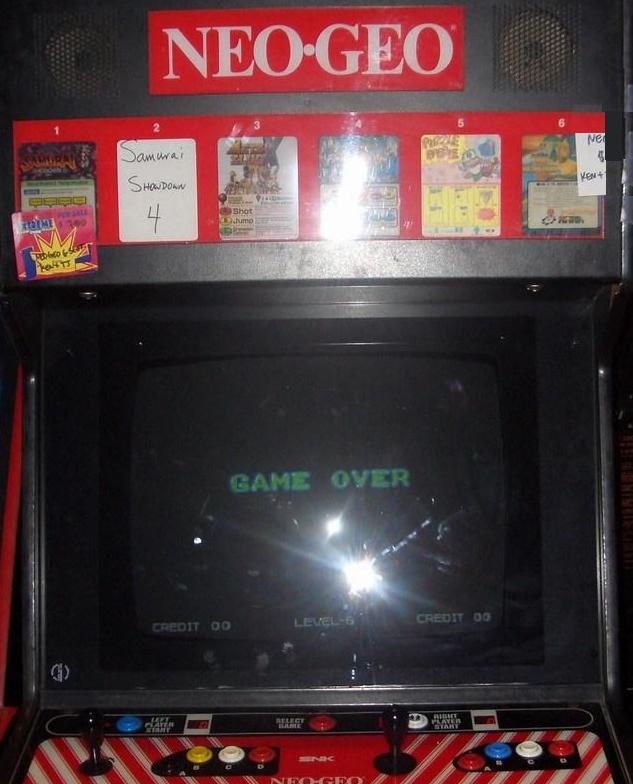
Overview
| Cabinet | Contents | Screen |
|---|---|---|
| Neo 19 | upright, NEO-MVH MV4FT board (4 slots) ✅ manual | CRT 19″ (Hitachi GMK-19FSN or Toei TC-HV19LMS) — 520 × 646 × 1340 mm, 60 kg |
| Neo 25 | upright | CRT 25″ |
| Neo 29 | upright, MV-4F motherboard (4 slots) | CRT 29″, rotatable (no mechanism) ⚠️ this page wrote "15/25 kHz"; the archived SNK manuals give 15.75 / 24.8 kHz** |
| MVS-6 | wide 6-cart cabinet | CRT 27″ |
| "Big Red" (US) | US 4-slot upright | CRT 25″ |
| "Gold Cab" (US) | US upright | CRT 19″ |
| Candy MVS | MVS in a JAMMA candy cab | cabinet-dependent |
(US cabinets are uprights, non-rotatable monitors, stereo sound. Slot counts come from the MV-1 / MV-2 / MV-4 / MV-6 motherboards.)
SNK candy cabs (SC series & Neo Candy)
Besides the uprights, SNK made real sit-down candy cabs, designated SCxx-n (size + slot count):
| Model | Screen | Slots | Note |
|---|---|---|---|
| SC14-2 | 14″ | 2 | mini counter candy |
| SC19-4 | 19″ | 4 | the "Neo candy mini" — the most common; plexi start/credit display |
| SC25-4 | 25″ | 4 | like the SC19-4 in 25″ — rare (high value) |
| SCB-U4 | — | 4 | SC variant |
| Neo Candy 25 / 29 | 25″ / 29″ | multi | large-screen Neo-Geo candy |
| Candy 18 / 25 / 26 | 18-26″ | — | SNK candy variants |
- These SNK candies are compact, JAMMA (MVS), with the Neo-Geo button layout and the multi-slot game selector. The SC19-4 is the "accessible collector" model; the SC25-4 is far rarer.
Manufacturer figures — four cabinets from manuals
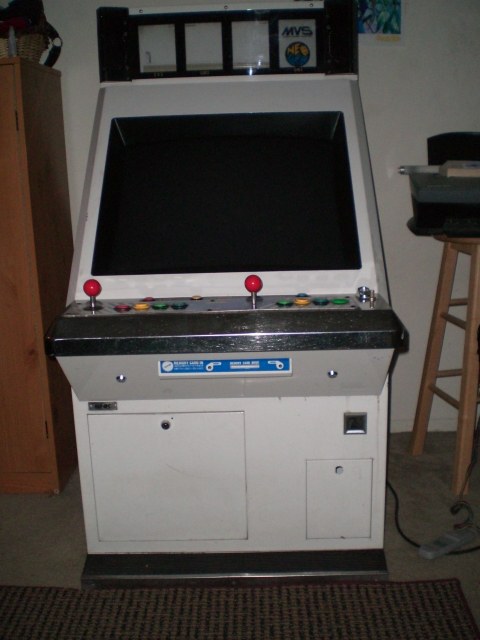
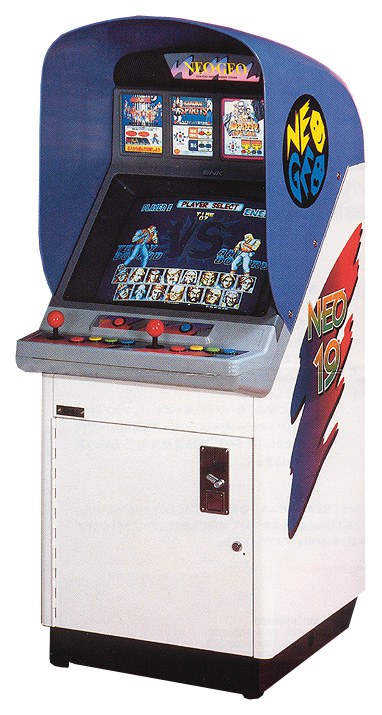
Five SNK manuals have been archived here since 12 August. They give this page's first documented figures — it published none:
| Neo 19 | MVS-U / 33 | Super Neo 29 Candy | Super Neo 29 Type Ⅱ | |
|---|---|---|---|---|
| Width | 520 | 780 | 710 | 710 |
| Depth | 646 | 980 | 890 | 890 |
| Height | 1340 | 1473 ⚠️ casters included | 1717 | 1927 |
| Weight | 60 kg ⚠️ +6.5 kg with the stand | 146 kg | 94 kg | 99 kg |
| Supply | AC 100 V ±10 V | AC 100 V ±10 V | AC 100 V ±10 V | AC 100 V ±10 V |
| Power draw | 100 W | 120 W | 120 W | 175 W |
| Fuse | 3 A | 3 A | 6 A ×2 | 6 A ×2 |
| Monitor | 19″ | 33″ | 29″ | 29″ |
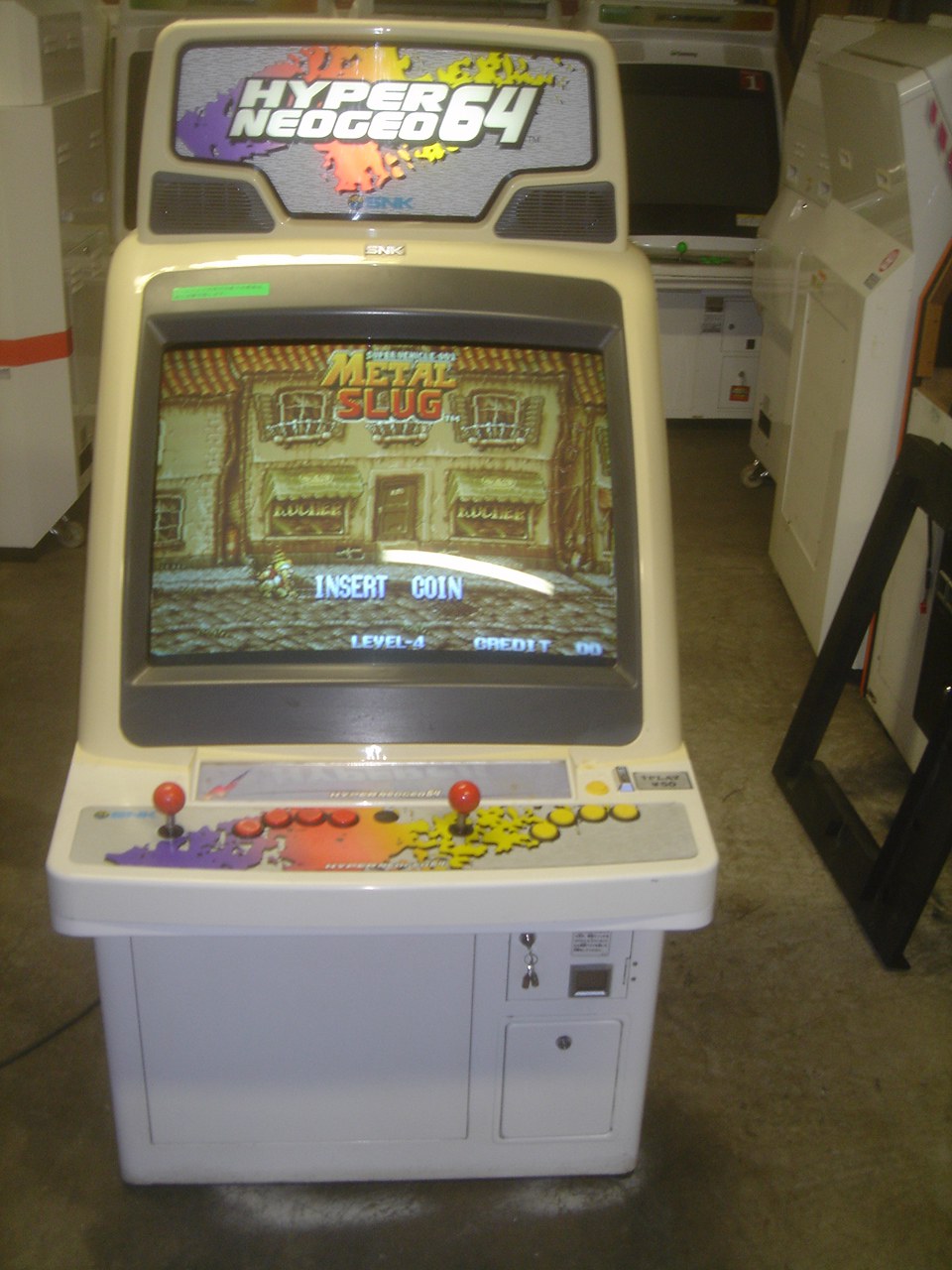
| Board | NEO-MVH MV4FT | NEO-MVH MV1 or MV20 | any JAMMA board | HYPER NEOGEO 64 |
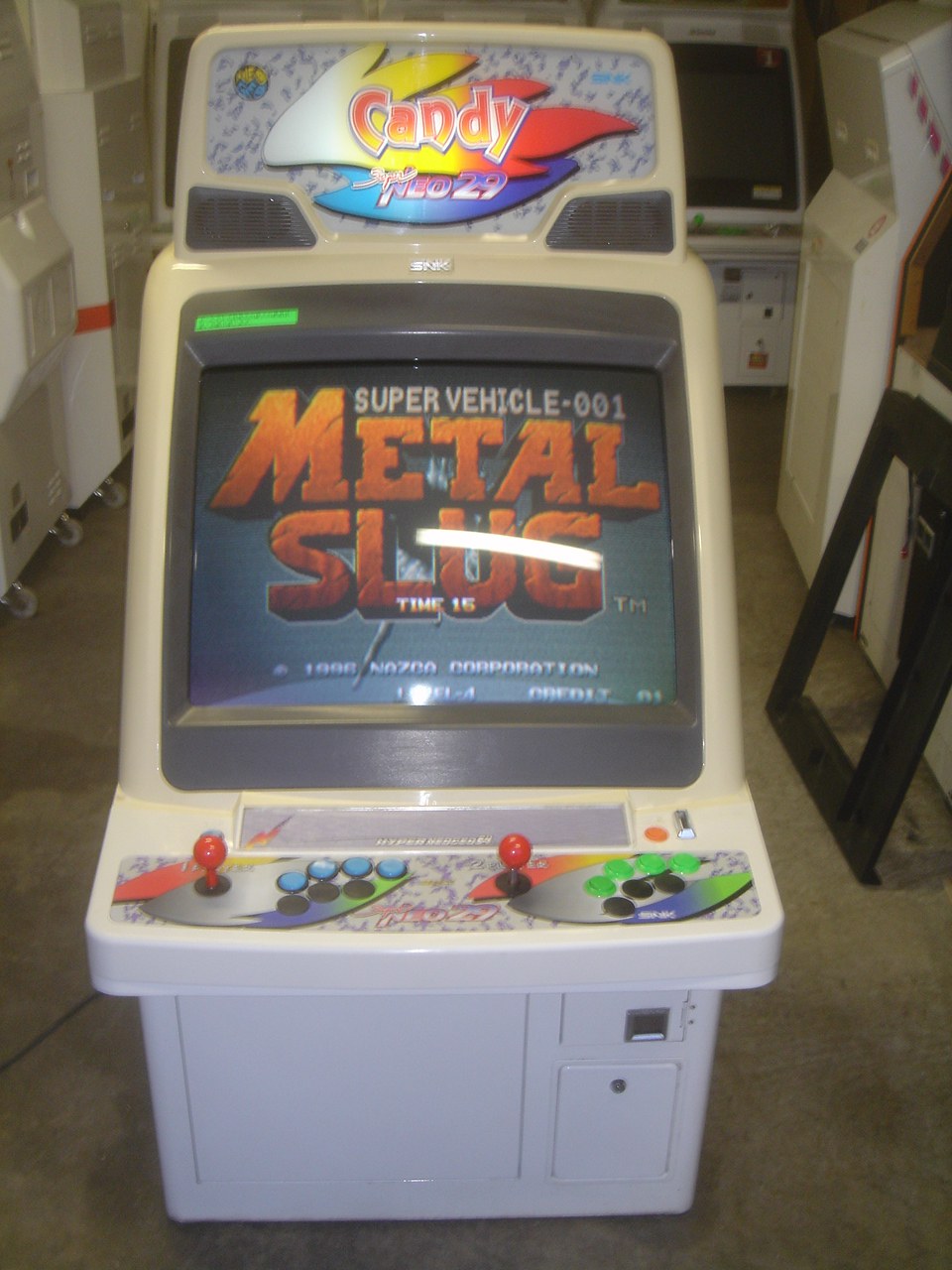
Super Neo 29 Candy — two manufacturer warnings not to miss
Its manual carries two explicit warnings, both on folio 4:
1. The monitor leaves the factory set to 15.75 kHz, and must be switched by hand. "The monitor's horizontal frequency is set to 15.75 kHz as shipped. If you use a PCB at 24.8 kHz, you must switch the monitor to 24.8 kHz. Left as is, the picture will not display correctly and it will cause monitor failure." The switching method is on folio 24 of the same manual.
So this is not a monitor that simply "shows nothing" on the wrong frequency, as on a Vewlix: it is a monitor that destroys itself. → CRT safety
2. One cartridge only, if fitted as a Neo-Geo. "This cabinet is a JAMMA-standard unit. To use it in a Neo-Geo configuration, you must fit a 1-slot Neo-Geo board. Using a 2-slot or 4-slot board will cause failure."
⚠️ This is the exception that contradicts this page's multi-slot reflex: MVS is multi-cartridge in general, but not in that cabinet.
What the manuals correct or make precise
- The U1 / U2 / U4 suffix names the motherboard, not the cabinet. The MVS-U/33 manual prints the same 仕様 block twice — folios 26 and 38 — with a single line of difference: NEO-MVH MV20 in the first, NEO-MVH **MV1 in the second. Dimensions, weight, tube, fuse: identical. One 33″ cabinet, several motherboards.
- The Super Neo 29 Type Ⅱ is not an MVS cabinet. Its 仕様 block names itself SUPER NEO 29 TYPE Ⅱ and gives, on line 5, HYPER NEOGEO 64 基板. ⚠️ Hard*Candy serves this PDF under two cabinet names ("Super Neo 29" and "Super Neo 29 Type II"); it is one file, verified by hash, and it carries the Type Ⅱ. So this wiki has nothing on the base Super Neo 29.
- The 29″'s frequency is 15.75 / 24.8 kHz, not the "15/25" this page rounded it to.
- The monitors are named. Neo 19: Hitachi GMK-19FSN or Toei Tsushin Kogyo TC-HV19LMS. MVS-U/33: Toei Tsushin Kogyo TC-A33IS. The 29″ units are not referenced, only described (帯電防止コーティング済, antistatic coating).
- The coin mech on both Super Neo 29s is an Asahi Seiko AD-81P2, set to ¥100 as shipped — the same family as the Capcom Cute's AD-81P.
Two heights again — but not for the same reason
The Neo 19 is 1340 mm, and its manual sells an optional upright stand (アップライト台) that adds 150 mm of height and 6.5 kg, casters included. That is 1490 mm on its stand.
The MVS-U/33, meanwhile, states its 1473 mm as キャスター含む — casters included, not deducted.
It is the same family of trap as on Japanese candy cabs, where the second height comes from an instruction panel: here it comes from below, not from above. → Dimensions and conventions
What these manuals do not cover
⚠️ No document archived here covers the Neo 25, MVS-6, Big Red, Gold Cab, or the SC / Neo Candy series described below. Those rows rest on community sources, and the table above holds only for the four cabinets it names.
Technical notes
- MVS = JAMMA-compatible: the MVS motherboards (MV-1 1-slot, MV-2, MV-4, MV-6) use a JAMMA pinout, which is why an MVS drops into a candy cab (Astro City…) just as well as a dedicated SNK cabinet.
- Multi-slot: the MVS's killer feature. The operator loads several carts; a selector lets the player choose. SNK button panel (4 buttons in a row, "Neo-Geo" layout).
- Carts: each game is an MVS cartridge (not to be confused with the consumer AES carts, physically incompatible). See the PCB page Neo-Geo MVS.
- Power: the cabinet's PSU (SNK upright) or the host candy cab's.
⚡ Connector & power
| Aspect | Value |
|---|---|
| Connector | JAMMA (MVS is JAMMA-compatible — hence its versatility) |
| Carts | MVS (MV-1/2/4/6 = 1 to 6 slots) — ≠ AES |
| Monitor sync | 15 kHz (standard 25″/29″ CRT) |
| Power | 100–120 V (US) or 100 V (JP) depending on the SNK cabinet |
| Consumption | 140 W on the New Candy 25 (SNK flyer) — see below |
Manufacturer's figures for the New Candy 25
The SNK flyer archived here gives, in its 仕様 box: 使用電源 AC100V ±10V (50/60Hz) · 消費電力 140W · 外形寸法: 幅620mm × 奥行き790mm × 高さ1216mm · 重量 90kg.
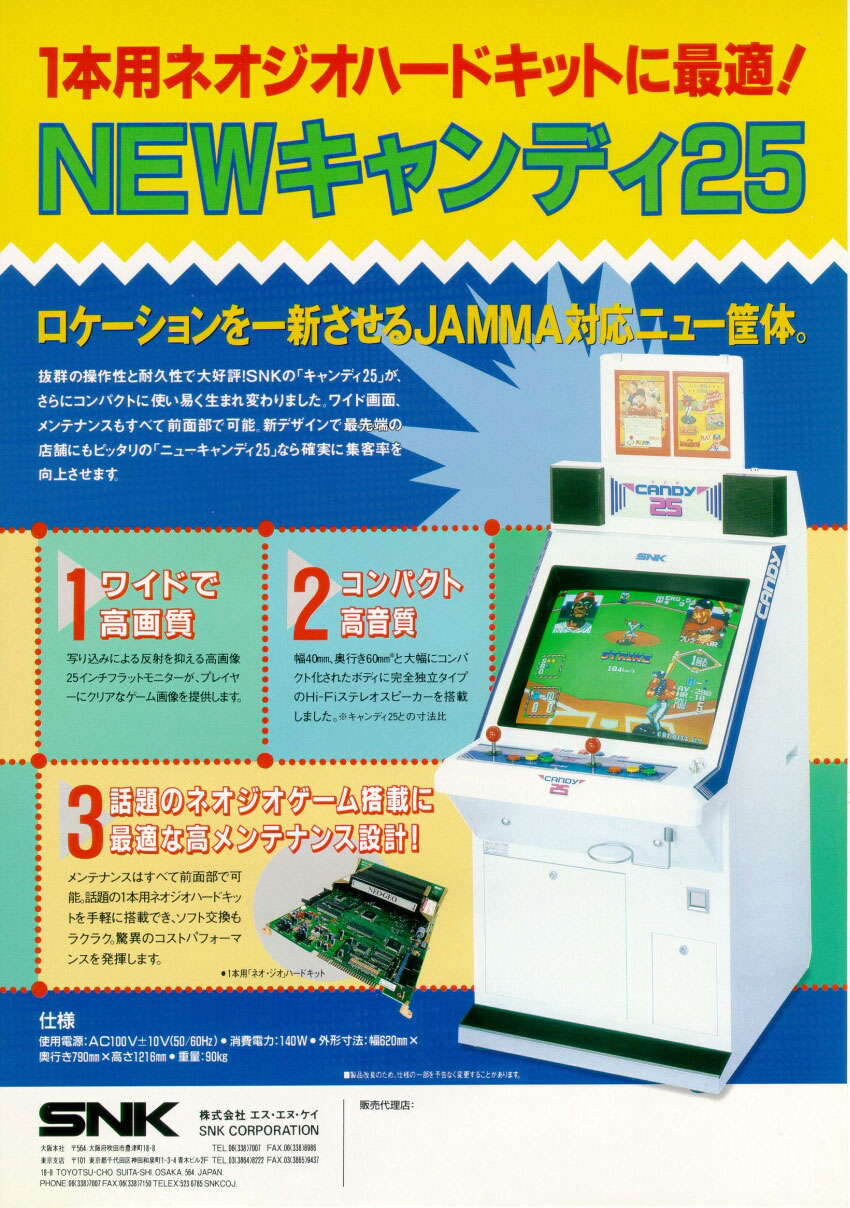
That is 620 wide, 790 deep, 1216 tall — width, depth and height spelled out by SNK — for 90 kg. That is narrower than a Canary (660) and far lower than a Sega candy cab.
⚠️ It is not the smallest on the wiki, though: the Capcom Status 25 is 598 × 785 × 1133 and the Status 18 560 × 660 × 1105, both more compact.
The flyer presents it as "ideal for the 1-slot Neo Geo hard kit" and JAMMA compatible, with a 25″ flat monitor, fully separate Hi-Fi stereo speakers, and entirely front-side maintenance. Against the original Candy 25 it gains 40 mm in width and 60 mm in depth of compactness — the flyer says so without giving the older cabinet's figures.
⚠️ These values apply to that cabinet. The other MVS units (MVS-U4, MVS-U2, SC19B-4, SC14B-2…) have their own, not documented here.
The flyer's figures, in the form the footprint comparison expects — SNK labels them 幅 / 奥行き / 高さ, so there is no order to guess:
| Cabinet | Cabinet figures (幅) × (奥行き) × (高さ) | Weight | Source |
|---|---|---|---|
| New Candy 25 | 620 × 790 × 1216 mm | 90 kg | SNK flyer, 仕様 box |
(Sources: Arcade Otaku / MVS documentation.)
→ Detailed wiring: the MVS is JAMMA-compatible → see JAMMA wiring (button 4 is on pin 25/c) and Control panels & buttons (Neo-Geo 4-button layout).
Common faults
| Symptom | Likely cause | Lead |
|---|---|---|
| Cart contacts | slot/cart oxidation | Clean connectors (slot and cart) |
| Multi-slot selector dead | selection logic / switch | Check the selection circuit |
| Image (CRT) | chassis, recap | Adjustments + recap |
| Dead battery (games) | MVS save | See Neo-Geo MVS |
Procedure — a cabinet that will not start ✅
There is a CRT in this cabinet
The tube stays charged with the cabinet unplugged, and the anode cap is the first thing your hand meets behind the monitor. Discharge it, work with one hand, and never alone if you can help it. → CRT safety
This cabinet is documented as 100 V
It does not go straight onto a European socket. It needs a step-down transformer rated for the whole cabinet, monitor included — not a travel adapter. Feeding 230 V to a cabinet built for 100 V destroys the supply, and usually the monitor with it. → Cabinet power
What this adds
Ordered for a cabinet, not for a board: mains, low-voltage supply, loom, monitor, then the game. The overwhelming majority of "dead cabinets" are dead for a reason that has nothing to do with the PCB — which is why the board comes last here.
1. Mains, and what sits between it and the cabinet. The switch, the fuse or breaker, the isolation transformer if there is one. A cabinet that shows no sign of life at all is almost never electronic.
2. The low-voltage supply — measured under load. Aim for +5 V where power reaches the board — the JAMMA edge, or the JVS power connector, depending on the cabinet — with the game running, not on an idle bench. If the supply has an adjustment (most candy and JVS bricks do; the ATX brick in a PC cabinet does not), do it then and not before: set off-load, it leaves a board that boots and then glitches. With no adjustment the measurement still earns its keep — it tells you whether the supply holds. Check +12 V too, and −5 V if the board uses it: many do not, and an ATX brick does not provide it. → Cabinet power
3. The loom and the connector. Reseat, and check the grounds — a cabinet with a poor ground gives rolling picture, phantom inputs and noise, all at once, and none of it looks like a wiring fault. → Wiring
4. The monitor. This page does not give a single monitor spec — it covers several cabinets. Check which one you have before concluding anything. CRT: no picture but the tube is warm and there is EHT — that is sync or video, not the tube. No EHT at all — chassis. A picture that shrinks, wanders or shifts colour is a chassis recap, and on these monitors that is a scheduled job, not a repair.
5. Scan rate — the mismatch that breaks nothing. If the board's rate is not one the monitor accepts, you get no picture and nothing is faulty. Check what this cabinet takes against what the board puts out before opening anything. → Modernising a cabinet
6. The control panel. Microswitches and the loom, in that order. A single dead direction is a switch; a whole player dead is the loom or its ground. → Control panels
7. Coin mech and sound. Last, because they hide nothing: a mech that no longer registers is usually dirty or misadjusted, and silence with a good picture points at the amplifier and its supply rails.
Repair
- Board side: it all happens on the Neo-Geo MVS (slot cleaning, battery, MV-x recap).
- Monitor / power: standard CRT maintenance + the cabinet's PSU.
Manuals (archived)
- 📘 MV-1F manual (1 slot) (PDF)
- 📘 MV-2F / MV-4F manual (multi-slot) (PDF)
- 📘 MV-6F manual (6 slots) (PDF)
- 📗 JAMMA vs MVS pinout (PDF)
(Source: Arcade Otaku Wiki, archived locally for preservation.)
Photos / assets
See the MVS 6-slot cabinet photo at the top of the page. (To add: Neo 29 upright, SNK 4-button panel, MVS cart.)
Repair & maintenance
Modernise (video, PSU, JVS, upscaler, PC/FPGA) → Modernising a cabinet. CRT monitor (discharge HV!) → CRT safety (Nanao MS8/MS9 or equivalent chassis) · recap → Recap · diagnosis → PCB fault-finding.
Documents (archived)
- 📄 Flyer SNK — NEW キャンディ25 ← the source of the New Candy 25's figures
Sources & attribution
- SNK — NEO 19 取扱説明書, 28 pp., ref. 95-4210, archived here — folio 3, 仕様: AC100V ±10V, 100 W, 幅520 × 奥行646 × 全高1340 mm, body weight 60 kg (with the upright stand +6.5 kg), board NEO-MVH MV4FT, tube 19″ Hitachi GMK-19FSN or Toei Tsushin Kogyo TC-HV19LMS, fuse 3 A, and the optional upright stand: +150 mm of height, with casters
- SNK — MVS-U / 33 取扱説明書, ref. 95-3785, part 1 (25 pp.) · part 2 (35 pp.) — folios 26 and 38, two 仕様 blocks identical but for one line: AC100V ±10V, 120 W, 幅780 × 奥行980 × 高さ1473(キャスター含む), 146 kg, tube 33″ TC-A33IS(東映通信工業), fuse 3 A; only the board changes — NEO-MVH MV20 on folio 26, NEO-MVH MV1 on folio 38
- SNK — SUPER NEO 29 CANDY 取扱説明書, 21 pp., archived here — folio 4, 本機仕様: AC100V ±10V, 120 W, 全幅710 × 奥行き890 × 全高1717 mm, 94 kg, any JAMMA board, 29″ antistatic monitor shipped horizontal, convertible to vertical, 6 A ×2 fuses, 旭精工 AD-81P2 coin mech. ⚠️ The same folio carries both warnings published above: mandatory 15.75 → 24.8 kHz switching on pain of destroying the monitor (method on folio 24), and 1-slot Neo-Geo boards only — 2 or 4 slots will cause failure
- SNK — SUPER NEO 29 TYPE Ⅱ 取扱説明書, 42 pp., archived here — folio 7, 本機仕様: AC100V ±10V, 175 W, 全幅710 × 奥行き890 × 全高1927 mm, 99 kg, HYPER NEOGEO 64 基板, 29″ antistatic monitor, 6 A ×2 fuses, 旭精工 AD-81P2 coin mech. ⚠️ Hard*Candy serves this PDF under two cabinet names (Super Neo 29 and Super Neo 29 Type II) — same MD5, and the document names itself TYPE Ⅱ: this wiki has nothing on the base Super Neo 29
-
MV25TA-0 and MV25UP-0 — their manuals exist on Hard*Candy and were fetched, but no specifications block was found in either (19 pages swept page by page). Not archived: this wiki does not archive a document it can quote nothing from
-
SNK — sales flyer NEWキャンディ25, archived here : flyer — 使用電源, 消費電力, 幅 × 奥行き × 高さ spelled out, weight, monitor, JAMMA compatibility. Found via The Arcade Flyer Archive
-
Arcade Otaku Wiki — SNK Neo-Geo MVS cabinets (multi-slot MV-2/4/6, JAMMA) — https://wiki.arcadeotaku.com/
- Arcade-Projects / Arcade-Museum / WorthPoint — SNK SC-series candy cabs: SC14-2, SC19-4 (19″ 4-slot), SC25-4 (25″, rare), SCB-U4 — https://www.arcade-projects.com/threads/neogeo-snk-sc-19.14519/
- Internal page: Neo-Geo MVS (the system)
Image:
-
super-neo-29-type-2-borne.jpg— source Hard*Candy (⚠️ no licence statement anywhere on the site) — https://www.hard--candy.com/wiki/candy/Super_Neo_29_Type_II -
super-neo-29-candy-borne.jpg— source Hard*Candy (⚠️ no licence statement anywhere on the site) — https://www.hard--candy.com/wiki/candy/Super_Neo_29_Candy -
mvs-u-33-borne.jpg— source Hard*Candy (⚠️ no licence statement anywhere on the site) — https://www.hard--candy.com/wiki/candy/MVS-U4~33 -
neo-19-borne.jpg— source Hard*Candy (⚠️ no licence statement anywhere on the site) — https://www.hard--candy.com/wiki/candy/Neo_19 -
neogeo-mvs.jpg— Bryan Kreutz, CC BY-SA 3.0 — https://commons.wikimedia.org/wiki/File:Neo_Geo_6_port_arcade_cabinet.jpg

Review & corrections
How this space is used
Spotted a wrong value, an outdated procedure, a chip reference that does not match your board? Say so here, with what you observed (model, board revision, serial number, measurement). Every report is cross-checked against a source before anything changes — an unverifiable correction is published as “reported by …, not cross-checked” rather than silently applied.
Reading is open to everyone; posting requires signing in with Discord. Reports from the wiki's declared reviewers are handled first; anyone else's are read too, but go through a human before anything is changed.