Sega RingEdge / RingWide
Sega's Windows PC generation after the Lindbergh (2009): two variants, RingEdge (high-end) and RingWide (budget), on Windows Embedded. Tied to the ALL.Net network and locked by a keychip. Border Break, Hatsune Miku: Project DIVA Arcade, Sangokushi Taisen…
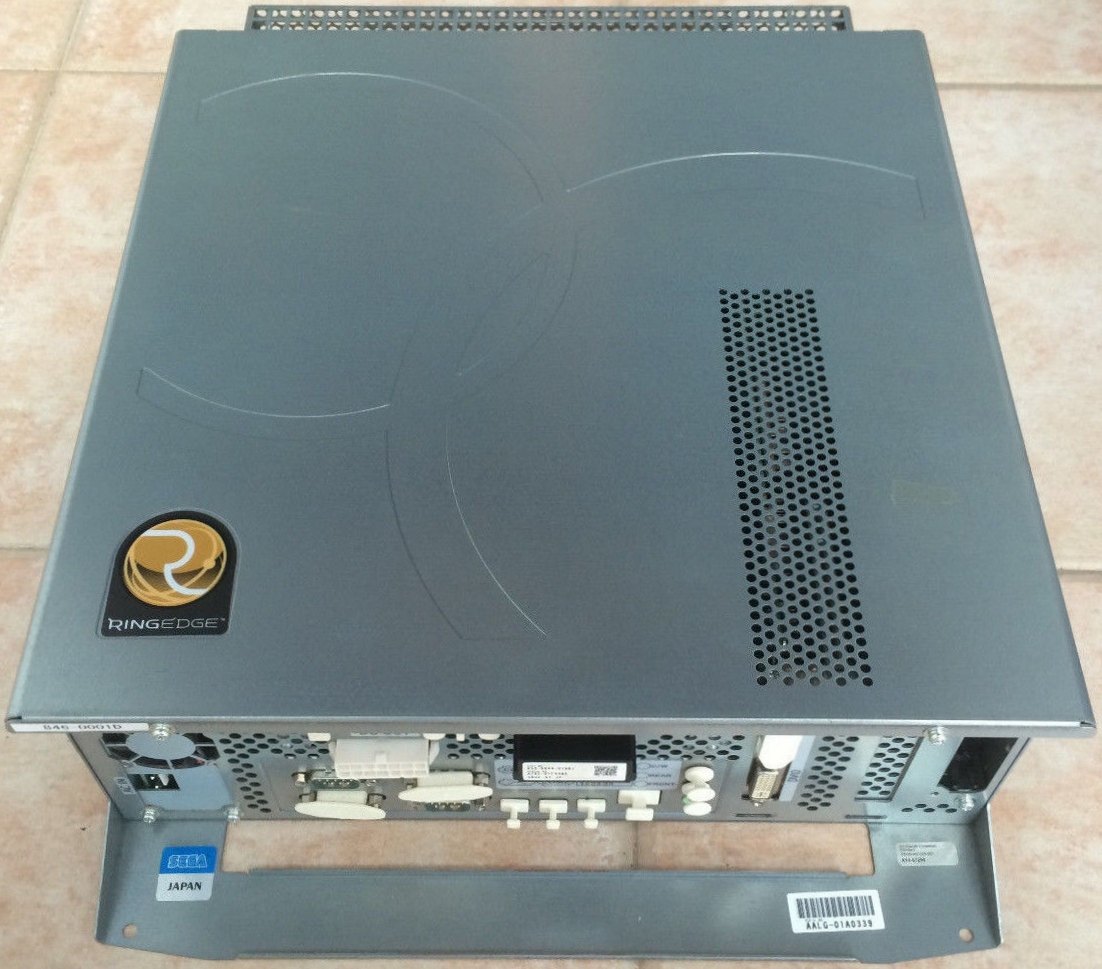
Identification
| Field | Value |
|---|---|
| Manufacturer | Sega |
| Year | 2009 |
| Base | x86 PC — Windows Embedded 2009 |
| Network | ALL.Net (profiles, rankings, P-ras digital distribution) |
| Security | keychip (gates boot/launch) |
| Output | up to 2 screens 1920×1200, 5.1 sound |
Architecture (PC)
| Model | CPU | RAM | GPU | Storage |
|---|---|---|---|---|
| RingEdge (high-end) | Intel Pentium Dual-Core E2160 (1.8 GHz) | 1 GB DDR2 (PC-6400) | NVIDIA GeForce 8800 GS (384 MB GDDR3, SM4.0) | 32 GB SSD |
| RingWide (budget) | Intel Celeron 440 (2.0 GHz) | 1 GB DDR2 (PC-5300) | ATI Radeon HD 2xxx (128 MB, SM4.0) | SSD |
Gigabit networking; both do 5.1 and dual screen. It's a Windows PC in an arcade case (after the Lindbergh's Linux, before Nu / ALLS).
Security, network & preservation (the real topic)
- Keychip: a security chip gates the boot and launch of the game. Many resold boards lack their keychip (Sega property, returned at the end of the operator contract) → a major preservation obstacle.
- ALL.Net: Sega's network (since 2004) for profiles/rankings/online play; extended as ALL.Net P-ras for digital distribution and updates. Server-dependent games → a separate preservation topic.
- Preservation: the community has reverse-engineered the keychip protocols to keep cabinets running; imaging the SSD is the first step.
Notable games
Border Break (2009, AM2, first game), Hatsune Miku: Project DIVA Arcade, Sangokushi Taisen, Sega Network Taisen Mahjong MJ, Ollie King… (mostly networked / player-card games).
Faults & repair
Standard PC hardware:
| Symptom | Likely cause | Lead |
|---|---|---|
| Won't boot/launch | missing/dead keychip | Critical part (Sega property); see preservation |
| Overheating / GPU crash | GeForce 8800 / Radeon HD (fan/paste) | Clean, re-paste, ventilate |
| SSD end of life | wear | Image the SSD |
| Reboots | ATX PSU / capacitors | Replace / recap |
| Controls / player card | JVS I/O, card reader | JVS / reader diagnosis |
Modernisation & mods
The common ground for every JAMMA board
Video, power, control panel and upscalers depend on the cabinet rather than the board: everything is centralised in Modernising a cabinet. To run the board outside a cabinet (at home, on a display): supergun.
- Hard disk ⚠️: a perishable medium — image the drive before it fails, then consider an SSD/CF replacement → PCB preservation hub.
- Scan rate 📺: PC-based hardware — VGA output (31 kHz and above). ⚠️ A 15 kHz chassis is incompatible: you need a VGA/tri-sync monitor or a computer display. (Derived from the platform's PC nature documented above — not measured from MAME.)
- FPGA / emulation: see the Emulation & FPGA section below.
Repair (technician)
- Keychip: without the keychip (often missing from resold boards, Sega's property) the game won't start — check before suspecting the hardware.
- x86 PC (Pentium Dual-Core + GeForce 8800 GS): PC diagnosis — PSU, RAM, GPU (caps/fan), SSD; a consumer GPU can have capacitor / BGA joint failures.
- Network / player-card reader: an ALL.Net / JVS I/O dependency.
→ Methods: PCB fault-finding · Recap · Traces & vias
Procedure — a dead board, step by step ✅
What this adds
The general method lives in PCB diagnosis. This is its application to this platform: the same order, but with the values actually expected here, so you do not have to go back and forth.
This platform is a PC
Most of what kills one of these is not on a board: the disk, the dongle, the BIOS settings or the OS. Go through those first — the procedure below still applies to the rails and the boot, but stripping a machine that simply will not boot off its disk wastes a day.
Tools: multimeter, oscilloscope (or frequency counter), current-limited bench supply, desoldering braid. → Tooling
If the board is still in a cabinet
A CRT holds its charge with the machine unplugged. → CRT safety
1. Inspection, power off. Corrosion, cut tracks, oxidised EPROM legs, leaking SMD capacitors, dubious earlier repairs.
2. The connector, before anything else. A large share of "dead boards" are a contact problem, not a fault. Clean the contacts with isopropyl alcohol and reseat — not with an abrasive eraser on a gold edge, which takes the plating off and brings the problem back worse. It costs two minutes and settles the question.
3. Power, measured on the board. Aim for +5.0 V measured as close as possible to where power reaches the board — not at the PSU output: the drop is in the loom, and that is exactly what makes a board boot on the bench and not in the cabinet. Where you probe depends on this board's connector — JAMMA edge, JVS loom or a proprietary harness — plenty of makers kept one long after JAMMA arrived — see Identification above. → Wiring Check −5 V and +12 V too if the sound stage uses them. Suspected short: bring it up current-limited and find the hot spot.
4. /RESET. It must release after power-up. Held low = the CPU never starts. A 1–2 Hz loop is not the reset circuit, it is the watchdog: the CPU is crashing at boot, so look at the bus, not at the reset.
5. Clocks. There is no measurement table for this platform — MAME's sources yield nothing usable for it. Any frequency quoted under Architecture on this page serves as a marker; otherwise compare against a working board rather than against a number: an invented value condemns healthy parts. → PCB diagnosis
6. Bus. Activity on the main CPU's address lines tells you whether it is running or frozen. Frozen with good clocks and good reset → work RAM, bus buffers, ROMs.
7. It boots but the picture or the sound is wrong — that is another job: see Common faults on this page, then signal tracing.
Emulation & FPGA
- Emulation: Windows PC games → no MAME; preservation via SSD image + keychip (community RE protocols). No FPGA core.
Lineage
After the Lindbergh (Linux PC, 2005), before Nu / ALLS (2014+). The Europa-R variant (driving: Sega Rally 3, Initial D) is the same PC family.
Photos / assets
(To add: RingEdge vs RingWide board, keychip, SSD, JVS I/O.)
Sources & attribution
- System16 / Arcade Heroes — Sega RingEdge / RingWide Hardware (CPU/GPU specs, Windows Embedded, ALL.Net, dual screen) — https://www.system16.com/hardware.php?id=910
- Wikipedia — ALL.Net — CC-BY-SA — https://en.wikipedia.org/wiki/ALL.Net
- r1cebank — Sega Nu/keychip preservation (keychip protocols, series) — https://r1ce.net/
Image:
-
ringedge-systeme.jpg— uploaded by Black Squirrel to Sega Retro (site CC BY 4.0; ⚠️ the file carries no individual licence) — https://segaretro.org/File:Ringedge_system.jpg

Review & corrections
How this space is used
Spotted a wrong value, an outdated procedure, a chip reference that does not match your board? Say so here, with what you observed (model, board revision, serial number, measurement). Every report is cross-checked against a source before anything changes — an unverifiable correction is published as “reported by …, not cross-checked” rather than silently applied.
Reading is open to everyone; posting requires signing in with Discord. Reports from the wiki's declared reviewers are handled first; anyone else's are read too, but go through a human before anything is changed.