Sega Mark III¶
The Master System's Japanese ancestor (1985): the third machine in the SG-1000 line, redesigned to move past the SG-1000's TMS9918 with an in-house VDP. Rebranded as the Master System in the West (1986). Takes cartridges and Sega Card (My Card), with an FM sound (YM2413) add-on.
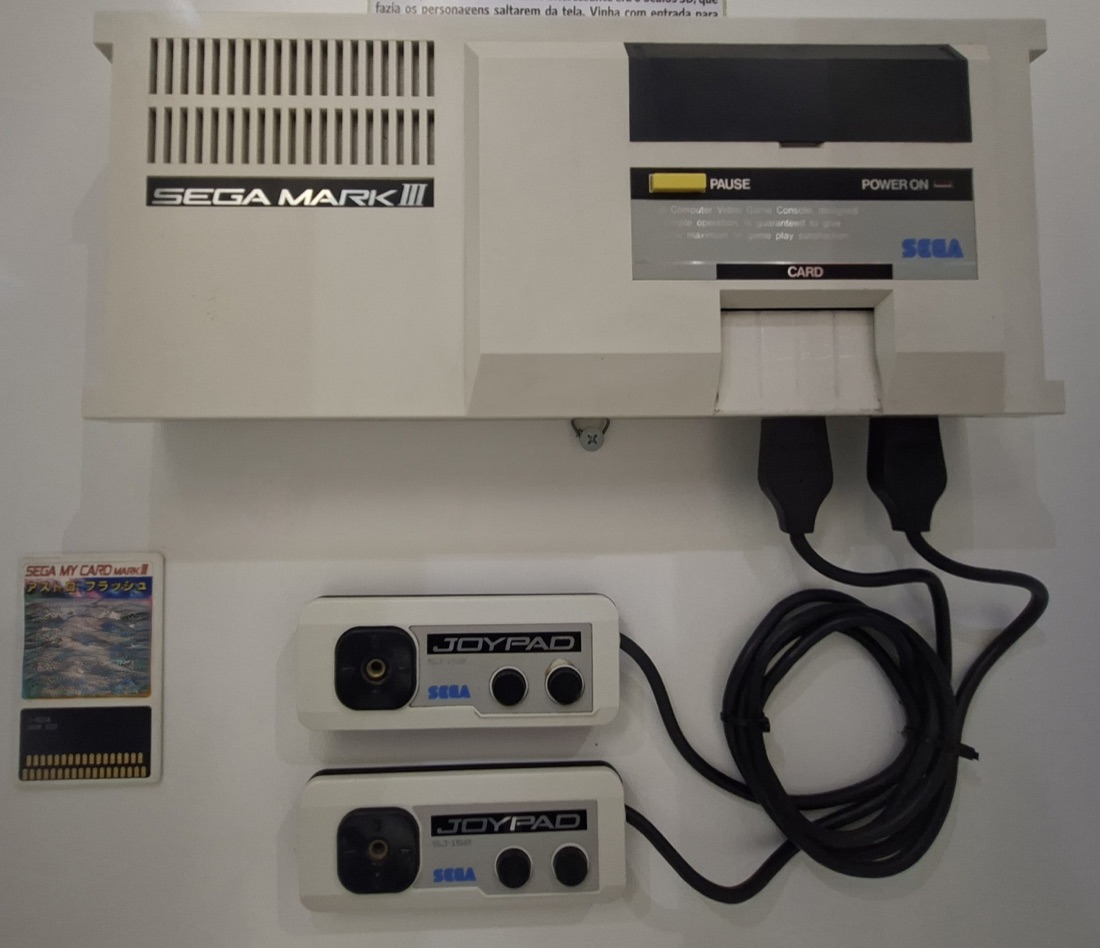
Sega Mark III — photo by Sintegrity, CC BY-SA 4.0 (Wikimedia Commons).
Identification¶
| Field | Value |
|---|---|
| Manufacturer | Sega |
| Released | 20 October 1985 (Japan, ¥15,000) |
| Line | SG-1000 → SG-1000 II → Mark III → Master System (West, 1986) |
| Media | Cartridge (Mega Cartridge) + Sega Card / My Card (≤ 32 KiB) |
| Sound | built-in PSG + FM Sound Unit (YM2413) add-on |
Architecture (detail)¶
| Block | Chip | Clock | Role |
|---|---|---|---|
| CPU | Zilog Z80A | 3.58 MHz | (rated 4 MHz, underclocked) |
| Video | Sega in-house VDP (315-5124, TMS9918-derived) | 256×192, 32 colours on-screen from 64 | |
| Sound | Texas Instruments SN76489 (PSG, 3 square + noise) | + YM2413 (FM) via add-on | |
| Memory | 8 KiB RAM · 16 KiB VRAM · 8 KiB ROM |
The VDP derives from the TMS9918 (SG-1000) but borrows from Sega System 2 arcade hardware: more colours, better sprites. On sound, the FM Sound Unit (YM2413 chip) markedly enriches compatible games — it became standard on the Japanese Master System of 1987. In the West the Mark III becomes the Master System (new shell, same guts).
Repair (technician)¶
- Cartridge & Sega Card contacts: the My Card slot and cartridge port oxidise → isopropyl clean, the No. 1 cause of "game won't start".
- Capacitors: routine recap (period electrolytics) if picture/sound degrade or boot is flaky.
- Video output: DIN; the Mark III outputs an RGB-capable signal (like the SMS) → a clean RGB mod is possible (see video mods).
- FM Sound Unit: an external add-on (expansion connector) — check the connector and the YM2413 if FM is silent.
- Compatibility: the Mark III reads SG-1000 carts; a Master System reads Mark III games (same ROMs), handy for testing.
Common faults¶
| Symptom | Likely cause | Lead |
|---|---|---|
| Game won't start | cartridge / My Card contacts | Clean the connectors |
| Degraded picture/sound | tired caps | Targeted recap |
| FM silent | FM add-on / YM2413 | Check connector, test the chip |
| Nothing on screen | PSU / joints / VDP | Check PSU, reflow, VDP |
Procedure — a dead console, step by step ✅¶
What this adds
Ordered for a console, not for an arcade board: what kills these is almost never the CPU. It is, in real order, the power supply, the capacitors, the drive or the cartridge slot, and only then the logic. → PCB diagnosis
1. The power supply. Two cases, depending on the machine. External brick: ⚠️ read the marking on the machine, next to the socket, and check the adapter against it — voltage and polarity. A centre-negative machine fed centre-positive loses its fuse, sometimes its regulator; do not trust a third-party label or a generic tip. Internal supply (the machine plugs straight into the wall): mains is inside the shell. Unplug, wait, and confirm the large capacitors are discharged before touching the board. Either way, measure under load: a failing supply holds its voltage until it is asked for current.
2. The fuse. Many of these machines have one right behind the socket — it is the part designed to die. Test it in continuity, out of circuit. A fuse that blows again is a short, not a fuse problem.
3. Capacitors. On most machines of this age this is the default suspect rather than a last resort — leaking SMD electrolytics eat the tracks underneath before they give any other sign. ⚠️ Not all of them are like that: some carry very few and are not recapped on principle. Read what this page says about it before reaching for the iron. → Recap
4. The cartridge connector. Cartridge contacts with isopropyl alcohol, never an abrasive eraser: it takes the gold plating off and the problem comes back worse. On the machine side, inspect the slot pins — splayed, bent or oxidised — and check continuity between slot and board.
5. Video output. Isolate the machine from the display: another cable, another TV, another input. A sizeable share of "dead consoles" are a dead cable, or a display that will not lock onto what this machine outputs — see the video section of this page for what that is.
6. Still nothing. Now, and only now, the logic: rails on the board, reset, clock, bus. → PCB diagnosis
Mods & preservation — what to buy, how¶
- RGB mod 🟠: the 315-5124 VDP outputs RGB → same bypass procedure as the Master System (THS7314-style video buffer, sync extraction). See the detailed procedure in Master System § RGB — the Mark III shares the VDP.
- Flashcart: the Master EverDrive X7 (Krikzz) — SMS/Mark III games on SD, plug-and-play 🟢 (the SG-1000 library runs too).
- FM Sound Unit: period add-on that enriches the audio (~40 games 1987-89 drive the YM2413) — keep/connect it; the Japanese/Master System can take an internal FM mod (see Master System § FM).
- Recap: few electrolytics → recap is secondary (check power/output).
- ⚠️ Do not host ROMs — method only.
Photos / assets¶
(To add: Mark III, FM Sound Unit, My Card, motherboard.)
Advanced repair — cross-cutting methods
Sources & attribution¶
-
Photo Sega Mark III — Sintegrity, CC BY-SA 4.0, Wikimedia Commons — https://commons.wikimedia.org/wiki/File:SEGA_Mark_III_(1).jpg
-
Wikipedia — Sega Mark III (in-house VDP, Z80A 3.58 MHz, YM2413 FM, line → Master System) — CC-BY-SA — https://en.wikipedia.org/wiki/Master_System
- Internal: Master System · SG-1000
.jpg)
Review & corrections
How this space is used
Spotted a wrong value, an outdated procedure, a chip reference that does not match your board? Say so here, with what you observed (model, board revision, serial number, measurement). Every report is cross-checked against a source before anything changes — an unverifiable correction is published as “reported by …, not cross-checked” rather than silently applied.
Reading is open to everyone; posting requires signing in with Discord. Reports from the wiki's declared reviewers are handled first; anyone else's are read too, but go through a human before anything is changed.