Big-format cabinets (Sega Megalo, Taito Teatro)
The 41″ to 50″ cabinets for versus and deluxe: a big CRT tube (Megalo 410, 41″) or a 3-tube CRT projector (Megalo 50 / Super Megalo 2 / Teatro 50, 50″). Repair differs from a candy cab: the 50″ are convergence projectors, not a single tube.
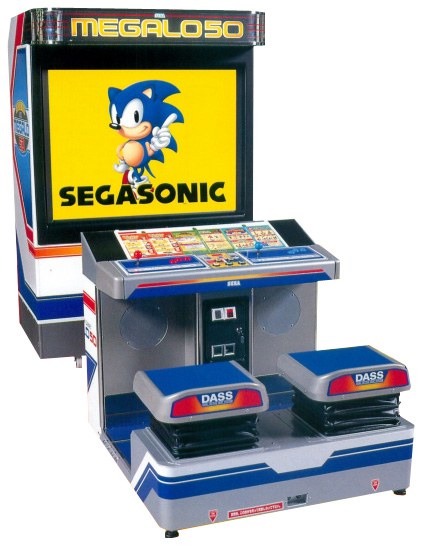
Overview
| Cabinet | Maker | Year | Display | Notes |
|---|---|---|---|---|
| Megalo 410 | Sega | 90s | 41″ tube 15/24/31 kHz | 2-player stand-up; antimicrobial control panel (a first) |
| Megalo 50 | Sega | 1992 | 50″ projector | std / deluxe (deluxe = 2 seats moving L/R); up to 3 PCBs selectable; projector ≈ ¥1.52 M |
| Super Megalo | Sega | 90s | big screen | shipped with Virtua Fighter, Sega Model 2 wiring |
| Super Megalo 2 | Sega | 90s | 50″ 3-tube projection 15/24 kHz | subwoofer + active servo stereo |
| Teatro 50 | Taito | 1996 | 50″ projection 15/24 kHz (auto) | fold-down front panel (screen maintenance), seat backrest with sound |
| Teatro 50 EX | Taito | 2000s | variant | evolution of the Teatro 50 |
Manufacturer dimensions — Megalo 50 ✅
The first dimensions published here for this cabinet — and they come from Sega's catalogue
The Sega '93 Amusement Machine Guide, CABINETS page, gives for the メガロ50 スタンダード / MEGALO 50 STANDARD:
| Item | Printed value |
|---|---|
| 外形寸法 · Outer Dimensions | 1,230 (W) × 2,260〜3,200 調節可 (D) × 1,880 (H) mm |
| 重量 · Weight | 356 kg |
| 消費電力 · Power Supply | AC 100 V, 305 W |
| Display | 50 インチプロジェクションディスプレイ — 50-inch projector |
| Patent | 〒95-4429 PAT. PEND. |
⚠️ The depth is given as a range, and the catalogue says why: the word 調節可 beside the figure means adjustable. ⓘ So it is not an installation allowance — the cabinet itself extends from 2.26 m to 3.20 m, seats included.
ⓘ These dimensions appeared nowhere on this wiki, which cited only an Arcade-Museum entry without dimensions for this cabinet.
✅ Super Megalo 2: catalogue and manual give the same numbers — under two different labels
The Sega '94 Amusement Machine Guide gives for the スーパーメガロ2: 1,140 (W) × 2,200〜3,100 (D) × 1,867 (H) mm, 330 kg, AC 100 V 360 W, 50″ projector, 2 players.
⚠️ These are exactly the numbers this page already publishes from the Owner's Manual — but the manual calls them "Installation space" and the catalogue 外形寸法 · Outer Dimensions.
✅ That is real information, and it qualifies something this wiki repeats. On other Sega machines, "installation space" is not the cabinet's own dimensions — the trap recorded four times elsewhere here. ⚠️ On this one, both labels carry the same values, from two separate Sega documents.
ⓘ Which does not mean the two notions coincide in general: it means that here, they do — and that the label alone does not let you conclude. It takes two documents to know, and here we have them.
ⓘ And the catalogue explains the range: the Megalo 50 carries 調節可 (adjustable) at the same position in its figure. The depth of these cabinets adjusts.
ⓘ The catalogue also documents the advertised feature: "Features dual function via UP-CONVERTER" — two system boards, one at 15 kHz and one at 24 kHz, switched at one touch, "so a long-run hit game and a newer game can be simultaneously contained".
What the two catalogues confirm, without changing anything
✅ A year apart, both guides give the same dimensions this wiki already publishes for its two most-cited candy cabs:
| '93 catalogue | '94 catalogue | What this wiki publishes | |
|---|---|---|---|
| Astro City | 750 × 905 × 1,445 · 93 kg · 140 W | identical | 750 × 905 × 1,445 · 93 kg ✅ |
| Aero City | 660 × 955 × 1,320 · 110 kg · 150 W | identical | 660 × 955 × 1,320 · 110 kg ✅ |
ⓘ Corroboration from an independent source — the wiki's figures came from service manuals; these come from the sales catalogue, and they agree to the millimetre.
ⓘ The '93 guide also documents the MULTI CABINET SWING — 880 (W) × 995 (D) × 1,980 (H), 125 kg, AC 100 V 125 W, 26″ monitor — and the range's seats, dimensioned too (type D 390 × 390 × 580, type G 460 × 460 × 580, type SP 860 × 420 × 680…).
Manufacturer figures — Super Megalo 2
The owner's manual archived here is Sega Enterprises' English export edition. Its SPECIFICATIONS page gives:
| Item | Value |
|---|---|
| Installation space | 1,140 mm (W) × 2,200 ~ 3,100 mm (D) — 44.9 in. × 86.6 ~ 122.0 in. |
| Height | 1,867 mm (73.5 in.) |
| Weight | ~330 kg (726.8 lbs) |
| Monitor | 50 INCH PROJECTION DISPLAY |
The depth is a range, not a figure
2,200 to 3,100 mm: Sega gives not the cabinet's depth but the installation space, which depends on what you leave in front of it. A 330 kg cabinet you believe fits in 2.20 m may want 3.10. And the item is called Installation space, not dimensions — it is the 所要面積, the same convention as on the Astro City II.
Two projectors, two power draws
The manual publishes power by region, and for Taiwan by projector supplier — which incidentally documents that the Super Megalo 2 did not have a single display type:
| Supply | Power | Max current |
|---|---|---|
| AC 110 V 50 Hz | 375 W | 4.4 A |
| AC 110 V 60 Hz | 360 W | 4.3 A |
| AC 120 V 60 Hz | 360 W | 4.0 A |
| AC 220 V 50 Hz | 380 W | 2.3 A |
| AC 220 V 60 Hz | 370 W | 2.2 A |
| AC 240 V 50 Hz | 380 W | 2.1 A |
| AC 240 V 60 Hz | 370 W | 2.0 A |
| Taiwan — Hitachi projector | 385 W max · 365 W min | 4.5 A · 4.2 A |
| Taiwan — Mitsubishi projector | 345 W max · 335 W min | 4.1 A · 3.9 A |
⚠️ 40 W between a Hitachi and a Mitsubishi projector on the same cabinet. On a convergence machine, knowing which one you have changes the spare parts, not just the electricity bill.
(Manual's note: "Descriptions in this manual are subject to change without prior notice.")
Three display types = three repairs
Direct big tube (Megalo 410, 41″)
- HV discharge essential (a big tube stores more) → CRT safety.
- Tri-sync 15/24/31 kHz chassis → repair like Nanao MS29xx / equivalent: recap, HOT/flyback, reflow.
3-tube CRT projector (Megalo 50, Super Megalo 2, Teatro 50)
- The image is formed by 3 small CRTs (R / G / B) projected onto a screen → the key maintenance is convergence (aligning the 3 colours) and focus of each tube.
- Worn tubes (dim, burn-in) = replacement; check the optical coupling fluid between tube and lens; geometry/keystone adjustments.
- Teatro 50: a fold-down front panel → easier screen/optics access.
- HV discharge + recap of the boards (PSU, deflection, convergence).
DLP projector (House of the Dead 4, 62″) ✅
ⓘ A third technology, and it is not repaired like the other two. The House of the Dead 4 has neither a direct tube nor a CRT trio: its screen is a 62-inch DLP projector, to which the manual devotes a whole chapter — screen cleaning, adjustment, lamp unit replacement.
- ⚠️ The projector and its base weigh 177 kg — "DLP + DLP BASE: 1,503 mm × 635 mm × 1,869 mm, 177 kg" — on a machine of 320 kg "when assembled". ⓘ That is 55 % of the mass in the display and its base (this wiki's calculation).
- ⚠️ The shipping table does not add up: 177 + 23 (billboard) + 113 (main cabinet) = 313 kg, against 320 kg assembled. ⓘ Seven kilos of difference, not explained by the manual — published as they stand.
- ⓘ No convergence to set, no coupling fluid, no EHT discharge: the tube projector's gestures do not apply.
- ⚠️ But a wear part the CRTs do not have: the lamp. The projector counts its hours
(
LAMP TIMER), and the manual warns that the counter is reset by hand after a change — P button held ~4 seconds untilTIMER: 00000.
⚠️ An out-of-sync image can come from the projector, not the board
The manual imposes a setting: "You must set FORCE Mode to OFF for this product."
ⓘ FORCE ON fixes the reception timing; on OFF it locks automatically to the signal. ⚠️ And the manual warns in either case: "if this does not match the timing signal recorded in the projector, the image may fall out of sync".
✅ Worth checking before blaming the video board on this kind of cabinet.
⚠️ What this changes for preservation
ⓘ A fading tube is replaced by another tube, and those still exist. ⚠️ A projector lamp is a proprietary consumable with a finite life — once the model is out of production, the whole display becomes the problem.
ⓘ This wiki has neither the stated lamp life nor the lamp part number — chapter 11-3 describes the removal, not the part. ⚠️ The gap is written down rather than filled.
Wiring & power
- JAMMA for most; Super Megalo = Sega Model 2 wiring (dedicated, not standard JAMMA) → see Sega Model 2 PCB.
- Multi-PCB selector (Megalo 50: up to 3 games) → check the selection switch/harness.
- 100 V AC brick (Japan) → power + step-down.
Repair & maintenance
Modernise (video, PSU, JVS, upscaler, PC/FPGA) → Modernising a cabinet. 41″ (tube) → CRT safety + Nanao MS29xx / equivalents + Recap. 50″ (projector) → 3-tube convergence/focus, tube replacement, HV discharge. Board diagnosis → PCB fault-finding.
See also
- Sega R360 (another Sega deluxe, motion) · Other candy cabs · Deluxe / sit-down cabs.
Sources & attribution
- Sega Enterprises — SUPER MEGALO 2 Owner's Manual (English export edition), 65 pp., archived here — SPECIFICATIONS page: Installation space 1,140 (W) × 2,200~3,100 mm (D) ⚠️ depth given as a range, Height 1,867 mm, Weight ~330 kg, Monitor 50 INCH PROJECTION DISPLAY, power by region, and two separate Taiwan lines depending on whether the projector is Hitachi or Mitsubishi. ⚠️ This PDF has no text layer: everything quoted from it was read off the rendered pages. Via Hard*Candy
- PDF — sega-93-amusement-machine-guide.pdf — セガ アミューズメントマシン総合カタログ '93 / Sega '93 Amusement Machine Guide, 16 pp., scanned at 600 dpi. ⓘ A sales catalogue, not a service manual — but its CABINETS page gives each cabinet's 外形寸法 (outer dimensions), weight and consumption. ✅ It is the source of the Megalo 50 dimensions. Harvested from Internet Archive's arcademanuals collection.
- PDF — sega-94-amusement-machine-guide.pdf — Sega '94 Amusement Machine Guide, 20 pp., 600 dpi. ⚠️ It gives the Super Megalo 2 the same numbers as the service manual, but labelled 外形寸法 / Outer Dimensions rather than Installation space. Harvested from the same collection.
- Arcade-Museum — Megalo 50 Cabinet (Sega, 1992, projector, 3 PCBs, deluxe seats) — https://www.arcade-museum.com/Videogame/megalo-50-cabinet
- Arcade Otaku Wiki — Sega Megalo 410 (41″ 15/24/31, antimicrobial CP) & Super Megalo 2 (50″ 3-tube projection 15/24, subwoofer) — https://wiki.arcadeotaku.com/w/Sega_Megalo_410
- Arcade Otaku Wiki / Arcade Flyer Archive — Taito Teatro 50 (1996, 50″ 15/24 auto projection, fold-down panel) — https://wiki.arcadeotaku.com/w/Taito_Teatro_50
- Museum of the Game — Super Megalo (Virtua Fighter, Model 2 wiring) — https://forums.arcade-museum.com/threads/sega-super-megalo-2-compatability.212630/
Image:
-
megalo-50-borne.jpg— catalogue view, source Hard*Candy (⚠️ no licence statement anywhere on the site) — https://www.hard--candy.com/wiki/candy/Megalo50 - Sega — The House of the Dead 4, Service Manual (62″ DLP projector, 177 kg, LAMP TIMER, FORCE Mode) — PDF
Review & corrections
How this space is used
Spotted a wrong value, an outdated procedure, a chip reference that does not match your board? Say so here, with what you observed (model, board revision, serial number, measurement). Every report is cross-checked against a source before anything changes — an unverifiable correction is published as “reported by …, not cross-checked” rather than silently applied.
Reading is open to everyone; posting requires signing in with Discord. Reports from the wiki's declared reviewers are handled first; anyone else's are read too, but go through a human before anything is changed.