Sega System C / C-2 converts
The System C (1989, also called "System 14") and the System C-2 (1992) are, essentially, Mega Drive hardware in a cabinet: 68000 + 315-5313 VDP + YM3438, the C-2 adding a µPD7759 (samples). Hence a cheap, well-understood conversion — the only real lock being the 317-0xxx protection chip on the C-2 games.
| Field | Value |
|---|---|
| Platforms | Sega System C (1989) · System C-2 (1992) |
| Type | ROM reprog + 317-0xxx protection handling (C-2) + EEPROM/battery |
| Difficulty | 🟡 (unprotected C game) → 🟠 (protected C-2 game) |
| Suicide? | no program "battery key"; lock = the 317-0xxx chip |
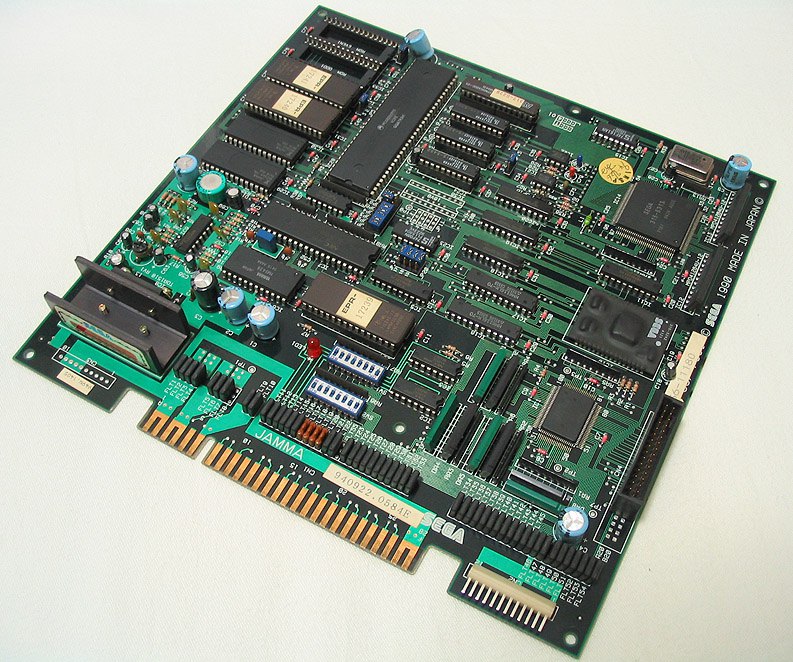
Architecture (≈ Mega Drive)
| Block | Chip | Clock | Role |
|---|---|---|---|
| CPU | Motorola 68000 | ~7.67 MHz (XL2 = 53.693 MHz / 7) | game logic |
| Video | 315-5313 (Mega Drive VDP) | 320×224; extended palette vs Mega Drive (more on-screen colours on C-2) | |
| Sound (FM) | Yamaha YM3438 (OPN2C, YM2612-compatible) | 6 FM voices | |
| Sound (samples) | µPD7759 (System C-2 only) | ADPCM sample playback | |
| Settings/save | EEPROM + battery-backed RAM (per game) |
It's almost a Mega Drive: same VDP, same FM family. Hence simple conversion and preservation on the video/sound side. JAMMA cabinets, 15 kHz output.
System C games (no µPD7759): Bloxeed, Columns, Columns II. System C-2 games: Puyo Puyo, Puyo Puyo 2, Puzzle & Action: Tant-R / Ichidant-R, Stack Columns, Poto Poto, Thunder Force AC, Borench, Ribbit!, Twin Squash, OOPArts…
The lock: the 317-0xxx protection chip (C-2)
Almost all C-2 games (and Bloxeed USA on the C side) carry a Sega protection chip
marked 317-0xxx (a per-game number). The 68000 reads this chip and the game
crashes / won't boot without the right response.
| Game (examples) | Chip |
|---|---|
| Bloxeed (USA) | 317-0140 |
| Columns | 317-0149 |
| Columns II | 317-0160 |
| Puyo Puyo | 317-0203 |
| Tant-R (JP) | 317-0211 |
| Ichidant-R (JP) | 317-0224 |
| Puyo Puyo 2 | 317-0228 |
Bloxeed(the very first, board C) does NOT read the protection → it's the easiest game to reproduce/convert.- The protection works as a per-game table of 256 4-bit values; it was
reverse-engineered by the MAME community (the tables live in the
sega/segac2.cppdriver). → a base for a conversion (supply the right protection logic) or a faithful emulation.
No classic 'de-suicide', but…
There is no battery-backed program decryption key (like CPS-2/System 16 FD1094). The lock is hardware: the game's 317-0xxx chip. To convert to a protected game you need the target game's chip (or a substitute reproducing its table). Some games also have a battery-backed RAM (scores/settings) — watch it for preservation.
Converting (summary)
- Gather the target game's ROMs (68000 program, graphics, sound; + µPD7759 samples if C-2).
- Burn the EPROMs at the right sizes/positions on a compatible donor board (C vs C-2 depending on the µPD7759).
- Handle the protection:
- unprotected game (Bloxeed, bare C board) → nothing special;
- 317-0xxx game → supply the game's chip (or a substitute reproducing its 256×4-bit table, derived from MAME).
- Handle the EEPROM / battery (settings, possible backup) — reset as needed.
- Test: video (VDP), FM (YM3438), samples (µPD7759 on C-2), save.
Settings (DIP)
System C/C-2 are configured with DIP switches (coinage, difficulty, options) and/or EEPROM soft-dips depending on the game. After a conversion, apply the target game's table — see the general DIP convention.
Before / after
- Unprotected System C game (Bloxeed, Columns): reprogram ROMs → another game, simple (close to an arcade Mega Drive repro).
- C-2 game with 317-0xxx: conversion possible with the correct protection chip/table; without it, the game won't boot.
Where to read more
- MAME — driver
sega/segac2.cpp(68000, 315-5313, YM3438, µPD7759, per-game 317-0xxx chips, protection tables) — https://github.com/mamedev/mame/blob/master/src/mame/sega/segac2.cpp - Wikipedia — Sega System C-2 (Mega Drive base, games) — https://en.wikipedia.org/wiki/Sega_System_C
- Home kinship: Sega Mega Drive (same VDP/FM).
Sources & attribution
- MAME —
sega/segac2.cpp(System C "System 14" / C-2: 68000 @ ~7.67 MHz, VDP 315-5313, YM3438, µPD7759, per-game 317-0xxx protection table, Bloxeed without protection) — https://github.com/mamedev/mame - Wikipedia — Sega System C / C-2 — CC-BY-SA — https://en.wikipedia.org/wiki/Sega_System_C
-
Internal page: Mega Drive (shared VDP/FM) Image:
-
sega-system-c2-carte.jpg— Komatta, public domain, Wikimedia Commons — https://commons.wikimedia.org/wiki/File:Sega_system_c2_pcb.jpg

Review & corrections
How this space is used
Spotted a wrong value, an outdated procedure, a chip reference that does not match your board? Say so here, with what you observed (model, board revision, serial number, measurement). Every report is cross-checked against a source before anything changes — an unverifiable correction is published as “reported by …, not cross-checked” rather than silently applied.
Reading is open to everyone; posting requires signing in with Discord. Reports from the wiki's declared reviewers are handled first; anyone else's are read too, but go through a human before anything is changed.