Neo-Geo converts
"Converting" a Neo-Geo covers two things: (1) moving a game from one format to the other (MVS ↔ AES), and (2) reprogramming a cartridge to another game (EPROM). MVS and AES run the same code; all the subtlety is in the cartridge pinout and, for later games, the ROM encryption.
| Field | Value |
|---|---|
| Platform | SNK Neo-Geo (MVS arcade / AES home) |
| Convert types | MVS↔AES (adapter/reshell) · cartridge reprogram (EPROM) |
| Difficulty | 🟡 (adapter) → 🟠 (EPROM reprogram, donor boards, decrypted ROMs) |
| Suicide? | No (no battery-backed key on the base hardware) |
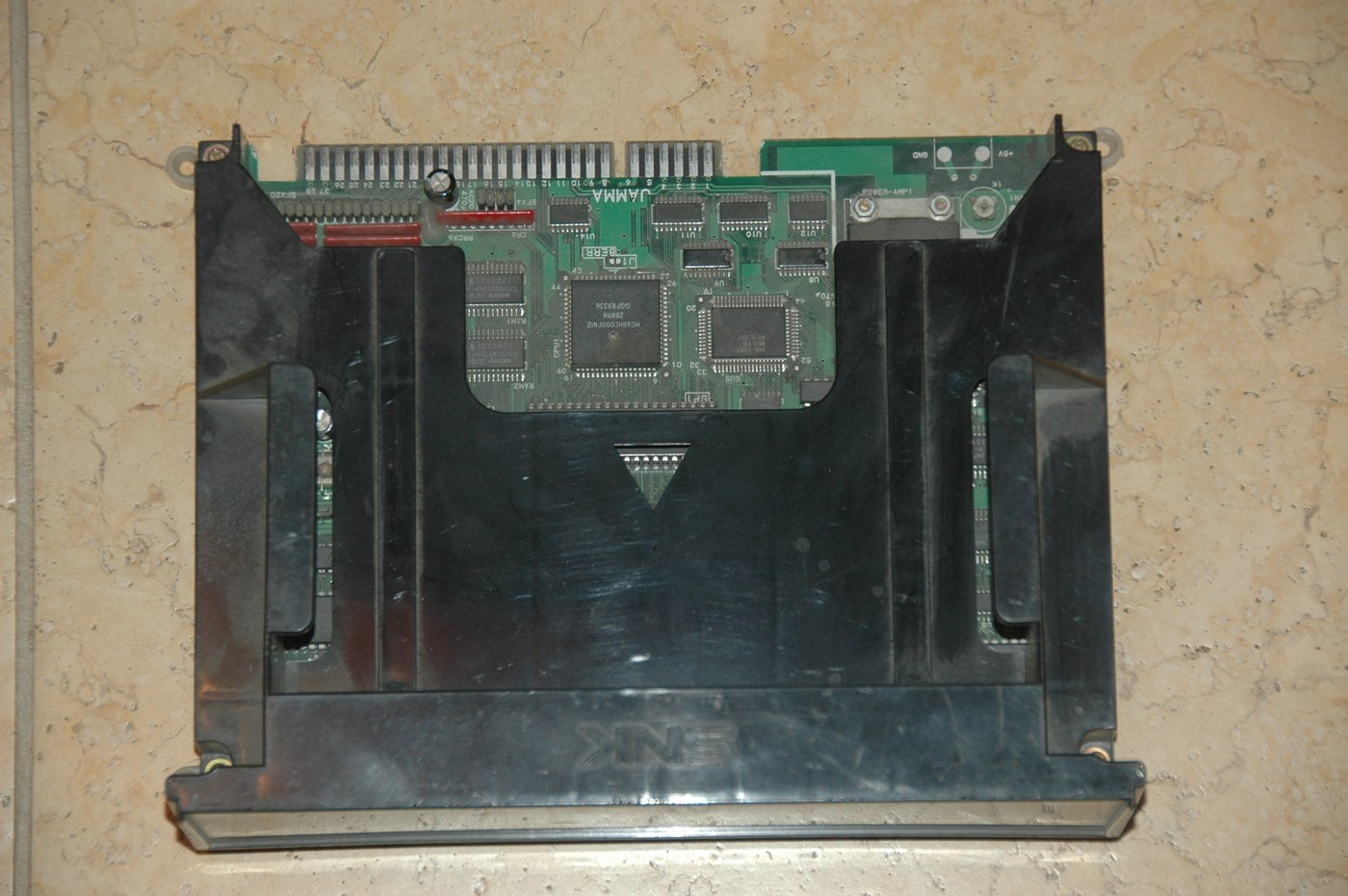
Cartridge anatomy (to know before reprogramming)
A Neo-Geo cartridge = two stacked PCBs, each with specific ROM types:
| Board | ROM | Role |
|---|---|---|
| PROG (top) | P (P1/P2…) | 68000 code (program) |
| V | ADPCM samples (voice/sound) | |
| CHA (bottom) | C (C1/C2…) | sprites (graphics tiles) |
| S (S1) | fix layer (text/HUD) | |
| M1 | Z80 code (sound program) |
1. Reprogramming a cartridge to another game (EPROM)
Donor boards
Not every PROG/CHA works. The most versatile:
- PROG: PROGBK1 (the best donor); also PROG-TOP, PROG-GSC(3), PROG4096.
- CHA: CHA256 / CHA256B / CHA512Y support any conversion; also CHA42G-3/-3B.
- Avoid boards with plated-through holes: painful desoldering.
ROMs needed (key point: everything must be decrypted)
You need: decrypted P, decrypted V, decrypted C, M1, and the extracted S (see the encryption box).
| ROM | Typical EPROM |
|---|---|
| 1 MB files (P, C, V…) | M27C800 |
| 2 MB files | M27C160 |
| S1 (fix) | M27C1000 |
| M1 (Z80) | M27C1001 |
Solder without sockets
With sockets, the shell no longer closes. Conversion EPROMs are soldered directly (no socket) onto the donor board.
The encryption wall (later games)
Late Neo-Geo carts carry protection/encryption chips — that's what makes a "raw" conversion impossible without decrypted ROMs:
| Chip | What it encrypts | Consequence for converting |
|---|---|---|
| CMC42 / CMC50 | encrypted C (sprites) + generates the S internally | you need decrypted C and an extracted S (no physical S) |
| SMA | scrambled P + bankswitch (e.g. KOF98, Metal Slug 3…) | need decrypted P + handle the banking |
| NEO-PVC | encrypted P + bankswitch + RAM (KOF2003, SVC…) | decrypted P required |
| PCM2 | scrambled V (ADPCM) addressing | decrypted V required |
→ In practice: start from decrypted ROMs (MAME decrypted dumps) + a donor board without a protection chip, and supply the extracted S for CMC games. This is the point that trips up beginners.
Encryption by game: can you reprogram by plain EPROM?
The question that decides everything on Neo-Geo. The classic games (≈ up to 1999) are
NOT encrypted → direct EPROM reprog possible. From 1999-2000, SNK adds encryption
chips (C/S/M1/V and/or scrambled P) → you need decrypted ROMs (MAME dumps) and sometimes
a specific donor board; no simple reflash. (Source: MAME hash/neogeo.xml, cartridge
types. Board view: Neo-Geo MVS PCB.)
| Scheme | What it encrypts / protects | Plain EPROM reprog? | Notable games |
|---|---|---|---|
None (rom) |
— | ✅ yes | ~225 games: Metal Slug 1/2, KOF 94-97, Samurai Shodown 1-4, Fatal Fury, Art of Fighting, Real Bout, Last Blade 1/2, Blazing Star, Pulstar, Shock Troopers, Waku Waku 7… |
ROM protection (kof98, fatfury2, mslugx) |
logic (P not encrypted) | ⚠️ chip/patch needed | KOF '98, Fatal Fury 2, Metal Slug X |
| SMA | scrambled P (address) + CMC42 | ❌ no | KOF '99, Garou, Metal Slug 3, KOF 2000 |
| CMC42 | C / S1 / M1 encrypted | ❌ no | Sengoku 3, Prehistoric Isle 2, Ganryu, Strikers 1945 Plus, NITD, Bang Bead, Zupapa |
| CMC50 | CMC42 + M1 | ❌ no | KOF 2001, KOF 2000 (neo), Jockey GP |
| PCM2 | + V (ADPCM) encrypted | ❌ no | Metal Slug 4, Rage of the Dragons, Pochi & Nyaa |
| NEO-PVC | scrambled P + protection + CMC50 | ❌ no | Metal Slug 5, SNK vs Capcom Chaos, KOF 2003 |
KOF2002-type (k2k2) |
P protection | ❌ no | KOF 2002, Matrimelee, Samurai Shodown 5 / SP |
In plain terms for the technician
-
Pre-1999 game (Metal Slug 1/2, KOF 94-97, Samurai Shodown…) → direct EPROM reprog on a donor cart (see the EPROM table above).
-
2000+ encrypted game → you need the decrypted ROMs (P/C/S/M1/V per scheme) and often a donor cart of the right type or a multi (NeoSD). You cannot convert an encrypted game by a plain EPROM reflash.
-
The many bootlegs (
boot_*) bypass encryption — don't confuse them with an original.
2. Format conversion: MVS ↔ AES
MVS and AES have a different cartridge pinout (but the same code). Two ways:
- Adapter (riser): the simplest — a converter that reorders the pins and accepts the other world's cartridge (MVS→AES or AES→MVS). No ROM changes.
- Reshell: transplant the PROG/CHA PCBs into an AES shell (or fit a 161-in-1 multi into AES), often via a ribbon cable to CHA/PROG adapter boards.
Reference pinouts: NeoGeo Development Wiki (MVS and AES signals/pins).
Region & BIOS
Region/language behaviour comes from the BIOS. The UniBIOS (Razoola) switches region + MVS/AES — nearly essential to comfortably play converted carts.
Procedure (EPROM reprogram, summary)
- Pick a compatible donor board (PROGBK1 + CHA256/512Y).
- Gather the target game's decrypted ROMs (P/V/C/M) + extracted S.
- Burn the EPROMs at the right sizes (see table).
- Desolder the original ROMs, solder the EPROMs (no socket).
- Handle bankswitch if the game requires it (big P).
- Test: image, fix layer (S), sprites (C), sound (M1/V).
Settings (soft-dips)
Neo-Geo is configured in software, not via physical game DIPs: the MVS BIOS offers a test/soft-dip menu (coinage, free play, demo time, multi-slot selection). The UniBIOS adds region, MVS/AES, cheats, diagnostics. On AES (home), no operator soft-dips — settings are in the game. Nothing to re-set after a format conversion (the code is identical); see the general convention.
Beware of bootlegs
The "161-in-1" are unofficial copies (dubious quality/legality), sometimes used as a base for AES reshelling. For a clean route, see the multi solutions.
Before / after
- EPROM reprogram: a donor cartridge becomes the target game.
- MVS→AES: an arcade game becomes playable on the home console.
Where to buy / read more
- PROGBK1 / CHA256 donor boards & AES shells: Neo-Geo shops (NeoStore…).
- MVS↔AES adapters: specialist shops.
- Technical docs: NeoGeo Development Wiki — https://wiki.neogeodev.org/index.php?title=Cartridges · https://wiki.neogeodev.org/index.php?title=Cartridge_ROM_arrangements
- EPROM conversion guides: Arcade-Projects — https://www.arcade-projects.com/
- Clean multi: NeoSD (Terraonion) — https://www.terraonion.com/ · Multi.
Sources & attribution
- NeoGeo Development Wiki — Cartridges / ROM arrangements (P/V/C/S/M1, PROG/CHA, boards) — https://wiki.neogeodev.org/
- Arcade-Projects — Neo-Geo cartridge conversions (donors, EPROM, decrypted ROMs) — https://www.arcade-projects.com/
-
Internal pages: Neo-Geo MVS · Neo-Geo AES Image:
-
neogeo-cartouche-mvs.jpg— Cyberjobe, public domain, Wikimedia Commons — https://commons.wikimedia.org/wiki/File:Neogeo_snk_pcb.JPG

Review & corrections
How this space is used
Spotted a wrong value, an outdated procedure, a chip reference that does not match your board? Say so here, with what you observed (model, board revision, serial number, measurement). Every report is cross-checked against a source before anything changes — an unverifiable correction is published as “reported by …, not cross-checked” rather than silently applied.
Reading is open to everyone; posting requires signing in with Discord. Reports from the wiki's declared reviewers are handled first; anyone else's are read too, but go through a human before anything is changed.