Arcade cabinet types
An overview of the main arcade cabinet families — from the American upright to the Japanese candy cab, via the cocktail, the sit-down/motion cabinet and the modern LCD generation. Each format has its own wiring, screen and repair constraints.
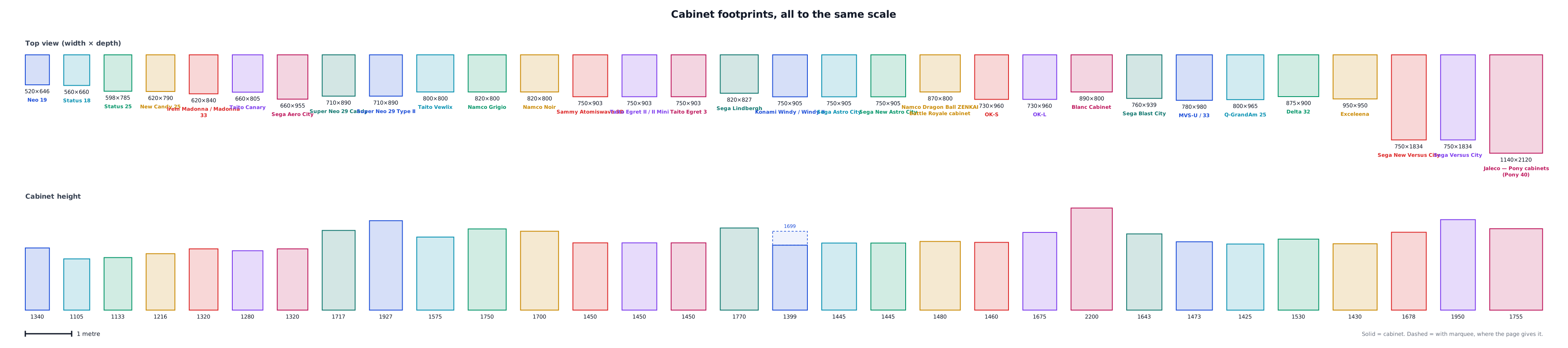
Each cabinet's own page figures, brought to a common scale. Solid bar = the bare cabinet; dashed = with marquee, where the page gives it — only one does. ⚠️ The chart does not show the whole corpus: what is missing, and why, is set out just below.
Arcade Otaku lists depth first — eight inversions on this wiki
Verified against the manufacturer's own document on twelve cabinets: Astro City, New Astro City, Aero City, Versus City, Blast City, Lindbergh, Windy, Canary, Egret II, Egret 3, Vewlix and Grigio. Their infobox says "905 x 750", the manufacturer's document says 750 wide by 905 deep. Since their infoboxes never say so, copying their order verbatim flips the cabinet — which is what had happened to eight pages on this wiki.
⚠️ And it is not peculiar to Arcade Otaku. On the Grigio, Arcade Otaku publishes "800 x 820" and Hard*Candy "820 x 800" — the same numbers, the opposite order, neither declaring which is which. The Namco manual settles it: 820 wide. Two databases contradicting each other is the signal that neither knows.
⚠️ Many of these confirmations come from sales flyers, not manuals. Sega and Taito published bilingual leaflets in which the figures are labelled (W) (D) (H) in English: it is the clearest possible source on the order, and often easier to find than a service manual. All of them are archived on this wiki, page by page.
Two of the formerly excluded cabinets are back, because the proof was asleep in the repository: the Sega Versus City manual labels 750 mm (幅) × 1,834 mm (奥行), and the Namco dimension drawing published on the Dragon Ball Zenkai page carries the 890 on the front view and the 800 on the side. A reason for exclusion deserves re-examining, not renewing.
The Grigio came back when the document turned up, not when the reasoning felt good enough: the Namco manual declares 横幅 (W) 820 × 奥行 (D) 800, and the suspicion of an inversion — right for weeks — still had to wait for its proof.
That is the rule that matters: a guessed width is the cabinet that will not fit through the door on loading day.
The second trap: “height” does not mean the same thing everywhere
Japanese manufacturers routinely publish two heights — the bare cabinet, and the cabinet including the instruction panel. And they do not always say which one they are giving.
The textbook case is the Egret II. Its manual states a single figure, 1764, unqualified; its flyer splits the two lines: 高さ 1450 for the cabinet, インスト含む高さ 1765 with the panel. This wiki was therefore publishing 1764 as a cabinet height, and drawing the Egret II 31 cm too tall on this very chart — right next to an Egret 3 measured bare, when the two machines have exactly the same envelope.
The chart now only accepts bare-cabinet heights; a page whose only known height is “panel included” is left out rather than mixed in.
The Grigio is a variant of the same trap: its infoboxes announce "1270 / 1750 mm, adjustable height", and this page had spun that into a cabinet "that goes from seated to standing play". The Namco manual says something else entirely — 1270 is the shipping height, signboard not yet fitted, and there is no height adjustment at all.
The corpus has yielded four different notations for three numbers: 所要面積 at Sega (width × depth), 縦 × 横 × 奥行 on the Aero City (height × width × depth), (W) × (H) × (D) on the Egret 3 flyer but (W) × (D) × (H) on both Vewlix flyers — Taito is not consistent with itself —, and height → width → depth at Capcom on the Status 25. There is no "obvious" order: there is only what the document declares.
What the chart does not show — and why
The comparison can now read a range page: a column table, a triplet inside one cell, an 外形寸法 spec row, or one row per cabinet. On one condition: the page must declare which table to read and the order of its figures. Status 25 and 18, the New Candy 25 and the Exceleena came in that way, along with nine others.
What is still out is no longer out because of page layout, but because the document does not give the installed cabinet:
| Missing | What the document gives instead |
|---|---|
| Cyber Lead (Namco) | 760 × 950 × 1470 — 出荷時 figures, as shipped. Not the footprint once installed. |
| G-Balance (other candy cabs) | 820 × 781 × 1870 panel included, and 820 × 530 × 1490 搬入時. No bare-cabinet triplet: between the two, depth moves by 251 mm. |
| Astro City 2 | 750 × 1,005 of Installation space — the area to reserve, servicing included — and 1,445 high. The cabinet itself is not dimensioned. |
| Naomi Deluxe Universal (other candy cabs) | 1,054 × 1,981 × 2,144 assembled, and 1,862 for the monitor block alone in transport. No document separates cabinet height from sign height. |
All four do have manufacturer figures, published on their page. None has the figure this chart draws. The script reports them in its output, with the reason, rather than ignoring them silently — and a page may declare for itself why it stays out, which is what the Astro City 2 does. Otherwise the message "add a marker" would have someone draw a cabinet 100 mm too deep.
The Vewlix is in the chart with the L's figures, 800 × 800 × 1575 — ⚠️ a recomposed triplet: the footprint comes from the 設置時 drawing and the height from the 搬入時 drawing, both in its manual, but no document publishes the two together. Details on its page.
Three cabinets in the chart do not rest on a document that names them
- the New Versus City: its figures come from Arcade Otaku, and the order is carried over from the Versus City, a different machine;
- the Blast City: the archived manual is the game's (SEGA Bass Fishing) and never names the cabinet; and the 1643 and 760 published are not the manual's (65 in = 1651, 30 in = 762) but Arcade Otaku's;
- the Noir: its figures come from the Tekken 6 SD-S game manual, not archived on this wiki.
All three are plausible and flagged as such on their page. They stay in the chart, but that is not the same thing as a manufacturer document naming the cabinet.
✅ The Atomiswave SD was the fourth. It left the list on 12 August 2026: its Sammy manual is archived, and dimensions the cabinet itself — 750 × 903 × 1450 cabinet only.
The “~750 × ~900” shape is not universal
It is the shape of Sega and Taito candy cabs, not a Japanese rule: the Namco Exceleena is 950 × 950 per its service manual, and the Cyber Lead 760 × 950. Measure rather than assume, even between cabinets of the same era.
The main families
| Type | Description | Examples |
|---|---|---|
| Upright | tall vertical US/EU cabinet, marquee on top, ~19-25″ monitor | dedicated US cabs (Pac-Man, MK), generic JAMMA |
| Cocktail / table | horizontal screen under glass, 2 players face to face (flipped image) | Pac-Man cocktail, Space Invaders table |
| Cabaret / mini | a smaller upright (less bulky) | mini-cabs |
| Candy cab (JP) | small moulded-plastic cabinet, rotatable monitor, interchangeable panel, JAMMA/JVS standard | Astro City, Egret II, Windy |
| Sit-down / cockpit / deluxe | a sit-in cabinet, often motion (actuators) | OutRun, After Burner, Sega R360 |
| Modern LCD | flat 16:9 screen, arcade PC, versus | Vewlix, Noir |
| Bartop (modern) | small countertop cabinet, often emulation/RetroPie | DIY bartops |
What changes between types
- Screen: CRT 15 kHz (classic), 24/31 kHz or tri-sync (late candy cabs), LCD (modern). See Astro City and Blast City.
- Wiring: JAMMA (56-pin edge, standard since 1985), JVS (serial, modern arcade), or dedicated harnesses (pre-JAMMA cabs).
- Power: a candy brick (JP) vs a US cabinet PSU; the critical +5 V adjustment → candy cab PSU.
- Controls: interchangeable panel (candy) vs fixed (dedicated).
Playing a PCB at home
Without a cabinet, you plug a JAMMA board via a supergun (JAMMA → RGB + gamepads + power). It's the "living-room preservation" route for PCBs.
Repair (cross-cutting)
- CRT monitor: recap + adjustments (see Nanao MS8 / MS9); ⚠️ high voltage.
- Power: candy cab PSU.
- JAMMA/JVS contacts, harness, buttons/joysticks.
Repair & maintenance
Modernise (video, PSU, JVS, upscaler, PC/FPGA) → Modernising a cabinet. Cross-cutting methods: CRT safety · Recap · PCB fault-finding.
Sources & attribution
- Arcade Otaku Wiki — cabinet types / candy cabs — https://wiki.arcadeotaku.com/w/Cabinets
- Internal pages: Astro City · supergun · candy cab PSU
Review & corrections
How this space is used
Spotted a wrong value, an outdated procedure, a chip reference that does not match your board? Say so here, with what you observed (model, board revision, serial number, measurement). Every report is cross-checked against a source before anything changes — an unverifiable correction is published as “reported by …, not cross-checked” rather than silently applied.
Reading is open to everyone; posting requires signing in with Discord. Reports from the wiki's declared reviewers are handled first; anyone else's are read too, but go through a human before anything is changed.