Conversions & multi (arcade)
Two ways to run other games on an existing arcade PCB:
- Convert: turn one game's board into another — reprogram/swap the ROMs, set the customs, handle the security. A historical scene skill (making a rare game playable from a common board).
- Multi: a single kit (usually SD/flash) carrying a whole library and replacing ROMs/CD/cartridge — the modern preservation route. See the dedicated page: Multi-game solutions.
Ethics & legality
This wiki describes the method (how it works, how you repair/convert), never hosts ROMs. Conversions are done from your own dumps. Multi bootlegs ("N-in-1") are mentioned for information — dubious legality and variable quality.
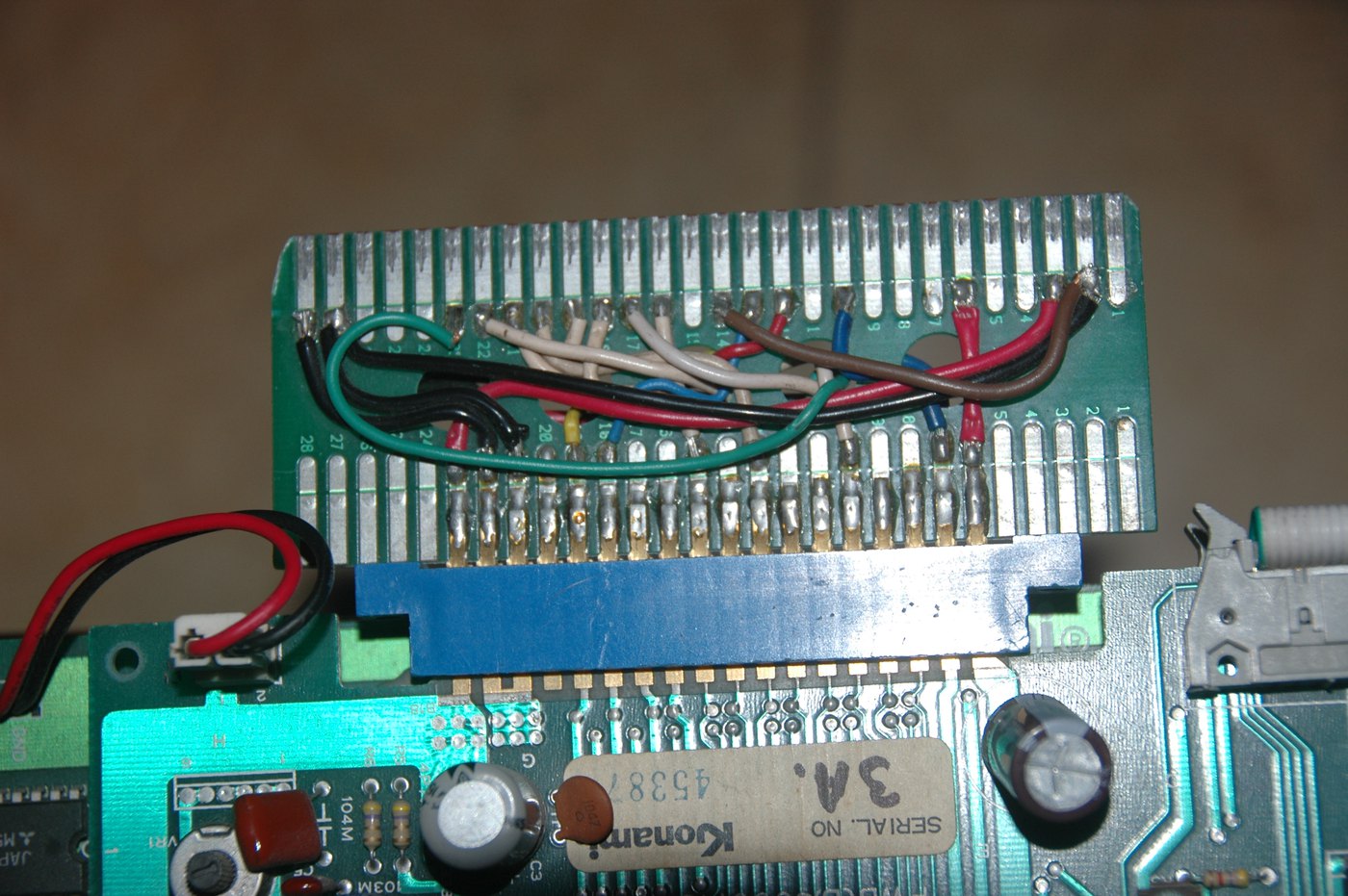
Convert vs Multi — which to choose?
| Criterion | Convert (swap/reprogram ROMs) | Multi (SD/flash kit) |
|---|---|---|
| Games available | 1 (the target game) | the whole platform |
| Reversible | yes (keep the original ROMs) | yes (removable kit) |
| Preserving the original board | you modify a board | you don't touch it (interposed kit) |
| Skill | EPROM, customs, security | plug in + SD |
| Cost | low (ROMs) | high (kit) |
| "Suicide" security | platform-dependent | often bypassed |
Conversions by platform
| Platform | Difficulty | Key points | Page |
|---|---|---|---|
| CPS-1 | 🟡 | B-board + CPS-B-21 config; base non-suicide (except Kabuki/Dash) · OpenKey codes | CPS-1 converts |
| CPS-2 | 🟠 | key encryption → mainly B-board swap; phoenix/de-suicide · jumpers per game | CPS-2 converts |
| CPS-3 | 🟠 | CD + cartridge (keys) + SIMM flash; Darksoft multi | CPS-3 converts |
| Neo-Geo | 🟡 | MVS ↔ AES (same code, different cart/pinout) | Neo-Geo converts |
| System 16/18/24 | 🟠 | FD1094/FD1089: Arduino re-key, ROM+68000 de-suicide · keys per game | FD1094/FD1089 |
| IGS PGM | 🟠🔴 | IGS027A (ARM) protection: dump internal ROM + patched P | PGM converts |
| Namco 2/11/12 | 🟠🔴 | MCU (Sys 2) / per-game KEYCUS (Sys 11/12) · KEYCUS per game | Namco converts |
| Namco 357/369 | 🟠 | PS3-based arcade; HDD+dongle; retail board conversion | System 357/369 |
| Konami 573 | 🟡🟠 | media + paired security cartridge; 573in1 tool · catalogue | Konami 573 |
| Taito F3 | 🟡 | cartridge (Neo-Geo/CPS2-like); region keying + byte | Taito F3 converts |
| Sega System 32 | 🟡🟠 | suicide: decrypted-ROM de-suicide; Big/Small ROM board | System 32 |
| Taito B / F2 | 🟡🟠 | ROM reprogram + per-game C-Chip (TC0030CMD) | Taito B/F2 |
| Sega System 24 | 🟡🟠 | floppy: imaging + HxC/Gotek emulator (± FD1094) | System 24 |
| Taito Z / H / X | 🟡🟠 | ROM reprogram; C-Chip on Z/H; X simpler | Taito Z/H/X |
| Sega System 18 | 🟠 | FD1094 + 8751 MCU: ROM de-suicide + remove 8751 | System 18 |
| Sega System C / C-2 | 🟡🟠 | Mega Drive base; per-game 317-0xxx protection chip | System C/C-2 |
| Sega X / Y-Board | 🟠 | super-scaler; FD1094 on some games | X/Y-Board |
| Taito G-NET | 🟡 | ZN-2 base; CAT702 + mod-BIOS → CF cards | G-NET |
| Konami GX / Viper | 🟡🟠 | ROM board (GX, EEPROM reinit) / CF card (Viper, RTC+DS2430) | GX/Viper |
| IREM M72 / M92 | 🟡🟠 | ROM board + per-game i8751 MCU (dumped) | M72/M92 |
| Toaplan V1/V2 | 🟠 | HD647180 MCU (dumped) + custom GP9001 VDP | Toaplan |
| Psikyo | 🟠 | 68020 / SH-2; PS3/4/5 variants + security EEPROM | Psikyo |
| Cave 68000 | 🟠 | 038/013 customs; per-game sprite layouts | Cave 68000 |
| Data East | 🟠 | DECO Cassette (tape+dongle); 146/104/156 ASIC | Data East |
| SNK Hyper 64 | 🔴 | VR4300 cartridge; mostly preservation | Hyper 64 |
The red thread: security
Many platforms encrypt the program or authenticate it with a battery-backed SRAM key (the "suicide": CPS-2, CPS-3, System 16 FD1094). Every conversion must account for this lock — hence phoenix ROMs (decrypted, battery-less) and multi kits (which handle security internally).
DIP settings — the general rule
After a conversion, the board is set up like the target game: the config (difficulty, lives, credits, region…) follows the game, not the board. There are two main ways to configure an arcade game:
A. Physical DIP switches (1980s / early-90s systems)
One or more micro-switch banks on the board. Most common convention (8-way bank), to adapt per game:
| Switch | Typical function |
|---|---|
| 1-2 | Coinage |
| 3-4 | Difficulty |
| 5 | Lives / bonus (extend) |
| 6 | Demo sound (on/off) |
| 7 | Flip screen (cocktail-upright) |
| 8 | Free play (or) Test / service |
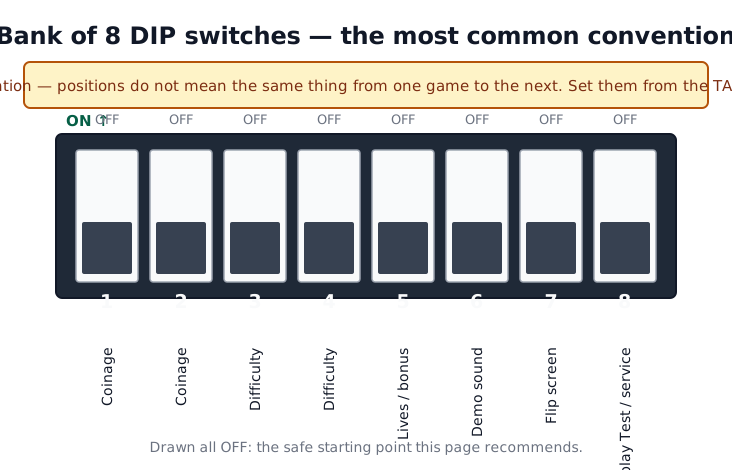
The same table as it looks on the board. The levers are drawn all OFF, the safe starting point recommended below. ⚠️ The convention is indicative: set them from the target game's table.
- Many platforms have 2 banks (A/B) or even 3 (e.g. CPS-1: DIP A = coinage, B = difficulty, C = lives/flip/free-play/test).
- Region is sometimes a DIP (Toaplan, IREM…), sometimes hard-wired/soldered (see the Region-free pages on the system side).
After conversion: TARGET game's DIP
Positions don't mean the same thing from one game to another. Once converted, set the board per the target game's DIP table (source: the game's entry in MAME, DIP switches menu, or the game manual). Safe start: all OFF, then enable service/test to check.
B. Soft-dips / test menu (cartridge / EEPROM systems)
Newer systems (CPS-2/3, Neo-Geo, System GX, Viper, ST-V, Naomi…) are set via a software test menu ("soft-dips") stored in EEPROM, reached with the TEST button. Key points:
- On many of these, changing game forces an EEPROM reset: hold TEST at power on (Konami GX), or the board does it on first boot.
- CPS-2: the physical jumpers do NOT set the game — they configure the ROM size/type (see CPS-2 converts). Game settings are soft-dips (TEST menu).
- Neo-Geo MVS: settings via the BIOS/soft-dips (UniBIOS adds more).
Preservation note: the per-game DIP values form a very large dataset (MAME scale). The wiki documents the logic and conventions above (reusable), plus full flagship-game tables transcribed in-wiki → DIP settings — flagship games. More games are added on request (transcribed from the durable MAME definitions).
Sources & attribution
- Arcade-Projects community (convert/multi guides) — https://www.arcade-projects.com/
- DIP / soft-dip conventions: MAME (per-game DIP switches menu) — https://www.mamedev.org/
-
Internal pages: CPS-1 · CPS-2 · CPS-3 · Neo-Geo MVS Image:
-
adaptateur-jamma.jpg— Cyberjobe, public domain, Wikimedia Commons — https://commons.wikimedia.org/wiki/File:Adattatore_Jamma.JPG

Review & corrections
How this space is used
Spotted a wrong value, an outdated procedure, a chip reference that does not match your board? Say so here, with what you observed (model, board revision, serial number, measurement). Every report is cross-checked against a source before anything changes — an unverifiable correction is published as “reported by …, not cross-checked” rather than silently applied.
Reading is open to everyone; posting requires signing in with Discord. Reports from the wiki's declared reviewers are handled first; anyone else's are read too, but go through a human before anything is changed.