Sega R360
Sega's most spectacular cabinet: the R360 (1990) spins the player a full 360° on two axes (complete rotation, upside-down included). Built for G-LOC: Air Battle, it's a deluxe motion cabinet — not a candy cab.
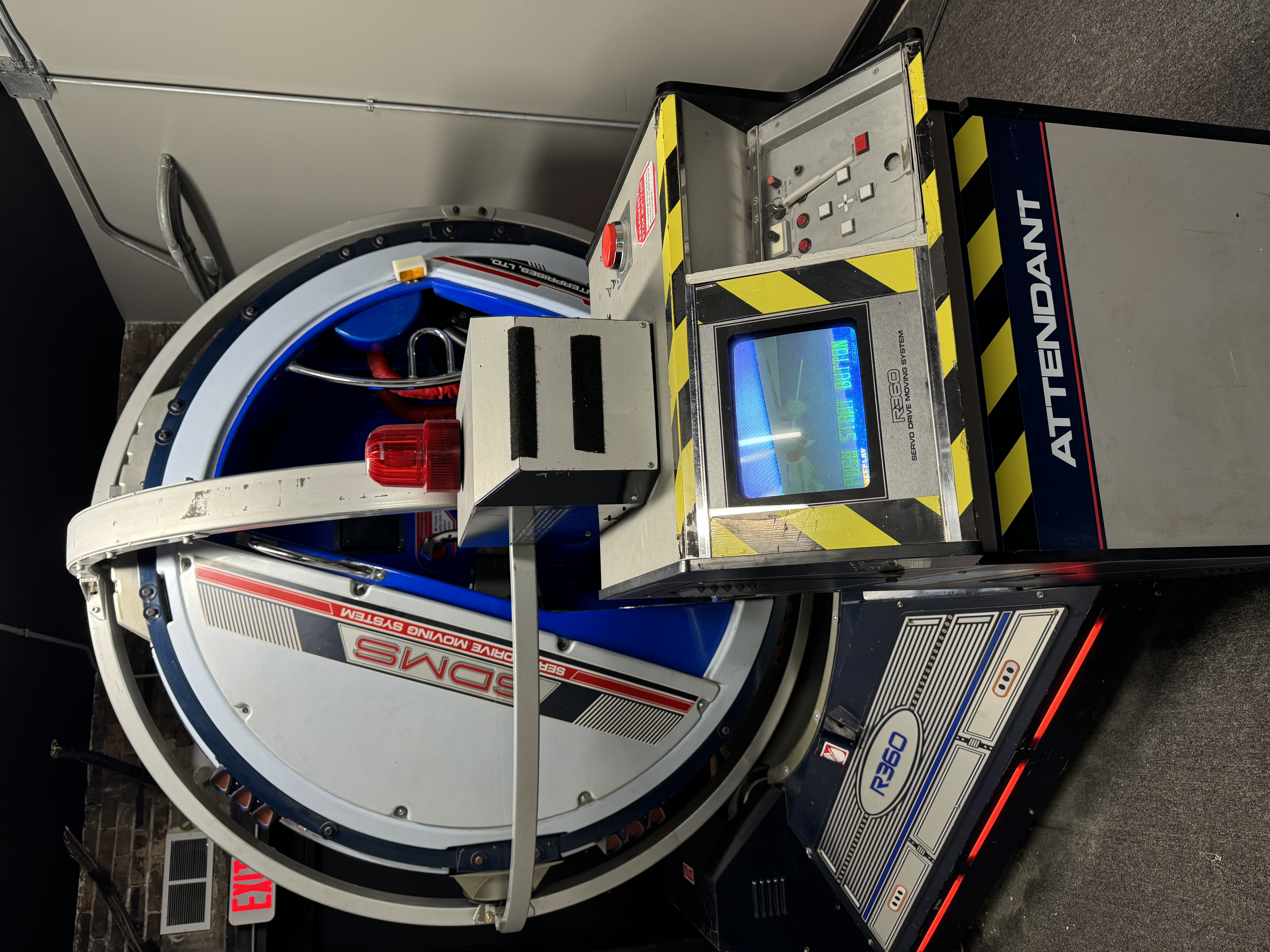
Identification
| Field | Value |
|---|---|
| Manufacturer | Sega |
| Year | 1990 |
| Type | Deluxe / motion (360° 2-axis gyroscopic cockpit) |
| Flagship game | G-LOC: Air Battle (Y-Board hardware) |
| Screen | CRT inside the closed cockpit |
| Safety | mandatory 5-point harness + emergency stop |
Games & production
- Release: Japan November 1990, international early 1991.
- Only 2 compatible games: G-LOC: Air Battle (1990) and Wing War (1994).
- Commercial flop: roughly 100 units built, even fewer sold → a very rare cabinet today.
- Safety: bar + 4-point harness, emergency stop both inside the cabin and on the attendant tower.
What makes it unique
- Full 360° rotation on two axes (roll + pitch): the seat can go upside down. A motorised outer frame swings the closed cabin around.
- Closed cockpit: the player is strapped in (harness), the operator has an emergency-stop button. Driven by a game-controlled hydraulic/electromechanical system.
- Hardware: runs on the Sega Y-Board (same as G-LOC / Galaxy Force II). The "game" side is therefore Sega Y-Board, but wrapped in a proprietary motion mechanism.
- Footprint / weight: a massive structure (rotating cage + counterweights + motors), a heavy install reserved for large arcades.
⚡ Connector & power
| Aspect | Value |
|---|---|
| Format | dedicated motion cabinet (no exposed JAMMA edge — internal Y-Board PCB) |
| Game system | Sega Y-Board (3× 68000 + sprite motors) |
| Motion | motorised 2-axis rotating frame + position sensors |
| Power | three-phase / high power (rotation motors) — far beyond a candy cab |
| Safety | operator emergency stop + player harness mandatory |
A hazardous cabinet
The R360 involves heavy mechanics and powerful motors. Any return to service requires checking the safety systems (limit switches, emergency stop, harness) and the rotation mechanics. This is not a plug-and-play cabinet.
Faults / maintenance (general)
- Rotation mechanics: bearing/counterweight wear, play in the frame — the heart of the maintenance.
- Safety systems: limit-switch sensors, emergency stop, harness → check first.
- Game side: it's Y-Board → see the Sega Y-Board page for the electronics (recap; desuicide n/a here).
- Monitor: CRT inside the cockpit → Sega/Nanao-chassis-style maintenance.
Procedure — a cabinet that will not start ✅
There is a CRT in this cabinet
The tube stays charged with the cabinet unplugged, and the anode cap is the first thing your hand meets behind the monitor. Discharge it, work with one hand, and never alone if you can help it. → CRT safety
What this adds
Ordered for a cabinet, not for a board: mains, low-voltage supply, loom, monitor, then the game. The overwhelming majority of "dead cabinets" are dead for a reason that has nothing to do with the PCB — which is why the board comes last here.
1. Mains, and what sits between it and the cabinet. The switch, the fuse or breaker, the isolation transformer if there is one. A cabinet that shows no sign of life at all is almost never electronic.
2. The low-voltage supply — measured under load. Aim for +5 V where power reaches the board — the JAMMA edge, or the JVS power connector, depending on the cabinet — with the game running, not on an idle bench. If the supply has an adjustment (most candy and JVS bricks do; the ATX brick in a PC cabinet does not), do it then and not before: set off-load, it leaves a board that boots and then glitches. With no adjustment the measurement still earns its keep — it tells you whether the supply holds. Check +12 V too, and −5 V if the board uses it: many do not, and an ATX brick does not provide it. → Cabinet power
3. The loom and the connector. Reseat, and check the grounds — a cabinet with a poor ground gives rolling picture, phantom inputs and noise, all at once, and none of it looks like a wiring fault. → Wiring
4. The monitor. This page describes the monitor as: CRT inside the closed cockpit. CRT: no picture but the tube is warm and there is EHT — that is sync or video, not the tube. No EHT at all — chassis. A picture that shrinks, wanders or shifts colour is a chassis recap, and on these monitors that is a scheduled job, not a repair.
5. Scan rate — the mismatch that breaks nothing. If the board's rate is not one the monitor accepts, you get no picture and nothing is faulty. Check what this cabinet takes against what the board puts out before opening anything. → Modernising a cabinet
6. The control panel. Microswitches and the loom, in that order. A single dead direction is a switch; a whole player dead is the loom or its ground. → Control panels
7. Coin mech and sound. Last, because they hide nothing: a mech that no longer registers is usually dirty or misadjusted, and silence with a good picture points at the amplifier and its supply rails.
Photos / assets
See the cabinet photo at the top of the page. (To add: cabin upside down, harness, rotating frame.)
Repair & maintenance
Modernise (video, PSU, JVS, upscaler, PC/FPGA) → Modernising a cabinet. CRT monitor (discharge HV!) → CRT safety · PSU/recap → Recap · ⚠️ high-power motion (mechanical/hydraulic safety — outside electronics scope). Diagnosis: PCB fault-finding.
Sources & attribution
- Arcade Otaku Wiki / Sega Retro — Sega R360 (360° 2-axis motion cab, G-LOC, Y-Board, 1990)
- Internal page: Sega Y-Board (game hardware)
Image:
-
r360.jpg— Expandinglight5, CC0 — https://commons.wikimedia.org/wiki/File:Sega_R360_Arcade_Machine.jpg

Review & corrections
How this space is used
Spotted a wrong value, an outdated procedure, a chip reference that does not match your board? Say so here, with what you observed (model, board revision, serial number, measurement). Every report is cross-checked against a source before anything changes — an unverifiable correction is published as “reported by …, not cross-checked” rather than silently applied.
Reading is open to everyone; posting requires signing in with Discord. Reports from the wiki's declared reviewers are handled first; anyone else's are read too, but go through a human before anything is changed.