Emerson Arcadia 2001
An 8-bit console from 1982 built around an S2650, best known for having been sold under around thirty different names worldwide. If you come across an unidentified cartridge console from 1982-1983, there is a good chance this is it.
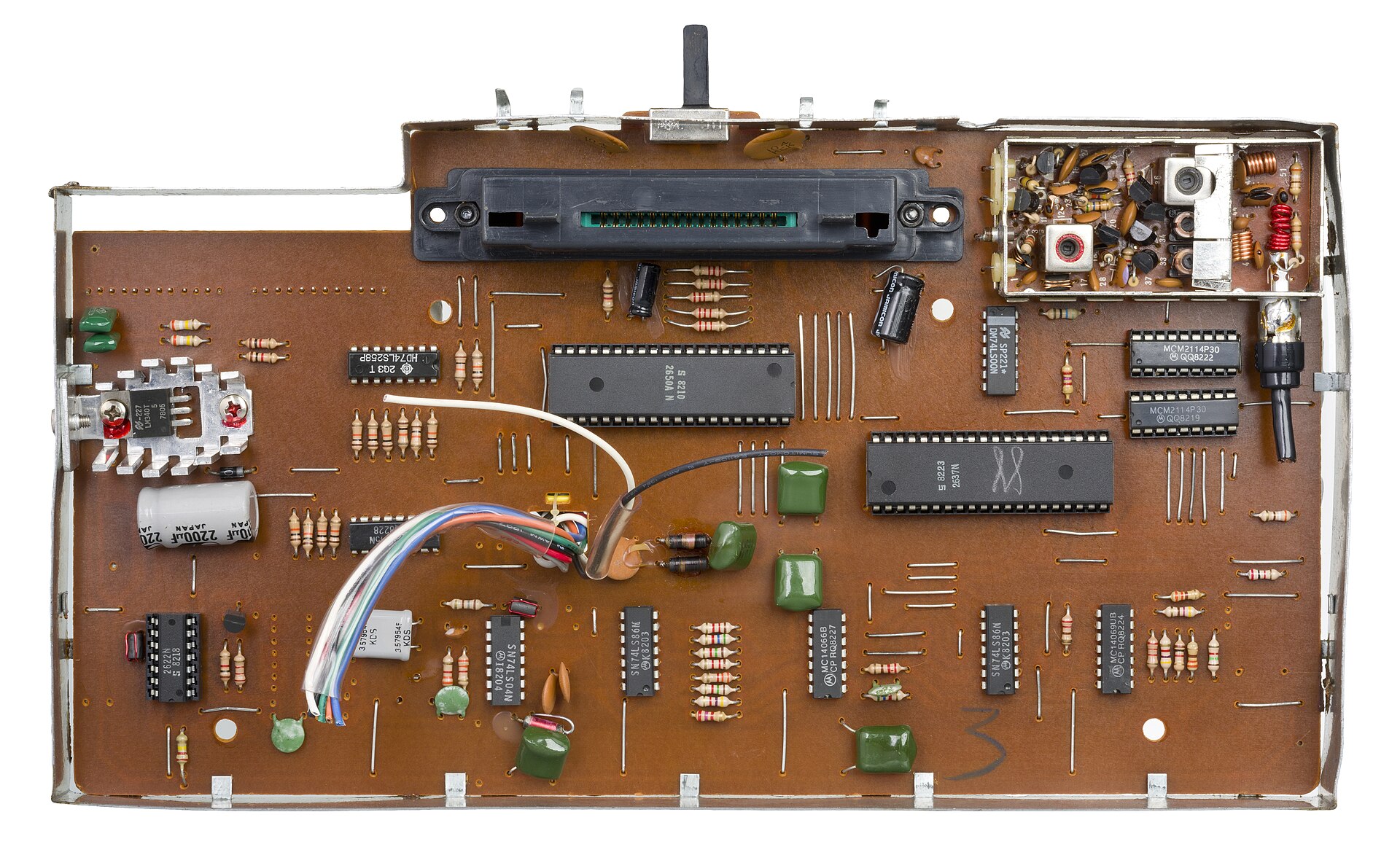
The Arcadia 2001 board. You can read the S 2650A (date code 8210), the 2637 video chip, two MCM2114 RAMs, the 7805 on its heatsink and the caged RF modulator. Photo by Evan-Amos (Vanamo Media), public domain.
Identification
| Field | Value |
|---|---|
| Manufacturer | Emerson (USA) — plus some thirty rebadgers, see below |
| Year | 1982 |
| CPU | Signetics S2650 — ⚠️ frequency depends on the TV standard, see below |
| Video | 60 Hz scan, 262 lines — ⚠️ NTSC figures |
| Sound | machine-specific circuit |
| Media | cartridge |
Expected clock — measurement table ✅
The frequency depends on the TV standard — don't condemn a crystal too fast
This is the trap on this machine, and it affects most of the European units in the list below.
| Standard | Crystal | Divider | CPU clock |
|---|---|---|---|
| NTSC | 3.58 MHz | ÷ 4 | 895 kHz |
| PAL | 4.433 MHz | ÷ 5 | 886.6 kHz |
Both values are their standard's colour subcarrier: on a machine of this era the colour crystal doubles as the processor clock after division.
⚠️ Measuring 4.433 MHz on a European machine's crystal is normal. The MAME driver configures only the NTSC variant for all thirty-two machines, but its own documentation gives both cases.
⚠️ What we do not know: no consulted source says which physical unit carries which crystal. Go by what is fitted on the board.
⚠️ The same machine under thirty-two names
This is the most useful part of this page. All of these consoles are the same hardware and are repaired the same way:
| Year | Trade name | Brand | Country |
|---|---|---|---|
| 1982 | Arcadia 2001 | Emerson | USA |
| 1982 | Arcadia | Bandai | Japan |
| 1983 | Home Arcade | Advision | France |
| 1982 | Dynavision | Yamagiwa | Japan |
| 1982 | Ekusera | P.I.C | Japan |
| 1982 | Leonardo | GiG Electronics | Italy |
| 1982 | Home Arcade Centre | Hanimex | UK |
| 1982 | HMG-2650 | Hanimex | Germany |
| 1982 | Leisure-Vision | Leisure-Dynamics | Canada |
| 1982 | Schmid TVG 2000 | Schmid | Germany |
| 1982 | Tunix Home Arcade | Monaco Leisure | New Zealand |
| 1983 | Mr. Altus Tele Brain | H.G.S. | Germany |
| 1983 | Polybrain Video Computer Game | Polybrain | Germany |
| 198? | Intelligent Game MPT-03 | Intelligent Game | USA |
| 198? | ITMC MPT-03 | ITMC | France |
| 198? | Prestige Video Computer Game MPT-03 | Prestige | France |
| 198? | Poppy MPT-03 Tele Computer Spiel | Transonic | Germany |
| 198? | Soundic MPT-03 | Soundic | Finland |
| 198? | Tempest MPT-03 | Tempest | Australia |
| 198? | Tobby MPT-03 | Tobby | ? |
| 198? | Intercord XL 2000 System | Intercord | Germany |
| 198? | Intervision 2001 | Intervision | Switzerland |
| 198? | Ormatu 2001 | Ormatu Electronics | Netherlands |
| 198? | Rowtron 2000 | Rowtron | UK |
| 198? | Sheen Home Video Centre 2001 | Sheen | Australia |
| 198? | Tele-Fever | Tchibo | Germany |
| 198? | Trakton Computer Video Game | Trakton | Australia |
| 198? | Tryom Video Game Center | Tryom | USA |
| 198? | UVI Compu-Game | Orbit Electronics | New Zealand |
| 198? | Video Master | Grandstand | New Zealand |
| 198? | Tele-Computer Cosmos | Mobilar (?) | Spain (?) |
| 198? | Palladium Video-Computer-Game | Neckermann | Germany — ⚠️ 16 keys instead of 12 |
The Palladium is not alone: it heads a family
The MAME driver notes that Neckermann's Palladium has 16 keys on its controllers instead of 12, and additionally gives it a distinct memory map (ROM blocks where the others have mirrors).
More importantly, three further machines are attached to the Palladium in the driver: Mr. Altus Tele Brain, Polybrain and Trakton. "Only the casing changes" therefore does not hold for those four.
Two uncertain entries, exactly as the source gives them
The driver itself marks two lines with a question mark: the brand of the Tele-Computer Cosmos ("Mobilar?") and its country ("Spain?", the author noting he only found pictures of a German Cosmos), plus the country of the Tobby MPT-03. We reproduce them with their uncertainty.
Common faults
| Symptom | Likely cause | Lead |
|---|---|---|
| Won't power up | S2650 or its crystal | ⚠️ 895 kHz (NTSC) or 886.6 kHz (PAL) — see the box |
| No picture | video stage or RF modulator | A 1982 machine: period RF output |
| Cartridge not recognised | connector contacts | Clean with isopropyl, never an abrasive |
| No sound, or wrong sound | machine-specific sound circuit | ⚠️ see the caveat below |
Procedure — a dead console, step by step ✅
What this adds
Ordered for a console, not for an arcade board: what kills these is almost never the CPU. It is, in real order, the power supply, the capacitors, the drive or the cartridge slot, and only then the logic. → PCB diagnosis
1. The power supply. Two cases, depending on the machine. External brick: ⚠️ read the marking on the machine, next to the socket, and check the adapter against it — voltage and polarity. A centre-negative machine fed centre-positive loses its fuse, sometimes its regulator; do not trust a third-party label or a generic tip. Internal supply (the machine plugs straight into the wall): mains is inside the shell. Unplug, wait, and confirm the large capacitors are discharged before touching the board. Either way, measure under load: a failing supply holds its voltage until it is asked for current.
2. The fuse. Many of these machines have one right behind the socket — it is the part designed to die. Test it in continuity, out of circuit. A fuse that blows again is a short, not a fuse problem.
3. Capacitors. On most machines of this age this is the default suspect rather than a last resort — leaking SMD electrolytics eat the tracks underneath before they give any other sign. ⚠️ Not all of them are like that: some carry very few and are not recapped on principle. Read what this page says about it before reaching for the iron. → Recap
4. The cartridge connector. Cartridge contacts with isopropyl alcohol, never an abrasive eraser: it takes the gold plating off and the problem comes back worse. On the machine side, inspect the slot pins — splayed, bent or oxidised — and check continuity between slot and board.
5. Video output. Isolate the machine from the display: another cable, another TV, another input. A sizeable share of "dead consoles" are a dead cable, or a display that will not lock onto what this machine outputs — see the video section of this page for what that is.
6. Still nothing. Now, and only now, the logic: rails on the board, reset, clock, bus. → PCB diagnosis
Repair (technician)
- Signetics' S2650 is not a common processor. Unlike a 6502 or a Z80, replacements are not easy to find — worth considering before condemning it.
- A single crystal, but its value depends on the standard: 3.58 MHz on NTSC, 4.433 MHz on PAL. Identify the standard before concluding.
- The name on the case tells you nothing about the hardware. See the table: thirty-two names, one machine. A service note found for one applies to the others.
→ Methods: PCB diagnosis · Recap
Preservation status
What the source says it does not know
The MAME driver carries three explicit caveats worth knowing:
- the character ROM has not been dumped — the driver is still looking for it;
- the front-panel RESET key is not implemented;
- all thirty-two variants carry the "imperfect sound" flag (counted one by one);
- four of them additionally carry "not working": Mr. Altus Tele Brain, Palladium, Polybrain and Trakton — the four of the Palladium family.
In other words: if your machine's sound does not match the emulator's, that is not proof your machine is faulty.
Modernisation & mods
- ⚠️ Do not host ROMs — method only.
Photos / assets
(To take: the board with the S2650 and the crystal, the cartridge connector, and if at all possible two differently branded cases side by side — the most telling illustration this page could have.)
Archived manufacturer documentation ✅
Manufacturer documentation archived locally. ⚠️ These are owner's and reference manuals, not service manuals: they give the specifications, the connectors and the expected behaviour, but not the schematics or troubleshooting voltages.
Status
Manufacturer documents with no explicit licence, kept for preservation (machines out of production for decades).
Sources & attribution
Text (synthesis; sources listed for attribution):
- MAME —
src/mame/arcadia/arcadia.cpp(GPL-2.0+, driver by Peter Trauner; documentation consolidated and enhanced by Manfred Schneider from earlier work by PeT and Paul Robson, minor updates by incog): the S2650 at 3,580,000 ÷ 4, the 60 Hz scan over 262 lines, the machine-specific sound circuit, the driver header giving the CPU "at 3.58/4 MHz (for NTSC) or at 4,433/5 (for PAL)" — the source of this page's conditional — the full list of the thirty-two variants (thirty-one rebadges plus the original Emerson) with their years, brands and countries — including the uncertainties the driver itself notes about the Tele-Computer Cosmos and the Tobby MPT-03 — the note about the Palladium's 16 keys, the "imperfect sound" flag on all thirty-two variants and the "not working" flag on four of them, the Palladium's distinct memory map and the three machines attached to it, and the driver's TODOs: RESET key not implemented and character ROM not dumped — https://github.com/mamedev/mame/blob/master/src/mame/arcadia/arcadia.cpp
Image:
-
arcadia-2001-carte.jpg— Evan-Amos, Public domain — https://commons.wikimedia.org/wiki/File%3AEmerson-Arcadia-2001-Motherboard-01.jpg

Review & corrections
How this space is used
Spotted a wrong value, an outdated procedure, a chip reference that does not match your board? Say so here, with what you observed (model, board revision, serial number, measurement). Every report is cross-checked against a source before anything changes — an unverifiable correction is published as “reported by …, not cross-checked” rather than silently applied.
Reading is open to everyone; posting requires signing in with Discord. Reports from the wiki's declared reviewers are handled first; anyone else's are read too, but go through a human before anything is changed.