Sega System 16
Sega's flagship arcade platform (1985), successor to System 1/2. Shinobi, Golden Axe, Altered Beast, Fantasy Zone… Two major variants (16A and 16B) and a crucial point: many games use encrypted 68000 CPUs, including the FD1094s that "suicide" when their battery dies.
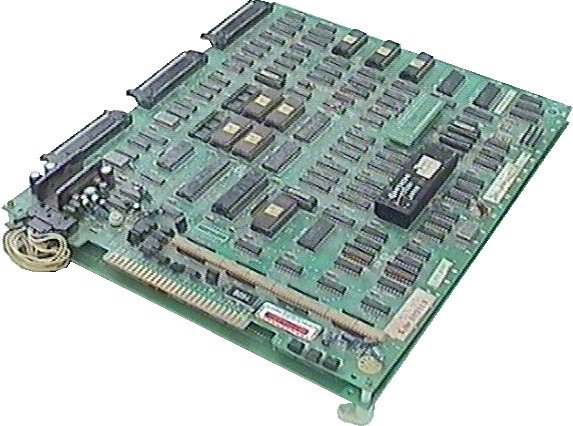
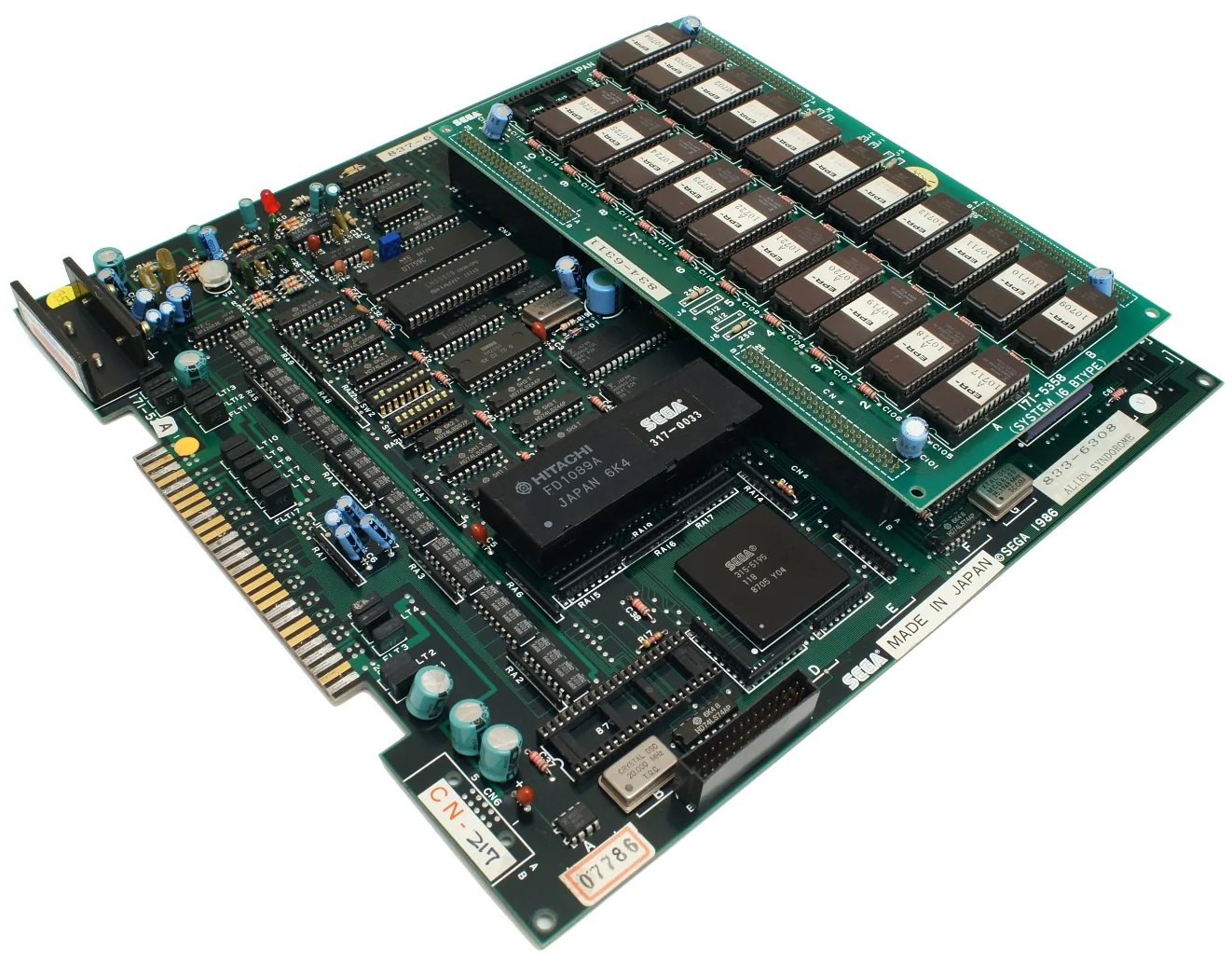
Identification
| Field | Value |
|---|---|
| Manufacturer | Sega |
| Year | 1985 (→ ~1990) |
| System / family | System 16 (16A, 16B) |
| Connector type | JAMMA |
| Players | 2 |
| Screen orientation | Horizontal |
| CPU | Motorola 68000 @ 10 MHz |
Architecture
| Block | Chip | Clock | Role |
|---|---|---|---|
| Main CPU | Motorola 68000 | ~10 MHz | often encrypted: FD1094 (68000 core + battery-backed SRAM key) or FD1089 |
| Sound CPU | Zilog Z80 | ~4 MHz | |
| Sound | Yamaha YM2151 (FM) + NEC µPD7759 (ADPCM samples) | ||
| Video | Sega customs (tilemaps + sprites) | 320×224, multi-plane scrolling |
FD1094 = 'suicide' risk
The FD1094 is a 68000 whose program is decrypted on the fly with a key stored in battery-backed SRAM. Dead battery = key lost = silent board. Most games' keys have been extracted/dumped by the community (recoverable), but you must reprogram the module. See also CPS-2 (same preservation logic).
Notable games: Shinobi (1987), Altered Beast (1988), Golden Axe (1989), Fantasy Zone, Alien Syndrome…
System 16A vs 16B
Two hardware revisions (and sub-variants). The 16B is the most common; the layout, customs and ROM format differ.
Encryption & "suicide"
Sega protected many games with an encrypted 68000:
- FD1094: encrypted 68000 whose key is in battery-backed SRAM. When the battery dies → key lost → dead game ("suicide"). It's Sega's suicide equivalent, earlier than the CPS-2. (Also used on System 18, X/Y-board, System 24.)
- FD1089 (A/B): encrypted 68000 with a fixed key (in the chip) → no battery, no suicide.
- Some games use an unencrypted 68000 (no issue).
Decryption & restoration (FD1094)
The FD1094 key (~8 KB) lives in the module's SRAM, on battery. The MAME team (Nicola Salmoria, Charles MacDonald…) extracted and archived most games' keys → several preservation routes:
- Extract the key from a living board (before the battery dies) and archive it — that's how the community saved most games.
- Re-inject an archived key into an FD1094 module (or a programmable substitute) to revive a suicided board.
- Decrypted ROMs + bare 68000: convert the board to run without the FD1094 (bypass), with the already-decrypted ROMs.
FD1089 games (fixed key) and unencrypted games don't have this problem.
→ Full FD1094/FD1089 guide: de-suicide, Arduino re-key, conversion
Common faults
| Symptom | Likely cause | Lead |
|---|---|---|
| Dead FD1094 game | Flat battery (suicide) | Restore the key / decrypted ROMs; replace the battery |
| Shaky / unstable image | Capacitors | Recap |
| Corrupted graphics / sprites | Customs, ROMs, contacts | Reseat, cleaning |
| No sound | Z80 / YM2151 | Sound-stage diagnosis |
| No image | Power, customs, JAMMA contacts | Base diagnosis |
Recap
Few electrolytic capacitors on these boards (sound/video stage) — targeted recap if the image is shaky / sound degraded / a cap leaks. The real issue remains the FD1094 battery (suicide). Kits: Console5 (arcade PCB).
Repair & conversion: ROM board, EPROM per socket
- 4 System 16B ROM board types (171-5358 / 5521 / 5704 / 5797): a game is tied to its board type. Converting = swap the ROM board + protection chip.
- Size → EPROM: 32 KB → 27C256 · 64 KB → 27C512 · 128 KB → 27C010 · 256 KB → 27C020. Program sockets A1-A8 (or IC1/IC2 on 171-5797).
- Full game-by-game table (board + sockets + protection) and 317-xxxx keys: → EPROM / ROM board / de-suicide guide · Per-game key table
Conversions & mods
- Decrypted ROMs (FD1094): free you from the battery.
- Native RGB via JAMMA.
- ⚠️ Do not host ROMs — method only.
Modernisation & mods
The common ground for every JAMMA board
Video, power, control panel and upscalers depend on the cabinet rather than the board: everything is centralised in Modernising a cabinet. To run the board outside a cabinet (at home, on a display): supergun.
- Anti-suicide 🟠: some games/variants of this platform do suicide (battery-backed key) — see the dedicated section above to find out whether yours is affected. If so, the durable route is de-suiciding → conversions and de-suiciding, not merely replacing the battery → save batteries.
- Storage 🟡: the game lives in EPROM/mask ROM on the board. Changing or restoring a game means reprogramming the EPROMs (and, for a mask ROM, using a pinout adapter) → EPROM method.
- Media preservation: replacing the original storage, multicarts, ODEs and modern options by family → PCB preservation hub.
- Scan rate 📺: ~15.7 kHz / 60.0 Hz — standard resolution, a classic 15 kHz chassis is fine — the most common JAMMA case → tri-sync and upscalers.
(Computed from the MAME sources —
sega/segas16a.cpp + segas16b.cpp— pixel clock ÷ htotal.) - FPGA / emulation: see the Emulation & FPGA section below.
Repair (technician)
- FD1094 / FD1089 = key in battery-backed SRAM: flat battery = suicide (dead game, healthy board, not a hardware fault). Replace the battery without cutting the key (piggyback); otherwise de-suicide — backup batteries.
- Sega customs (tilemaps/sprites): corrupt = video RAM + buffers first, the custom next. Sound: Z80 + YM2151 + µPD7759.
→ Methods: PCB fault-finding · Recap · EPROM · Traces & vias
Expected clocks — measurement table ✅
Values extracted from the MAME sources for this platform. On a scope or frequency counter, a clock that is missing or off-value points straight at the crystal, the divider or the chip at fault — the fastest starting point on a dead board.
| Component | Expected clock | Role |
|---|---|---|
| I8751 | 8 MHz | protection MCU |
| M68000 | 10 MHz | main CPU |
| YM2151 | 4 MHz | FM (sound) |
| Z80 | 4 MHz · 5 MHz | sound CPU (usually) |
How to read this table
Several values for one component = several board variants in this family (or several instances of the chip clocked differently). These frequencies are those of the clock signal at the component's input, not of its original crystal — on many boards the clock is divided down from a single master crystal.
DIP settings ✅
39 games on this platform, settings extracted from the MAME sources (INPUT_PORTS_START blocks). The Position column gives the switch's physical reference on the board (SW2:!3,!4 = bank SW2, levers 3 and 4) — which is what lets you set it up without the paper manual. Games are sorted by MAME set name.
DIP settings — MAME set altbeast
| Setting | Position | Options (default in bold) |
|---|---|---|
| Credits Needed | SW2:1 | 1 Credit To Start · 2 Credit To Start |
| Demo Sounds | SW2:2 | Off · On |
| Lives | SW2:3,4 | 2 · 3 · 4 · Free Play |
| Player Meter | SW2:5,6 | 2 · 3 · 4 · 5 |
| Difficulty | SW2:7,8 | Easy · Normal · Hard · Hardest |
DIP settings — MAME set atomicp
| Setting | Position | Options (default in bold) |
|---|---|---|
| Coin B | SW1:1,2,3 | 4C 1C · 3C 1C · 2C 1C · 1C 1C · 1C 2C · 1C 3C · 1C 4C · 1C 5C |
| Coin A | SW1:4,5,6 | 4C 1C · 3C 1C · 2C 1C · 1C 1C · 1C 2C · 1C 3C · 1C 4C · 1C 5C |
| Lives | SW1:7,8 | 1 · 2 · 3 · 5 |
| Difficulty | SW2:1,2 | Easy · Normal · Hard · Hardest |
| Level Select | SW2:3 | Off · On |
| Flip Screen | SW2:4 | Off · On |
| Demo Sounds | SW2:5 | Off · On |
| Allow Continue | SW2:6 | No · Yes |
| Game Mode | SW2:7 | Normal Tetris · Atomic Point |
DIP settings — MAME set aurail
| Setting | Position | Options (default in bold) |
|---|---|---|
| Cabinet | SW2:1 | Upright · Cocktail |
| Demo Sounds | SW2:2 | Off · On |
| Lives | SW2:3,4 | 2 · 3 · 4 · 5 |
| Bonus Life | SW2:5 | 80K/200K/500K/1000K · 100K/300K/700K/1000K |
| Difficulty | SW2:6 | Normal · Hard |
| Controller | SW2:7 | 1 Player Side · 2 Players Side |
| Special Function Mode | SW2:8 | Off · On |
DIP settings — MAME set bayroute
| Setting | Position | Options (default in bold) |
|---|---|---|
| Allow Continue | SW2:1 | Off · On |
| Demo Sounds | SW2:2 | Off · On |
| Lives | SW2:3,4 | 1 · 3 · 5 · Free Play |
| Bonus Life | SW2:5,6 | 100k · 150k · 200k · None |
| Difficulty | SW2:7,8 | Easy · Normal · Hard · Hardest |
DIP settings — MAME set bullet
| Setting | Position | Options (default in bold) |
|---|---|---|
| Players | SW2:1 | 2 · 3 |
| Demo Sounds | SW2:2 | Off · On |
| Lives | SW2:3,4 | 2 · 3 · 4 · 5 |
DIP settings — MAME set cencourt
| Setting | Position | Options (default in bold) |
|---|---|---|
| Debug Display | SW2:1 | Off · On |
DIP settings — MAME set cotton
| Setting | Position | Options (default in bold) |
|---|---|---|
| Demo Sounds | SW2:1 | Off · On |
| Lives | SW2:2,3 | 2 · 3 · 4 · 5 |
| Difficulty | SW2:4,5 | Easy · Normal · Hard · Hardest |
DIP settings — MAME set dddoor
| Setting | Position | Options (default in bold) |
|---|---|---|
| Advertising Interval | SW2:1,2 | 30 Seconds · 1 Minute · 3 Minutes · 5 Minutes |
| Coinage | SW1:1,2,3,4 | 4C 1C · 3C 1C · 2C 1C · 1C 1C · 1C 1C · 1C 1C · 1C 1C · 1C 1C · 1C 1C · 1C 1C … |
| Large Prize Discharge Rate | SW1:6,7,8 | 14% · 16% · 18% · 20% · 22% · 24% · 26% · 50% |
DIP settings — MAME set ddux
| Setting | Position | Options (default in bold) |
|---|---|---|
| Demo Sounds | SW2:1 | Off · On |
| Difficulty | SW2:2,3 | Easy · Normal · Hard · Hardest |
| Lives | SW2:4,5 | 2 · 3 · 4 · 5 |
| Bonus Life | SW2:6,7 | 150k · 200k · 300k · 400k |
DIP settings — MAME set dfjail
| Setting | Position | Options (default in bold) |
|---|---|---|
| Coinage | SW1:1,2,3,4 | 8C 1C · 7C 1C · 6C 1C · 5C 1C · 4C 1C · 3C 1C · 2C 1C · 1C 1C · 1C 2C · 1C 3C … |
| Lives | SW1:5,6,7 | 1 · 2 · 3 · 4 · 5 · 6 · 7 · 8 |
| Difficulty | SW2:1,2 | Easy · Normal · Hard · Hardest |
| Demo Sounds | SW2:3 | Off · On |
| Flip Screen | SW2:4 | Off · On |
DIP settings — MAME set dunkshot
| Setting | Position | Options (default in bold) |
|---|---|---|
| Winner Advances | SW2:1 | Off · On |
| Demo Sounds | SW2:2 | Off · On |
| VS Time | SW2:3,4 | 2P 1:30/ 3P 2:00/ 4P 2:30 · 2P 2:00/ 3P 2:30/ 4P 3:00 · 2P 2:30/ 3P 3:00/ 4P 3:30 · 2P 3:00/ 3P 3:30/ 4P 4:00 |
| Difficulty | SW2:5,6 | Easy · Normal · Hard · Hardest |
| CPU Starts With +6 Pts. | SW2:7 | Off · On |
| Allow Continue | SW2:8 | Off · On |
DIP settings — MAME set eswat
| Setting | Position | Options (default in bold) |
|---|---|---|
| Credits To Start | SW2:1 | 1 Credit · 2 Credits |
| Demo Sounds | SW2:2 | Off · On |
| Flip Screen | SW2:3 | Off · On |
| Timer | SW2:4 | Normal · Hard |
| Difficulty | SW2:5,6 | Easy · Normal · Hard · Hardest |
| Lives | SW2:7,8 | 1 · 2 · 3 · 4 |
DIP settings — MAME set exctleag
| Setting | Position | Options (default in bold) |
|---|---|---|
| Demo Sounds | SW2:1 | Off · On |
| Starting Points | SW2:2,3,4 | 2000 · 3000 · 4000 · 5000 · 6000 · 7000 · 8000 · 9000 |
| Difficulty | SW2:5,6 | Easy · Normal · Hard · Hardest |
| Point Table | SW2:7,8 | Easy · Normal · Hard · Hardest |
DIP settings — MAME set fantzoneta
| Setting | Position | Options (default in bold) |
|---|---|---|
| Cabinet | SW2:1 | Upright · Cocktail |
| Demo Sounds | SW2:2 | Off · On |
| Lives | SW2:3,4 | 2 · 3 · 4 · 240 (Cheat) |
| Extra Ship Cost | SW2:5,6 | 5000 · 10000 · 15000 · 20000 |
| Difficulty | SW2:7,8 | Easy · Normal · Hard · Hardest |
DIP settings — MAME set fpoint
| Setting | Position | Options (default in bold) |
|---|---|---|
| Demo Sounds | SW2:2 | Off · On |
| Difficulty | SW2:5,6 | Easy · Normal · Hard · Hardest |
| Clear Round Allowed | SW2:7 | 1 · 2 |
| 2 Cell Move | SW2:8 | No · Yes |
DIP settings — MAME set fpointbl
| Setting | Position | Options (default in bold) |
|---|---|---|
| Demo Sounds | SW2:2 | Off · On |
| Difficulty | SW2:5,6 | Easy · Normal · Hard · Hardest |
| Clear Round Allowed | SW2:7 | 1 · 2 |
| 2 Cell Move | SW2:8 | No · Yes |
| Coin A | SW1:1,2,3,4 | 4C 1C · 3C 1C · 2C 1C · 2 Coins/1 Credit 5/3 6/4 · 2 Coins/1 Credit 4/3 · 1C 1C · 1 Coin/1 Credit 2/3 · 1 Coin/1 Credit 4/5 · 1 Coin/1 Credit 5/6 · 2C 3C … |
| Coin B | SW1:5,6,7,8 | 4C 1C · 3C 1C · 2C 1C · 2 Coins/1 Credit 5/3 6/4 · 2 Coins/1 Credit 4/3 · 1C 1C · 1 Coin/1 Credit 2/3 · 1 Coin/1 Credit 4/5 · 1 Coin/1 Credit 5/6 · 2C 3C … |
DIP settings — MAME set fz2
| Setting | Position | Options (default in bold) |
|---|---|---|
| Lives | SW2:3,4 | 2 · 3 · 4 · 240 (Cheat) |
| Difficulty | SW2:7,8 | Easy · Normal · Hard · Hardest |
DIP settings — MAME set goldnaxe
| Setting | Position | Options (default in bold) |
|---|---|---|
| Credits Needed | SW2:1 | 1 Credit To Start · 2 Credits To Start |
| Demo Sounds | SW2:2 | Off · On |
| Difficulty | SW2:3,4,5,6 | Special · Easiest · Easier · Easy · Normal · Hard · Harder · Hardest |
DIP settings — MAME set hwchamp
| Setting | Position | Options (default in bold) |
|---|---|---|
| Demo Sounds | SW2:2 | Off · On |
| Start Level Select | SW2:3 | Off · On |
| Allow Continue | SW2:4 | No · Yes |
| Difficulty | SW2:5,6 | Easy · Normal · Hard · Hardest |
| Time Adjust | SW2:7,8 | Easy · Normal · Hard · Hardest |
DIP settings — MAME set lockonph
| Setting | Position | Options (default in bold) |
|---|---|---|
| Coin A | SW0:1,2,3 | 4C 1C · 3C 1C · 2C 1C · 1C 1C · 1C 2C · 1C 3C · 1C 4C · 1C 5C |
| Coin B | SW0:4,5,6 | 4C 1C · 3C 1C · 2C 1C · 1C 1C · 1C 2C · 1C 3C · 1C 4C · 1C 5C |
| Flip Screen | SW0:8 | Off · On |
| Difficulty | SW1:1,2,3 | 0 · 1 · 2 · 3 · 4 · 5 · 6 · 7 |
| Allow Continue | SW1:4 | No · Yes |
| Region | SW1:5 | Korea · Europe |
DIP settings — MAME set mvp
| Setting | Position | Options (default in bold) |
|---|---|---|
| Credits To Start | SW2:1 | 1 Credit · 2 Credits |
| Demo Sounds | SW2:2 | Off · On |
| Innings | SW2:3 | 1 Credit 1 Inning · 2 Credits 3 Innings |
| Time Limits | SW2:4,5,6 | 1 Normal · 2 · 3 · 4 · 5 · 6 · 7 · 8 Hardest |
| Difficulty | SW2:7,8 | Easy · Hard · Normal · Hardest |
DIP settings — MAME set passsht
| Setting | Position | Options (default in bold) |
|---|---|---|
| Demo Sounds | SW2:1 | Off · On |
| Initial Point | SW2:2,3,4 | 2000 · 3000 · 4000 · 5000 · 6000 · 7000 · 8000 · 9000 |
| Point Table | SW2:5,6 | Easy · Normal · Hard · Hardest |
| Difficulty | SW2:7,8 | Easy · Normal · Hard · Hardest |
DIP settings — MAME set passshtj
| Setting | Position | Options (default in bold) |
|---|---|---|
| Demo Sounds | SW2:1 | Off · On |
| Initial Point | SW2:2,3,4 | 2000 · 3000 · 4000 · 5000 · 6000 · 7000 · 8000 · 9000 |
| Point Table | SW2:5,6 | Easy · Normal · Hard · Hardest |
| Difficulty | SW2:7,8 | Easy · Normal · Hard · Hardest |
DIP settings — MAME set riotcity
| Setting | Position | Options (default in bold) |
|---|---|---|
| 2 Credits to Start | SW2:1 | Off · On |
| Demo Sounds | SW2:2 | Off · On |
| Lives | SW2:3,4 | 1 · 2 · 3 · 4 |
| Bonus Life | SW2:5,6 | Easy · Normal · Hard · Hardest |
| Difficulty | SW2:7 | Normal · Hard |
| Attack Button to Start | SW2:8 | Off · On |
DIP settings — MAME set ryukyu
| Setting | Position | Options (default in bold) |
|---|---|---|
| Demo Sounds | SW2:1 | Off · On |
| Cancel per Credit | SW2:2 | 2 · 3 |
| Timer Speed | SW2:3 | 20 seconds · 30 seconds |
| PCM Voice | SW2:4 | Off · On |
| Omikuji Difficulty | SW2:5,6 | Easy · Normal · Hard · Hardest |
| Difficulty | SW2:7,8 | Easy · Normal · Hard · Hardest |
DIP settings — MAME set sdi
| Setting | Position | Options (default in bold) |
|---|---|---|
| Allow Continue | SW2:1 | Off · On |
| Demo Sounds | SW2:2 | Off · On |
| Lives | SW2:3,4 | 2 · 3 · 4 · Free |
| Difficulty | SW2:5,6 | Easy · Normal · Hard · Hardest |
| Bonus Life | SW2:7,8 | Every 50000 · 50000 · 100000 · None |
DIP settings — MAME set shinobi
| Setting | Position | Options (default in bold) |
|---|---|---|
| Cabinet | SW2:1 | Upright · Cocktail |
| Demo Sounds | SW2:2 | Off · On |
| Lives | SW2:3,4 | 2 · 3 · 5 · Free Play |
| Difficulty | SW2:5,6 | Easy · Normal · Hard · Hardest |
| Enemy's Bullet Speed | SW2:7 | Slow · Fast |
| Language | SW2:8 | Japanese · English |
DIP settings — MAME set sjryuko
| Setting | Position | Options (default in bold) |
|---|---|---|
| Coin A | SW1:1,2,3,4 | 4C 1C · 3C 1C · 2C 1C · 1C 1C · 1 Coin/1 Credit · 2C 3C · 1C 2C · 1C 3C · 1C 4C · 1C 5C … |
| Coin B | SW1:5,6,7,8 | 4C 1C · 3C 1C · 2C 1C · 1C 1C · 1 Coin/1 Credit · 2C 3C · 1C 2C · 1C 3C · 1C 4C · 1C 5C … |
| CPU Level | SW2:1,2 | Weak · Medium Weak · Medium Strong · Strong |
| Demo Sounds | SW2:3 | Off · On |
DIP settings — MAME set snapper
| Setting | Position | Options (default in bold) |
|---|---|---|
| Coin B | SW0:1,2,3 | 4C 1C · 3C 1C · 2C 1C · 1C 1C · 1C 2C · 1C 3C · 1C 4C · 1C 5C |
| Coin A | SW0:4,5,6 | 4C 1C · 3C 1C · 2C 1C · 1C 1C · 1C 2C · 1C 3C · 1C 4C · 1C 5C |
| Lives | SW0:7,8 | 1 · 2 · 3 · 5 |
| Demo Sounds | SW1:5 | Off · On |
DIP settings — MAME set sonicbom
| Setting | Position | Options (default in bold) |
|---|---|---|
| Difficulty | SW2:1,2,3 | Easy · Normal · Hard 1 · Hard 2 · Hard 3 · Hard 4 · Hard 5 · Hardest |
| Lives | SW2:4,5 | 2 · 3 · 4 · 5 |
| Bonus Life | SW2:6,7 | 30k · 40k · 50k · 80k |
| Cabinet | SW2:8 | Upright · Cocktail |
DIP settings — MAME set tetris
| Setting | Position | Options (default in bold) |
|---|---|---|
| Demo Sounds | SW2:2 | Off · On |
| Difficulty | SW2:5,6 | Easy · Normal · Hard · Hardest |
DIP settings — MAME set timescan
| Setting | Position | Options (default in bold) |
|---|---|---|
| Flip Screen | SWE:1 | Off · On |
| Out Lane Pin | SWE:2 | Near · Far |
| Special | SWE:3,4 | 3 Credits · 2 Credits · 1 Credit · 2000000 Points |
| Allow Continue | SWE:5 | No · Yes |
| Cabinet | SW2:1 | Upright · Cocktail |
| Extended Score | SW2:2,3,4,5 | Credit 1000000/2000000 · Credit 1200000/2500000 · Credit 1500000/3000000 · Credit 2000000/4000000 · Credit 1000000 · Credit 1200000 · Credit 1500000 · Credit 1800000 · Ball 100000 · Ball 200000 … |
| Number Match | SW2:6 | No · Yes |
| Pin Rebound | SW2:7 | Well · A Little |
| Lives | SW2:8 | 3 · 5 |
DIP settings — MAME set toryumon
| Setting | Position | Options (default in bold) |
|---|---|---|
| Demo Sounds | SW2:1 | Off · On |
| VS Play Mode | SW2:5 | 1 Set · 3 Set |
| Difficulty | SW2:6,7,8 | Easy · Normal · Hard · Hard+1 · Hard+2 · Hard+3 · Hard+4 · Hard+5 |
DIP settings — MAME set tturf
| Setting | Position | Options (default in bold) |
|---|---|---|
| Continues | SW2:1,2 | None · 3 · Unlimited · Unlimited |
| Difficulty | SW2:3,4 | Easy · Normal · Hard · Hardest |
| Starting Energy | SW2:5,6 | 3 · 4 · 6 · 8 |
| Demo Sounds | SW2:7 | Off · On |
| Bonus Energy | SW2:8 | 1 · 2 |
DIP settings — MAME set ultracin
| Setting | Position | Options (default in bold) |
|---|---|---|
| Advertise Sound Interval | SW2:1,2 | Off · No Interval · 4 Cycle · 2 Cycle |
| Advertise Coin Indication | SW2:3 | Coin · 100 - 400 Yen |
| Game Time | SW2:4 | Short · Normal |
| Difficulty | SW2:5,6 | Easy · Normal · Hard · Hardest |
DIP settings — MAME set wb3
| Setting | Position | Options (default in bold) |
|---|---|---|
| Demo Sounds | SW2:2 | Off · On |
| Lives | SW2:3,4 | 2 · 3 · 4 · 5 |
| Bonus Life | SW2:5 | 50k/100k/180k/300k · 50k/150k/300k |
| Difficulty | SW2:6 | Normal · Hard |
| Test Mode | SW2:7 | No · Yes |
DIP settings — MAME set wfishing
| Setting | Position | Options (default in bold) |
|---|---|---|
| Coinage | SW1:1,2,3,4 | 4C 1C · 3C 1C · 2C 1C · 1C 1C · Free Play · 1C 1C · 1C 1C · 1C 1C · 1C 1C · 1C 1C … |
| Demo Sounds | SW2:1 | On · Off |
| Advertise Coin Indication | SW2:3 | 100-400 Yen · Coin |
DIP settings — MAME set wrestwar
| Setting | Position | Options (default in bold) |
|---|---|---|
| Demo Sounds | SW2:2 | Off · On |
| Round Time | SW2:3,4 | 100 · 110 · 120 · 130 |
| Allow Continue | SW2:6 | No · Yes |
| Difficulty | SW2:7,8 | Easy · Normal · Hard · Hardest |
DIP settings — MAME set wwthomas
| Setting | Position | Options (default in bold) |
|---|---|---|
| Coinage | SW1:1,2,3,4 | 4C 1C · 3C 1C · 2C 1C · 2C 1C · 2C 1C · 2C 1C · 2C 1C · 2C 1C · 2C 1C · 2C 1C … |
| Advertise Sound Interval | SW2:1,2 | Off · No Interval · 4 Cycle · 2 Cycle |
| Advertise Coin Indication | SW2:3 | Coin · 100 - 400 Yen |
| Card Holding Time | SW2:4 | Normal · Long |
Check against your own board
These settings apply to the game and revision described by MAME. One title may have several DIP sets depending on region or revision, and some systems use soft-dips (settings in memory, via the test menu) rather than physical switches. In case of a discrepancy, the board's silkscreen and the test menu are authoritative.
See also: DIP reference · game manuals
Procedure — a dead board, step by step ✅
What this adds
The general method lives in PCB diagnosis. This is its application to this platform: the same order, but with the values actually expected here, so you do not have to go back and forth.
Tools: multimeter, oscilloscope (or frequency counter), current-limited bench supply, desoldering braid. → Tooling
If the board is still in a cabinet
A CRT holds its charge with the machine unplugged. → CRT safety
1. Inspection, power off. Corrosion, cut tracks, oxidised EPROM legs, leaking SMD capacitors, dubious earlier repairs. On this platform the battery is the first suspect: its leakage eats tracks under the holder, and the damage is often hidden by the battery itself. Lift it to look.
2. The connector, before anything else. A large share of "dead boards" are a contact problem, not a fault. Clean the contacts with isopropyl alcohol and reseat — not with an abrasive eraser on a gold edge, which takes the plating off and brings the problem back worse. It costs two minutes and settles the question.
3. Power, measured on the board. Aim for +5.0 V measured as close as possible to where power reaches the board — not at the PSU output: the drop is in the loom, and that is exactly what makes a board boot on the bench and not in the cabinet. Where you probe depends on this board's connector — JAMMA edge, JVS loom or a proprietary harness — plenty of makers kept one long after JAMMA arrived — see Identification above. → Wiring Check −5 V and +12 V too if the sound stage uses them. Suspected short: bring it up current-limited and find the hot spot.
4. /RESET. It must release after power-up. Held low = the CPU never starts. A 1–2 Hz loop is not the reset circuit, it is the watchdog: the CPU is crashing at boot, so look at the bus, not at the reset.
5. Clocks — the values expected on this platform.
- I8751 → 8 MHz (Protection MCU)
- M68000 → 10 MHz (Main CPU)
- YM2151 → 4 MHz (FM (sound))
- Z80 → 4 MHz · 5 MHz (Sound CPU (usually))
No clock on the M68000 (10 MHz) and there is no point measuring anything else: the fault is the crystal, the divider, or the chip itself. That single measurement splits a dead board in two.
Several values for one component means several board variants in this family, not several readings on the same one: identify yours before calling a clock wrong. That is the mistake that replaces a healthy crystal.
6. Bus. Activity on the main CPU's address lines tells you whether it is running or frozen. Frozen with good clocks and good reset → work RAM, bus buffers, ROMs.
7. It boots but the picture or the sound is wrong — that is another job: see Common faults on this page, then signal tracing.
Procedure — replacing the battery without losing the key ✅
Not every board in this family is concerned
Check on this page whether your game is one of the encrypted ones before touching anything. On the others the battery only holds settings, and losing it costs nothing but a re-setup.
The order is the whole procedure
The decryption key of the FD1094 lives in SRAM held up by that battery. Cutting the old cell before the new one is soldered erases it, instantly and for good: the board goes silent and only a de-suicide brings the game back. So the new cell goes in first, in parallel.
- Board powered off, old battery left in place.
- Measure the old cell in circuit and note it (a CR2032 is 3 V nominal). This is what tells you whether you are ahead of the failure or already behind it.
- Solder the new cell in parallel with the old one — piggyback — watching polarity. A reversed cell discharges the old one through itself and erases the key just as surely.
- Re-measure at the holder: the voltage must have come back up. Do not go on before it has.
- Only now, remove the old cell.
- Power up and check the game boots.
Already dead? This procedure will not bring it back — the key is gone. → de-suicide
Emulation & FPGA
- MAME: System 16A/B emulated, including FD1094/FD1089 decryption via extracted keys.
- FPGA / MiSTer: the jts16 core (Jotego) — System 16A/B in rebuilt logic (unencrypted games and titles whose FD1094 key is known).
Photos / assets
(To add: 16B board, FD1094 module + battery, customs.)
Sources & attribution
- Wikipedia — Sega System 16 (base specs, games, versions) — CC-BY-SA — https://en.wikipedia.org/wiki/Sega_System_16
- System16.com — Sega System 16 Hardware — to reference — https://www.system16.com/hardware.php?id=696
- MAME — FD1094/FD1089 decryption — to reference
Image:
-
system16b-carte.jpg— uploaded by Black Squirrel to Sega Retro (site CC BY 4.0; ⚠️ the file carries no individual licence) — https://segaretro.org/File:System16b_motherboard.png -
system16a-carte.jpg— uploaded by Mikel to Sega Retro (site CC BY 4.0; ⚠️ the file carries no individual licence) — https://segaretro.org/File:System16a_motherboard.jpg


Review & corrections
How this space is used
Spotted a wrong value, an outdated procedure, a chip reference that does not match your board? Say so here, with what you observed (model, board revision, serial number, measurement). Every report is cross-checked against a source before anything changes — an unverifiable correction is published as “reported by …, not cross-checked” rather than silently applied.
Reading is open to everyone; posting requires signing in with Discord. Reports from the wiki's declared reviewers are handled first; anyone else's are read too, but go through a human before anything is changed.