Mattel Intellivision
The console that took on the Atari 2600 (1979). And technically it had the means: where everyone else was 8-bit, Mattel fitted a 16-bit processor — clocked, however, at under one megahertz.
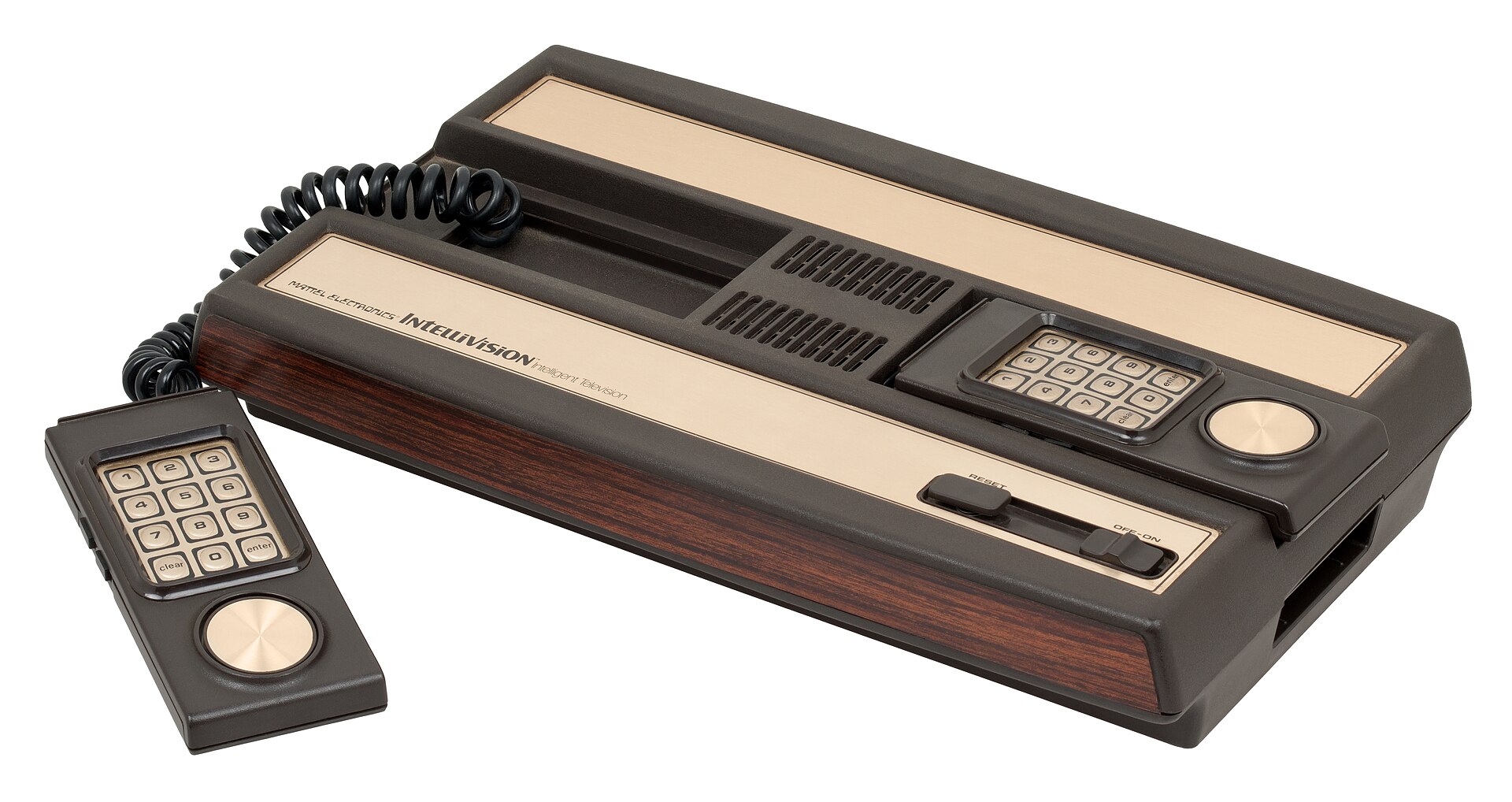
The Intellivision and its disc controllers. Photo by Evan-Amos (Vanamo Media), CC BY-SA 3.0.
Identification
| Field | Value |
|---|---|
| Manufacturer | Mattel Electronics (USA) |
| Years | 1979-1983 |
| CPU | General Instrument CP1610 @ ~895 kHz — 16-bit, colorburst ÷ 4 |
| Video | STIC (Standard Television Interface Chip) @ 3.579545 MHz |
| Sound | AY-3-8914 @ ~1.79 MHz (colorburst ÷ 2) |
| Speech (option) | SP0256 @ 3.12 MHz — Intellivoice module |
| Master crystal | 3.579545 MHz — the NTSC colorburst |
| Media | cartridge |
A 16-bit machine in 1979 — but a slow one
General Instrument's CP1610 is a genuine 16-bit processor, released when the competition was 8-bit. The trade-off: it runs at about 895 kHz, the NTSC colorburst divided by 4.
In other words: do not expect a round megahertz. Measuring ~0.9 MHz on an Intellivision's CPU is the normal value.
Expected clocks — measurement table ✅
| Component | Expected clock | Role |
|---|---|---|
| CP1610 | ~894.9 kHz | 16-bit CPU (3.579545 ÷ 4) |
| STIC | 3.579545 MHz | video |
| AY-3-8914 | ~1.79 MHz | sound (3.579545 ÷ 2) |
| SP0256 | 3.12 MHz | speech — Intellivoice module only |
Everything derives from the colorburst
The CPU, the STIC and the sound generator all come from the same 3.579545 MHz. A general clock failure therefore has one possible cause — while the speech module's SP0256 has its own crystal at 3.12 MHz.
The models
| Model | Year | Notes |
|---|---|---|
| Intellivision | 1979 | the original |
| Intellivision (Sears) | 1981 | Sears-branded version |
| Keyboard Component | 1981 | ⚠️ see below |
| Intellivision II | 1982 | redesigned case |
| Intellivoice | 1982 | speech synthesis module |
| Entertainment Computer System (ECS) | 1983 | computer expansion |
The Keyboard Component is a machine inside the machine
The Keyboard Component is not a mere keyboard: it carries its own processor — an M6502 — and a TMS9927 display controller, clocked from a separate 7.15909 MHz crystal.
In repair it is therefore a second complete system to diagnose on its own terms, with its own clocks.
The Intellivoice, and its quirk
The Intellivoice module adds an SP0256 — General Instrument's speech synthesiser.
An unusual operation, recorded by reverse-engineering
MAME's notes report that the module holds 64 ten-bit words which it simply serialises to the SP0256, and that the SP0256-012 blindly jumps to a fixed address when certain samples are played.
That is not a defect: it is how the chip is used. Odd speech behaviour therefore does not necessarily accuse the module.
Common faults
| Symptom | Probable cause | Next step |
|---|---|---|
| Nothing starts | 3.579545 MHz crystal | CPU, STIC and sound derive from it together |
| CPU “too slow” | nothing — ~895 kHz is the normal value | See the box |
| No picture, sound fine | STIC | Custom chip with no replacement |
| No sound | AY-3-8914 | An AY-3-8910 variant, harder to source |
| No speech | Intellivoice module or its 3.12 MHz crystal | A crystal separate from the console's |
| Cartridge not read | connector contacts | Isopropyl alcohol, never an abrasive |
| Keyboard Component silent | its M6502 or its 7.15909 MHz crystal | A second system in its own right |
Procedure — a dead console, step by step ✅
What this adds
Ordered for a console, not for an arcade board: what kills these is almost never the CPU. It is, in real order, the power supply, the capacitors, the drive or the cartridge slot, and only then the logic. → PCB diagnosis
1. The power supply. Two cases, depending on the machine. External brick: ⚠️ read the marking on the machine, next to the socket, and check the adapter against it — voltage and polarity. A centre-negative machine fed centre-positive loses its fuse, sometimes its regulator; do not trust a third-party label or a generic tip. Internal supply (the machine plugs straight into the wall): mains is inside the shell. Unplug, wait, and confirm the large capacitors are discharged before touching the board. Either way, measure under load: a failing supply holds its voltage until it is asked for current.
2. The fuse. Many of these machines have one right behind the socket — it is the part designed to die. Test it in continuity, out of circuit. A fuse that blows again is a short, not a fuse problem.
3. Capacitors. On most machines of this age this is the default suspect rather than a last resort — leaking SMD electrolytics eat the tracks underneath before they give any other sign. ⚠️ Not all of them are like that: some carry very few and are not recapped on principle. Read what this page says about it before reaching for the iron. → Recap
4. The cartridge connector. Cartridge contacts with isopropyl alcohol, never an abrasive eraser: it takes the gold plating off and the problem comes back worse. On the machine side, inspect the slot pins — splayed, bent or oxidised — and check continuity between slot and board.
5. Video output. Isolate the machine from the display: another cable, another TV, another input. A sizeable share of "dead consoles" are a dead cable, or a display that will not lock onto what this machine outputs — see the video section of this page for what that is.
6. Still nothing. Now, and only now, the logic: rails on the board, reset, clock, bus. → PCB diagnosis
Repair (technician)
- One crystal for the console. A general failure has one cause — except on the modules, which have their own.
- The CP1610 has no common replacement: it is an uncommon General Instrument processor, unlike the competition's 6502.
- The AY-3-8914 is not an AY-3-8910: it is a variant, and substitution is not direct.
- Diagnose the modules separately: Intellivoice and Keyboard Component each have their own clock.
→ Methods: PCB diagnosis · Recap
Modernisation & mods
- No battery, no suicide.
- Video output: RF as standard — composite/RGB mods exist in the community. → RGB & SCART
- ⚠️ Do not host ROMs — method only.
Photos / assets
(To take: the main board with the CP1610 and the STIC, the Intellivoice module opened with its SP0256, and the Keyboard Component — a rare item — with its 6502.)
Archived technical documentation ✅
Manufacturer documentation archived locally: schematics, block diagrams, expected voltages, parts lists. The reference when a symptom matches no known fault.
Status
Manufacturer documents kept for preservation (machines out of production for decades), with no explicit licence — the same position as for the cabinet manuals already archived here.
Sources & attribution
Text (synthesised here; sources listed for attribution):
- MAME —
src/mame/mattel/intv.cpp(BSD-3-Clause / GPL): the CP1610 at 3.579545 MHz ÷ 4 annotated “Colorburst/4”, the STIC at the full colorburst, the AY8914 at colorburst ÷ 2, the SP0256 at 3,120,000 Hz for the Intellivoice; the Keyboard Component with its M6502 and TMS9927 at 7.15909 MHz ÷ 8; the model list (1979 original, Sears 1981, Keyboard Component 1981, Intellivision II 1982, Intellivoice 1982, ECS 1983); and the reverse-engineering notes on the speech module — 64 ten-bit words serialised to the SP0256, and the SP0256-012 jumping to a fixed address on certain samples — https://github.com/mamedev/mame/blob/master/src/mame/mattel/intv.cpp
Image:
-
intellivision.jpg— Evan-Amos, CC BY-SA 3.0 — https://commons.wikimedia.org/wiki/File%3AIntellivision-Console-Set.jpg

Review & corrections
How this space is used
Spotted a wrong value, an outdated procedure, a chip reference that does not match your board? Say so here, with what you observed (model, board revision, serial number, measurement). Every report is cross-checked against a source before anything changes — an unverifiable correction is published as “reported by …, not cross-checked” rather than silently applied.
Reading is open to everyone; posting requires signing in with Discord. Reports from the wiki's declared reviewers are handled first; anyone else's are read too, but go through a human before anything is changed.