Sega ST-V (Titan Video)
Sega's 2D arcade platform (1994) based on the Saturn architecture: two SH-2, VDP1/VDP2, SCSP sound. Cartridge-based (trivial game swap), in a JAMMA cabinet. Ideal for preservation: cart-based and region-free at the BIOS.
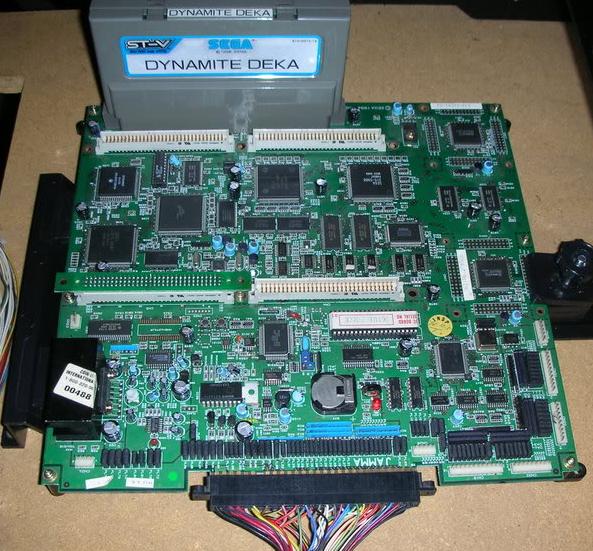
Identification
| Field | Value |
|---|---|
| Manufacturer | Sega |
| Year | 1994 |
| Base | Sega Saturn (arcade) |
| Media | Cartridge |
| I/O | JAMMA |
| Region | set at BIOS / jumpers (easy region-free) |
Architecture (= Saturn)
| Block | Chip | Clock | Role |
|---|---|---|---|
| CPU | 2 × Hitachi SH-2 | 28.6 MHz | same as Saturn |
| Graphics | VDP1 (sprites/polygons) + VDP2 (backgrounds/rotation) | ||
| Sound | Motorola 68EC000 + Yamaha SCSP | 32 voices | |
| Media | cartridge (ROM) | no CD → trivial swap, no laser to maintain |
ST-V = Sega Titan Video: a Saturn in arcade form on cartridge. The hardware being identical, Saturn↔ST-V development was very close — hence many cross-ports (e.g. Radiant Silvergun, Cotton, Guardian Force exist in ST-V arcade and on the home Saturn).
→ See the Sega Saturn (same hardware, home side).
Region & save
- Region set at the BIOS / jumpers: the ST-V is easily region-free (unlike many platforms). Some games still check the region → adapt the BIOS.
- Save: a battery-backed SRAM stores bookkeeping and settings (not the game, which is ROM on the cartridge). No "suicide": a dead battery loses the settings, not the game.
Notable games
Golden Axe: The Duel, Radiant Silvergun (1998), Cotton 2 / Cotton Boomerang, Die Hard Arcade (Dynamite Deka), Puyo Puyo Sun, Guardian Force, Groove on Fight, Astra SuperStars, Baku Baku Animal…
Preservation & emulation
- Cart-based = simple preservation: no laser, trivial swap.
- Emulation: MAME emulates the ST-V (and being a Saturn, the Saturn ecosystem is close); cartridge dumps are well preserved. No dedicated FPGA/MiSTer core (the Saturn core remains experimental).
- Multi-game: flash cartridges (Darksoft & co.) bundle several games. → ST-V multi (Darksoft)
- Targeted recap depending on age; clean the cartridge contacts; replace the battery (settings) if needed.
Common faults
| Symptom | Likely cause | Lead |
|---|---|---|
| Cartridge not read / crash | Oxidised cartridge slot contacts | Clean the cartridge edge + the slot |
| Lost settings / region | Flat battery (RTC/config) | Replace the battery |
| No / noisy sound | SCSP (like the Saturn) | Sound-stage diagnosis |
| No image | Power, VDP1/VDP2, contacts | Base diagnosis (Saturn-like) |
A Saturn base → the Saturn repair ecosystem applies (VDP1/VDP2, SCSP). Cart-based = simple preservation (no laser).
Modernisation & mods
The common ground for every JAMMA board
Video, power, control panel and upscalers depend on the cabinet rather than the board: everything is centralised in Modernising a cabinet. To run the board outside a cabinet (at home, on a display): supergun.
- Battery 🟢: a save battery is fitted (settings/counters/RTC). ⚠️ On this platform, a dead battery does NOT kill the game — it is a leaking battery that corrodes traces. Check and replace it before it leaks → save batteries.
- Storage 🟢: a cartridge system — the modern route is a multi-game cart / flashcart rather than reprogramming, where one exists for the platform → PCB preservation hub.
- Scan rate 📺: the screen configuration lives in the Sega VDP device rather than the driver — not measured here. These VDPs output standard ~15 kHz: a 15 kHz chassis is fine. (Derived from the VDP family documented above, not computed from MAME.) → tri-sync and upscalers.
- FPGA / emulation: see the Emulation & FPGA section below.
Repair (technician)
- Saturn base (2× SH-2, SCSP, VDP1/VDP2): the same fault families as a Saturn (recap, RAM, video customs). Cartridge = trivial swap, no laser to maintain.
- Sound: 68EC000 + SCSP — diagnose the sound stage.
- Capacitors: recap (period electrolytics). Cartridge contacts: clean.
→ Methods: PCB fault-finding · Recap · EPROM · Traces & vias
Expected clocks — measurement table ✅
Values extracted from the MAME sources for this platform. On a scope or frequency counter, a clock that is missing or off-value points straight at the crystal, the divider or the chip at fault — the fastest starting point on a dead board.
| Component | Expected clock | Role |
|---|---|---|
| M68000 | 11.2896 MHz | main CPU |
How to read this table
Several values for one component = several board variants in this family (or several instances of the chip clocked differently). These frequencies are those of the clock signal at the component's input, not of its original crystal — on many boards the clock is divided down from a single master crystal.
DIP settings ✅
1 games on this platform, settings extracted from the MAME sources (INPUT_PORTS_START blocks). The Position column gives the switch's physical reference on the board (SW2:!3,!4 = bank SW2, levers 3 and 4) — which is what lets you set it up without the paper manual. Games are sorted by MAME set name.
DIP settings — MAME set stv
| Setting | Position | Options (default in bold) |
|---|---|---|
| PDR1 | — | Off · On |
| PDR2 | — | Off · On |
Check against your own board
These settings apply to the game and revision described by MAME. One title may have several DIP sets depending on region or revision, and some systems use soft-dips (settings in memory, via the test menu) rather than physical switches. In case of a discrepancy, the board's silkscreen and the test menu are authoritative.
See also: DIP reference · game manuals
Procedure — a dead board, step by step ✅
What this adds
The general method lives in PCB diagnosis. This is its application to this platform: the same order, but with the values actually expected here, so you do not have to go back and forth.
Tools: multimeter, oscilloscope (or frequency counter), current-limited bench supply, desoldering braid. → Tooling
If the board is still in a cabinet
A CRT holds its charge with the machine unplugged. → CRT safety
1. Inspection, power off. Corrosion, cut tracks, oxidised EPROM legs, leaking SMD capacitors, dubious earlier repairs.
2. The connector, before anything else. A large share of "dead boards" are a contact problem, not a fault. Clean the contacts with isopropyl alcohol and reseat — not with an abrasive eraser on a gold edge, which takes the plating off and brings the problem back worse. It costs two minutes and settles the question.
3. Power, measured on the board. Aim for +5.0 V measured as close as possible to where power reaches the board — not at the PSU output: the drop is in the loom, and that is exactly what makes a board boot on the bench and not in the cabinet. Where you probe depends on this board's connector — JAMMA edge, JVS loom or a proprietary harness — plenty of makers kept one long after JAMMA arrived — see Identification above. → Wiring Check −5 V and +12 V too if the sound stage uses them. Suspected short: bring it up current-limited and find the hot spot.
4. /RESET. It must release after power-up. Held low = the CPU never starts. A 1–2 Hz loop is not the reset circuit, it is the watchdog: the CPU is crashing at boot, so look at the bus, not at the reset.
5. Clocks — the values expected on this platform.
- M68000 → 11.2896 MHz (Main CPU)
No clock on the M68000 (11.2896 MHz) and there is no point measuring anything else: the fault is the crystal, the divider, or the chip itself. That single measurement splits a dead board in two.
6. Bus. Activity on the main CPU's address lines tells you whether it is running or frozen. Frozen with good clocks and good reset → work RAM, bus buffers, ROMs.
7. It boots but the picture or the sound is wrong — that is another job: see Common faults on this page, then signal tracing.
Photos / assets
(To add: ST-V board, cartridge slot, BIOS/region.)
Sources & attribution
- Wikipedia — Sega Titan Video (ST-V) — CC-BY-SA — https://en.wikipedia.org/wiki/Sega_Titan_Video
- System16 — Sega ST-V Hardware — to reference
Image:
-
stv-pcb.jpg— Robert Ivy (Robivy64), CC BY-SA 3.0 — https://commons.wikimedia.org/wiki/File:Sega_ST-V_Dynamite_Deka_PCB_20100324.jpg

Review & corrections
How this space is used
Spotted a wrong value, an outdated procedure, a chip reference that does not match your board? Say so here, with what you observed (model, board revision, serial number, measurement). Every report is cross-checked against a source before anything changes — an unverifiable correction is published as “reported by …, not cross-checked” rather than silently applied.
Reading is open to everyone; posting requires signing in with Discord. Reports from the wiki's declared reviewers are handled first; anyone else's are read too, but go through a human before anything is changed.