Recap: general method
Replacing capacitors is the most universal retro repair. On many machines (Mega Drive 2, Game Gear, PC Engine, Amiga, mono MVS, CRT chassis) it is the No. 1 cause of failure — and sometimes an emergency (electrolyte eating the board).
Why capacitors die
- Aluminium electrolytics: the electrolyte dries out → ESR (series resistance) rises, capacitance drops → filtering fails, ripple, instability, degraded sound/video.
- SMD electrolytics (Game Gear, MD2, PCE, Amiga…): the electrolyte leaks and corrodes traces/vias under the part → emergency: the longer you wait, the more the board is eaten.
- Heat (near regulators, flyback) and time accelerate everything.
Diagnosis
- Visual: bulged top, brown/greenish leak, corrosion around the legs, film on the board, fishy smell (electrolyte).
- In-circuit ESR meter: reads without desoldering; an abnormally high ESR = dead cap. On PSU filtering, compare to neighbouring caps of the same value.
- On the scope: excessive ripple on a rail = tired filtering.
- Doubt: on a "known-recap" machine (MD2, GG…), do a full preventive recap.
Removal (the critical move)
SMD: never 'twist off'
Twisting an SMD cap to rip it out tears the pads and often the vias → a much longer repair. Use hot air (300-350 °C, flux) or two irons / one iron with lots of solder bridging both legs to heat them together.
- Through-hole: add fresh solder, desoldering pump (or vacuum station on multilayer), finish with wick. Never force a stubborn cap → you rip the via.
- Multilayer: internal planes sink the heat → preheat + vacuum station. Patience.
Cleaning (mandatory on a leak)
- Neutralise the electrolyte: it is conductive and corrosive. Isopropyl alcohol + brush, work under the old footprint.
- Stubborn leak: water + a little baking soda (neutralises the acid), alcohol rinse, dry (gentle hot air).
- Inspect corroded traces/vias under the microscope → repair before refitting (see traces & vias).
Refitting
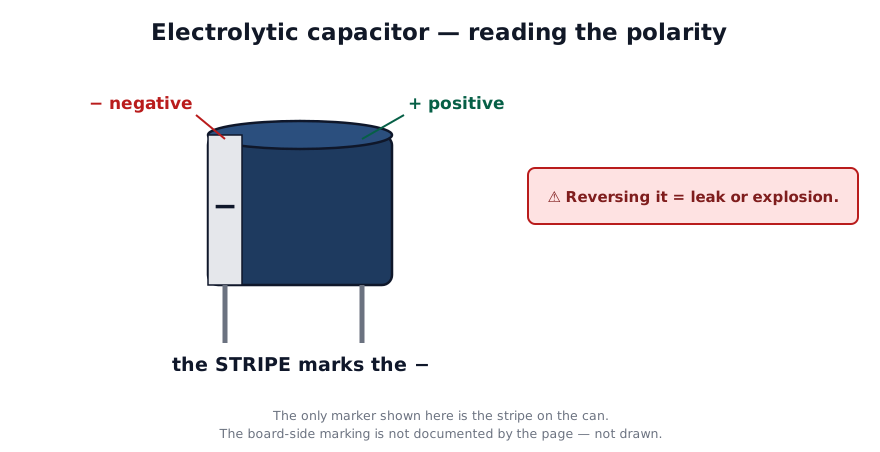
The stripe on the can marks the negative. The diagram carries only that marker: the board-side marking is not documented here, and a wrong marker would cause exactly the damage we are trying to avoid.
- Polarity: respect the − (stripe) / +; reversal = leak/explosion.
- Value: same µF; voltage ≥ original (going up in voltage is fine). Don't raise the µF except on bulk filtering if space allows.
- Quality: low-ESR, 105 °C, reputable series (Panasonic FR/FM, Nichicon, Rubycon). On hotspots, 105 °C is mandatory.
- Polymer / MLCC replacement: at some points a polymer (or several MLCCs) gives far lower ESR and no leak — relevant for local filtering.
Tantalum and MLCC cases
- Tantalum: polarised (mind the direction), never exceed the voltage (failure mode is a short → flames). Derate the voltage generously.
- Ceramic MLCC: non-polarised, no leak; beware mechanical cracks (board flex) that create shorts.
After recap
- Visual check (polarity, bridges), rail measurements, ripple on the scope.
- Extended functional test (heat soak).
Kits & supply
- Console5, RetroFixes, etc. offer per-machine cap kits (values pre-sorted) — handy so nothing is missed.
See also
The values, surveyed board by board ✅
ⓘ 131 surveyed boards — this wiki now carries cap maps: location by location, the value and the voltage as a contributor read them off their own board. → 131 surveyed boards
⚠️ This is not a manufacturer specification. A revision changes the list: read the can before you pull it, and where it disagrees with your board, your board is right. ⓘ A voltage the sheet does not give shows as —, never as a plausible number.
Sources & attribution
- Synthesis of established recap practice (retro/arcade); values = read off the board / cap kit, never invented.
Review & corrections
How this space is used
Spotted a wrong value, an outdated procedure, a chip reference that does not match your board? Say so here, with what you observed (model, board revision, serial number, measurement). Every report is cross-checked against a source before anything changes — an unverifiable correction is published as “reported by …, not cross-checked” rather than silently applied.
Reading is open to everyone; posting requires signing in with Discord. Reports from the wiki's declared reviewers are handled first; anyone else's are read too, but go through a human before anything is changed.