Sega System 32 converts (de-suicide & conversion)
The System 32 has a suicide battery: the program is encrypted and decrypted via a security module/daughter board. Dead battery = dead game. Good news: all games have been patched/decrypted by the community — you de-suicide by burning decrypted ROMs (often just one) and removing the module. Conversions are done via a compatible ROM board.
| Field | Value |
|---|---|
| Platform | Sega System 32 / Multi 32 |
| Type | de-suicide (decrypted ROMs) + conversion via ROM board |
| Difficulty | 🟡 (1-ROM de-suicide) → 🟠 (full conversion) |
| Suicide? | Yes — encrypted program, key in the battery-backed security module |
Architecture
| Block | System 32 | Multi 32 |
|---|---|---|
| CPU | NEC V60 @ 16.1 MHz | NEC V70 @ 20 MHz |
| Sound CPU | Z80 @ 8.05 MHz | same |
| Sound | 2× YM3438 + Ricoh RF5C68 | MultiPCM (YMW-258-F) |
| Screen | 1 monitor | 2 monitors (dual screen) + more RAM |
V60/V70 share the same instruction set (V60/V70/V80 compatible), but Multi 32 ≠ System 32 hardware-wise (see cross-platform conversion below).
Suicide & de-suicide
- The program is encrypted; a daughter board / security module holds the key (battery-backed SRAM). Dead battery = no decryption = mute board.
- De-suicide: burn decrypted ROMs and remove the security module (the board no longer needs to decrypt).
Often just ONE ROM to change
In most cases, one ROM must be replaced by its decrypted version for the game to run without the module — sometimes a second to fix the checksum. The community has released the patched ROMs for all System 32 games.
Converting to another game
Conversion happens at the ROM board level, provided you use the right board type:
| ROM board type | Chips |
|---|---|
| "Big" | 18 chips |
| "Small" | 20 chips |
Each type is compatible with certain titles. To convert:
- Check the target game uses the same ROM board type (Big/Small) as your donor.
- Burn the target game's decrypted ROMs (no security module needed).
- Fit them on the ROM board, set the DIPs.
- Test (image, YM3438/RF5C or MultiPCM sound depending on platform).
Which EPROM to replace a blown chip?
(Board architecture & faults: Sega System 32 PCB.)
Size → EPROM mapping (8-bit 27C parts, DIP32 unless noted):
| Dump size | Density | 8-bit EPROM (DIP32) | 16-bit / mask variant (DIP40/42) |
|---|---|---|---|
| 64 KB | 512 Kbit | 27C512 | — |
| 128 KB | 1 Mbit | 27C010 / 27C1001 | — |
| 256 KB | 2 Mbit | 27C020 / 27C2001 | — |
| 512 KB | 4 Mbit | 27C040 / 27C4001 | 27C400 / 27C4096 (mask pinout) |
| 1 MB | 8 Mbit | 27C080 / 27C801 | 27C800 (16-bit) |
| 2 MB | 16 Mbit | — | 27C160 (1M×16) / 27C322 (2M×16) |
epr- = reprogrammable EPROM · mpr- = factory mask ROM
In the ROM sets, epr-xxxxx = EPROM (directly replaceable with the same density).
mpr-xxxxx = factory mask ROM: if it dies you replace it with an equivalent-density
EPROM, but the mask pinout ≠ EPROM (especially ≥ 4 Mbit and 16-bit) → you often need a
pinout adapter (mask → 27C160/27C400).
Worked example: Golden Axe — The Revenge of Death Adder
GARDA is NOT an ordinary jumper conversion — it's a protected game
Golden Axe: The Revenge of Death Adder uses a dedicated ROM board (833-8933-02) +
a protection sub board (834-8529-02, a custom V25 running encrypted code, EPROM
epr-14468-02 at U3) + an A/D board (837-7968, for the analog levers).
→ You therefore cannot convert a generic System 32 (ROM board 837-7429) into GARDA by
reflashing EPROMs: you need the GARDA ROM board + V25 sub board + A/D board trio. The
realistic technician path: repair / reflash an existing GARDA board, you don't "build"
one from another game. (Verified: MAME sega/segas32.cpp.)
EPROM locations on a GARDA board (World Rev B set, ga2) — to replace a chip:
| Function | Socket | Original ROM | Size | Type | EPROM replacement |
|---|---|---|---|---|---|
| V60 program P0 | IC17 | epr-14961b | 128 KB | EPROM | 27C010 |
| V60 program P1 | IC8 | epr-14958b | 128 KB | EPROM | 27C010 |
| V60 data D0 | IC18 | epr-15148b | 256 KB | EPROM | 27C020 |
| V60 data D1 | IC9 | epr-15147b | 256 KB | EPROM | 27C020 |
| Sound Z80 (bank 0) | IC36 | epr-14945 | 64 KB | EPROM | 27C512 |
| Sound (banks) | IC35 / IC34 / IC24 | mpr-14944/43/42 | 1 MB ea | mask | 27C801 (+ adapter) |
| V25 protection | U3 (sub board) | epr-14468-02 | 64 KB | EPROM | 27C512 |
| Tiles | IC14 / IC5 | mpr-14948/47 | 2 MB ea | mask | 27C160 (+ adapter) |
| Sprites | IC32/30/28/26/31/29/27/25 | mpr-14949…14956 | 2 MB ea | mask | 27C160 (+ adapter) |
- Don't mix revisions: World Rev B (
ga2, epr-1496xb/1514xb), US Rev A (ga2u, epr-1495xa/1514xa), Japan (ga2j) have different programepr-s — keep a consistent set. - Program/sound
epr-s are reburnable; thempr-s (graphics/PCM sound) are huge mask ROMs: in practice you reuse the originals and only reburn if one dies.
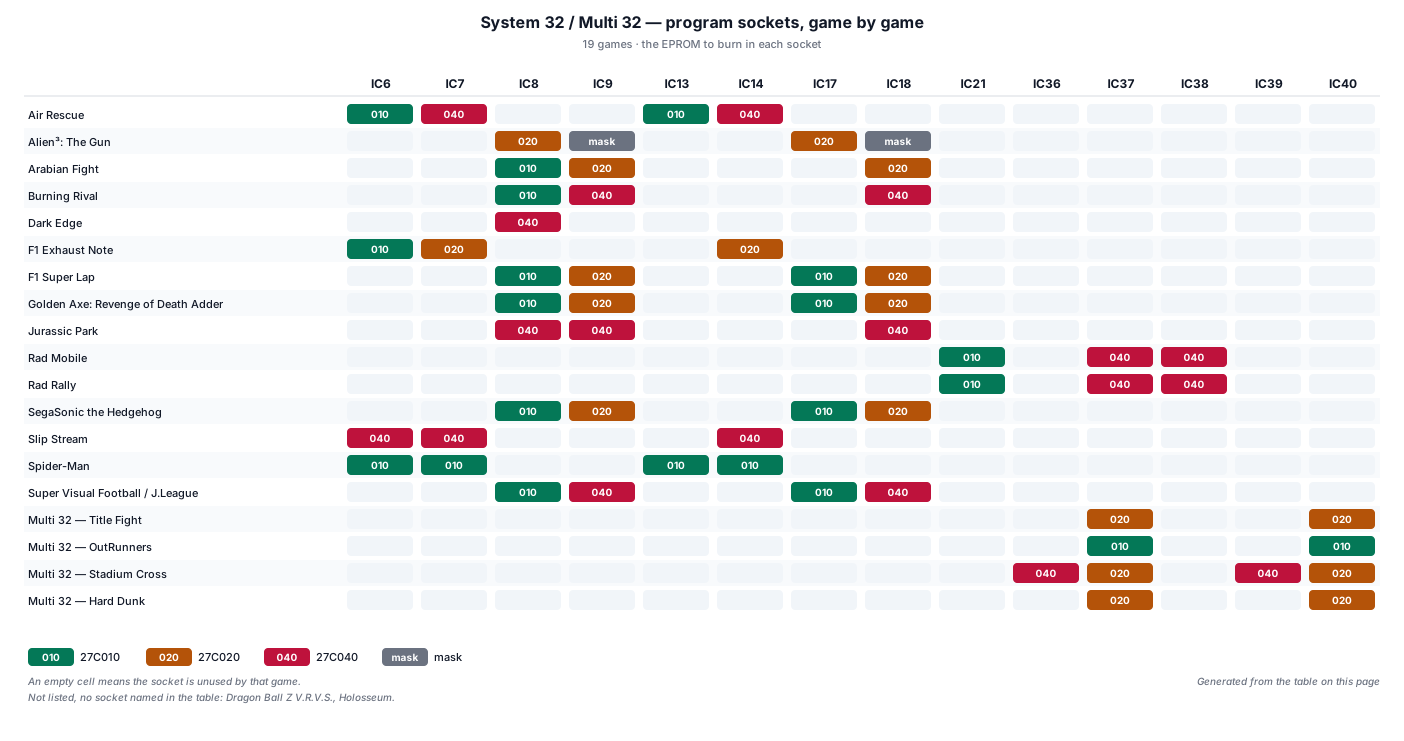
Game by game: program EPROM per socket (System 32 / Multi 32)
Program/data sockets (reburnable epr- EPROMs) per game, with density → the EPROM to
burn. Reference World/Export set; US/JP revisions have different epr-s (same density).
(Source: MAME sega/segas32.cpp.)
| Game | romset | Program sockets (EPROM) | Note |
|---|---|---|---|
| Air Rescue | arescue |
IC13/IC6 = 27C010 · IC14/IC7 = 27C040 | |
| Alien³: The Gun | alien3 |
IC17/IC8 = 27C020 · IC18/IC9 = mask 27C040 | data = mask ROM |
| Arabian Fight | arabfgt |
IC8 = 27C010 · IC18/IC9 = 27C020 | ⚠ protected — V25 sub board epr-14468-01 |
| Burning Rival | brival |
IC8 = 27C010 · IC18/IC9 = 27C040 | |
| Dark Edge | darkedge |
IC8 = 27C040 | |
| Dragon Ball Z V.R.V.S. | dbzvrvs |
2× 27C040 | |
| F1 Exhaust Note | f1en |
IC6 = 27C010 · IC14/IC7 = 27C020 | |
| F1 Super Lap | f1lap |
IC17/IC8 = 27C010 · IC18/IC9 = 27C020 | |
| Golden Axe: Revenge of Death Adder | ga2 |
IC17/IC8 = 27C010 · IC18/IC9 = 27C020 | ⚠ protected — V25 epr-14468-02 (detailed above) |
| Holosseum | holo |
4× 27C010 | |
| Jurassic Park | jpark |
IC8/IC18/IC9 = 27C040 | |
| Rad Mobile | radm |
IC21 = 27C010 · IC37/IC38 = 27C040 | |
| Rad Rally | radr |
IC21 = 27C010 · IC37/IC38 = 27C040 | |
| SegaSonic the Hedgehog | sonic |
IC17/IC8 = 27C010 · IC18/IC9 = 27C020 | |
| Slip Stream | slipstrm |
IC6/IC14/IC7 = 27C040 | jumper reference game below |
| Spider-Man | spidman |
IC13/IC7/IC14/IC6 = 27C010 | |
| Super Visual Football / J.League | svf / jleague |
IC17/IC8 = 27C010 · IC18/IC9 = 27C040 | |
| Multi 32 — Title Fight | titlef |
IC37/IC40 = 27C020 | dual screen |
| Multi 32 — OutRunners | orunners |
IC37/IC40 = 27C010 | dual screen |
| Multi 32 — Stadium Cross | scross |
IC37/IC40 = 27C020 · IC36/IC39 = 27C040 | dual screen |
| Multi 32 — Hard Dunk | harddunk |
IC37/IC40 = 27C020 | dual screen |
What this tells you concretely
-
Only 2 System 32 games are protected (V25 sub board): Arabian Fight and GARDA. Everything else is an "ordinary" ROM-board conversion (reburn the
epr-s, reuse the graphicsmpr-masks, set the jumpers). -
The Multi 32 games (dual-screen: Title Fight, OutRunners, Stadium Cross, Hard Dunk) use a different socket layout (IC37/IC40…) — see the Multi 32 note below.
System 32 ROM board jumpers (837-7429-01)
On the generic ROM board (non-protected games), jumpers JP1–JP32 configure the EPROM size each socket bank accepts. The position depends on the density fitted — refer to the board silkscreen and the EPROM type used.
MAME reference table (Slip Stream example; "may vary depending on ROM types used"):
| JP1: 2-3 | JP9: 1-2 | JP17: 1-2 | JP25: 2-3 |
| JP2: 2-3 | JP10: 2-3 | JP18: 2-3 | JP26: 1-2 |
| JP3: 2-3 | JP11: 1-2 | JP19: 1-2 | JP27: 1-2 |
| JP4: 1-2 | JP12: 1-2 | JP20: 2-3 | JP28: 2-3 |
| JP5: 2-3 | JP13: 1-2 | JP21: 1-2 | JP29: 1-2 |
| JP6: 2-3 | JP14: 2-3 | JP22: 2-3 | JP30: 2-3 |
| JP7: 1-2 | JP15: 2-3 | JP23: 1-2 | JP31: 1-2 |
| JP8: 2-3 | JP16: 2-3 | JP24: 1-2 | JP32: 1-2 |
Generic ROM board EPROM locations (silkscreen → IC → type):
| Role | Silkscreen | IC | EPROM type |
|---|---|---|---|
| CPU program | P0 / P1 | IC13 / IC6 | 27C4002 / 27C4000 |
| CPU data | D0 / D1 | IC7 / IC14 | 27C4000 (4 Mbit) |
| Sound | SND0 / SND1 | IC35 / IC31 | 27C010 / 27C4000 |
| Scroll (SCR0-3) | SCR0…3 | IC38/34/29/25 | 27C4000 |
| Sprites (OBJ0-7) | OBJ0…7 | IC36/32/27/23/37/33/28/24 | 27C4000 |
(837-7429-01 = standard System 32 ROM board. GARDA and other protected games have their own ROM board — see above.)
System Multi 32 → System 32 (complicated)
Converting a Multi 32 game to plain System 32 (or the reverse) is trickier: different hardware (V70 vs V60, dual screen, MultiPCM vs YM3438/RF5C, RAM). It's not a simple ROM-board swap — for well-documented cases only.
Before / after
- De-suicide: a suicided board (dead battery) lives again, battery-less, with 1 (or 2) decrypted ROMs.
- Conversion: a game's ROM board becomes another game of the same board type.
Where to read more
- Arcade-Projects — System 32 desuicide and conversions: all games patched and released! — https://www.arcade-projects.com/
- MiSTer — System 32 core (meathax) — https://github.com/meathax/s32
- vgmrips — Sega System 32 (sound/CPU chips) — https://vgmrips.net/wiki/Sega_System_32
Open-source FPGA core archived here
An FPGA (MiSTer) recreation of System 32 / Multi 32, SystemVerilog sources to
compile: s32.tar.gz ·
README — upstream:
https://github.com/meathax/s32. We host no arcade ROMs.
Sources & attribution
- Arcade-Projects — System 32 desuicide and conversions (decrypted ROMs, 1 ROM + checksum, ROM boards Big 18 / Small 20) — https://www.arcade-projects.com/
- vgmrips — Sega System 32 (V60/V70, YM3438/RF5C68, MultiPCM) — https://vgmrips.net/wiki/Sega_System_32
- Internal page: Sega System 32
Diagrams: generated by scripts/svg-sockets.py from the tables on this page,
on every run — no data is copied into the script. These are logical maps: the pages
give socket designators, never their position on the board, and we do not invent it.
Review & corrections
How this space is used
Spotted a wrong value, an outdated procedure, a chip reference that does not match your board? Say so here, with what you observed (model, board revision, serial number, measurement). Every report is cross-checked against a source before anything changes — an unverifiable correction is published as “reported by …, not cross-checked” rather than silently applied.
Reading is open to everyone; posting requires signing in with Discord. Reports from the wiki's declared reviewers are handled first; anyone else's are read too, but go through a human before anything is changed.