"Western" cabinets (upright, cabaret, cocktail)
An overview of Western (US/EU) arcade cabinets — as opposed to Japanese candy cabs. These include the tall upright, its scaled-down cabaret / mini version, and the cocktail / table cabinet. Wooden cabinets (MDF/particleboard), usually a smaller, fixed monitor, and JAMMA wiring from the mid-1980s on.
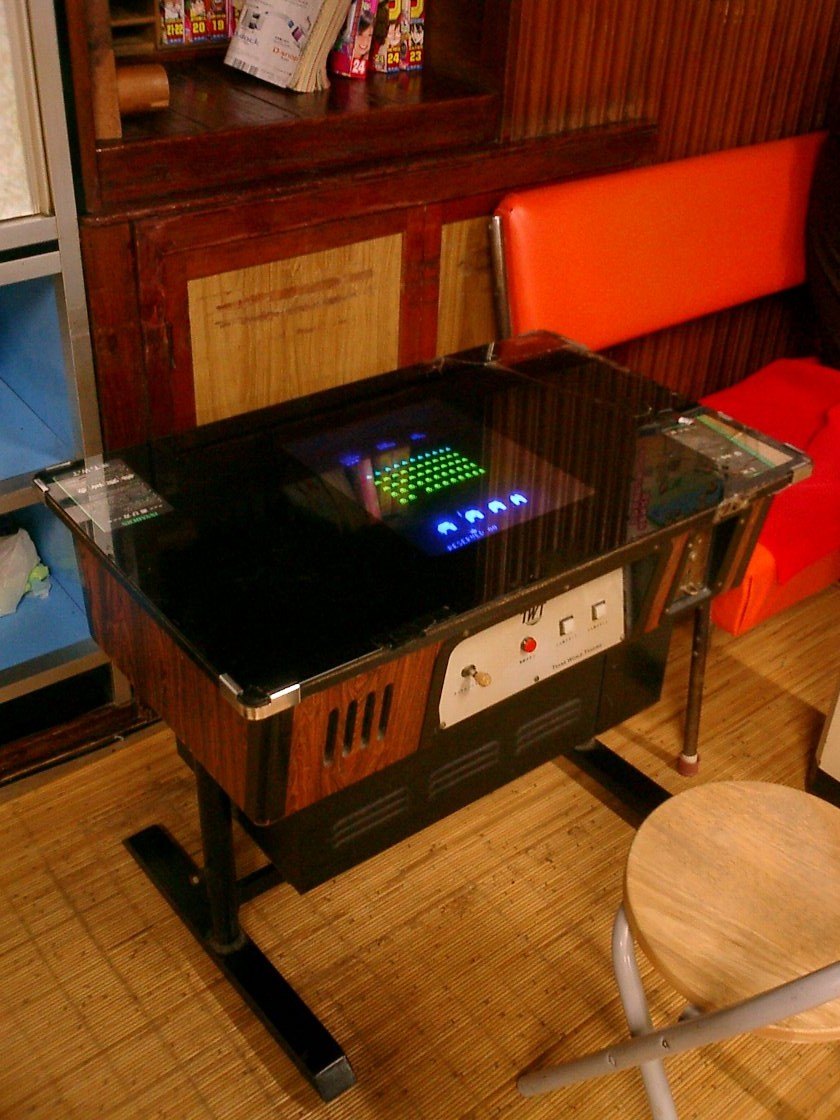
The Western form factors
| Format | Description | Screen | Note |
|---|---|---|---|
| Upright | tall vertical cabinet (~1.8 m / 6 ft), control panel at waist height, lit marquee on top | CRT ~19–25″, often fixed | the dominant format in North America |
| Cabaret / mini | scaled-down upright, less bulky, aimed at small spaces / the home | smaller CRT | compacted "upright" style |
| Cocktail / table | low table cabinet, screen flat under glass, 2 players seated across | horizontal CRT, image flips (game-controlled) each turn | common in 1980s bars |
(Per Wikipedia — Arcade cabinet.)
The footprint of all three formats, from a manufacturer ✅
The figures above are second-hand orders of magnitude. These come from an original document, and they cover all three formats at once: Bally/Midway's Standardized General Instructions (© 1983), under "Location requirements". ⓘ The table is identical in all five manuals of that family archived on this wiki — so it is a house standard, not one game's spec sheet.
| Format | Floor space | Height |
|---|---|---|
| Upright | 32″ × 25″ (81 cm × 63 cm) — APPROX. | 70″ (175 cm) — APPROX. |
| Mini (cabaret) | 20″ × 24″ (50 cm × 60 cm) | 61″ (153 cm) |
| Cocktail | 32″ × 22″ (81 cm × 55 cm) | 29″ (73 cm) |
⚠️ The metric column of the heights does not follow the inch column. 70″ is 177.8 cm, not 175; 61″ is 154.9 cm, not 153. The floor-space figures convert correctly. ⓘ For a doorway, trust the converted inch figure: the manual states the cabinet 3 cm shorter than it is.
⚠️ The manual never says which of the two figures is the width and which the depth — and two of the five manuals print the upright in the opposite order (25″ × 32″ instead of 32″ × 25″), the same numbers transposed. ⓘ This wiki does not arbitrate: the source does not say.
✅ And the operating envelope, which cabinet spec sheets rarely give:
| Item | What the manual writes |
|---|---|
| Mains | Domestic 110 V @ 60 Hz · Foreign 200 V to 240 V @ 50 Hz |
| Temperature | 32 to 100 °F (0 to 38 °C) |
| Humidity | not over 95 % relative |
ⓘ The same manual puts a number on the mains floor below which no game works — 105 VAC — and describes its symptom, which is not the one you expect → mains chain.
📄 MCR System Games — Standardized General Instructions · MCR II System Games
Construction & materials
- Wood: MDF or laminated particleboard panels, unlike the moulded plastic of candy cabs. Heavier to move, but simpler to repair/rebuild.
- Artwork: side screen-printing, backlit marquee, bezel around the tube. Dedicated cabinets (Pac-Man, Mortal Kombat…) carry game-specific artwork.
- Monitor: usually smaller (~19–25″) than a candy cab's 29″, and most often non-rotatable (orientation fixed at build time). ⚠️ "Most often" is not "always" — see the documented counter-example below.
A western cabinet with a rotatable monitor (1983) ⚠️
The counter-example, from the maker's own service manual
This wiki writes above that a western upright's screen is "most often not rotatable". ⓘ True most often — and here is the proof that it is not a rule:
"The monitor mounting board has the feature of holding the monitor in a horizontal or vertical position."
ⓘ That is Taito America's G.T.C. 100 Universal Cabinet. Two thumb screws, pull the board out by its hand slots, turn it over, put the screws back. ⚠️ Nothing improvised: the drawing labels the part "Monitor Cover — Horizontal or Vertical".
ⓘ The difference from a candy cab is still real: a candy turns its tube without stripping the front; here you open the cabinet and take out panel, glass and artwork. ⚠️ But saying "western = fixed at manufacture" is wrong, and a 1983 conversion manual said so before us.
The compact format, at two makers ✅
The three-format table above is Bally/Midway's. A second maker puts figures on its slim cabinet — and it names its axes:
| Bally/Midway "Mini" (© 1983) | Taito America Trimline™ (ref. 72-0001-001) | |
|---|---|---|
| Footprint | 20″ × 24″ (50 × 60 cm) — ⚠️ axes unnamed | width 20″ (51 cm) × depth 24″ (61 cm) |
| Height | 61″ (153 cm) | 54″ (138 cm) |
| Weight | (not given) | 190 lb (86 kg), packaged |
| Mains | 110 V / 60 Hz (range) | 120 VAC 60 Hz, ⓘ ≈ 250 W |
| Screen | (not given) | ⓘ parts list: Monitor Shroud 14″ |
⓵ Both footprints are the same pair of numbers, 20 and 24 — and ⓘ Taito says which one is the width, where Bally/Midway never does. ⚠️ That does not prove Bally/Midway's convention; this wiki still does not arbitrate. ⓘ But the Trimline is genuinely lower than the Mini: 54″ against 61″.
📄 G.T.C. 100 — Service Instructions · Crazy Climber Trimline™
Wiring & power
- JAMMA (56-pin edge) has been the standard for generic uprights since ~1985 → JAMMA wiring. Pre-JAMMA cabinets use dedicated harnesses.
- Power: cabinet PSU (often 110/230 V by region) — see the power principle; the +5 V rail is critical for logic.
- Controls: fixed panel (dedicated) or rewired (generic JAMMA cabinet) — see Control panels.
Western vs candy cab (JP)
| Western upright | Candy cab (JP) | |
|---|---|---|
| Material | wood (MDF/particleboard) | moulded plastic |
| Monitor | ~19–25″, often fixed — ⚠️ but not always | 29″, often rotatable |
| Artwork | dedicated screen-print + marquee | neutral shell, interchangeable panel |
| Ergonomics | standing | seated |
(See also the overview: cabinet types.)
Repair (cross-cutting)
- CRT monitor: recap + adjustments — see Nanao MS8 / MS9; ⚠️ high voltage.
- Wooden cabinet: re-glue/reinforce panels, replace T-molding, redo artwork.
- JAMMA contacts, harness, buttons/joysticks.
Playing a PCB at home
As with candy cabs, you can wire a JAMMA board without a cabinet via a supergun.
Photos / assets
(To add: dedicated US upright, cabaret, glass-top cocktail.)
Repair & maintenance
Modernise (video, PSU, JVS, upscaler, PC/FPGA) → Modernising a cabinet. CRT monitor (discharge HV!) → CRT safety · Wells-Gardner / Sanyo 20-EZ (US) / Hantarex (EU) chassis · recap → Recap · diagnosis → PCB fault-finding.
Sources & attribution
- Wikipedia — Arcade cabinet (upright ~6 ft, cocktail flipped image, cabaret/mini scaled down, plastic 29″ candy cabs vs 20–25″ wooden uprights) — https://en.wikipedia.org/wiki/Arcade_cabinet
- Arcade Otaku Wiki — Cabinets (cabinet families) — https://wiki.arcadeotaku.com/w/Cabinets
- Internal pages: cabinet types · JAMMA wiring · supergun
Image:
-
borne-cocktail.jpg— Tomomarusan, CC BY 2.5 — https://commons.wikimedia.org/wiki/File:Space_Invaders.JPG

Review & corrections
How this space is used
Spotted a wrong value, an outdated procedure, a chip reference that does not match your board? Say so here, with what you observed (model, board revision, serial number, measurement). Every report is cross-checked against a source before anything changes — an unverifiable correction is published as “reported by …, not cross-checked” rather than silently applied.
Reading is open to everyone; posting requires signing in with Discord. Reports from the wiki's declared reviewers are handled first; anyone else's are read too, but go through a human before anything is changed.