Taito F3 converts
The Taito F3 is a cartridge system (common motherboard + game cartridge, Neo-Geo / CPS-2 style): it's the convertible Taito. No suicide encryption on the base hardware — conversion = reprogram the EPROMs, and handle the region lock (physical and software).
| Field | Value |
|---|---|
| Platform | Taito F3 System (1994) |
| Type | cartridge EPROM reprogram (or single-board → cartridge) |
| Difficulty | 🟡 (EPROM + region keying) |
| Suicide? | No (no battery-backed key on the base hardware) |
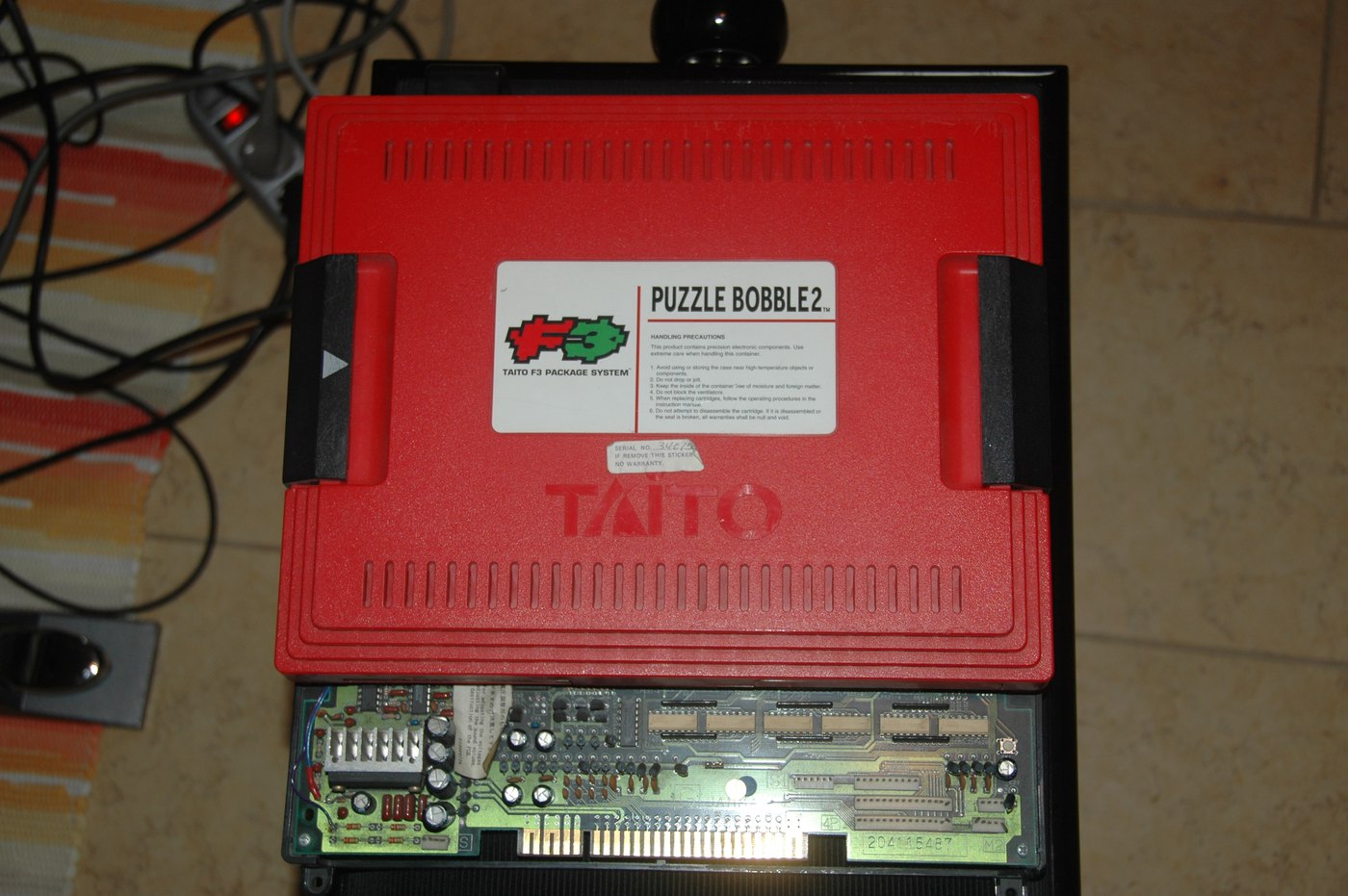
Architecture (common motherboard)
| Block | Chip | Role |
|---|---|---|
| CPU | MC68EC020 | game logic |
| Sound (CPU) | MC68000 | drives the sound |
| Sound | Ensoniq ES5505 (samples) + ES5510 (DSP, reverb) | |
| Video | Taito customs (sprites/tilemaps, 2D) | 15 kHz, JAMMA |
⚠️ Some databases show a "PowerVR2" for the F3: that's an infobox error — the F3 is a 2D sprite system (Taito customs), not PowerVR 3D.
The board's potentiometer is NOT the volume
On the F3 board, the potentiometer trims internal IC voltages — not the sound. Turning it at random can destroy the motherboard. Don't touch it.
The cartridge system
- Most F3 kits = motherboard + pluggable game cartridge, "very close to Neo-Geo or CPS-2".
- Some early games shipped as a single board — hence the interest of single-board → cartridge conversions (or to another game).
The region lock (dual: physical + software)
Motherboard AND cartridge are region-locked and don't interoperate. Two mechanisms stack:
- Physical keying: stoppers on the motherboard match holes positioned by region on the cartridge → prevent cross-region insertion.
- Software region byte: in the program.
Changing the region (the exact move)
- Physical: remove/modify the connector keys (stoppers).
- Software: change the last byte of the last program EPROM (the rightmost):
01= Japan02= USA03= Europe
Making a dual-region cartridge (worked example)
On Puzzle Bobble 2 (original EPROM 27C020-12):
- Double the size: reprogram into a 27C040-12 (2× capacity), with both region versions copied/edited.
- Fit an SPDT switch on the cartridge lid: one outer contact to +5 V, the other to ground.
- On the 27C040 EPROM, the top address line is pin 31: bend pin 31 out of the body, trim the thin part of the leg, and solder a wire from pin 31 to the switch's centre contact.
- The switch flips between the two halves of the EPROM → two regions on demand.
EPROM sizes (memo)
| ROM image | EPROM |
|---|---|
| 2 MB | 27C160 |
| 512 KB | 27C040 |
| 256 KB | 27C020 |
Program EPROM, game by game
The F3 is 32-bit (68EC020) → the program always sits on 4 EPROMs (one per byte lane).
Density per game: early = 27C010/020, late = 27C040. The region byte is in the
last program EPROM (see the region lock). (Source: MAME taito/taito_f3.cpp. Board view:
Taito F3 PCB.)
| Game | Program (×4) | Game | Program (×4) | |
|---|---|---|---|---|
| Riding Fight | 4× 27C020 | Bubble Memories | 4× 27C040 | |
| Arabian Magic | 4× 27C020 | Puzzle Bobble 2 | 4× 27C020 | |
| Ring Rage | 4× 27C020 | Puzzle Bobble 3 | 4× 27C040 | |
| Grid Seeker | 4× 27C020 | Puzzle Bobble 4 | 4× 27C040 | |
| Gunlock / Rayforce | 4× 27C020 | Pop'n Pop | 4× 27C040 | |
| Cup Finals | 4× 27C010 | Elevator Action Returns | 4× 27C040 | |
| Space Invaders DX | 4× 27C010 | Cleopatra Fortune | 4× 27C040 | |
| Kaiser Knuckle | 4× 27C040 | Puchi Carat | 4× 27C040 | |
| Darius Gaiden | 4× 27C040 | Kyukyoku Tiger II | 4× 27C020 | |
| Bubble Bobble II | 4× 27C020 | Land Maker | 4× 27C040 |
F3 conversion = very doable (no suicide)
The F3 has no battery: reburn the 4 EPROMs of the target game onto the cartridge (same density) and handle the physical key + region byte. Bi-region trick: see the dedicated section above.
Converting to another game (summary)
- Gather the target game's ROMs (your dumps): program + graphics + sound.
- Burn the EPROMs at the right sizes.
- Set the region byte (last program EPROM) + handle the keying.
- For a single-board → cartridge (or the reverse), follow the full conversion guide (Arcade-Projects).
- Test image, sprites, sound (ES5505/5510).
Before / after
- EPROM reprogram: the F3 cartridge/board becomes the target game.
- Dual-region: a single cartridge playable in JP/US/EU via the switch.
Where to read more
- Arcade-Projects — Taito F3 single board conversion complete guide & Taito F3 conversions — https://www.arcade-projects.com/
- Arcade Otaku Wiki — Taito F3 System (regioning, keying) — https://wiki.arcadeotaku.com/w/Taito_F3_System
- Solvalou — Taito F3 all-region (region byte, dual-region) — https://solvalou.com/arcade/taitof3
Sources & attribution
- Arcade Otaku Wiki — Taito F3 System (Neo-Geo/CPS2-style cartridge, stoppers/holes) — https://wiki.arcadeotaku.com/w/Taito_F3_System
- Solvalou — region (byte 01/02/03, EPROM 27C160/040/020, dual-region pin 31) — https://solvalou.com/arcade/taitof3
-
Arcade-Projects — F3 conversion guides — https://www.arcade-projects.com/ Image:
-
taito-f3-cartouche.jpg— Cyberjobe, public domain, Wikimedia Commons — https://commons.wikimedia.org/wiki/File:Puzzlebobble2pcb.JPG

Review & corrections
How this space is used
Spotted a wrong value, an outdated procedure, a chip reference that does not match your board? Say so here, with what you observed (model, board revision, serial number, measurement). Every report is cross-checked against a source before anything changes — an unverifiable correction is published as “reported by …, not cross-checked” rather than silently applied.
Reading is open to everyone; posting requires signing in with Discord. Reports from the wiki's declared reviewers are handled first; anyone else's are read too, but go through a human before anything is changed.