Atari ST (520/1040, STE, Mega, Falcon)
The great Amiga rival (1985): 68000, a GEM/TOS interface in ROM, and above all built-in MIDI ports that made it the music-production micro and a major demoscene platform. Standard 16-bit repair: recap, floppy, TOS ROM, customs (GLUE/MMU/SHIFTER).
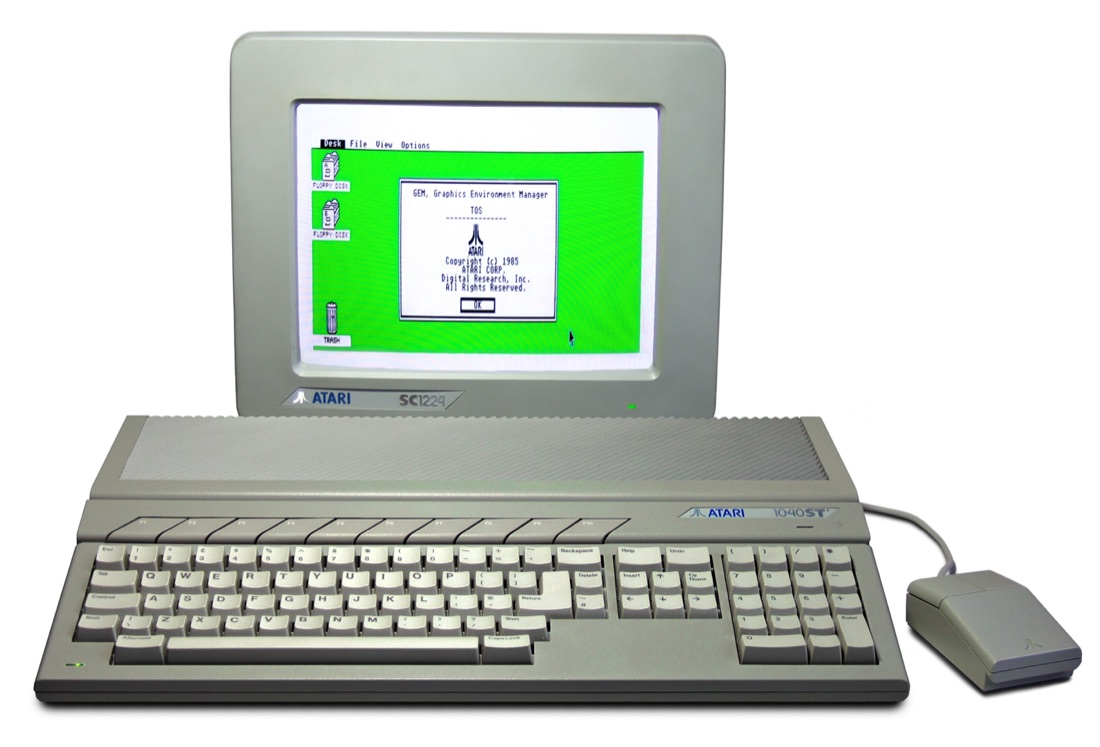
Atari 1040STf — photo by Bill Bertram, CC BY-SA 2.5 (Wikimedia Commons).
Identification / models
| Model | Year | CPU | Note |
|---|---|---|---|
| 520 ST / 1040 ST(F/FM) | 1985-86 | 68000 @ 8 MHz | the mainstream base (F = internal floppy) |
| Mega ST (1/2/4) | 1987 | 68000 | "pro" separate-case version + blitter |
| STE (520/1040) | 1989 | 68000 | blitter, stereo DMA sound, 4096-colour palette, better joysticks |
| Mega STE | 1991 | 68000 @ 16 MHz | Mega + STE + cache |
| TT030 | 1990 | 68030 | Unix/pro workstation |
| Falcon030 | 1992 | 68030 + DSP 56001 | multimedia, 16-bit audio, the swan song |
Architecture (customs)
| Chip | Role |
|---|---|
| 68000 @ 8 MHz | CPU (68030 on TT/Falcon) |
| GLUE | bus/addressing logic |
| MMU (RAM controller) | memory management / refresh |
| SHIFTER | video (320×200 16 c. / 640×400 mono) |
| YM2149 (PSG) | 3-channel sound (+ stereo DMA on STE/Falcon) |
| MFP 68901 | timers, interrupts, serial |
| IKBD (HD6301) | keyboard + mouse + joysticks (dedicated microcontroller) |
| TOS/GEM (ROM) | system + GUI |
Repair (technician)
- Recap: PSU electrolytics (internal on STF/STE) and the board → the No. 1 source of instability; ⚠️ a mains RIFA cap in the PSU (can smoke/explode) → replace it. Recap.
- TOS ROM: on a socket; versions 1.0 → 2.06 / 4.x (Falcon) — software compatibility.
- Floppy drive (720 KB DS): tired mechanism → Gotek/HxC for preservation.
- IKBD (6301): dead keyboard/mouse = the microcontroller or its serial link → separate diagnosis.
- Customs (GLUE/MMU/SHIFTER): rare → substitution (donor); corrupt video = SHIFTER + RAM.
- Video output: RGB DIN → clean SCART (video mods).
Original service manual ✅
Manufacturer manual archived locally. It typically carries the schematics, the block diagram, the expected voltages and waveforms, the parts list and the disassembly procedures — the reference when a symptom matches no known fault.
- Atari 520ST / 1040ST — service manual — PDF
- 520ST — schematic (1985) — PDF
- 1040STE — schematic rev. A — PDF
- Atari TT030 — PDF
Status
A manufacturer document with no explicit licence, kept for preservation (machine long out of production) — the same position as for the cabinet and arcade manuals already archived here. Source: Internet Archive.
Procedure — a dead computer, step by step ✅
What this adds
Ordered for a home computer: what kills these is its power supply, its battery, its capacitors, its socketed RAM and its keyboard — roughly in that order, and well before the CPU. → PCB diagnosis
1. The power supply — measured before it is plugged in. This is the one step not to swap around. On a machine of this age a supply does not simply stop: a 5 V regulator that fails high puts 7, 9, 12 V onto the bus and takes the RAM and the custom chips with it. Measure every rail off the machine, under a dummy load if you can, and only then plug it in. This page documents RIFA capacitors on this machine: the mains filter caps that crack, then let go in smoke on the first power-up. Replace them before you switch on, not after.
2. The battery, if it has one. Any RTC or backup cell soldered to a board is a future leak. If yours has one and it has never been changed, take it out before it takes the tracks with it. → Backup batteries
3. Capacitors. Recap is the default on these machines, not a last resort — and on the supply first, since that is what protects everything else. → Recap
4. RAM, on its sockets. These machines were built to be repaired: the RAM, and often the logic, sit in sockets. Reseat everything first — thirty years of oxide is a classic no-boot. Then swap chips: a bad RAM chip usually gives a repeatable pattern of garbage or a screen frozen at a fixed character.
5. The keyboard. A console does not have one; a computer's is a wear part. A membrane keyboard fails as whole dead rows or columns — that is the membrane, not the machine. A mechanical one wants its contacts cleaning, not replacing. Check this page: the failure mode is often documented per model.
6. Storage — tape or disk. Both often come down to the same things: a dirty head, and for tape the azimuth and a belt turned to tar. ⚠️ On the floppy side, check whether the mechanism actually has a belt before looking for one: many do, but some drives are direct drive, and hunting a belt that isn't there means stripping a drive for nothing. A machine that boots but loads nothing is a drive fault, not a logic fault — do not go looking on the board for it.
7. Video output. RF, composite, RGB or a dedicated monitor, depending on the machine (see Identification). Test with something else before you conclude: a period modulator and a modern TV disagree far more often than either is broken.
8. Still nothing. Now the logic: rails on the board, reset, clock, bus. → PCB diagnosis
Common faults
| Symptom | Likely cause | Lead |
|---|---|---|
| Instability / crashes | tired PSU/board caps | Recap |
| Smoke / bang at power-on | mains RIFA in the PSU | Replace the RIFA |
| No picture / corrupt video | SHIFTER / RAM / GLUE | Substitute, RAM test |
| Dead keyboard/mouse | IKBD 6301 / link | Diagnose the microcontroller |
| Floppy not read | mechanism / head | Clean, Gotek |
Modernisation & mods — what to buy, how
PSU RIFA + STE/Falcon recap
The PSU's RIFA mains-filter caps blow into smoke with age → replace them on acquisition (smell / white smoke). Recap the board especially on STE/Falcon (leaking SMD/electrolytics).
Modern storage - Gotek + FlashFloppy or HxC 🟡: the ST is a heavy Gotek user (internal drive connector, select jumper) — ST/MSA images from USB. - UltraSatan / ACSI2STM 🟢: an SD card as an ACSI hard disk (external/internal ACSI port); CosmosEx 🟡 (storage + networking + mouse).
Video - 15 kHz RGB output (mono mode = 71 kHz) 🟢 → SCART then OSSC / RetroTINK or RGB2HDMI.
Expansion - RAM (Marpet et al. boards) 🟡; CT60/CT63 accelerators on the Falcon030 🟠; TOS switcher (multiple socketed versions) 🟡.
Reliability - Substitute the (reprogrammed) IKBD 6301 🟠 on a dead keyboard; clean contacts.
⚠️ Do not host TOS/games — method only.
See also
- Amiga (the rival) · Recap · PCB fault-finding · Traces & vias.
Sources & attribution
- Photo Atari 1040STf — Bill Bertram, CC BY-SA 2.5, Wikimedia Commons — https://commons.wikimedia.org/wiki/File:Atari_1040STf.jpg
- Wikipedia — Atari ST (68000, GLUE/MMU/SHIFTER, YM2149, IKBD, STE/Falcon) — CC-BY-SA — https://en.wikipedia.org/wiki/Atari_ST
- Established ST community knowledge (mains RIFA, recap, IKBD 6301) — synthesis.

Review & corrections
How this space is used
Spotted a wrong value, an outdated procedure, a chip reference that does not match your board? Say so here, with what you observed (model, board revision, serial number, measurement). Every report is cross-checked against a source before anything changes — an unverifiable correction is published as “reported by …, not cross-checked” rather than silently applied.
Reading is open to everyone; posting requires signing in with Discord. Reports from the wiki's declared reviewers are handled first; anyone else's are read too, but go through a human before anything is changed.