RGB & SCART — principle and amps
The foundation of clean retro video. Before modding a console, understand what an RGB signal is, how to output it over SCART, and why some setups need a video amp (THS7314 & co.).
The video quality scale
Worst to best, at equal resolution:
| Output | What happens | Quality |
|---|---|---|
| RF | video + sound modulated onto a TV carrier | 🟥 the worst (noise, crosstalk) |
| Composite (CVBS) | luminance + chrominance mixed on 1 wire | 🟧 blurry, dot crawl, rainbow |
| S-Video (Y/C) | luma and chroma separated | 🟨 sharp, but colours still encoded |
| RGB | red/green/blue separated + sync | 🟩 the original signal, no re-encoding |
| Component (YPbPr) | RGB transcoded to luma + colour differences | 🟩 RGB-equivalent, US-screen compatible |
RGB = what the video chip actually generates. Everything else is a degradation. The goal of a video mod is to short-circuit the encoding stages to recover RGB (or the digital signal, see HDMI).
SCART and sync
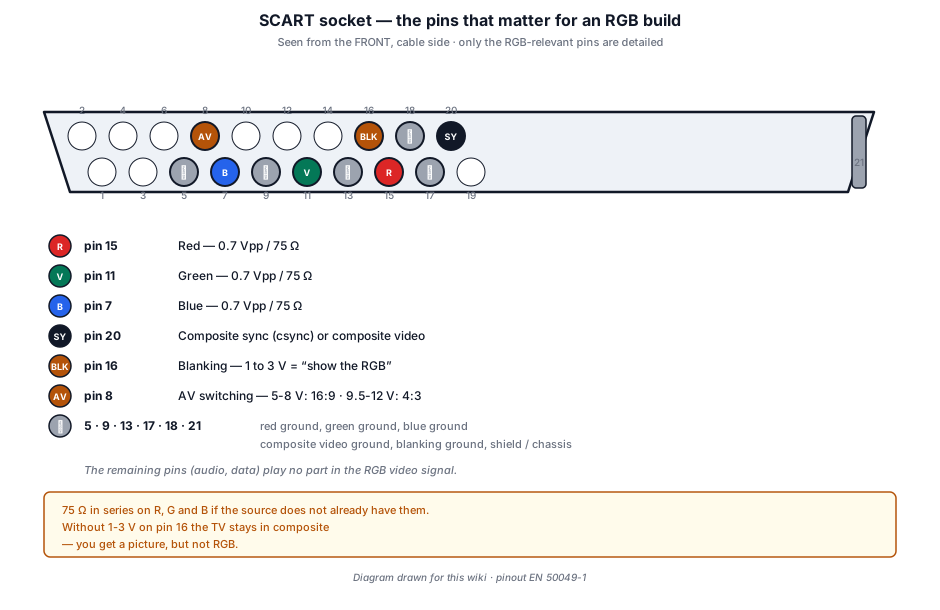
In Europe, RGB travels over the SCART socket:
- R, G, B: 0.7 Vpp into 75 Ω, pins 15/11/7.
- Sync: pin 20 (composite video) carries the sync. You send it either composite sync (csync) or composite video (sync-on-composite).
- Pin 16 (blanking / RGB switch): 1–3 V = "show RGB", otherwise the TV stays on composite. Don't forget it (often via a resistor from +5 V).
- Pin 8 (AV switch): switches the TV to AV and tells it the aspect ratio — 5–8 V = 16:9, 9.5–12 V = 4:3. The two ranges are distinct: this is what decides whether the picture arrives stretched or not.
csync, not separate H+V
A SCART wants a composite sync (csync) on pin 20, not separate H-sync and V-sync signals (that's VGA). Many consoles provide csync; otherwise you extract it (LM1881) or use composite video as sync.
When do you need a video amp?
Some consoles output RGB that's too weak or has a DC offset that darkens/washes the image, or a sync that's too weak. A video amp brings it back to level:
| Chip | Role | Typical use |
|---|---|---|
| THS7314 | triple video amp, filter + DC restoration | SNES, Mega Drive, N64… the classic |
| THS7374 / THS7376 | 4 channels (RGB + sync) | setups with sync to buffer |
| THS7316 | HD-bandwidth variant | 31 kHz sources |
| CXA1145 / CXA1645 | original encoder (Sony) — what you bypass | Mega Drive 1, PS1… |
Filtering: careful not to over-soften
The THS73xx come in versions with a more or less aggressive low-pass filter. For sharp 240p you often prefer the bypass mode (no filter) or a light filter. Too strong a filter = a soft image.
Consoles with native RGB (no mod required)
A good SCART cable is enough on: Super Nintendo (1-chip especially), Mega Drive (with csync), Saturn, Dreamcast, PlayStation 1/2, GameCube, Neo-Geo AES/MVS, Master System 1, PC Engine (via a light mod), Nintendo 64 (revision-dependent, often via a mod).
Consoles that require a mod for RGB: NES (NESRGB), late N64 (N64 RGB), Master System 2, SNS-101/SFC Jr (SNES bypass), Nintendo Wii (native RGB but must be enabled).
Safety & good practice
- Always 75 Ω in series on R/G/B if the source doesn't already have it.
- Never send raw +5 V TTL onto a 0.7 V video input.
- Check pin 16: a B&W image or no RGB switch = pin 16 forgotten.
- An OSSC / RetroTINK downstream converts this SCART RGB into clean HDMI.
Where to buy (cables & kits)
- Retro Gaming Cables (RGC, UK), Retro Access (US); RetroRGB lists the good cables per console: https://www.retrorgb.com/
- Amps: ready-made boards like a THS7314 breakout at mod shops, or the PCB to solder yourself.
Sources & attribution
- RetroRGB — RGB/csync dossiers per console — https://www.retrorgb.com/
- Texas Instruments datasheets THS7314/THS7374 (amp/DC-restore role)
-
Wikipedia — SCART (pinout) — CC-BY-SA
-
Wikipedia — SCART (EN 50049-1 / CENELEC: full pinout, grounds 5/9/13/17/18/21, and the 5-8 V = 16:9 / 9.5-12 V = 4:3 distinction on pin 8, which this wiki had conflated) — CC BY-SA — https://en.wikipedia.org/wiki/SCART
Diagram: peritel-brochage.en.svg is drawn for this wiki. The R/G/B levels,
sync and blanking come from the text above; the grounds and pin 8, from the standard.
Review & corrections
How this space is used
Spotted a wrong value, an outdated procedure, a chip reference that does not match your board? Say so here, with what you observed (model, board revision, serial number, measurement). Every report is cross-checked against a source before anything changes — an unverifiable correction is published as “reported by …, not cross-checked” rather than silently applied.
Reading is open to everyone; posting requires signing in with Discord. Reports from the wiki's declared reviewers are handled first; anyone else's are read too, but go through a human before anything is changed.