Watara Supervision
A 1992 handheld: a 65C02 at 4 MHz, a 160 × 160 screen, and a TV Link accessory that plugs it into a television.
Nothing on this board is replaceable
The Supervision's chips are buried under epoxy (glob top, dies mounted straight onto the board) — there is no package to desolder, not even for the processor.
The 65C02 core is an ordinary part and still manufactured, but that is of no help here: it is not in a package. A logic fault on this machine is not repairable at component level.
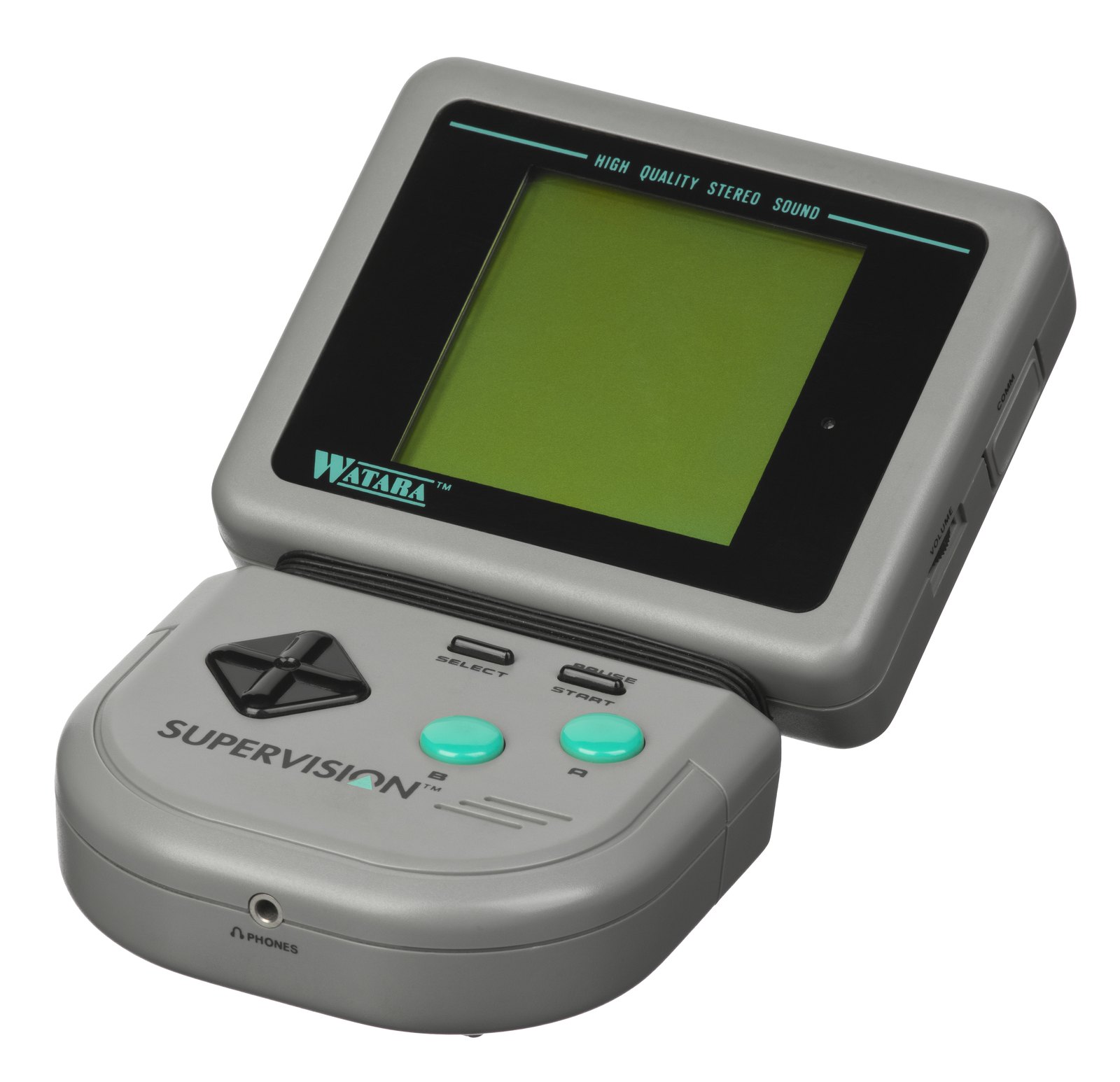
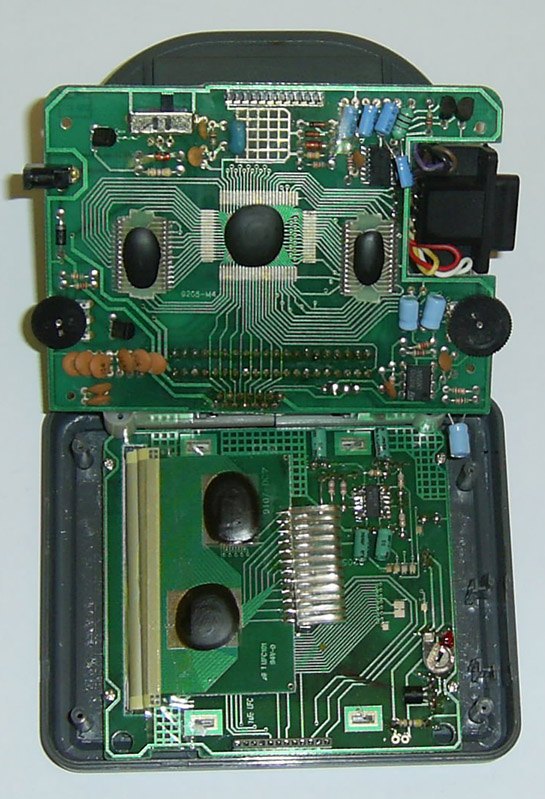
Identification
| Field | Value |
|---|---|
| Manufacturer | Watara |
| Year | 1992 ("before Christmas 1992") |
| CPU | W65C02 @ 4 MHz |
| Sound | machine-specific device @ 4 MHz — 2 tonal + 1 noise channel + stereo audio DMA |
| Screen | 160 × 160 LCD, 4 greys, 61 × 61 mm, 61 Hz |
| Media | cartridge |
| Power | 4 × AA or a 6 V adapter |
| 2-player link | DE-9 connector |
| Construction | glob-top chips — ⚠️ nothing replaceable |
Expected clocks — measurement table ✅
| Component | Frequency | Scope |
|---|---|---|
| W65C02 | 4 MHz | base model |
| Sound device | 4 MHz | same |
The TV Link variants do NOT run at 4 MHz
This is the measurement trap on this machine.
| Variant | CPU clock | Refresh |
|---|---|---|
| Supervision (base, 1992) | 4 MHz | 61 Hz |
| PAL colour TV Link (1993) | 4.43 MHz | 50 Hz |
| NTSC colour TV Link (1993) | 3.56 MHz ⚠️ | 60 Hz |
The PAL row follows the television standard: 4.43 MHz is the PAL subcarrier.
The NTSC row, however, does not — the NTSC subcarrier is 3.579545 MHz, nearly 20 kHz away from the driver's value. That is most likely why its author marked it with a question mark.
⚠️ Important caveat: the MAME driver marks the NTSC value with a bare "?". It is therefore unverified — do not condemn a crystal on that basis alone.
The TV Link accessory
An official accessory allowed play on a television, the picture switching to four colours instead of the handheld's greyscale. The MAME driver knows several variants — TV Link PAL, plus the "TV Link Colored" models in PAL and NTSC.
The full-colour version never existed
A full-colour TV Link was in the works but was cancelled: the console had failed to find its audience. There is no point hunting for one.
Common faults
| Symptom | Likely cause | Lead |
|---|---|---|
| No power | battery contacts, or the power socket | 4 × AA or a 6 V adapter |
| Blurred / ghosting image | ⚠️ may be the original screen | See below |
| Clock "wrong" on a TV Link | nothing — the frequency depends on the model | See the variants table |
| No sound on headphones | stereo audio DMA channel | The speaker is mono: test both |
| Cartridge not recognised | connector contacts | Isopropyl, never an abrasive |
| Dead 2-player link | the DE-9 connector or its cable | An external, accessible failure point |
The blurry screen is a factory defect, not a fault
The machine is known for a poor-quality screen, prone to blurring, to the point that following the action was difficult. That is how it left the factory: replacing the panel will not sharpen the picture.
Procedure — a dead console, step by step ✅
What this adds
Ordered for a console, not for an arcade board: what kills these is almost never the CPU. It is, in real order, the power supply, the capacitors, the drive or the cartridge slot, and only then the logic. → PCB diagnosis
1. The power supply. Two cases, depending on the machine. External brick: ⚠️ read the marking on the machine, next to the socket, and check the adapter against it — voltage and polarity. A centre-negative machine fed centre-positive loses its fuse, sometimes its regulator; do not trust a third-party label or a generic tip. Internal supply (the machine plugs straight into the wall): mains is inside the shell. Unplug, wait, and confirm the large capacitors are discharged before touching the board. Either way, measure under load: a failing supply holds its voltage until it is asked for current.
1b. Battery and its contacts. On this machine, before anything else: corroded battery contacts, or a cell that reads fine off-load and collapses under it, give exactly the symptoms of a dead machine.
2. The fuse. Many of these machines have one right behind the socket — it is the part designed to die. Test it in continuity, out of circuit. A fuse that blows again is a short, not a fuse problem.
3. Capacitors. On most machines of this age this is the default suspect rather than a last resort — leaking SMD electrolytics eat the tracks underneath before they give any other sign. ⚠️ Not all of them are like that: some carry very few and are not recapped on principle. Read what this page says about it before reaching for the iron. → Recap
4. The cartridge connector. Cartridge contacts with isopropyl alcohol, never an abrasive eraser: it takes the gold plating off and the problem comes back worse. On the machine side, inspect the slot pins — splayed, bent or oxidised — and check continuity between slot and board.
5. The screen. Lines, a dead half, a picture that fades: it is almost always the ribbon and its solder joints, not the panel. Reseat before you order anything. If this machine has a TV output — not all of them do — test that too: it tells the screen apart from what feeds it.
6. Still nothing. Now, and only now, the logic: rails on the board, reset, clock, bus. → PCB diagnosis
Repair (technician)
- ⚠️ Do not expect to swap a chip: everything is under epoxy (see the box at the top of this page). The only genuinely repairable points are external: batteries and their contacts, the power socket, the cartridge connector, the DE-9 connector, the screen.
- Check the model before measuring: a PAL TV Link at 4.43 MHz and an NTSC one at ~3.56 MHz are within spec, not drifting.
- The battery compartment first, as on any handheld of this age.
→ Methods: PCB diagnosis · Recap
Modernisation & mods
- ⚠️ Do not host ROMs — method only.
Photos / assets
(To take: the board and its epoxy blobs — the most useful illustration this page could have — the battery compartment, the DE-9 connector, and above all a TV Link accessory if you ever meet one: it is this console's rare part.)
Sources & attribution
Text (synthesis; sources listed for attribution):
- MAME —
src/mame/svision/svision.cpp(GPL-2.0+, driver by Peter Trauner): the W65C02 at 4 MHz and the sound device at 4 MHz; the 160 × 160 LCD at 61 Hz; and the variants with their own clocks — Super Vision (1992), PAL colour TV Link (1993) at 4,430,000 Hz / 50 Hz, NTSC colour TV Link (1993) at 3,560,000 Hz / 60 Hz, the latter value being followed by a "?" in the driver and therefore unverified, plus a TV Link PAL entry — https://github.com/mamedev/mame/blob/master/src/mame/svision/svision.cpp -
Wikipedia — Watara Supervision (CC-BY-SA): the release "before Christmas 1992"; the 65C02 running at 4 MHz (agreeing with MAME); the "160 × 160 pixels, 4 greys LCD" measuring 61 × 61 mm; power from "4 × AA batteries or 6V AC/DC adapter"; sound as "2 Tonal and 1 Noise Channel plus additional audio DMA stereo output channel" with built-in speaker and headphone jack; the TV Link accessory, games then displaying "in four colors", and the cancelled full-colour TV Link; the two-player link on a DE-9 connector; and the "poor quality screen which was prone to blurring" — https://en.wikipedia.org/wiki/Watara_Supervision
-
Wikipedia — Gamate (CC-BY-SA): this is the article documenting the Supervision's glob-top construction — "Unlike other Taiwanese or Hong Kong Game Boy competitors, such as the Watara Supervision, Hartung Game Master and the Mega Duck, the Gamate's internal hardware contains no epoxy covered chips" — https://en.wikipedia.org/wiki/Gamate
Image:
-
supervision-interieur.jpg— m.c.j. de Jong (mahjongg), Public domain — https://commons.wikimedia.org/wiki/File:Supervision_internals_open.jpg -
supervision-console.jpg— Evan-Amos, Public domain — https://commons.wikimedia.org/wiki/File:Watara-Supervision-Tilted.jpg


Review & corrections
How this space is used
Spotted a wrong value, an outdated procedure, a chip reference that does not match your board? Say so here, with what you observed (model, board revision, serial number, measurement). Every report is cross-checked against a source before anything changes — an unverifiable correction is published as “reported by …, not cross-checked” rather than silently applied.
Reading is open to everyone; posting requires signing in with Discord. Reports from the wiki's declared reviewers are handled first; anyone else's are read too, but go through a human before anything is changed.