Konami System 573 converts
The System 573 is an arcade PlayStation dedicated to Bemani games (DDR, Beatmania…). A game = data (CD/DVD, internal flash, PCMCIA card) + a security cartridge that pairs to the hardware. Converting/installing means writing the right media and handling the security cartridge — greatly eased by the homebrew tool 573in1.
| Field | Value |
|---|---|
| Platform | Konami System 573 (digital / analog) |
| Base | PlayStation 1 (R3000A, PS1 GPU/SPU) |
| Type | game install: media + security cartridge (paired) |
| Difficulty | 🟡 (disc install) → 🟠 (serial editing / flashing) |
| Suicide? | yes on the security cartridge (key/serial) + RTC |
📋 Identify a game / disc / cassette by its Konami product code → System 573 per-game catalogue (148 games, code + version, from MAME).
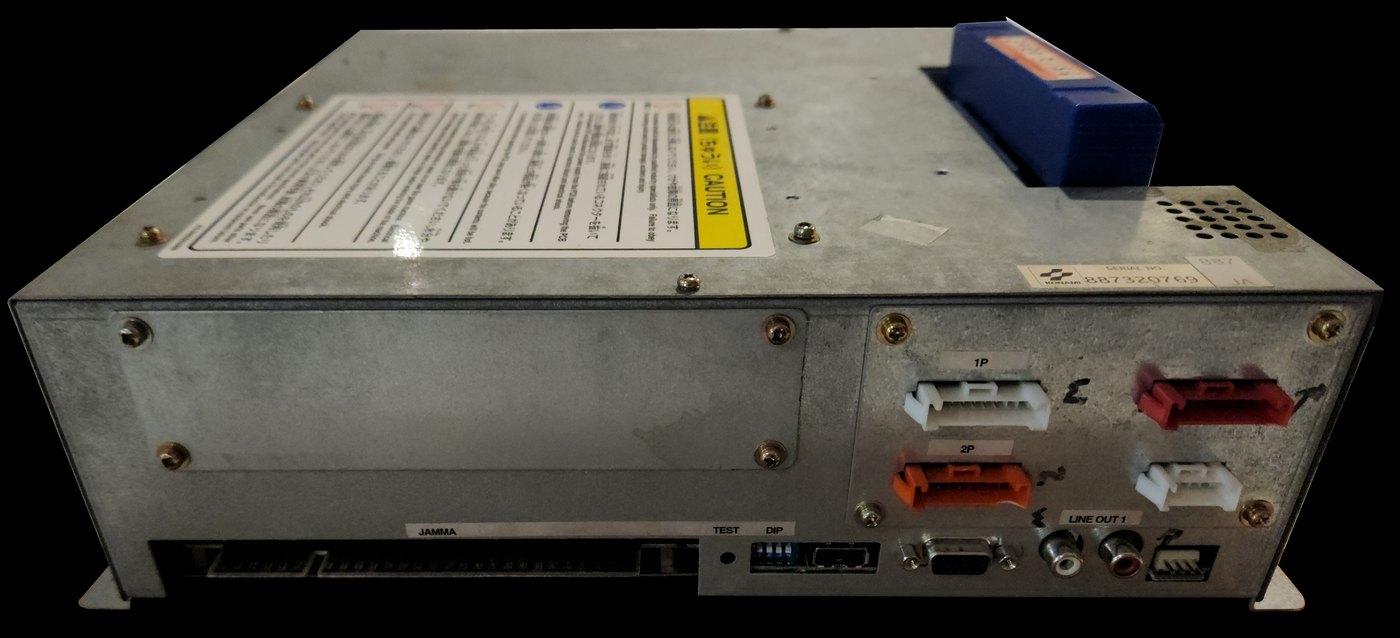
Where a 573 game lives
A 573 game combines several media depending on the title:
| Media | Content |
|---|---|
| CD-ROM / DVD | game data (audio, videos, charts) |
| Internal flash (onboard) | installed program/data |
| PCMCIA flash card | extra data (Bemani songs) |
| Security cartridge | key + serial number, paired to the hardware |
| RTC RAM | clock + persistent data |
The security cartridge (the crux)
- Holds a security EEPROM — two types: X76F041 or ZS01 — with a serial number.
- At install, it pairs to the 573's digital I/O board: once a game is installed, the cartridge is tied to that unit and no longer works as-is on another.
- Hence you can't "just swap" a cartridge between cabinets without editing the serial.
Install / change game (original method)
- Insert the game's install disc (some games have install disc + cartridge distinct from the play disc + cartridge).
- Flip the DIP switch at the back to erase and load the new game into the internal flash.
- The cartridge pairs to the digital I/O during install.
Pairing = trap
Some cartridges bind permanently to the unit at install. Reusing a cartridge on another cabinet requires re-editing its serial (see 573in1).
The key tool: 573in1 (homebrew)
573in1 (spicyjpeg) is the reference maintenance/install tool:
- Dump / erase / write binary images to: internal flash, PCMCIA flash cards, RTC RAM.
- Dump the security cartridge EEPROMs and edit the serial number → reinstall a game on another unit / reuse a same-type cartridge for another compatible game.
- Handles both cartridge types via its databases:
x76f041.dbandzs01.db.
→ This is what makes preservation and installs doable without original Konami gear.
"Patched" games without a cartridge
The community has produced patched versions of some games that no longer need the security cartridge — useful to run a title when the cartridge/serial is dead. (Use with your own data.)
Digital vs Analog 573
- Digital 573: fitted with the digital I/O board (Bemani: DDR, Beatmania…) — it's what pairs to the cartridge.
- Analog 573: without that board (simpler games). Pairing behaviour differs.
RTC & battery
The RTC (clock) has its RAM which can hold data/serial; a dead battery can cause errors. 573in1 can dump/write the RTC RAM.
Procedure (summary)
- Identify digital vs analog and the cartridge type (X76F041 / ZS01).
- Boot 573in1 (via a homebrew launch method) to back up flash + cartridge serial (preservation before any manipulation).
- Install the target game (install disc + DIP, or direct flash/PCMCIA write via 573in1).
- Edit the cartridge serial if you reuse it for another game/unit.
Before / after
- Clean install: the 573 cabinet runs the wanted game from its flash.
- Serial editing: a cartridge tied to one unit becomes usable elsewhere / for another compatible title.
Where to read more
- 573in1 (spicyjpeg) — tool + docs — https://github.com/spicyjpeg/573in1
· archived with us:
573in1.tar.gz(source) · README - Arcade Otaku Wiki — Konami System 573 — https://wiki.arcadeotaku.com/w/Konami_System_573
- Patched cartridge-less games: Arcade-Projects — https://www.arcade-projects.com/
Sources & attribution
- spicyjpeg — 573in1 (flash/PCMCIA/RTC, X76F041/ZS01 EEPROM, serial editing) — https://github.com/spicyjpeg/573in1
- Arcade Otaku Wiki — Konami System 573 (CD/DVD/Flash + cartridge, pairing) — https://wiki.arcadeotaku.com/w/Konami_System_573
-
Internal page: Konami System 573 Image:
-
system573-boitier.jpg— Jhonny, CC BY-SA 4.0, Wikimedia Commons — https://commons.wikimedia.org/wiki/File:Bemani_System_573.png

Review & corrections
How this space is used
Spotted a wrong value, an outdated procedure, a chip reference that does not match your board? Say so here, with what you observed (model, board revision, serial number, measurement). Every report is cross-checked against a source before anything changes — an unverifiable correction is published as “reported by …, not cross-checked” rather than silently applied.
Reading is open to everyone; posting requires signing in with Discord. Reports from the wiki's declared reviewers are handled first; anyone else's are read too, but go through a human before anything is changed.