Sega Lindbergh (cabinets)¶
The Lindbergh is Sega's first x86 (PC) arcade system (2005, launched with The House of the Dead 4). This page covers the cabinets built around it — chiefly the Lindbergh Universal, a sit-down LCD HD / JVS cabinet. Not to be confused with the City-series candy cabs: the Lindbergh targets big dedicated titles (rail-shooters, racers).
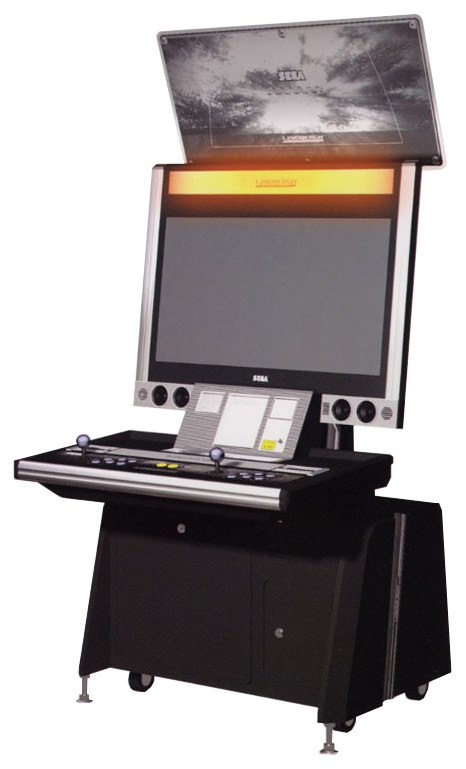
The Lindbergh system (recap)¶
Unlike classic PCBs, the Lindbergh is an arcade PC: Intel Pentium 4 (3.0 GHz) CPU, NVIDIA GeForce 6 (256 MB GDDR3) GPU, 1 GB DDR-400, running embedded Linux (MontaVista). JVS I/O, DVI/VGA (HD) video out. Revisions are identified by the case-lid colour:
| Variant (board) | Note |
|---|---|
| Lindbergh Yellow | standard version (most common) |
| Lindbergh Red / Blue | revisions with different specs |
(These are board variants, not cabinet variants.)
Lindbergh Universal — Identification¶
| Field | Value |
|---|---|
| Manufacturer | Sega |
| Year | 2007 (Arcade Otaku) |
| Type | Dedicated sit-down cabinet (HD LCD) |
| Screen | LCD 32″ widescreen, 31–60 kHz (WXGA 1360 × 768 per Highway Games) |
| I/O | JVS |
| Power | AC 100 V — 440 W / 6 A (Japanese SD manual) |
⚡ Connector & power¶
| Aspect | Value |
|---|---|
| Connector | JVS (no native JAMMA — arcade PC system) |
| Screen | LCD 32″ 16:9, 31–60 kHz / HD — no CRT to realign |
| Power | AC 100 V — 440 W / 6 A (Japan, SD) · AC 230 V — 460 W / 2 A (Europe, Upright) |
| Dimensions | 820 × 827 × 1770 mm (W×D×H) — Japanese SD manual |
| Dimensions, European version | 820 × 827 × 1800 mm cabinet · 2100 mm sign board included (exact height 2,097) |
| Weight | 122 kg (both manuals: with Lindbergh board mounted) |
Two manufacturer manuals, archived — and they describe different variants
| SD, シットダウンタイプ | Upright Type | |
|---|---|---|
| Document | Japanese manual 420-6942, print run E1-0604, 58 pp. | Manual 420-6942UK, SEGA AMUSEMENTS EUROPE, © 2007, 88 pp. |
| 所要面積 / Area | 820 mm (幅) × 827 mm (奥行) | 820 mm (W) × 827 mm (D) |
| Height | 高さ: 1,770 mm | Cabinet 1,800 · Complete cabinet 2,100 · overall 2,097 |
| Mass | 122 kg (LINDBERGH ボード搭載時) | 122 kg (with Lindbergh board mounted) |
| Consumption / current | 440 W, 6 A (AC 100 V 50/60 Hz) | 460 W, 2 A (AC 230 V, 60 Hz) |
| Monitor | 32V型ワイド液晶 | 32V wide-screen LCD |
Both spec sheets are perfectly legible — no more interpreting a glyph on a flyer. The Japanese one additionally requires a single-phase AC 100 V, 15 A minimum supply (§2).
⚠️ These are not two translations of one document. The Japanese cover reads リンドバーグユニバーサルキャビネットSD(シットダウンタイプ), the European one Lindbergh Universal Cabinet Upright Type. Same footprint, same mass, same panel — but 30 mm apart in height, and only the European one distinguishes cabinet from cabinet + sign board. This wiki does not arbitrate: both values are published with their document. The footprint comparison uses the Japanese SD**, consistent with the other cabinets in the chart.
The European manual had been in this wiki since 29 July
I searched the web for it, found it on Internet Archive, archived it — and it was already
in the repository, byte for byte (identical SHA-256), under pcb/sega/manuals/, linked
from the Lindbergh board page.
All that time this page was publishing a reading of a flyer at 5 pixels and stating that "no source documents the 2100 mm". The source was one directory away.
This was not a documentation problem but a filing one: a cabinet manual shelved with the boards, because the PDF is called "Lindbergh" — which names both the PC system and the cabinet. The duplicate has been deleted; this page now points at the original copy.
Two markets, two consumption figures — and this wiki confused them
This page announced 400 W as a correction of Arcade Otaku's "460 W". That was wrong twice over:
- Arcade Otaku was reproducing the European manual — 460 W at 230 V is correct;
- and the Japanese manual gives 440 W, 6 A, not 400 W.
This is the New Astro City trap, whose manual archived here is the European 230 V edition — and back into which this wiki has just fallen.
⚠️ The European manual carries an internal inconsistency: its Specification page is localised to 230 V, but its §4 still calls for "single-phase 100V AC" wiring, and its parts list carries 100 V fans and lamp. Only the spec sheet was converted.
The Japanese flyer is no longer the source of the figures
On the flyer (© SEGA 2006.2, SD-4840), the ■仕様 strip is 850 px wide and its glyphs 5 px tall. This wiki read 1,789, then 1,769, then 400 W off it, without ever being able to settle the matter.
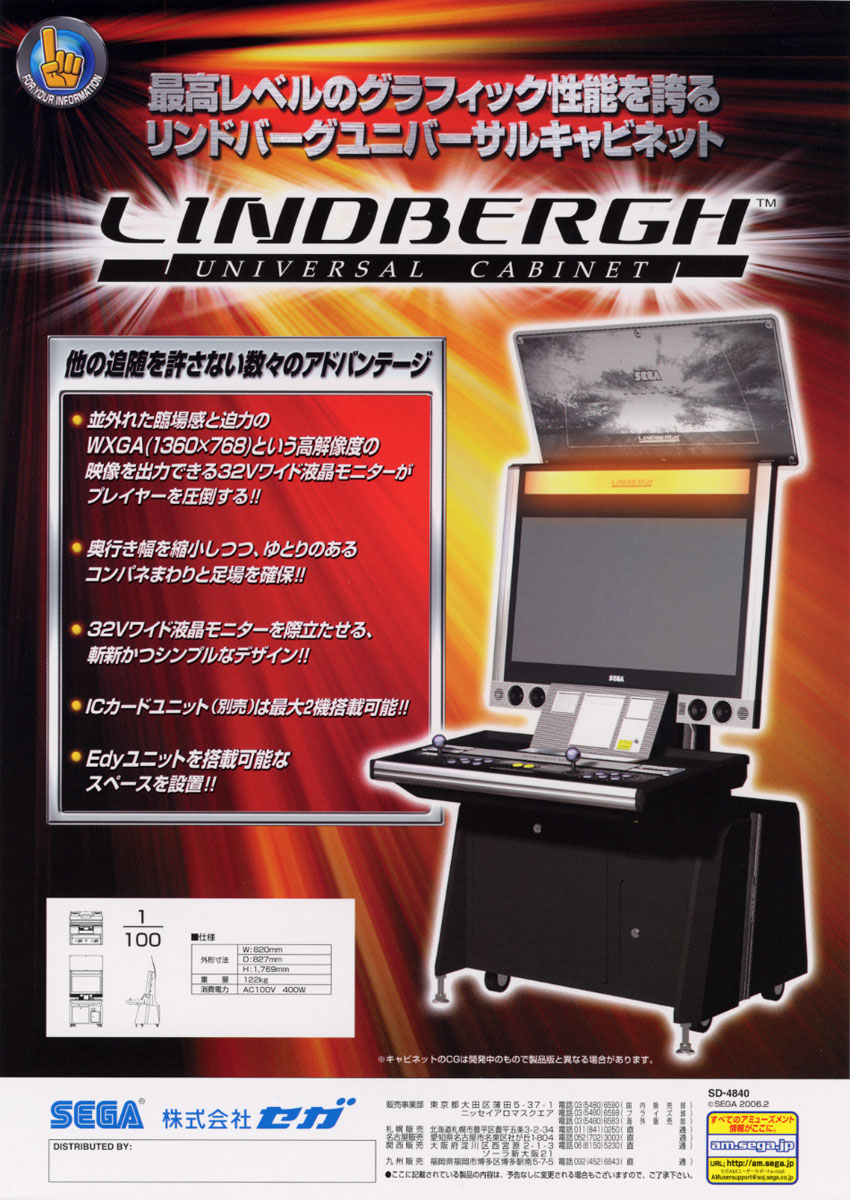
The Japanese manual gives 1,770 mm and 440 W, legibly. The flyer's figures are therefore no longer published — neither as a value nor as a caveat. What stays sharp on the scan and agrees: 820, 827, 122 kg, © SEGA 2006.2, and the 32″ WXGA 1360 × 768 panel.
Only one of the four “corrections” was one
This page published 827 wide by 820 deep, 1,800 mm tall and 460 W, after Arcade Otaku. All three were "corrected" against the Japanese flyer. The tally, once the European manual is opened:
| Original value | Verdict |
|---|---|
| 827 × 820 | ❌ genuinely swapped — the flyer labels W: 820mm · D: 827mm. It is the seventh width/depth inversion found on this wiki |
| 1,800 mm | ✅ right — it is the "Cabinet" figure in the manual's table 4 |
| 460 W | ✅ right — it is the consumption at 230 V, European market |
| 2,100 mm "with marquee" | ✅ right, and wrongly removed: it is the manual's "Complete cabinet" |
In other words one of Arcade Otaku's four values was wrong, and three were removed or replaced without cause. The Japanese flyer did not contradict them: it describes the other variant.
And the value that replaced them was wrong too: the flyer was read as 400 W where the Japanese manual prints 440 W, 6 A.
The flyer also pins down the panel: 32″ wide, WXGA 1360 × 768, and up to two IC card units as an option.
(Sources: archived 2006 Sega flyer for the dimensions, weight, consumption and panel. Arcade Otaku / Highway Games for the rest.)
→ Detailed wiring: JVS cabinet → JVS wiring, JVS I/O boards and Control panels.
Technical notes¶
- Arcade PC, not a PCB: maintenance is closer to a PC (drive/CF, PSU, cooling) than to a CRT chassis. The game lives on the Lindbergh media + a security dongle.
- HD output (DVI/VGA) → LCD 32″ 31–60 kHz: no CRT geometry to set.
- JVS I/O only — controls (triggers, wheel/pedals depending on the game) go through a JVS I/O board.
- Universal sit-down: designed to host different Lindbergh games (rail-shooters, racers) rather than a single title.
Lindbergh vs candy cab¶
| Candy cab (Astro/Blast/New Net City) | Lindbergh Universal | |
|---|---|---|
| Core | interchangeable JAMMA/JVS PCB | dedicated arcade PC (dongle) |
| Screen | CRT 29″ (tri-sync) | LCD 32″ HD |
| Format | compact seated, swappable panel | dedicated sit-down |
Common faults¶
| Symptom | Likely cause | Lead |
|---|---|---|
| No image | LCD panel / scaler / Lindbergh PC | Diagnose LCD; check the Lindbergh source |
| Game won't boot | dongle / media (CF/disk) | Check dongle + Lindbergh media |
| Dead controls | JVS I/O / harness | Diagnose JVS |
| Overheat / reboot | PC cooling, dust | Clean, check fans |
Procedure — a cabinet that will not start ✅¶
There is a CRT in this cabinet
The tube stays charged with the cabinet unplugged, and the anode cap is the first thing your hand meets behind the monitor. Discharge it, work with one hand, and never alone if you can help it. → CRT safety
This cabinet exists in both low and high voltage
This page documents both a low-voltage version (Japanese or North American market) and a 220-240 V one. Nothing here tells you which one you have.
Read the machine's label before plugging anything in. A step-down transformer on a cabinet already wired for 240 V is every bit as destructive as 230 V into a cabinet built for 100 V. → Cabinet power
What this adds
Ordered for a cabinet, not for a board: mains, low-voltage supply, loom, monitor, then the game. The overwhelming majority of "dead cabinets" are dead for a reason that has nothing to do with the PCB — which is why the board comes last here.
1. Mains, and what sits between it and the cabinet. The switch, the fuse or breaker, the isolation transformer if there is one. A cabinet that shows no sign of life at all is almost never electronic.
2. The low-voltage supply — measured under load. Aim for +5 V where power reaches the board — the JAMMA edge, or the JVS power connector, depending on the cabinet — with the game running, not on an idle bench. If the supply has an adjustment (most candy and JVS bricks do; the ATX brick in a PC cabinet does not), do it then and not before: set off-load, it leaves a board that boots and then glitches. With no adjustment the measurement still earns its keep — it tells you whether the supply holds. Check +12 V too, and −5 V if the board uses it: many do not, and an ATX brick does not provide it. → Cabinet power
3. The loom and the connector. Reseat, and check the grounds — a cabinet with a poor ground gives rolling picture, phantom inputs and noise, all at once, and none of it looks like a wiring fault. → Wiring
4. The monitor. This page does not give a single monitor spec — it covers several cabinets. Check which one you have before concluding anything. CRT: no picture but the tube is warm and there is EHT — that is sync or video, not the tube. No EHT at all — chassis. A picture that shrinks, wanders or shifts colour is a chassis recap, and on these monitors that is a scheduled job, not a repair.
5. Scan rate — the mismatch that breaks nothing. If the board's rate is not one the monitor accepts, you get no picture and nothing is faulty. Check what this cabinet takes against what the board puts out before opening anything. → Modernising a cabinet
6. The control panel. Microswitches and the loom, in that order. A single dead direction is a switch; a whole player dead is the loom or its ground. → Control panels
7. Coin mech and sound. Last, because they hide nothing: a mech that no longer registers is usually dirty or misadjusted, and silence with a good picture points at the amplifier and its supply rails.
Repair & modern use¶
The cabinet hosts a PC: PC + LCD maintenance (no CRT recap). Many collectors keep the original Lindbergh or repurpose the shell around another JVS system. See also the deluxe / sit-down cabinets overview.
Photos / assets¶
(To add: Lindbergh Universal, Lindbergh PC case, JVS I/O board.)
Repair & maintenance
Modernise (video, PSU, JVS, upscaler, PC/FPGA) → Modernising a cabinet. PC base (Lindbergh) + screen: PSU/board → Recap · diagnosis → PCB fault-finding.
Sources & attribution¶
- Sega — LINDBERGH UNIVERSAL CABINET flyer, © SEGA 2006.2 (SD-4840), ■仕様 box — archived here: flyer — dimensions, weight, consumption, panel. Found via The Arcade Flyer Archive
- Arcade Otaku Wiki — Sega Lindbergh Universal (2007, 32″ LCD 31–60 kHz, JVS, sit-down) — ✅ their infobox was reproducing the European manual (1800, 2100, 460 W); only their width/depth was swapped — https://wiki.arcadeotaku.com/w/Sega_Lindbergh_Universal
- Sega — リンドバーグユニバーサルキャビネット SD(シットダウンタイプ), manual ref. 420-6942, print run E1-0604, 58 pp., archived here — ⚠️ a 300 dpi reduction (44 MB) of the original 600 dpi scan (127 MB); the 仕様 box and the 総合配線図 wiring diagram were checked legible after reduction — 仕様 box: 820 × 827, 高さ 1,770 mm, 122 kg, 440 W / 6 A at AC100V, 32V型ワイド panel. Scanned and shared by Ziggy Cheetos Dust on Arcade-Projects
- Sega — Lindbergh Universal Cabinet Upright Type, manual ref. 420-6942UK, SEGA AMUSEMENTS EUROPE LTD, © SEGA CORPORATION 2007, 88 pp. — archived here — Specification page (overall height 2,097 mm, 122 kg, 460 W / 2 A at AC230V) and table 4 "Main dimensions" (Cabinet 1,800, Complete cabinet 2,100). Source: Internet Archive
- Highway Games — Lindbergh Universal (LCD 32″ widescreen, WXGA 1360×768) — https://www.highwaygames.com/arcade-machines/lindbergh-universal-9628/
- Sega Retro / Fandom & Liquisearch — Sega Lindbergh (Pentium 4 3.0 GHz, GeForce 6, 1 GB DDR-400, MontaVista Linux, Yellow/Red/Blue variants) — https://sega.fandom.com/wiki/Lindbergh_Arcade_Board
- Internal pages: Deluxe / sit-down cabinets · JVS wiring
Image:
-
lindbergh-borne.jpg— catalogue view, source Hard*Candy (⚠️ no licence statement anywhere on the site) — https://www.hard--candy.com/wiki/candy/LindberghUniversal
Review & corrections
How this space is used
Spotted a wrong value, an outdated procedure, a chip reference that does not match your board? Say so here, with what you observed (model, board revision, serial number, measurement). Every report is cross-checked against a source before anything changes — an unverifiable correction is published as “reported by …, not cross-checked” rather than silently applied.
Reading is open to everyone; posting requires signing in with Discord. Reports from the wiki's declared reviewers are handled first; anyone else's are read too, but go through a human before anything is changed.