Bandai Playdia
A Japanese CD console from 1994, aimed at children and sold with a wireless infrared controller. A technical curiosity: it is the only 8-bit machine of the fifth generation, at a time when its rivals were moving to 32 and 64 bits.
A poorly documented machine — this page is deliberately short
The Playdia has no MAME driver. The values below are the nominal figures given by Wikipedia: they have been neither corroborated by a technical source nor measured on a board. That is why this page carries no measurement table — we cannot tell you what you should read at the bench.
If you open a Playdia, the markings on the board are worth more than this page — and we would like to hear them.
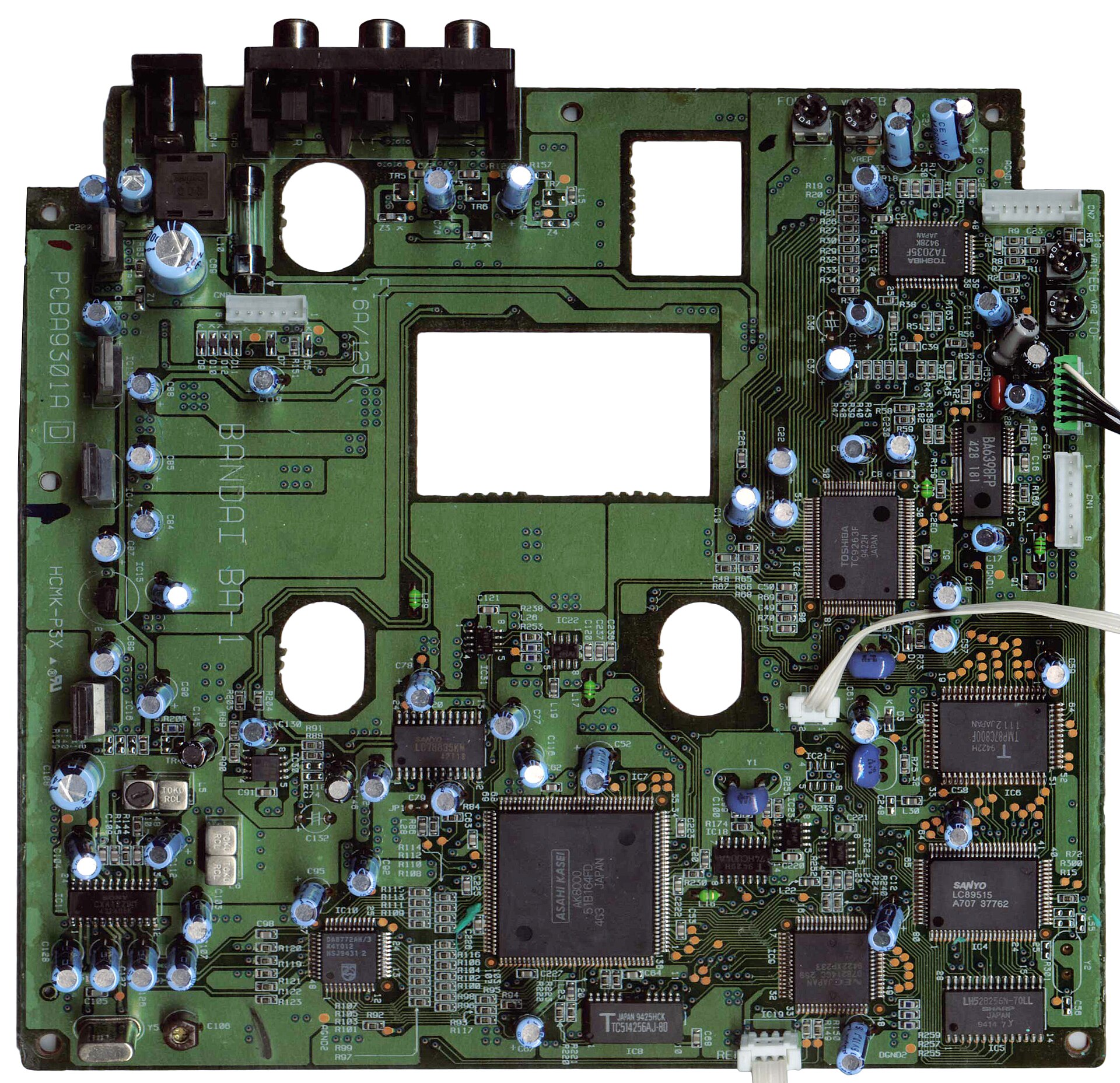
The Playdia board, silkscreened BANDAI BA-1. It confirms the chip list below: you can read Asahi Kasei's AK8000, Toshiba's TMP87C800F, the TC9263F and TA2035F, Sanyo's LC89515 and LC78835KN, the Philips DA8772AH and the Sharp LH52B256. Photo by Incog88, CC BY-SA 3.0.
Identification
| Field | Value |
|---|---|
| Manufacturer | Bandai |
| Year | 1994, Japan only |
| Launch price | ¥24,800 |
| Processors | NEC μPD78214GC 8-bit @ 12 MHz and Toshiba TMP87C800F 8-bit @ 8 MHz (Z80 derivative) |
| Audio / video | Asahi Kasei AK8000 · Sony CX1229M NTSC/PAL decoder |
| CD section | Sanyo LC89515 (host interface) · Toshiba TC9263F · Toshiba TA2035F servo · Rohm 6398FP motor driver |
| Memory | Sharp LH52B256 (32K × 8 SRAM) · Toshiba TC514256JAJ (256K × 4 DRAM) |
| Conversion | Philips DA8772AH (triple 8-bit DAC) · Sanyo LC78835K (18-bit DAC) |
| Media | CD-ROM |
| Controller | wireless infrared — 2 AAA batteries, storable in the console |
| Audience | children, mainly of primary-school age |
| Library | ~33 commercial titles, 1994-1996 |
| End | discontinued in 1996 |
What to know before opening one
- No BIOS and no menu. With no disc in, the console shows nothing but a blue screen. That is normal behaviour: a blue screen therefore proves nothing about the machine's condition beyond the fact that it powers up and outputs a picture.
- The controller is infrared. A console that "doesn't respond" does not necessarily have a console problem: controller batteries, a dirty IR window, or the receiver. Check the link before the board. ⚠️ This last point is the wiki's own reasoning, not a documented fact: the source establishes only that the controller is infrared.
- CD-ROM drive. As on any optical console of this generation, the mechanism and its laser are the wear parts. Nothing Playdia-specific is documented here — the general methods apply.
- Two 8-bit processors, one of them a Z80 derivative. We do not have the detail of how the work is split between them.
→ Methods: PCB diagnosis · Recap
A second life in the arcade
The unsold units became coin-ops
After the 1996 discontinuation, Banpresto, a Bandai subsidiary, converted the unsold consoles into coin-operated Micha King machines. A Playdia found inside an arcade cabinet is therefore not necessarily somebody's home-made conversion.
Modernisation & mods
- ⚠️ Do not host ROMs or disc images — method only.
Procedure — a dead console, step by step ✅
What this adds
Ordered for a console, not for an arcade board: what kills these is almost never the CPU. It is, in real order, the power supply, the capacitors, the drive or the cartridge slot, and only then the logic. → PCB diagnosis
1. The power supply. Two cases, depending on the machine. External brick: ⚠️ read the marking on the machine, next to the socket, and check the adapter against it — voltage and polarity. A centre-negative machine fed centre-positive loses its fuse, sometimes its regulator; do not trust a third-party label or a generic tip. Internal supply (the machine plugs straight into the wall): mains is inside the shell. Unplug, wait, and confirm the large capacitors are discharged before touching the board. Either way, measure under load: a failing supply holds its voltage until it is asked for current.
2. The fuse. Many of these machines have one right behind the socket — it is the part designed to die. Test it in continuity, out of circuit. A fuse that blows again is a short, not a fuse problem.
3. Capacitors. On most machines of this age this is the default suspect rather than a last resort — leaking SMD electrolytics eat the tracks underneath before they give any other sign. ⚠️ Not all of them are like that: some carry very few and are not recapped on principle. Read what this page says about it before reaching for the iron. → Recap
4. The drive. On this machine it is the dominant failure point. In order: does the tray move, does the disc spin, is the lens clean (cotton bud, isopropyl alcohol, no pressure), do the rails slide freely. A laser that no longer reads gets replaced; the gain pot is not something to tweak blind — that is the move that finishes off a laser that was still good.
5. Video output. Isolate the machine from the display: another cable, another TV, another input. A sizeable share of "dead consoles" are a dead cable, or a display that will not lock onto what this machine outputs — see the video section of this page for what that is.
6. Still nothing. Now, and only now, the logic: rails on the board, reset, clock, bus. → PCB diagnosis
Photos / assets
(To take: the motherboard with both processors and their markings legible, the infrared receiver, and the CD mechanism. This page is short of everything: any board photo at all would be a gain.)
Sources & attribution
Text (synthesis; a single source, for want of better):
- Wikipedia — Playdia (CC-BY-SA): the release "exclusively in Japan in 1994" at ¥24,800; the NEC μPD78214GC 8-bit @ 12 MHz and Toshiba TMP87C800F 8-bit @ 8 MHz (Z80 derivative) processors; the CD-ROM media; the wireless infrared controller with two AAA batteries storable in the console; the target audience ("the target age group was set mainly for elementary school students"); the roughly thirty titles released between 1994 and 1996; the observation that "Playdia is the only 8-bit fifth-generation game machine"; the 1996 discontinuation; and the conversion of unsold stock by Banpresto into coin-operated Micha King machines; the chip list reproduced in the identification table (AK8000, CX1229M, LC89515, TC9263F, TA2035F, 6398FP, LH52B256, TC514256JAJ, DA8772AH, LC78835K); and the fact that "there is no BIOS or menu when the user starts the console without a disc, all that shows is a blue screen" — https://en.wikipedia.org/wiki/Bandai_Playdia
Why there is no MAME source here
Unlike the other consoles on this wiki, no MAME driver exists for the Playdia —
verified two ways: the src/mame/bandai/ directory holds only the Design Master, the
RX-78, the SV-8000 and the WonderSwan, and MAME's full machine list contains no
occurrence of "playdia" at all. That is why the frequencies above remain nominal
catalogue values rather than values to measure.
Image:
-
playdia-carte.jpg— Incog88, CC BY-SA 3.0 — https://commons.wikimedia.org/wiki/File%3APlaydia-pcb.jpg

Review & corrections
How this space is used
Spotted a wrong value, an outdated procedure, a chip reference that does not match your board? Say so here, with what you observed (model, board revision, serial number, measurement). Every report is cross-checked against a source before anything changes — an unverifiable correction is published as “reported by …, not cross-checked” rather than silently applied.
Reading is open to everyone; posting requires signing in with Discord. Reports from the wiki's declared reviewers are handled first; anyone else's are read too, but go through a human before anything is changed.