Atari 7800
Atari console (1986), Atari 2600 backward-compatible, with the MARIA graphics chip. Composite output stock (better than the 2600), RGB via mod.
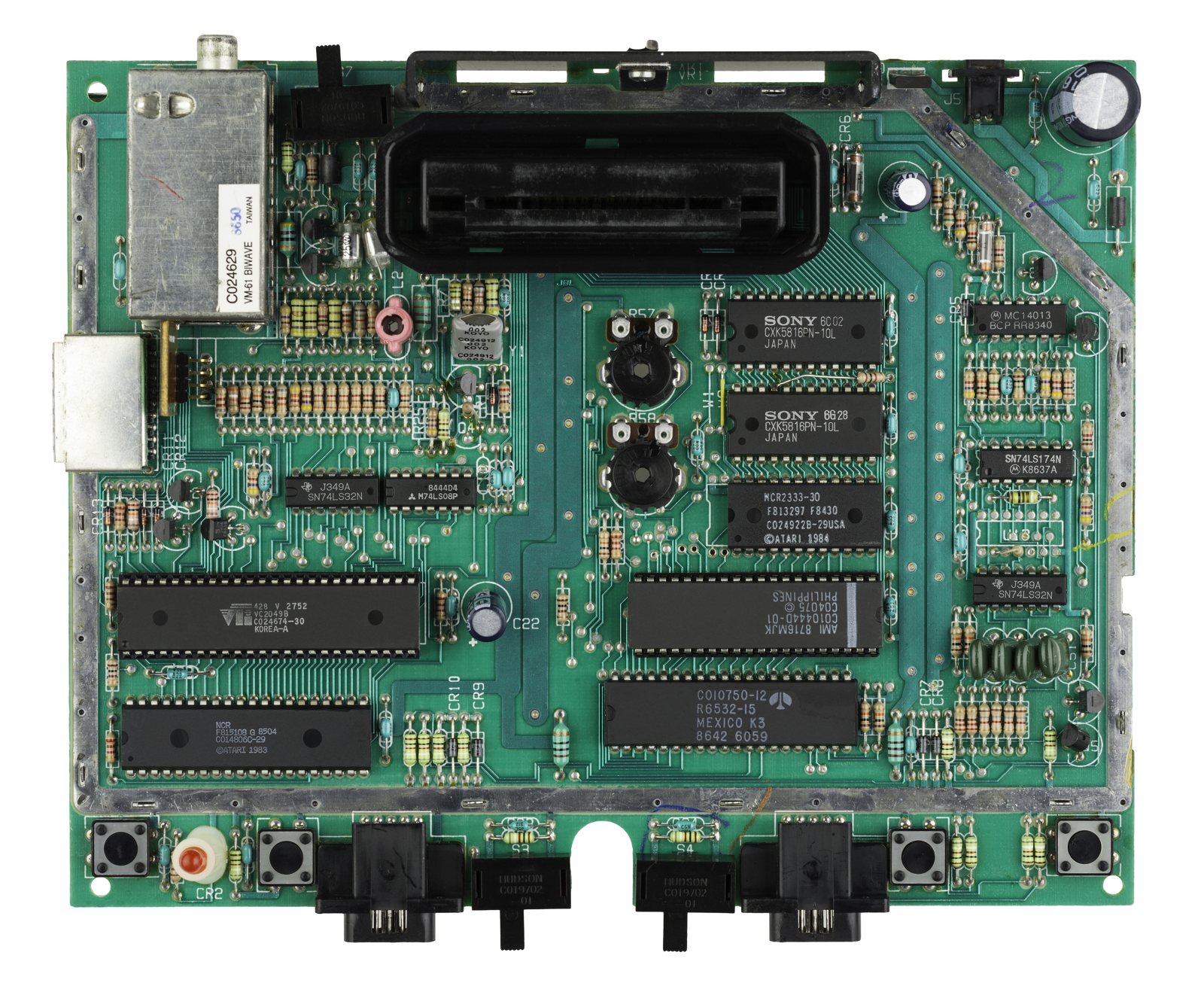
Identification
| Field | Value |
|---|---|
| Manufacturer | Atari |
| Release | 1986 |
| Backward-compat | Atari 2600 |
| Native video output | Composite (RGB via mod) |
| Media | Cartridge |
Architecture
| Block | Chip | Clock | Role |
|---|---|---|---|
| CPU | MOS 6502C "Sally" | ~1.79 MHz | can be paused by MARIA (bus access) |
| Graphics | MARIA | object DMA engine (sprites/tiles) reading a display list — far richer than the 2600 | |
| Sound | TIA (2 voices) | + POKEY on some cartridges (e.g. Ballblazer) for better sound | |
| Memory | 4 KB RAM | ||
| Backward-compat | native Atari 2600 | via the TIA + dedicated circuit |
MARIA favours objects (sprites) at the CPU's expense: during display it freezes the 6502, hence reduced CPU time for game logic.
Cartridge cryptographic signature
A rare trait for an 8-bit console: the 7800 has a digital signature system. The BIOS verifies a signature (a key-based algorithm, RSA-style) on the cartridge; an unsigned game falls back to 2600 mode or refuses to boot. This anti-piracy scheme long complicated homebrew (you had to re-sign the ROM). The key was eventually recovered, which reopened modern development. Worth knowing for flashcarts and launching homebrew.
Note: depending on the BIOS revision, some consoles are more permissive. Many flashcarts bypass the check.
Models & revisions ✅
Two models (NTSC and PAL), and two revisions within the NTSC one.
NTSC 7800 (1986-1992)
Released in North America in May 1986, two years after its announcement. RF output only, a faceplate with a thin rainbow and embossed "Atari 7800 ProSystem" text on the left.
Signature authentication — and its crack
All NTSC 7800s have a BIOS containing an authentication scheme which checks for a "signature" in the inserted game to determine whether it is a 7800 cartridge. This also doubled as a security check to prevent unauthorised games — a problem that had plagued the 2600. It was eventually cracked in the early 2000s, opening the way to homebrew.
| Revision | Period | What you need to know |
|---|---|---|
| With expansion port | 1984, 1985, 1986-1987 | Initially the C025233-001 board. An unused expansion port on the left side, originally intended for a planned LaserDisc add-on: it mostly carries video-related signals and provides no interface to the main system bus, severely limiting its use. The 1984 consoles (Atari Inc. production, halted by the corporate switchover) came from El Paso and Taiwan, but none were sold before May 1986. Some mid-1987 units no longer have the "Expansion Interface" label below the port. |
| No expansion port | 1987-1992 | Port omitted to save costs (the motherboard footprint remains). Manufactured in Taiwan, later units in China. Spotting it: some have an indent or blemish where the label used to be, some even still have the opening with no port populated — but most show no outward evidence at all. ⚠️ All have the C025233-002 board with the timing circuit (see below). |
The C025233-002 timing circuit: it fixes some 2600 games… and breaks others
The revised C025233-002 board incorporates a timing circuit intended to fix compatibility issues with certain Atari 2600 games — Kung-Fu Master and Dark Chambers.
⚠️ But that timing circuit introduces others, notably with Activision titles: The Activision Decathlon, Robot Tank and Space Shuttle: A Journey Into Space.
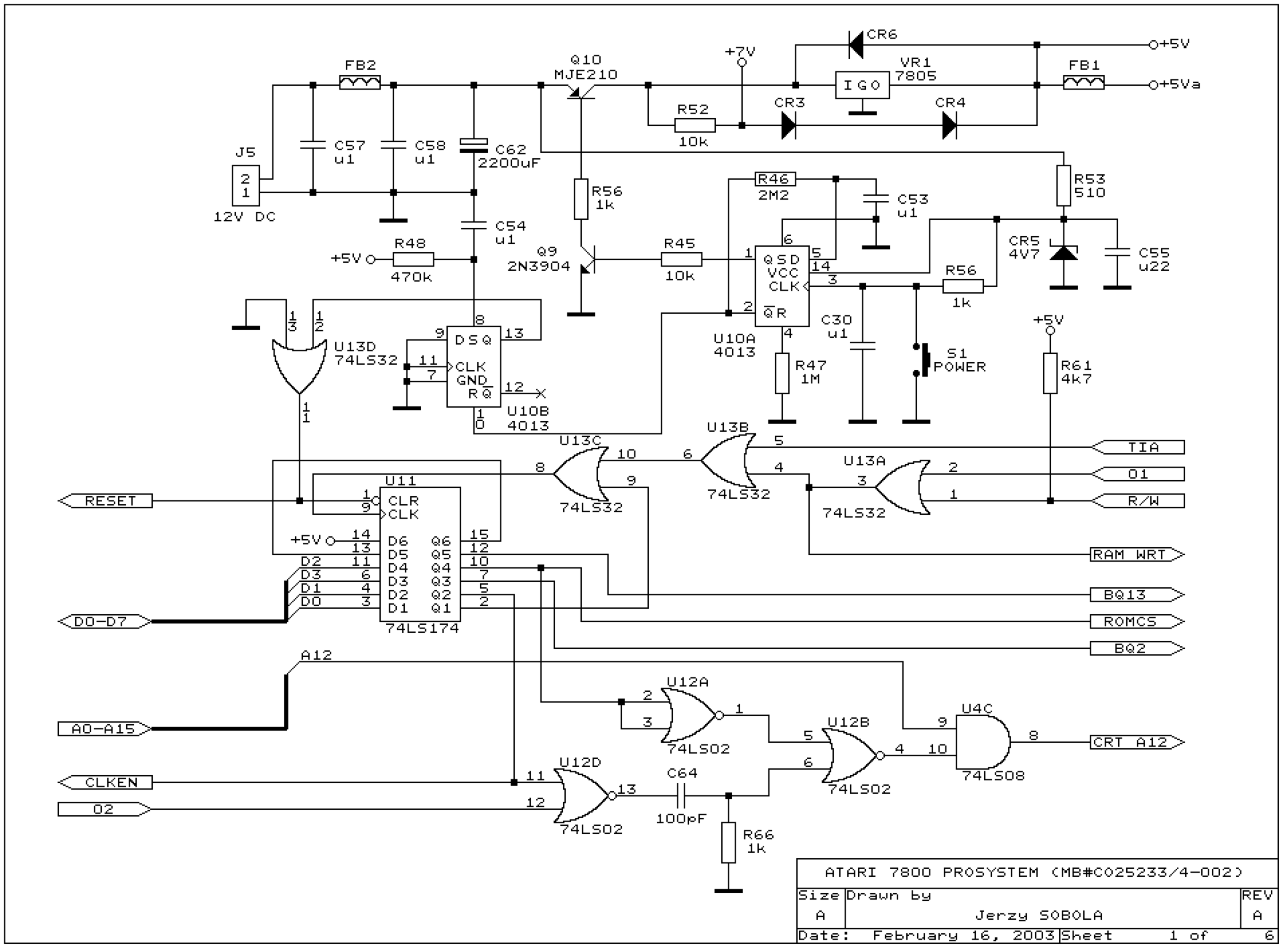
Worth knowing: some C025233-002 boards have the circuit not fully populated, with only a 0 ohm jumper where pins 2 and 4 of U13 (74LS02) would normally be — those consoles then have compatibility similar to older 7800s.
PAL 7800 (1989-1993)
The 7800 did not reach PAL regions until 1989, over three years after North America. PAL units have a different faceplate (similar to most 2600 Jr. consoles) and a green power LED instead of red. Otherwise very similar to NTSC consoles, and also RF-only.
The French exception: an RGB output that isn't really RGB
7800s sold in France eschewed RF output in favour of a 13-pin DIN connector that outputs RGB. ⚠️ But this is actually composite video decoded to RGB — it is not true RGB. The pinout of that connector is almost identical to the Atari ST's. (Source: ConsoleMods, CC-BY-SA.)
Region: why a PAL game won't boot on an NTSC console ✅
NTSC and PAL cartridges look identical, but two factors compound.
1. The BIOS lock (NTSC side only). The NTSC 7800's BIOS looks for a 960-bit encrypted "signature" in the game code to determine whether the cartridge is a 2600 or a 7800 one — and, presumably, to deter unauthorised third-party games. Signature found → the game runs. Signature absent → the system goes into 2600 backwards-compatibility mode and the game will not play.
⚠️ PAL 7800s do not have this encryption scheme, and PAL games do not contain that section of code. Direct consequence: PAL games will not run at all on a stock NTSC 7800. Workaround: swap the BIOS for one that does not perform the check — the PAL BIOS, or the one used in development units.
2. The hardware (and there the BIOS can't help). PAL games are coded specifically for PAL hardware: even with the lock lifted, many will exhibit major graphical glitching or simply not run on NTSC hardware.
The other direction is far more forgiving
PAL 7800s have an easier time running NTSC games — which is fortunate, as a number of 7800 games never received a PAL release. A sizable number of NTSC games run perfectly or have only minor graphical issues.
No power LED: the diagnostic tree ✅
Several conditions can stop a 7800 powering on — check them in this order:
- Check the AC adapter is putting out voltage with a multimeter (set to DC): red probe into the left pin of the power supply on the cable end, black into the other. No voltage → the supply must be replaced or repaired.
- ⚠️ The original Atari power supply has a very thin cable, easily kinked, which develops internal breaks. If the voltage cuts in and out when the cable is moved around, that is the diagnosis: a broken cable, to be repaired.
- The four console buttons use tact switches which become dirty. Check continuity
between the top and bottom legs of the power button's tact switch when pressed down. No
continuity, or intermittent continuity → the switch must be replaced.
- ✅ All four are standard 12 × 12 mm SPST switches, about 4.5 mm in height — readily available from various distributors.
- Check the 7805 voltage regulator, located directly behind the cartridge port and
attached to a large heat sink: it should receive around 9 V and put out 5 V.
- No leg at around 9 V → recheck the power supply, and inspect the power jack for damage, corrosion or failed solder joints.
- No leg at around 5 V → replace the 7805.
- Check the large 2200 µF capacitor in the upper right corner of the motherboard has not blown or leaked.
(Source: ConsoleMods, CC-BY-SA.)
Common faults
| Symptom | Likely cause | Lead |
|---|---|---|
| Cartridge not read | Contacts | Cleaning |
| Degraded image | Composite output / joints | Check, mod if needed |
| No image | Power, MARIA, contacts | Diagnosis |
| No power LED | Brick, broken cable, tactile switch, 7805, 2200 µF cap | Diagnostic tree |
| Power that cuts out and returns when the cable is moved | Internal break in the cable (very thin from the factory) | Repair the brick's cable |
| Front button does nothing | Dirty tactile switch | Test continuity; replace (SPST 12 × 12 mm, ~4.5 mm) |
| A PAL game will not start on an NTSC unit | The NTSC BIOS's 960-bit signature lock | See Region — and the hardware remains an obstacle |
| Activision Decathlon, Robot Tank or Space Shuttle (2600) misbehaving | Timing circuit on the C025233-002 board | Board revision — see the box |
(Few capacitors: recap secondary.)
Procedure — a dead console, step by step ✅
What this adds
Ordered for a console, not for an arcade board: what kills these is almost never the CPU. It is, in real order, the power supply, the capacitors, the drive or the cartridge slot, and only then the logic. → PCB diagnosis
1. The power supply. Two cases, depending on the machine. External brick: ⚠️ read the marking on the machine, next to the socket, and check the adapter against it — voltage and polarity. A centre-negative machine fed centre-positive loses its fuse, sometimes its regulator; do not trust a third-party label or a generic tip. Internal supply (the machine plugs straight into the wall): mains is inside the shell. Unplug, wait, and confirm the large capacitors are discharged before touching the board. Either way, measure under load: a failing supply holds its voltage until it is asked for current.
2. The fuse. Many of these machines have one right behind the socket — it is the part designed to die. Test it in continuity, out of circuit. A fuse that blows again is a short, not a fuse problem.
3. Capacitors. On most machines of this age this is the default suspect rather than a last resort — leaking SMD electrolytics eat the tracks underneath before they give any other sign. ⚠️ Not all of them are like that: some carry very few and are not recapped on principle. Read what this page says about it before reaching for the iron. → Recap
4. The cartridge connector. Cartridge contacts with isopropyl alcohol, never an abrasive eraser: it takes the gold plating off and the problem comes back worse. On the machine side, inspect the slot pins — splayed, bent or oxidised — and check continuity between slot and board.
5. Video output. Isolate the machine from the display: another cable, another TV, another input. A sizeable share of "dead consoles" are a dead cable, or a display that will not lock onto what this machine outputs — see the video section of this page for what that is.
6. Still nothing. Now, and only now, the logic: rails on the board, reset, clock, bus. → PCB diagnosis
Popular mods — what to buy, how
- UAV (Ultimate Atari Video) 🟠: a board that replaces the stock video buffer with clean composite + S-Video (the 7800 ships noisy composite) → transforms the picture. RGB mods also exist. Installs by soldering the small board to the video point.
- Flashcart: the 7800 GameDrive (RetroHQ) or Concerto — 2600 + 7800 games on SD, plug-and-play 🟢.
- Region: PAL/NTSC per game; documented switching.
- PSU recap + cartridge contact cleaning.
Photos / assets
(To add: console, MARIA, AV output.)
Advanced repair
Cartridge contacts + recap; composite video output → RGB mod possible. Methods: PCB fault-finding · Recap · Traces & vias.
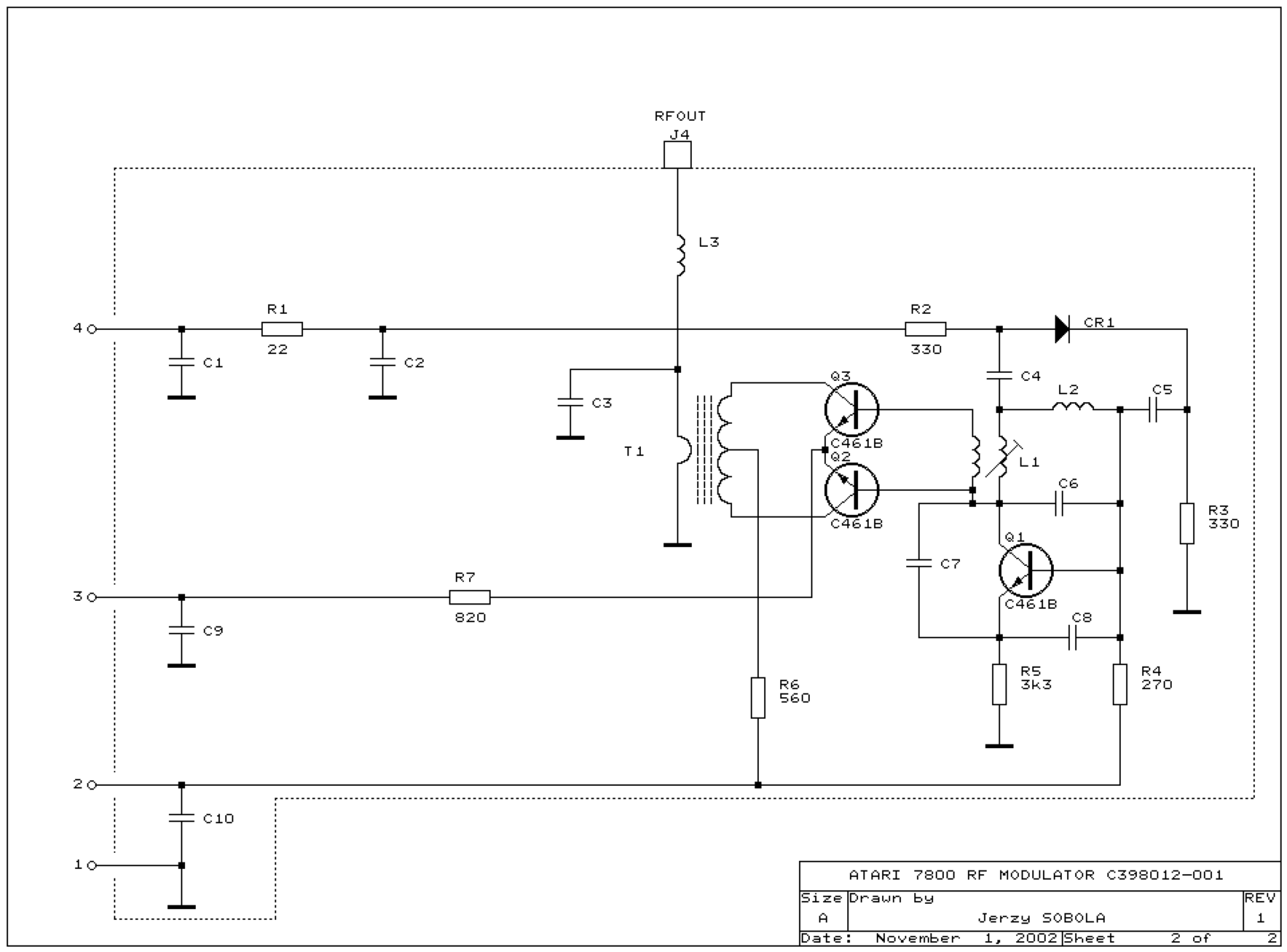
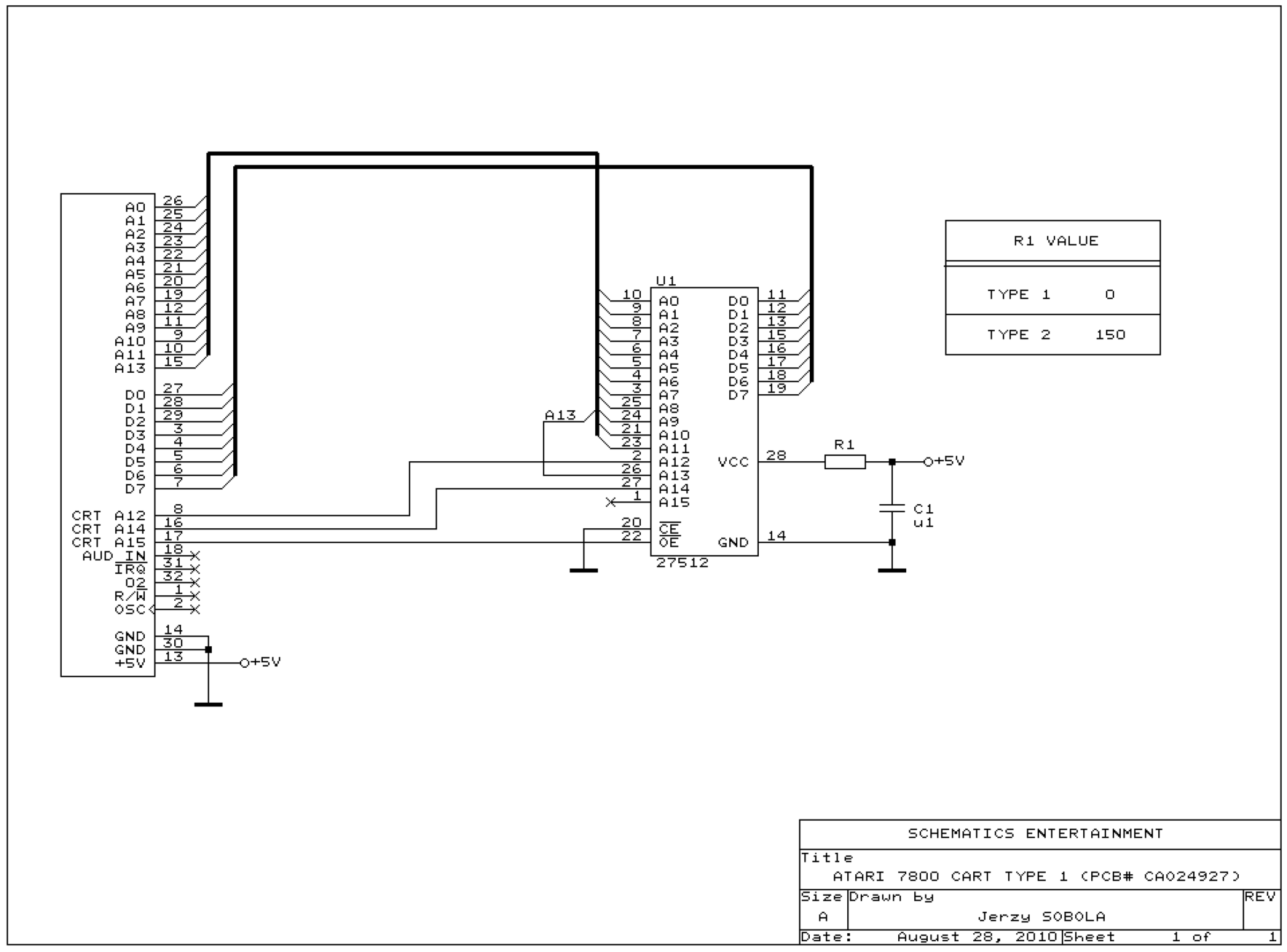
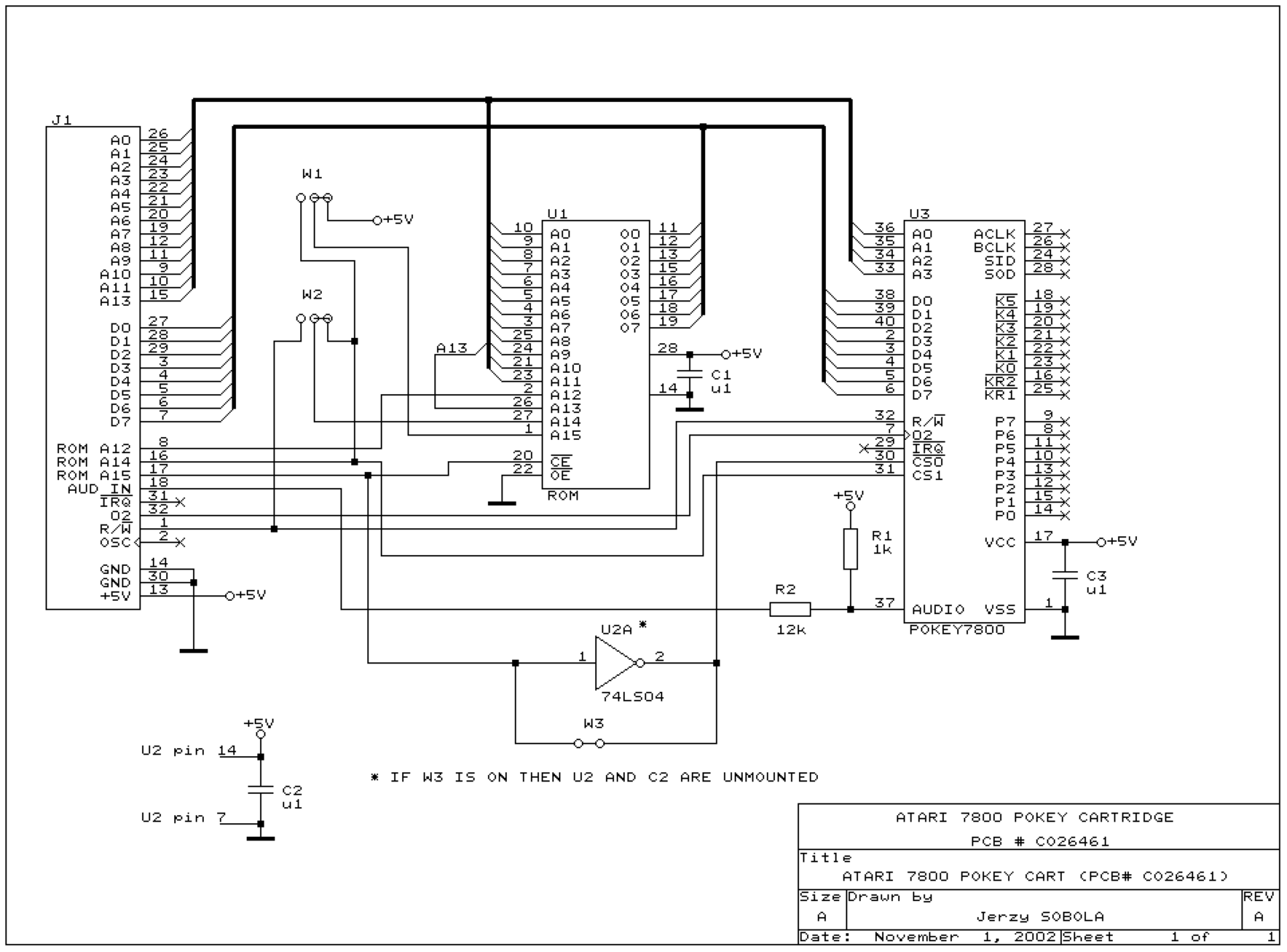
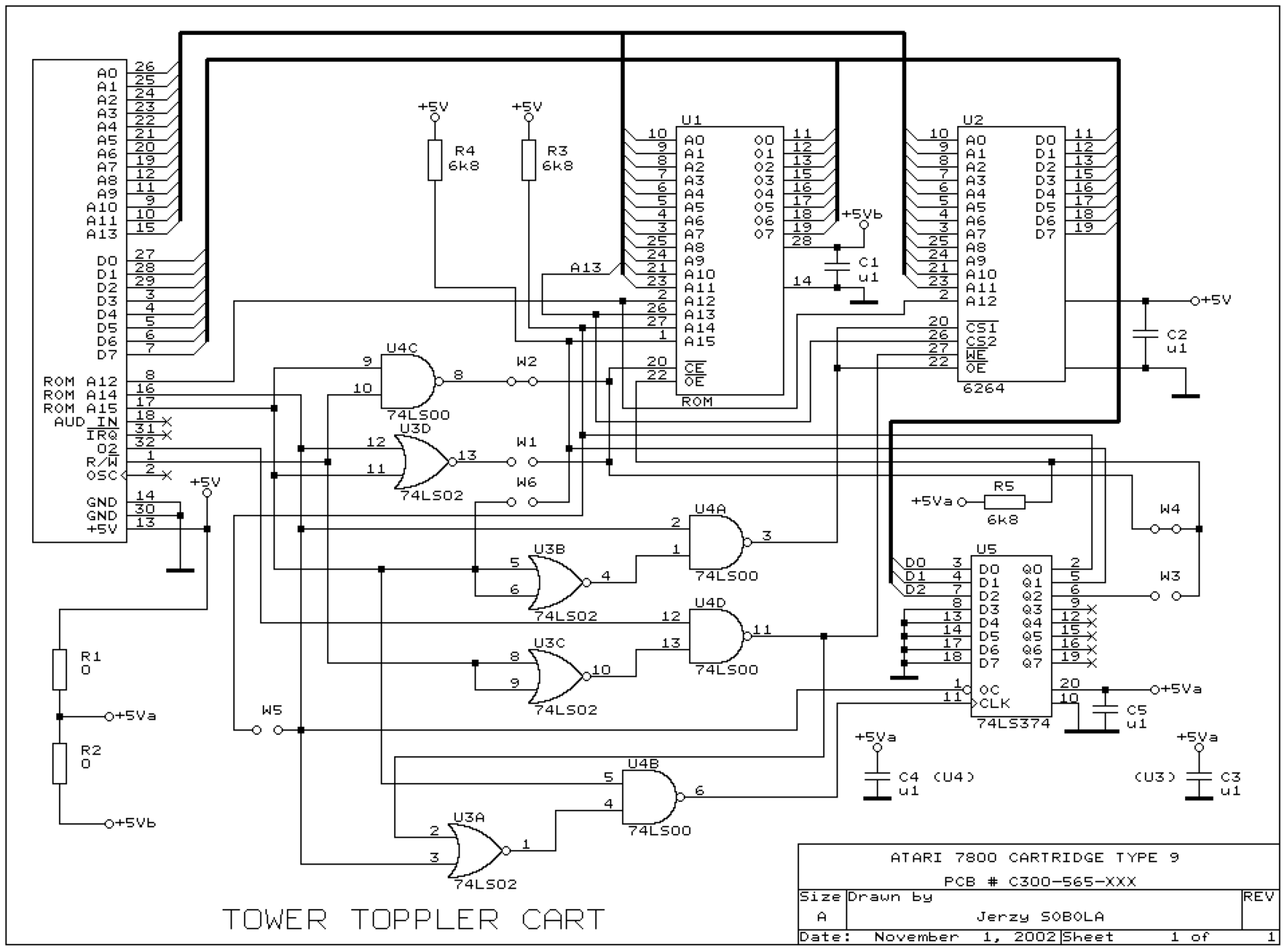
Additional schematics ✅
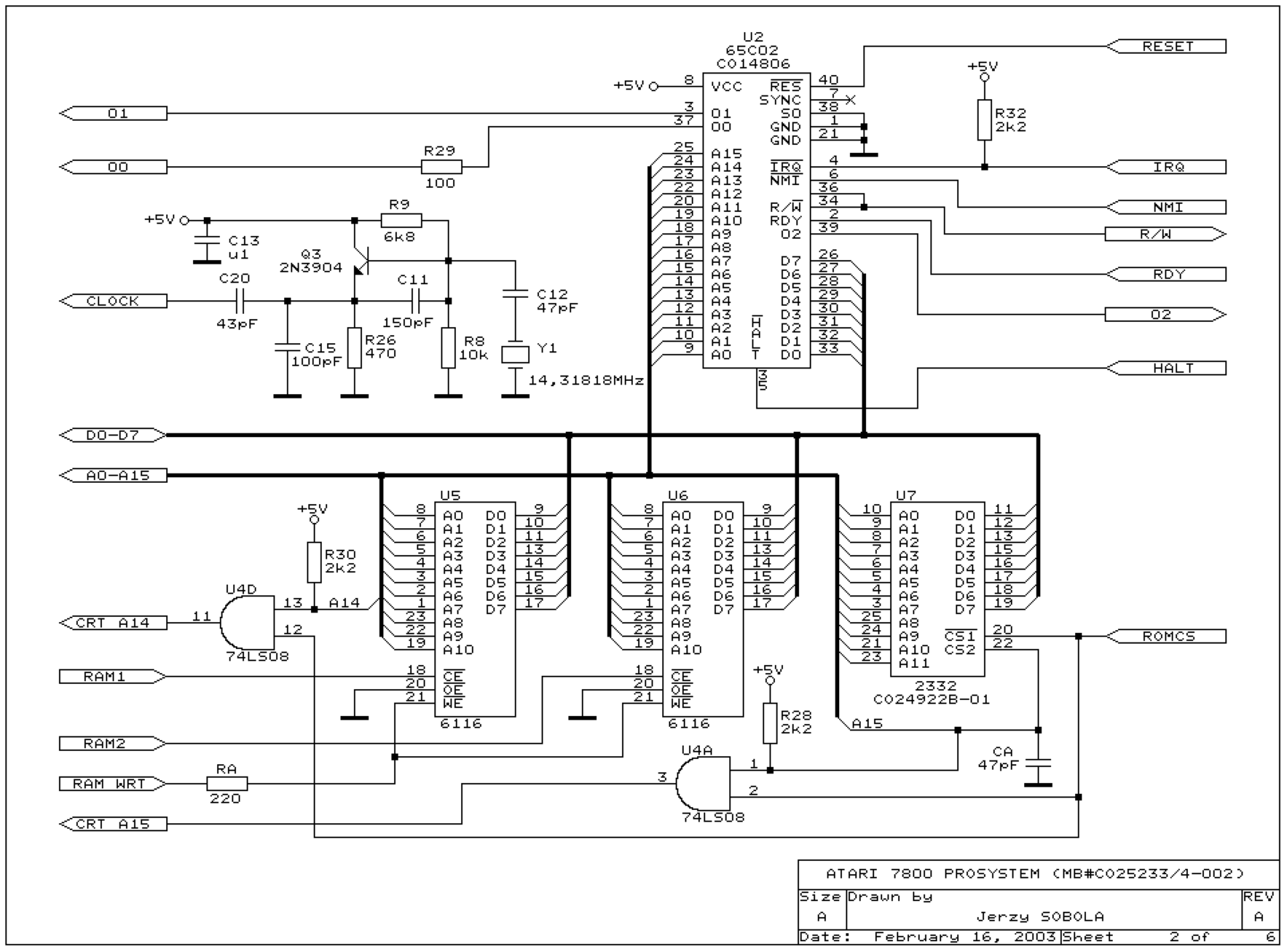
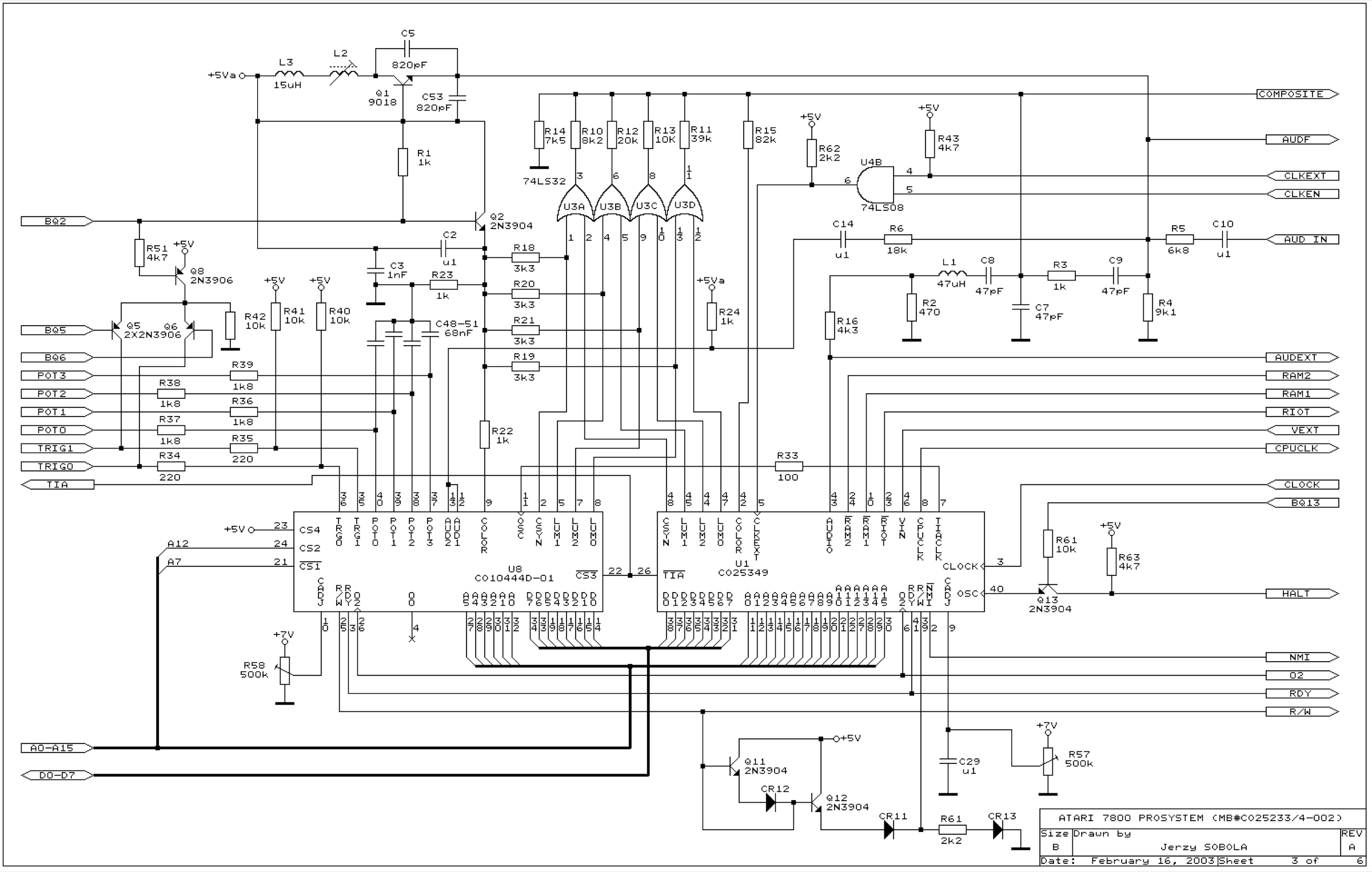
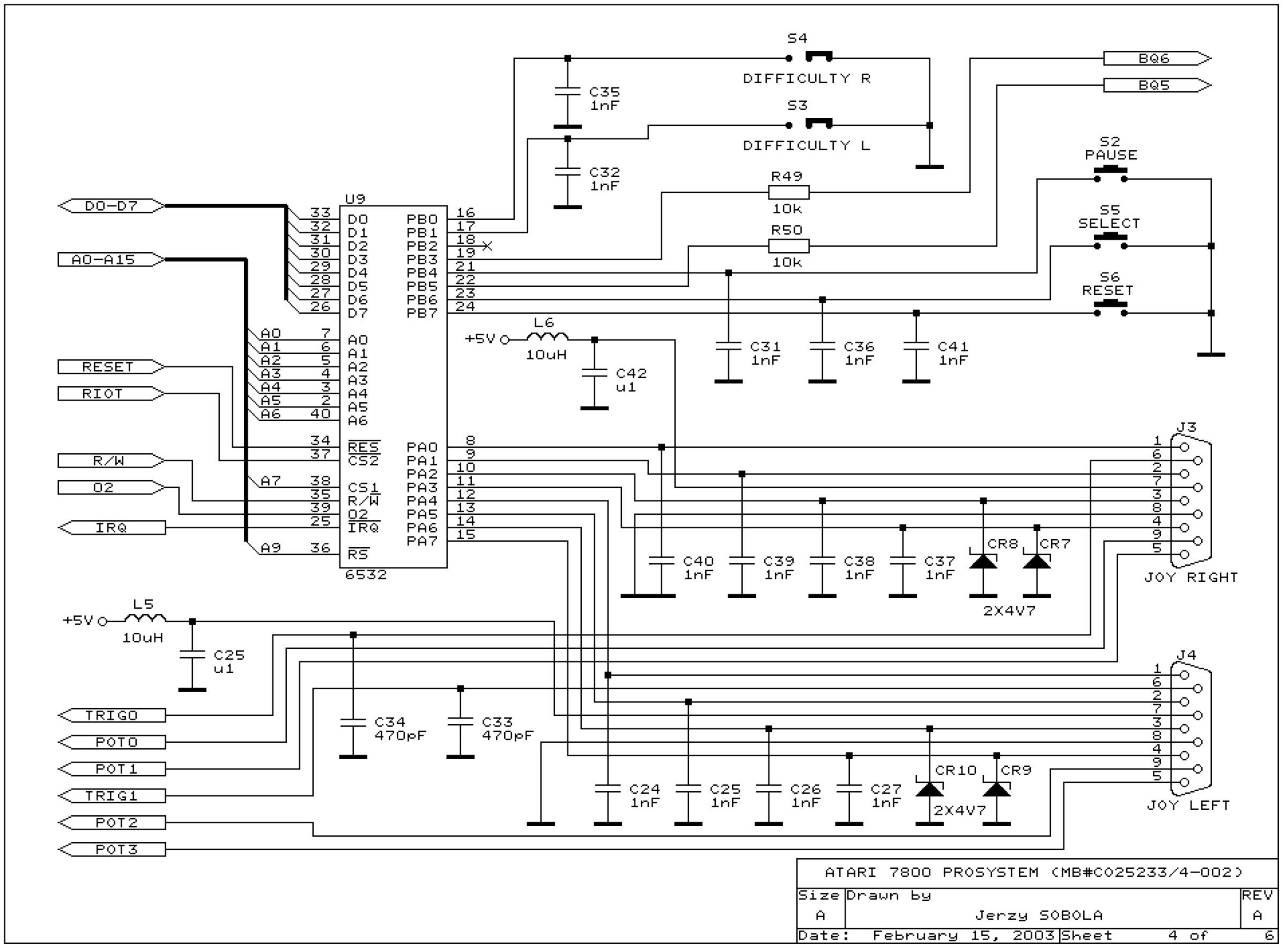
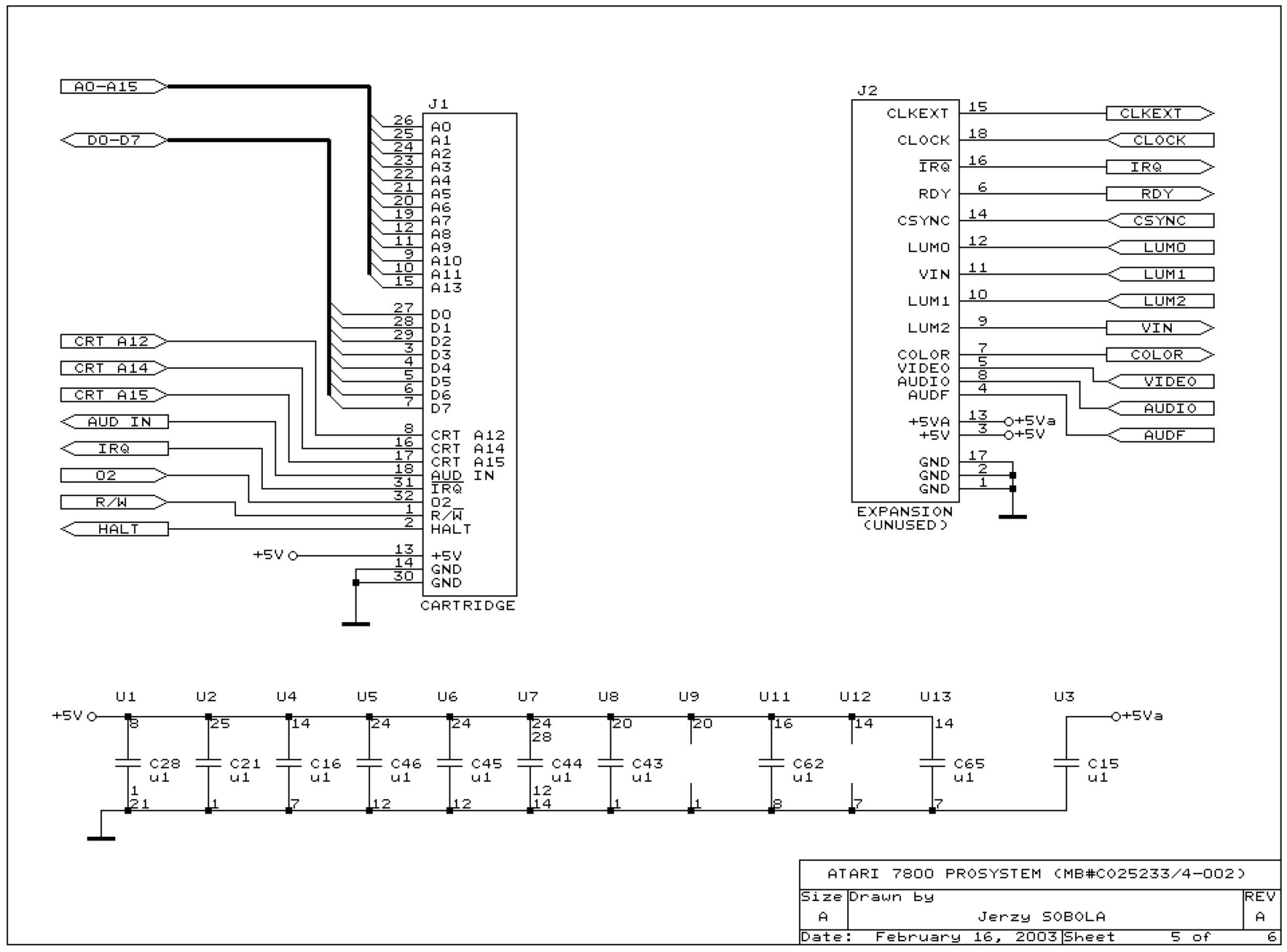
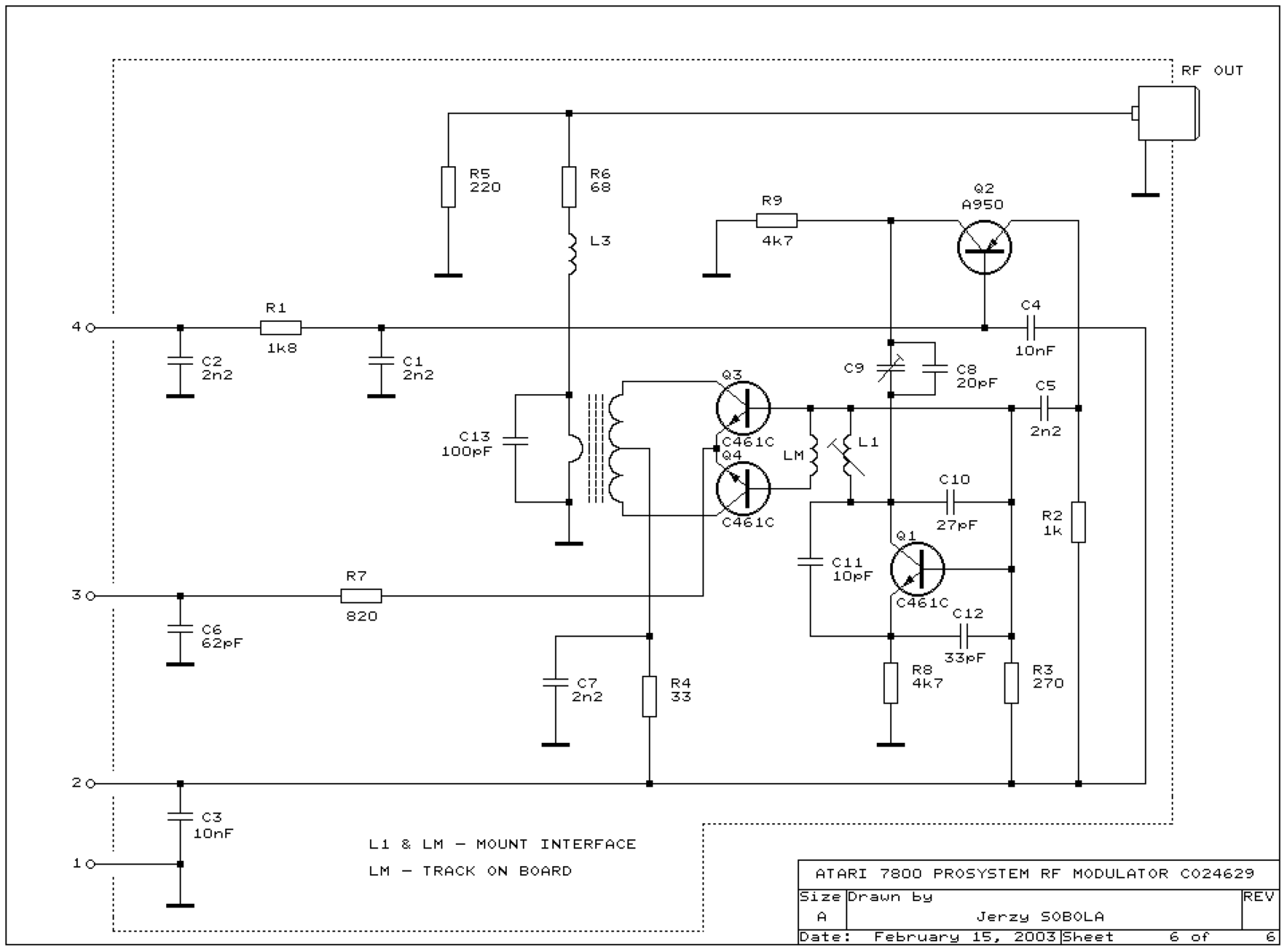
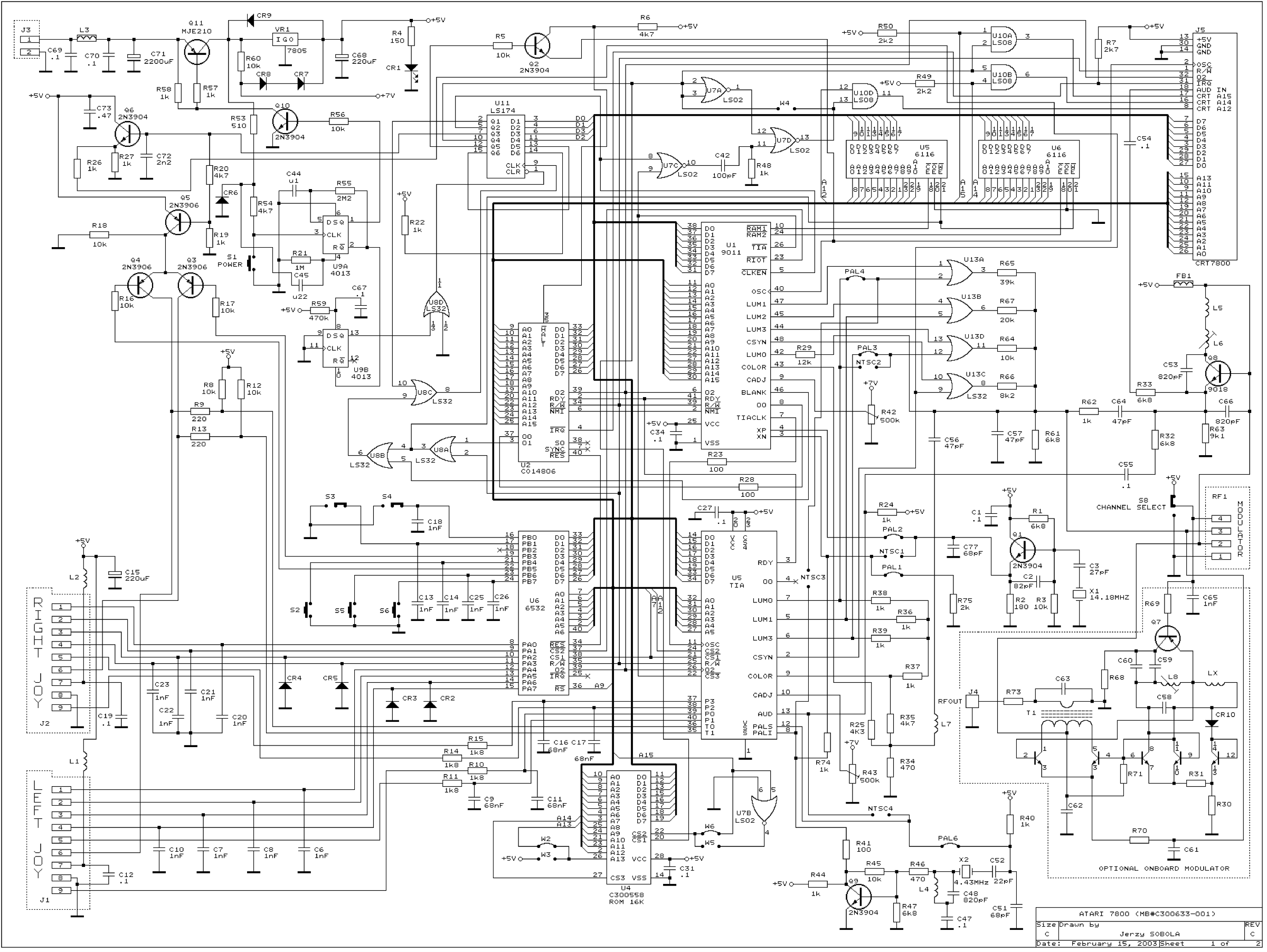
Plates grouped by machine. Expand to view.
Credit
Schematics redrawn by Jerzy Sobola, reproduced for preservation.
7800 NTSC — 6 planche(s)
7800 PAL — 5 planche(s)
Sources & attribution
- ConsoleMods Wiki — Atari 7800 Model Differences — CC-BY-SA — C025233-001/-002 revisions, the LaserDisc expansion port, the timing circuit and its cross-effects on 2600 games, the 0 ohm jumper on U13 (74LS02), PAL 7800 and the French 13-pin DIN (decoded composite, not true RGB) — https://consolemods.org/wiki/Atari_7800:Atari_7800_Model_Differences
- ConsoleMods Wiki — Region Information — CC-BY-SA — the 960-bit encrypted signature, falling back to 2600 mode when absent, no encryption on the PAL side, BIOS swapping and its hardware limits — https://consolemods.org/wiki/Atari_7800:Region_Information
- ConsoleMods Wiki — General Troubleshooting — CC-BY-SA — the "no power LED" tree: measuring the PSU, the thin broken cable, 12 × 12 mm SPST tact switches, 7805 ~9 V/5 V, the 2200 µF capacitor — https://consolemods.org/wiki/Atari_7800:General_Troubleshooting
- Wikipedia — Atari 7800 — CC-BY-SA — https://en.wikipedia.org/wiki/Atari_7800
Image:
-
atari-7800-board.jpg— Evan-Amos, public domain — https://commons.wikimedia.org/wiki/File:Atari-7800-Motherboard-Top.jpg

Review & corrections
How this space is used
Spotted a wrong value, an outdated procedure, a chip reference that does not match your board? Say so here, with what you observed (model, board revision, serial number, measurement). Every report is cross-checked against a source before anything changes — an unverifiable correction is published as “reported by …, not cross-checked” rather than silently applied.
Reading is open to everyone; posting requires signing in with Discord. Reports from the wiki's declared reviewers are handled first; anyone else's are read too, but go through a human before anything is changed.