Namco NA-1/2, NB-1/2 & System FL
Namco's 2D / light-3D platforms in the mid-90s, between the System 2 and the PlayStation shift. Three close families: NA (68000, Knuckle Heads), NB (68020, Point Blank, The Outfoxies) and System FL (i960, Final Lap R). Lesser-known but genuinely distinct platforms.
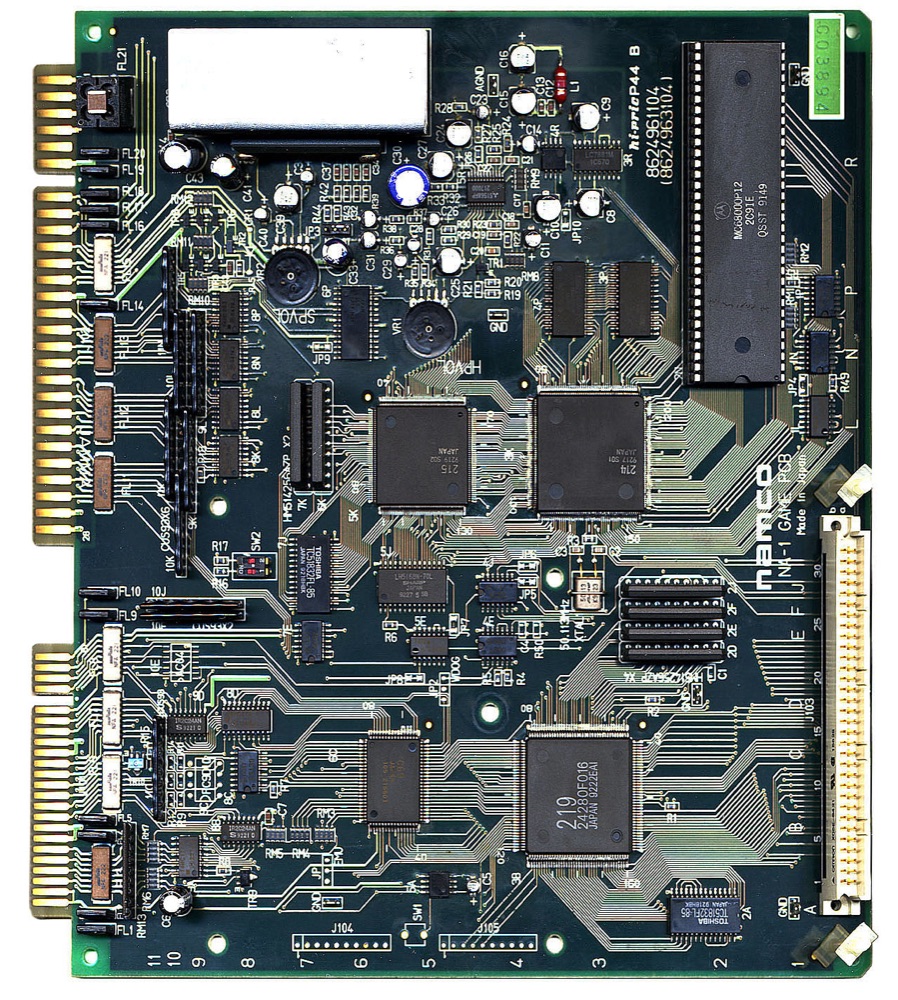
PCB Namco NA-1 — photo by Yaca2671, CC BY-SA 3.0 (Wikimedia Commons).
Overview
| Family | Year | CPU | Games (examples) | MAME driver |
|---|---|---|---|---|
| NA-1 / NA-2 | 1992 | Motorola 68000 + C69/C70 MCU | Knuckle Heads, Numan Athletics, Emeraldia, Tinkle Pit, Fighter & Attacker, Cosmo Gang the Puzzle | namco/namcona1.cpp |
| NB-1 / NB-2 | 1994 | Motorola 68020 | Point Blank (Gun Bullet), Great Sluggers, Super World Stadium '95-'97, Nebulas Ray, The Outfoxies, Mach Breakers | namco/namconb1.cpp |
| System FL | 1992 | Intel i960 | Final Lap R, Speed Racer | namco/namcofl.cpp |
Details
NA-1 / NA-2 (68000)
A 68000 base + a custom Namco MCU (C69 on NA-1, C70 on NA-2) handling inputs and part of the protection. Zoomable sprites, sound via the MCU + customs. The NA-2 is a faster revision.
NB-1 / NB-2 (68020)
A move to the 68020 (more 2D power, lots of sprites). Point Blank (light gun) and The Outfoxies are the showcases; the NB-2 adds capabilities (e.g. late Super World Stadium, Mach Breakers).
System FL (i960)
An Intel i960 base aimed at racing (heir to the Final Lap spirit), with Final Lap R and Speed Racer — a foot in advanced 3D/scaling.
Security & faults
- MCU protection (NA) / customs: dumps reverse-engineered by the community (MAME).
- Typical faults: rare customs/MCU, video RAM, sound stage, contacts — methodical diagnosis, recap by age.
Modernisation & mods
The common ground for every JAMMA board
Video, power, control panel and upscalers depend on the cabinet rather than the board: everything is centralised in Modernising a cabinet. To run the board outside a cabinet (at home, on a display): supergun.
- Storage 🟡: the game lives in EPROM/mask ROM on the board. Changing or restoring a game means reprogramming the EPROMs (and, for a mask ROM, using a pinout adapter) → EPROM method.
- Media preservation: replacing the original storage, multicarts, ODEs and modern options by family → PCB preservation hub.
- Scan rate 📺: NA: ~15.36 kHz / 60.0 Hz · NB: ~15.75 kHz / 59.7 Hz — standard resolution, a classic 15 kHz chassis is fine → tri-sync and upscalers.
(Computed from the MAME sources —
namco/namcona1.cpp + namconb1.cpp— pixel clock ÷ htotal.) - FPGA / emulation: see the Emulation & FPGA section below.
Repair (technician)
- Custom MCU (C69 on NA-1 / C70 on NA-2): handles inputs + protection; without a healthy/dumped MCU, a crash (donor / MAME).
- Namco customs: corrupt zoomed sprites = RAM + buffers first, the custom next.
- Sound: via the MCU + customs — diagnose the sound stage.
- Capacitors: recap. Oxidised EPROM sockets: turned-pin socket.
→ Methods: PCB fault-finding · Recap · EPROM · Traces & vias
Expected clocks — measurement table ✅
Values extracted from the MAME sources for this platform. On a scope or frequency counter, a clock that is missing or off-value points straight at the crystal, the divider or the chip at fault — the fastest starting point on a dead board.
| Component | Expected clock | Role |
|---|---|---|
| M68000 | 12.52825 MHz | main CPU |
| M68EC020 | 24.192 MHz | main CPU |
How to read this table
Several values for one component = several board variants in this family (or several instances of the chip clocked differently). These frequencies are those of the clock signal at the component's input, not of its original crystal — on many boards the clock is divided down from a single master crystal.
DIP settings ✅
5 games on this platform, settings extracted from the MAME sources (INPUT_PORTS_START blocks). The Position column gives the switch's physical reference on the board (SW2:!3,!4 = bank SW2, levers 3 and 4) — which is what lets you set it up without the paper manual. Games are sorted by MAME set name.
DIP settings — MAME set gunbulet
| Setting | Position | Options (default in bold) |
|---|---|---|
| Test switch | — | Off · On |
DIP settings — MAME set namcona1_joy
| Setting | Position | Options (default in bold) |
|---|---|---|
| DIP2 (Freeze) | — | Off · On |
| DIP1 (Test) | — | Off · On |
DIP settings — MAME set namcona1_quiz
| Setting | Position | Options (default in bold) |
|---|---|---|
| DIP2 (Freeze) | — | Off · On |
| DIP1 (Test) | — | Off · On |
DIP settings — MAME set namconb1
| Setting | Position | Options (default in bold) |
|---|---|---|
| Freeze Screen | SW1: 2 | Off · On |
| Test switch | — | Off · On |
DIP settings — MAME set zelost
| Setting | Position | Options (default in bold) |
|---|---|---|
| DIP2 (Freeze) | — | Off · On |
| DIP1 (Test) | — | Off · On |
Check against your own board
These settings apply to the game and revision described by MAME. One title may have several DIP sets depending on region or revision, and some systems use soft-dips (settings in memory, via the test menu) rather than physical switches. In case of a discrepancy, the board's silkscreen and the test menu are authoritative.
See also: DIP reference · game manuals
Procedure — a dead board, step by step ✅
What this adds
The general method lives in PCB diagnosis. This is its application to this platform: the same order, but with the values actually expected here, so you do not have to go back and forth.
Tools: multimeter, oscilloscope (or frequency counter), current-limited bench supply, desoldering braid. → Tooling
If the board is still in a cabinet
A CRT holds its charge with the machine unplugged. → CRT safety
1. Inspection, power off. Corrosion, cut tracks, oxidised EPROM legs, leaking SMD capacitors, dubious earlier repairs.
2. The connector, before anything else. A large share of "dead boards" are a contact problem, not a fault. Clean the contacts with isopropyl alcohol and reseat — not with an abrasive eraser on a gold edge, which takes the plating off and brings the problem back worse. It costs two minutes and settles the question.
3. Power, measured on the board. Aim for +5.0 V measured as close as possible to where power reaches the board — not at the PSU output: the drop is in the loom, and that is exactly what makes a board boot on the bench and not in the cabinet. Where you probe depends on this board's connector — JAMMA edge, JVS loom or a proprietary harness — plenty of makers kept one long after JAMMA arrived — see Identification above. → Wiring Check −5 V and +12 V too if the sound stage uses them. Suspected short: bring it up current-limited and find the hot spot.
4. /RESET. It must release after power-up. Held low = the CPU never starts. A 1–2 Hz loop is not the reset circuit, it is the watchdog: the CPU is crashing at boot, so look at the bus, not at the reset.
5. Clocks — the values expected on this platform.
- M68000 → 12.52825 MHz (Main CPU)
- M68EC020 → 24.192 MHz (Main CPU)
No clock on the M68000 (12.52825 MHz) and there is no point measuring anything else: the fault is the crystal, the divider, or the chip itself. That single measurement splits a dead board in two.
6. Bus. Activity on the main CPU's address lines tells you whether it is running or frozen. Frozen with good clocks and good reset → work RAM, bus buffers, ROMs.
7. It boots but the picture or the sound is wrong — that is another job: see Common faults on this page, then signal tracing.
Emulation & FPGA
- Emulation: MAME (
namcona1.cpp,namconb1.cpp,namcofl.cpp). - FPGA / MiSTer: no confirmed dedicated core → MAME.
EPROM repair
68000 program (+ C68/C75 MCU). Ex. (MAME namco/namcona1.cpp): Knuckle Heads / Numan Athletics / Super World Court = 4× 27C040 · Cosmo Gang the Puzzle = 2× 27C040. Per-game key/MCU (protection).
Lineage
Contemporary with the System 2 and the System 21/22 3D, before the PlayStation shift (System 11).
Photos / assets
(To add: NA-1/2, NB-1/2, System FL boards; C69/C70 MCU.)
Sources & attribution
-
Photo PCB Namco NA-1 — Yaca2671, CC BY-SA 3.0, Wikimedia Commons — https://commons.wikimedia.org/wiki/File:NAMCO_NA-1_01A.jpg
-
MAME —
namco/namcona1.cpp,namco/namconb1.cpp,namco/namcofl.cpp(68000/68020/ i960, C69/C70 MCU, games) — https://github.com/mamedev/mame - Wikipedia — Namco NA-1/NA-2 / Namco NB-1/NB-2 / Namco System FL — CC-BY-SA — https://en.wikipedia.org/wiki/Namco_System_NA-1/NA-2

Review & corrections
How this space is used
Spotted a wrong value, an outdated procedure, a chip reference that does not match your board? Say so here, with what you observed (model, board revision, serial number, measurement). Every report is cross-checked against a source before anything changes — an unverifiable correction is published as “reported by …, not cross-checked” rather than silently applied.
Reading is open to everyone; posting requires signing in with Discord. Reports from the wiki's declared reviewers are handled first; anyone else's are read too, but go through a human before anything is changed.