Apple II (II / II+ / IIe / IIc / IIGS)
The founder of US micro gaming (1977): a 6502, expansion slots, a Disk II drive — the platform of Wizardry, Karateka, Prince of Persia. Repair: RIFA/PSU, the IIGS battery, the Disk II drive, slot contacts.
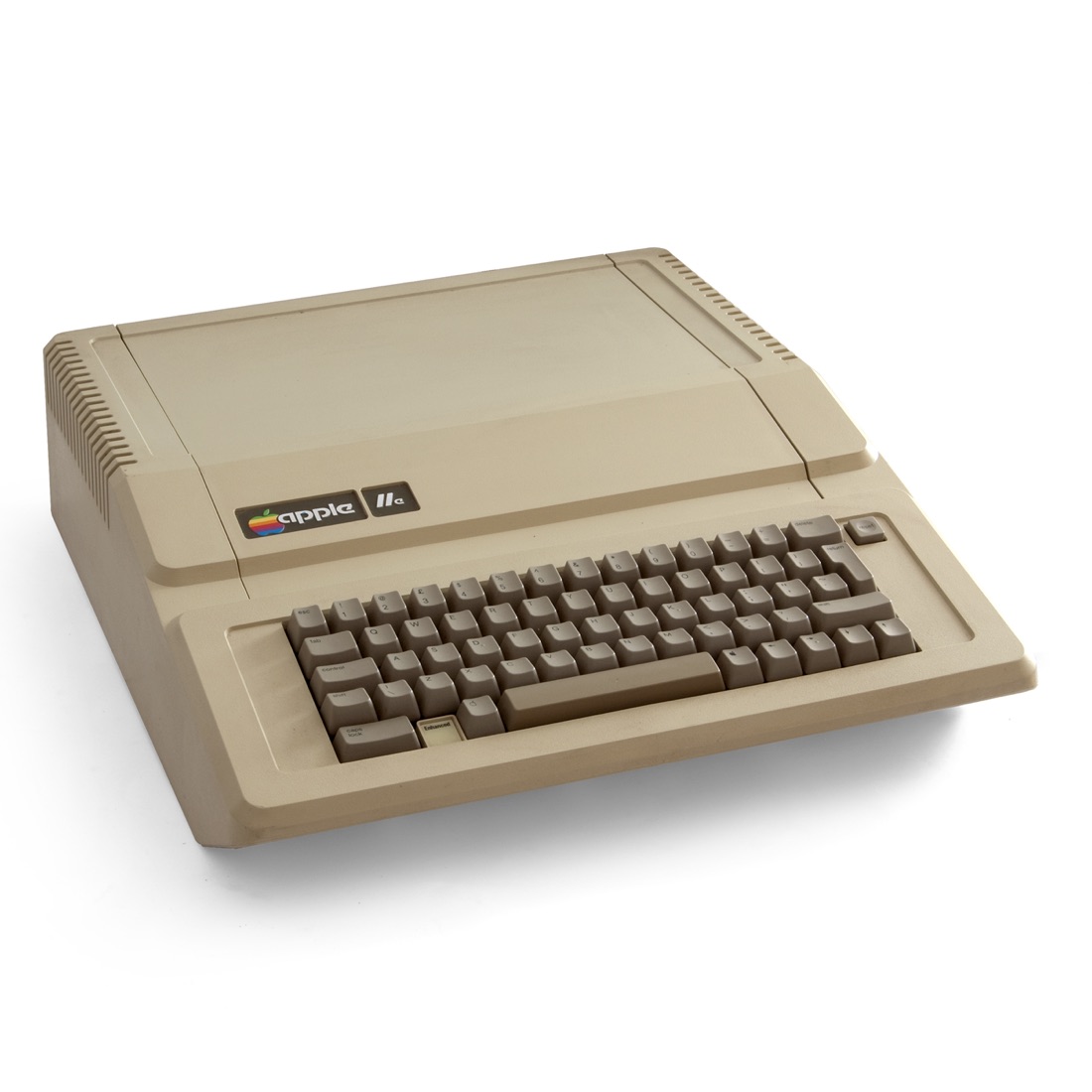
Apple IIe — photo by Bilby, CC BY 3.0 (Wikimedia Commons).
Identification / models
| Model | Year | CPU | Note |
|---|---|---|---|
| Apple II / II+ | 1977-79 | 6502 | the origin; linear then switching PSU |
| Apple IIe | 1983 | 6502 | the most common, full keyboard |
| Apple IIc | 1984 | 65C02 | compact, external PSU |
| Apple IIGS | 1986 | 65C816 (16-bit) | Ensoniq sound, ⚠️ leaking battery |
Clocks & frequencies ✅
| Component | Frequency | Role / scope |
|---|---|---|
| MOS 6502 | 1,023 MHz | CPU — soit 2/7 de la sous-porteuse couleur NTSC |
| Oscillateur maître | 14,31818 MHz | divisé par 14 pour l'horloge CPU, et par d'autres rapports pour la vidéo |
The whole machine's timing derives from a single 14.31818 MHz oscillator: CPU clock, video transfer counters and colour signals all come from it. A fault on that oscillator therefore affects everything at once.
Why this matters in repair
A clock that is missing or off-value on a frequency counter points straight at the crystal, its divider chain or the component it feeds — the fastest starting point on a machine that will not boot. Source: Wikipedia (CC-BY-SA).
Repair (technician)
RIFA caps & switching PSU
The RIFA (mains filter) caps in the switching PSUs (II+/IIe/IIc) smoke/explode with age → replace; recap the PSU if voltages are unstable → Recap.
Apple IIGS battery
The IIGS has a soldered (clock/settings) battery that leaks and eats the board → remove/replace it (remote holder) → backup batteries.
- Disk II drive (5.25″): speed adjustment (300 rpm) + head cleaning; a fragile ribbon cable.
- Socketed chips: diagnose by substitution (RAM, 6502, ROM); oxidised expansion slot contacts (language/80-column/controller cards) → clean.
- Keyboard: contacts / keys → clean.
- Video output: stock composite → RGB mods per model.
Procedure — a dead computer, step by step ✅
What this adds
Ordered for a home computer: what kills these is its power supply, its battery, its capacitors, its socketed RAM and its keyboard — roughly in that order, and well before the CPU. → PCB diagnosis
1. The power supply — measured before it is plugged in. This is the one step not to swap around. On a machine of this age a supply does not simply stop: a 5 V regulator that fails high puts 7, 9, 12 V onto the bus and takes the RAM and the custom chips with it. Measure every rail off the machine, under a dummy load if you can, and only then plug it in. This page documents RIFA capacitors on this machine: the mains filter caps that crack, then let go in smoke on the first power-up. Replace them before you switch on, not after.
2. The battery — before anything else. This page documents a cell that leaks — check on the page whether your model is one of the affected ones, several of these pages cover a whole range. Its electrolyte eats the copper underneath and keeps eating while the machine sits in a cupboard, so it comes out first, before any diagnosis. Neutralise, clean, then check continuity on the tracks around it — a machine that no longer boots after storage is very often this and nothing else. → Backup batteries
3. Capacitors. Recap is the default on these machines, not a last resort — and on the supply first, since that is what protects everything else. → Recap
4. RAM, on its sockets. These machines were built to be repaired: the RAM, and often the logic, sit in sockets. Reseat everything first — thirty years of oxide is a classic no-boot. Then swap chips: a bad RAM chip usually gives a repeatable pattern of garbage or a screen frozen at a fixed character.
5. The keyboard. A console does not have one; a computer's is a wear part. A membrane keyboard fails as whole dead rows or columns — that is the membrane, not the machine. A mechanical one wants its contacts cleaning, not replacing. Check this page: the failure mode is often documented per model.
6. Storage — tape or disk. Both often come down to the same things: a dirty head, and for tape the azimuth and a belt turned to tar. ⚠️ On the floppy side, check whether the mechanism actually has a belt before looking for one: many do, but some drives are direct drive, and hunting a belt that isn't there means stripping a drive for nothing. A machine that boots but loads nothing is a drive fault, not a logic fault — do not go looking on the board for it.
7. Video output. RF, composite, RGB or a dedicated monitor, depending on the machine (see Identification). Test with something else before you conclude: a period modulator and a modern TV disagree far more often than either is broken.
8. Still nothing. Now the logic: rails on the board, reset, clock, bus. → PCB diagnosis
Common faults
| Symptom | Likely cause | Lead |
|---|---|---|
| Smoke / bang at power-on | mains RIFA | Replace the RIFA |
| Instability / crashes | PSU (caps) / RAM | Recap PSU, substitute RAM |
| Corrosion (IIGS) | leaked battery | Remove, repair traces |
| Floppy not read | Disk II speed / head | Adjust speed, clean |
| Card not detected | slot contacts | IPA clean, reseat |
Modernisation & mods — what to buy, how
PSU RIFA + leaking IIGS battery
The PSU's RIFA filter caps smoke/explode with age → replace them on acquisition. On the IIGS, the soldered battery leaks and eats the board → relocate it (external coin-cell holder), clean/neutralize, repair traces.
Modern storage - Floppy Emu (BMOW) 🟢: emulates Disk II and a SmartPort hard disk from an SD card (external box on the drive connector); CFFA3000 🟢 (CF/USB as a hard disk, Apple slot card); A2Pico/BOOTI 🟢.
Video - Composite NTSC output 🟢 → an upscaler; period RGB cards (Apple RGB/Video-7) or modern ones 🟠 for RGB/VGA.
Expansion - 80-column / language cards (remade) 🟢, Mockingboard sound (remade) 🟢; the //e has free slots.
Reliability: few electrolytics on the Apple II board; clean the IC sockets.
⚠️ Do not host ROMs/games — method only.
Archived manufacturer documentation ✅
Manufacturer documentation archived locally.
Status
Manufacturer documents with no explicit licence, kept for preservation.
See also
Sources & attribution
- Photo Apple IIe — Bilby, CC BY 3.0, Wikimedia Commons — https://commons.wikimedia.org/wiki/File:Apple_IIe.jpg
- Wikipedia — Apple II series (6502/65C816, Disk II, models) — CC-BY-SA — https://en.wikipedia.org/wiki/Apple_II_series
- Established Apple II community knowledge (RIFA, IIGS battery, Disk II speed) — synthesis.

Review & corrections
How this space is used
Spotted a wrong value, an outdated procedure, a chip reference that does not match your board? Say so here, with what you observed (model, board revision, serial number, measurement). Every report is cross-checked against a source before anything changes — an unverifiable correction is published as “reported by …, not cross-checked” rather than silently applied.
Reading is open to everyone; posting requires signing in with Discord. Reports from the wiki's declared reviewers are handled first; anyone else's are read too, but go through a human before anything is changed.