Korean and Taiwanese candy cabs (Andamiro, WeChe)
Japan had no monopoly on the candy cab. Korea and Taiwan built them too, for their home markets and for export, with the same instincts — compact cabinet, rotatable monitor, JAMMA — and real differences: dual 110/220 V, ticket dispensing, and manuals that do not read like the Japanese ones.
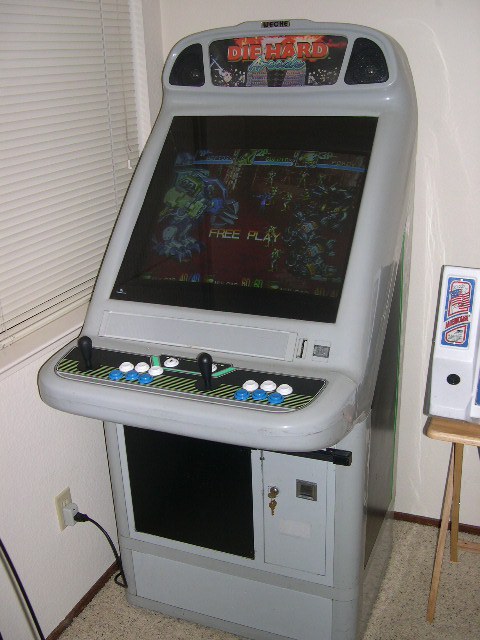
Overview
| Cabinet | Maker | Country | Screen | Manufacturer figures |
|---|---|---|---|---|
| Joy-Ro 21 | Andamiro | Korea | — | ⚠️ undocumented, see below |
| Joy-Ro 29 | Andamiro | Korea | — | ⚠️ undocumented |
| OK Baby (OK-S) | WeChe (Wee-Chin) | Taiwan | 28″ / 29″ | 730 × 960 × 1460 mm, 100 kg |
| OK Baby (OK-L) | WeChe | Taiwan | 28″ / 29″ | 730 × 960 × 1675 mm, 110 kg |
WeChe OK Baby — two models, and the second is the first on a base
The WeChe manual archived here is titled OK Baby Cabinet + Upright Base and publishes two spec panels side by side:
| OK-S | OK-L | |
|---|---|---|
| Power | 110 V . 220 V | 110 V . 220 V |
| Monitor | 28″ . 29″ | 28″ . 29″ |
| Weight | 100 kg | 110 kg |
| Coin | ticket, coin | ticket, coin |
And two dimension drawings, OK-S Size and OK-L Size:
| OK-S | OK-L | |
|---|---|---|
| Width | 730 mm | 730 mm |
| Depth | 960 mm (base 570) | 960 mm (base 570) |
| Cabinet height | 1460 mm | 1675 mm |
| Overall height | 1740 mm | 1955 mm |
| Panel height | 700 mm | 915 mm |
The manual's title explains the whole difference
+ Upright Base: the OK-L is the OK-S on a base. 215 mm more in cabinet height and in panel height alike, 10 kg more, same width, same depth, same tube. It is not a second cabinet, it is a height option.
Same mechanism as the SNK Neo 19's upright stand (+150 mm, +6.5 kg) — a height added from below, not from a panel on top as on Japanese candy cabs.
What Hard*Candy says, and why it is not what the manual says
The community entry gives "730 x 960 x 1460 mm (1740 mm with marquee), 100 kg (110 kg with Base)" — it mixes the two models: the figures are the OK-S's, the "110 kg with Base" is the OK-L's weight, and the OK-L's height (1675 / 1955) is missing altogether. The manual separates them cleanly.
Two things you will not find on a Japanese candy cab
- 110 V and 220 V on the same line, for both models. A Japanese candy of the same era is 100 V and nothing else → see Cabinet power.
ticket, coinunder Coin: the cabinet is built for a ticket dispenser, so for redemption. No Japanese candy cab archived here offers that.
Andamiro Joy-Ro 21 and 29 — two parts catalogues, no figures
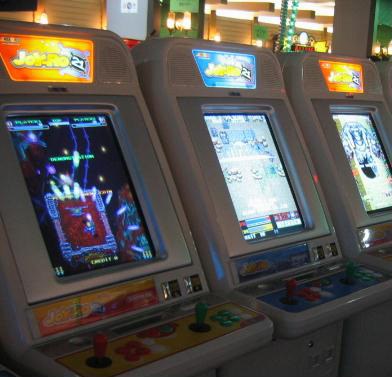
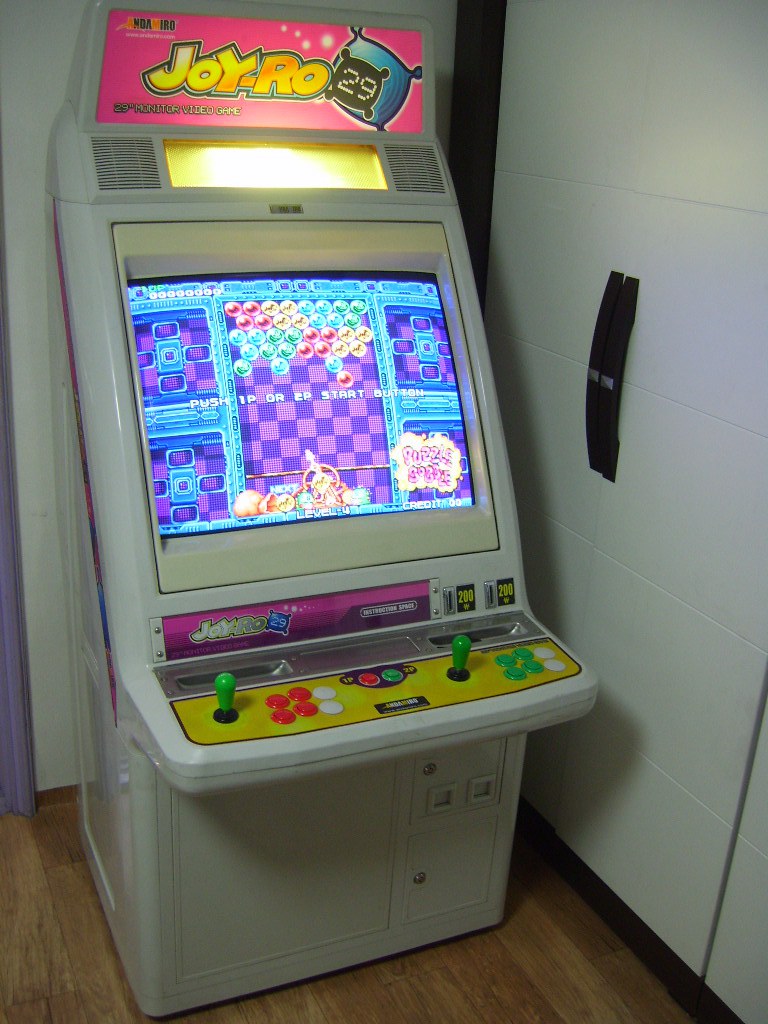
Both Andamiro manuals are archived — Joy-Ro 21 (21 pp.) and Joy-Ro 29 (24 pp.) — but it must be clear what they are: spare-parts catalogues, not datasheets.
⚠️ No figure for these cabinets rests on a document
All 21 and 24 pages were swept one by one. They contain complete parts lists, item
by item, in Andamiro's format (C03009-008A, M02009-038A, A02001-008A…) — but no
specifications block, no overall dimensions, no weight.
The dimensions in circulation (24.25 × 34.46 × 54.33 in for the 21, 28.35 × 35.43 × 65.75 in for the 29) come from a community entry, and they are in inches for a Korean cabinet — which smells of conversion. They are not published here.
What the catalogues do give
They are not empty documents. The parts lists name things you actually replace:
| Item | Andamiro reference |
|---|---|
| Power supply | SMPS SPS-1503BE (A02001-008A) |
| Mains filter | 250 V 6 A (A06000-003A) |
| Mains cord | 250 V - 10 A (A01000-003A) |
| Fuse | 5 A (A15004-001A) |
| Switch | rocker T-120 (A04004-001A) |
| Mains inlet | AC-011 (A28000-001A) |
| Lock | KEY ASS'Y 0720 (AM01-ZZZS02A) |
And an installation instruction, page 7 of both manuals: "Acceptable maximum current of this machine is 10 A with outlet", with an explicit ban on daisy-chaining beyond 10 A on the same outlet.
⚡ Connectors & power
| Aspect | Value |
|---|---|
| Connector | JAMMA on all four → JAMMA wiring |
| Voltage — OK Baby | 110 V or 220 V (WeChe manual) |
| Voltage — Joy-Ro | ⚠️ undocumented; the cord is rated 250 V - 10 A and the fuse 5 A |
| Max current — Joy-Ro | 10 A at the outlet, no chaining beyond (manuals, p. 7) |
A 110/220 V cabinet is not a 100 V cabinet
The OK Baby states 110 V and 220 V. That does not mean it adapts on its own: the manual documents no automatic switch. Before plugging in, read the machine's label and check which voltage it is wired for — the same caution as on the Astro City II, which exists in Japanese 100 V and in export 220-240 V.
Procedure — a cabinet that will not start ✅
This cabinet exists in both low and high voltage
This page documents both a low-voltage version (Japanese or North American market) and a 220-240 V one. Nothing here tells you which one you have.
Read the machine's label before plugging anything in. A step-down transformer on a cabinet already wired for 240 V is every bit as destructive as 230 V into a cabinet built for 100 V. → Cabinet power
What this adds
Ordered for a cabinet, not for a board: mains, low-voltage supply, loom, monitor, then the game. The overwhelming majority of "dead cabinets" are dead for a reason that has nothing to do with the PCB — which is why the board comes last here.
1. Mains, and what sits between it and the cabinet. The switch, the fuse or breaker, the isolation transformer if there is one. A cabinet that shows no sign of life at all is almost never electronic.
2. The low-voltage supply — measured under load. Aim for +5 V where power reaches the board — the JAMMA edge, or the JVS power connector, depending on the cabinet — with the game running, not on an idle bench. If the supply has an adjustment (most candy and JVS bricks do; the ATX brick in a PC cabinet does not), do it then and not before: set off-load, it leaves a board that boots and then glitches. With no adjustment the measurement still earns its keep — it tells you whether the supply holds. Check +12 V too, and −5 V if the board uses it: many do not, and an ATX brick does not provide it. → Cabinet power
3. The loom and the connector. Reseat, and check the grounds — a cabinet with a poor ground gives rolling picture, phantom inputs and noise, all at once, and none of it looks like a wiring fault. → Wiring
4. The monitor. This page does not give a single monitor spec — it covers several cabinets. Check which one you have before concluding anything.
5. Scan rate — the mismatch that breaks nothing. If the board's rate is not one the monitor accepts, you get no picture and nothing is faulty. Check what this cabinet takes against what the board puts out before opening anything. → Modernising a cabinet
6. The control panel. Microswitches and the loom, in that order. A single dead direction is a switch; a whole player dead is the loom or its ground. → Control panels
7. Coin mech and sound. Last, because they hide nothing: a mech that no longer registers is usually dirty or misadjusted, and silence with a good picture points at the amplifier and its supply rails.
See also
- Other Japanese candy cabs · SNK cabinets (the Neo 19's upright stand) · Western cabinets · European cabinets
- Cabinet types for the size comparison.
Sources & attribution
- WeChe (Wee-Chin) — OK Baby Cabinet + Upright Base, 36 pp., archived here — folio 2: two panels, OK-S and OK-L (110 V . 220 V, 28″/29″, 100 and 110 kg, ticket, coin) and two dimension drawings (OK-S 730 × 960 × 1460, overall 1740, panel 700; OK-L 730 × 960 × 1675, overall 1955, panel 915). ⚠️ This PDF has no text layer: everything quoted from it was read off the rendered page. Via Hard*Candy
- Andamiro — Joy-Ro 21, 21 pp., archived here — ⚠️ parts catalogue only, no specifications block (21 pages checked one by one). Parts lists and the "10 A max" installation note on p. 7 — https://www.hard--candy.com/wiki/candy/Joy-Ro_21
- Andamiro — Joy-Ro 29, 24 pp., archived here — ⚠️ same, no figures (24 pages checked) — https://www.hard--candy.com/wiki/candy/Joy-Ro_29
- Joy-Ro 21 and 29 dimensions — the inch values in circulation come from a community entry, with no document, and are not repeated here
- Hard*Candy — OK Baby, Joy-Ro 21, Joy-Ro 29 entries for the maker, country and era — ⚠️ their OK Baby figures mix the S and L models — https://www.hard--candy.com/wiki/candy-cabinets
Image:
-
joy-ro-21-salle.jpg— source Hard*Candy (⚠️ no licence statement anywhere on the site) — https://www.hard--candy.com/wiki/candy/Joy-Ro_21 -
joy-ro-29-borne.jpg— source Hard*Candy (⚠️ no licence statement anywhere on the site) — https://www.hard--candy.com/wiki/candy/Joy-Ro_29 -
ok-baby-borne.jpg— source Hard*Candy (⚠️ no licence statement anywhere on the site) — https://www.hard--candy.com/wiki/candy/OK_Baby (To be taken: no photograph of these cabinets is archived here.)
Review & corrections
How this space is used
Spotted a wrong value, an outdated procedure, a chip reference that does not match your board? Say so here, with what you observed (model, board revision, serial number, measurement). Every report is cross-checked against a source before anything changes — an unverifiable correction is published as “reported by …, not cross-checked” rather than silently applied.
Reading is open to everyone; posting requires signing in with Discord. Reports from the wiki's declared reviewers are handled first; anyone else's are read too, but go through a human before anything is changed.