Tools & workbench
The kit that separates a clean repair from a butchered board. This page targets the advanced technician: multilayer arcade PCBs, SMD customs, CRT chassis, EPROMs.
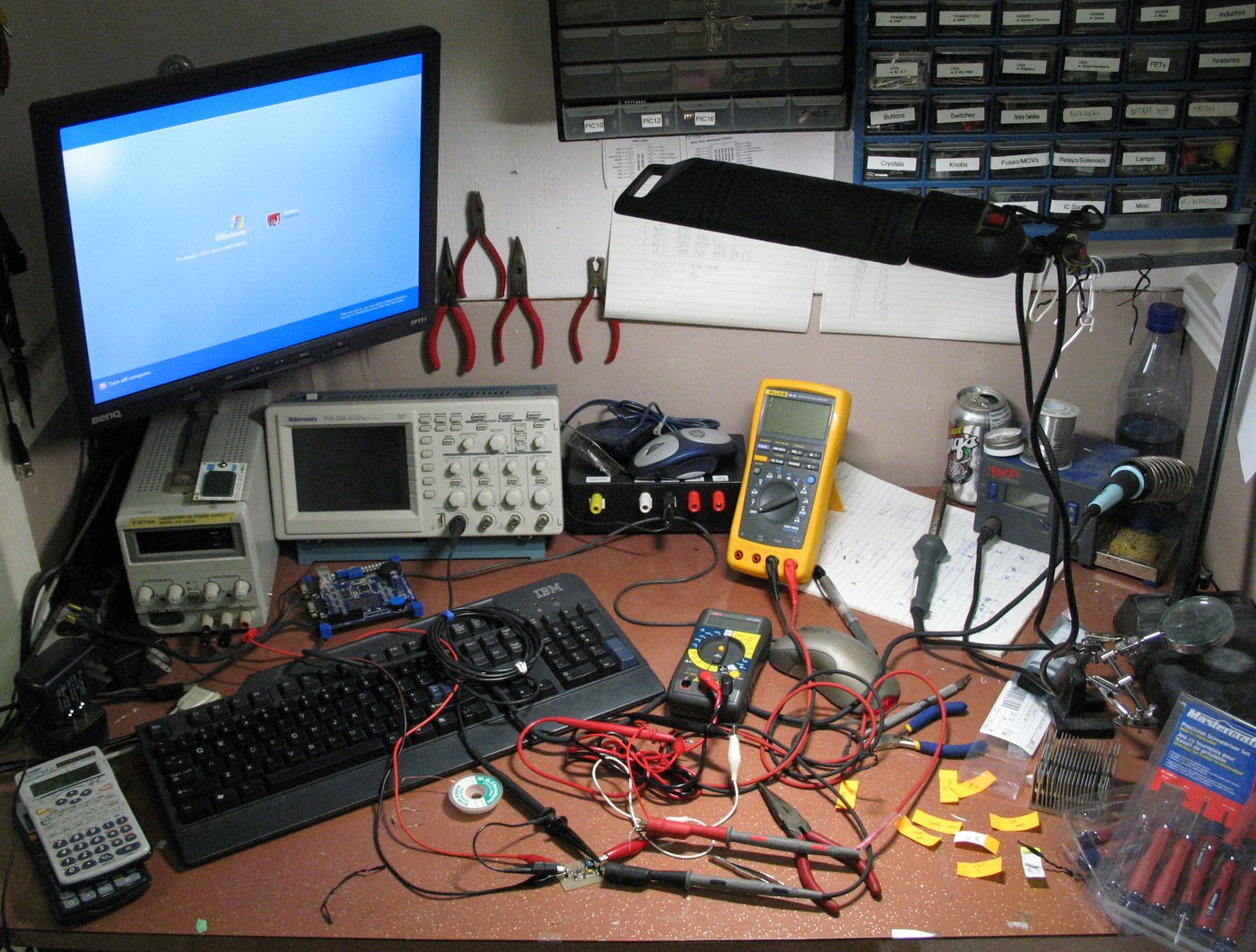
Soldering & desoldering
| Tool | Use | Technician notes |
|---|---|---|
| Temperature-controlled station (T12 / JBC / Hakko) | fine soldering and rework | fine tips (IC, SMD) and wide (ground planes); T12/JBC = fast thermal recovery, essential on ground planes |
| 60-80 W iron or large tip | ground planes, JAMMA connectors | a 25-40 W iron can't do it → cold joints, lifted pads |
| Hot-air station (rework) | SMD removal, SMD caps, QFP | 300-350 °C, flux; never "twist off" SMD caps (rips the pads) |
| Vacuum desoldering station | multilayer through-hole | near-mandatory on 4-6 layer arcade PCBs: internal planes sink the heat → hand pump + wick struggle |
| Desoldering braid + pump | complement, cleanup | wick to finish pads |
| Flux (no-clean gel) + isopropyl alcohol | the key consumable | wetting, bridges, cleaning corrosive residue |
| Alloy | Sn63/Pb37 (eutectic) | leaded stays the most controllable for repair; lead-free possible but hotter |
Preheat
A hotplate/preheater (or sweeping hot air) reduces thermal stress on multilayer PCBs and large ground planes — avoids lifting pads and vias.
Measurement & diagnosis
| Tool | Use | Notes |
|---|---|---|
| Multimeter | voltage, continuity, diode, capacitance | diode mode to trace logic in/outputs (clamp diodes) |
| In-circuit ESR meter | recap | reads ESR without desoldering → targets the dead electrolytics (recap) |
| Oscilloscope (≥ 100 MHz) | signal tracing, clocks, sync, video | check clocks (Xtal), reset, /IRQ, bus; compare a good vs dead board |
| Bench PSU with current limit | find a short without smoke | raise voltage current-limited → find the part that heats (finger / thermal cam / evaporating alcohol) |
| Isolation transformer | CRT / hot-chassis | mandatory whenever you touch a mains-referenced chassis (CRT safety) |
| Thermal camera / IR thermometer | short circuit, hotspot | finds the culprit under a current-limited supply |
| Logic probe / injector | slow logic, presence of activity | complements the scope |
| Dedicated arcade tester (Fluke 9010A + POD, ROM/RAM testers) | CPU boards | bus read/inject, RAM/ROM test (collector kit but the king of arcade diag) |
EPROM programming
- Universal programmer (TL866 II Plus / T48), reader, UV eraser (for quartz windows), PLCC/DIP adapters. See EPROM: read & burn.
Optics, ESD & extras
- Stereo microscope (×10-20) + ring light: joint inspection, reading markings, bridges invisible to the eye.
- ESD mat + wrist strap: customs (FPGA, GAL, MCU) are sensitive.
- IC extractor, DIP/PLCC insertion tool, tweezers, cutters.
- Wrap wire (trace repair), solder mask/lacquer, UV solder mask.
Consumables to always keep
Gel flux · 99 % isopropyl alcohol · wick · Sn63/Pb37 alloy · fine wrap wire · DIP turned-pin sockets · antistatic brushes · nitrile gloves (corrosive electrolyte).
See also
Sources & attribution
- Synthesis of established electronics-repair practice (arcade/retro).
- Internal pages cited above.
Image:
-
etabli-electronique.jpg— James Bastow, CC BY-SA 2.0, Wikimedia Commons — https://commons.wikimedia.org/wiki/File:Electronics_workbench.jpg

Review & corrections
How this space is used
Spotted a wrong value, an outdated procedure, a chip reference that does not match your board? Say so here, with what you observed (model, board revision, serial number, measurement). Every report is cross-checked against a source before anything changes — an unverifiable correction is published as “reported by …, not cross-checked” rather than silently applied.
Reading is open to everyone; posting requires signing in with Discord. Reports from the wiki's declared reviewers are handled first; anyone else's are read too, but go through a human before anything is changed.