Sega System 24
Sega arcade platform (1988) with a rare design choice: games on 3.5" floppies — which makes it today a preservation nightmare (floppies degrade). Dual 68000. Gain Ground, Bonanza Bros, Crackdown, Hot Rod…
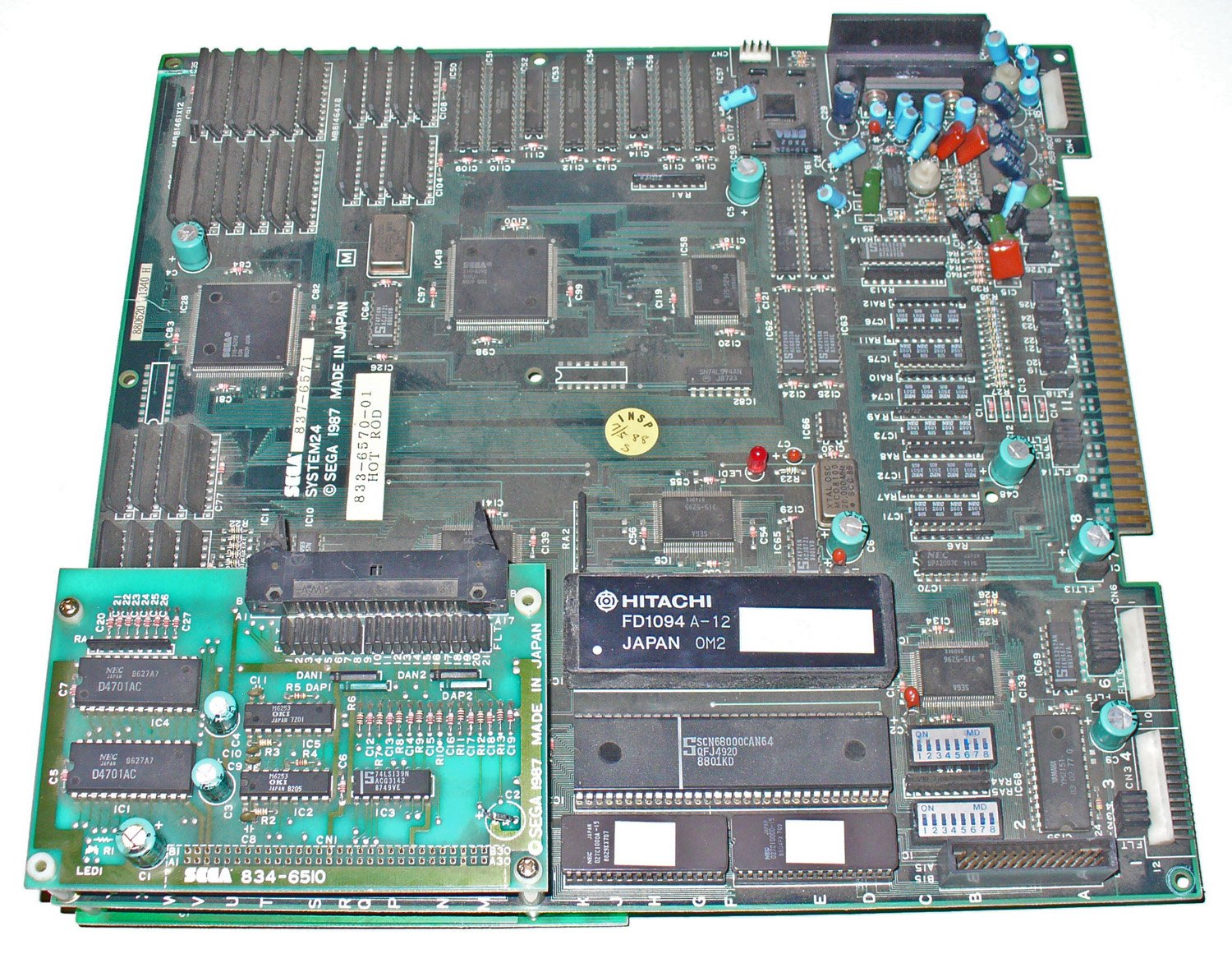
Identification
| Field | Value |
|---|---|
| Manufacturer | Sega |
| Year | 1988 |
| Media | 3.5" floppy (some games in ROM later) |
| Connector type | JAMMA |
Architecture
| Block | Chip | Clock | Role |
|---|---|---|---|
| CPU | 2 × Motorola 68000 | ~10 MHz | master + slave |
| Sound | Yamaha YM2151 + DAC (samples) | ||
| Video | Sega customs | high resolution (up to ~496×384), tilemaps + sprites |
Specificity: System 24 targets a high resolution (24 kHz monitor) for fine text and "puzzle/quiz" games. Original games shipped on 3.5″ floppy (see below).
⚠️ The floppy problem
Fragile medium
The original games are on 3.5" floppy: fading magnetism, a drive that wears out. Image the living floppies while there's still time; drive emulators (Gotek/HxC) let you run the images in place of the original drive.
→ Floppy imaging + HxC/Gotek + FD1094 guide (Anadisk dump, .s24→.hfe, sector layouts)
Notable games
Hot Rod (1988), Gain Ground, Bonanza Bros., Crack Down, Scramble Spirits, Dynamic Country Club, Quiz Rouka ni Tattenasai, Tokoro San no MahMahjan…
Some System 24 games also use the FD1094 protection (see System 16) on top of the floppy — hence the double difficulty.
Faults & preservation
- Floppy drive / dead floppies → Gotek/HxC + images.
- Targeted recap.
- Battery (config).
- Emulation: MAME emulates System 24 (from
.hfefloppy images/dumps) — the preservation route given the fragile media. No FPGA/MiSTer core.
Modernisation & mods
The common ground for every JAMMA board
Video, power, control panel and upscalers depend on the cabinet rather than the board: everything is centralised in Modernising a cabinet. To run the board outside a cabinet (at home, on a display): supergun.
- Anti-suicide 🟠: some games/variants of this platform do suicide (battery-backed key) — see the dedicated section above to find out whether yours is affected. If so, the durable route is de-suiciding → conversions and de-suiciding, not merely replacing the battery → save batteries.
- Storage 🟡: the game lives in EPROM/mask ROM on the board. Changing or restoring a game means reprogramming the EPROMs (and, for a mask ROM, using a pinout adapter) → EPROM method.
- Media preservation: replacing the original storage, multicarts, ODEs and modern options by family → PCB preservation hub.
- Scan rate 📺: ~24.39 kHz / 57.5 Hz — medium resolution, ⚠️ a 15 kHz-only chassis will not do: you need a medium-res monitor or a tri-sync → tri-sync and upscalers.
(Computed from the MAME sources —
sega/segas24.cpp— pixel clock ÷ htotal.) - FPGA / emulation: see the Emulation & FPGA section below.
Repair (technician)
- Floppy (see the dedicated section): drive/disk = weak point → imaging + HxC/Gotek (guide).
- FD1094 on some: flat battery = suicide → backup batteries.
- Dual 68000: a freeze = one CPU / its RAM → separate diagnosis. Sound: YM2151 + DAC.
- Capacitors: recap PSU + audio filtering. Oxidised EPROM sockets: turned-pin socket.
→ Methods: PCB fault-finding · Recap · EPROM · Traces & vias
Expected clocks — measurement table ✅
Values extracted from the MAME sources for this platform. On a scope or frequency counter, a clock that is missing or off-value points straight at the crystal, the divider or the chip at fault — the fastest starting point on a dead board.
| Component | Expected clock | Role |
|---|---|---|
| M68000 | 10 MHz | main CPU |
| YM2151 | 4 MHz | FM (sound) |
How to read this table
Several values for one component = several board variants in this family (or several instances of the chip clocked differently). These frequencies are those of the clock signal at the component's input, not of its original crystal — on many boards the clock is divided down from a single master crystal.
DIP settings ✅
14 games on this platform, settings extracted from the MAME sources (INPUT_PORTS_START blocks). The Position column gives the switch's physical reference on the board (SW2:!3,!4 = bank SW2, levers 3 and 4) — which is what lets you set it up without the paper manual. Games are sorted by MAME set name.
DIP settings — MAME set bnzabros
| Setting | Position | Options (default in bold) |
|---|---|---|
| Demo Sounds | SW2:1 | Off · On |
| Start Credit | SW2:2 | 1 · 2 |
| Coin Chute | SW2:3 | Common · Individual |
| Flip Screen | SW2:4 | Off · On |
| Difficulty | SW2:5,6 | Easy · Normal · Hard · Hardest |
| Lives | SW2:7,8 | 1 · 2 · 3 · 4 |
DIP settings — MAME set crkdown
| Setting | Position | Options (default in bold) |
|---|---|---|
| Coin Chute | SW2:7 | Common · Separate |
| Flip Screen | SW2:8 | Off · On |
DIP settings — MAME set dcclub_dips
| Setting | Position | Options (default in bold) |
|---|---|---|
| Start Credit | SW2:1 | 1 · 2 |
| Flip Screen | SW2:2 | Off · On |
| Demo Sounds | SW2:3 | Off · On |
| Timing Meter | SW2:4 | Normal · Easy |
| Initial Balls | SW2:5 | 1 · 2 |
| Balls Limit | SW2:6 | 3 · 4 |
| Difficulty | SW2:7,8 | Easy · Normal · Hard · Hardest |
DIP settings — MAME set gground
| Setting | Position | Options (default in bold) |
|---|---|---|
| Flip Screen | SW2:1 | Off · On |
| Demo Sounds | SW2:2 | Off · On |
| Difficulty | SW2:3,4,5 | Easiest · Easier · Easy · Little Easy · Normal · Little Hard · Hard · Hardest |
| Time Limit Per Stage | SW2:6,7 | Easiest · Easy · Normal · Hard |
| Clock Of Time Limit | SW2:8 | 1.00 sec · 0.80 sec |
DIP settings — MAME set hotrod
| Setting | Position | Options (default in bold) |
|---|---|---|
| Start Credit | SW2:6 | 1 · 2 |
| Coin Chute | SW2:7 | Separate · Common |
| Flip Screen | SW2:8 | Off · On |
DIP settings — MAME set hotrodj
| Setting | Position | Options (default in bold) |
|---|---|---|
| Start Credit | SW2:3 | 1 · 2 |
| Play Mode | SW2:4 | 4 Player · 2 Player |
| Game Style | SW2:5 | 4 Sides · 2 Sides |
| Language | SW2:6 | Japanese · English |
DIP settings — MAME set mahmajn
| Setting | Position | Options (default in bold) |
|---|---|---|
| Demo Sounds | SW2:1 | Off · On |
| Start Score | SW2:2 | 2000 · 3000 |
| Difficulty (computer) | SW2:3,4 | Easy · Normal · Hard · Hardest |
| Difficulty (player) | SW2:5,6 | Easy · Normal · Hard · Hardest |
DIP settings — MAME set qgh
| Setting | Position | Options (default in bold) |
|---|---|---|
| Flip Screen | SW2:1 | Off · On |
| Demo Sounds | SW2:2 | Off · On |
| Difficulty | SW2:3,4 | Easy · Normal · Hard · Hard |
| Lives | SW2:5,6 | 3 · 3 · 4 · 5 |
DIP settings — MAME set qrouka
| Setting | Position | Options (default in bold) |
|---|---|---|
| Play Mode | SW2:1 | 2 Player · 4 Player |
| Demo Sounds | SW2:2 | Off · On |
| Coin Chute | SW2:4 | Common · Separate |
| Lives | SW2:5,6 | 2 · 3 · 4 · 5 |
| Difficulty | SW2:7,8 | Easy · Normal · Hard · Hardest |
DIP settings — MAME set qsww
| Setting | Position | Options (default in bold) |
|---|---|---|
| Start Credit | SW2:1 | 1 · 2 |
| Demo Sounds | SW2:2 | Off · On |
| Flip Screen | SW2:3 | Off · On |
| Lives | SW2:5,6 | 2 · 3 · 4 · 5 |
| Difficulty | SW2:7,8 | Easy · Normal · Hard · Hardest |
DIP settings — MAME set quizmeku
| Setting | Position | Options (default in bold) |
|---|---|---|
| Play Mode | SW2:1 | 2 Player · 4 Player |
| Demo Sounds | SW2:2 | Off · On |
| Lives | SW2:3,4 | 2 · 3 · 4 · 5 |
| Answer Counts | SW2:5 | Every · 3 |
| Flip Screen | SW2:6 | Off · On |
| Difficulty | SW2:7,8 | Easy · Normal · Hard · Hardest |
DIP settings — MAME set roughrac
| Setting | Position | Options (default in bold) |
|---|---|---|
| Start Credit | SW2:1 | 1 · 2 |
| Demo Sounds | SW2:2 | Off · On |
| Flip Screen | SW2:3 | Off · On |
| Game Instruction | SW2:4 | Off · On |
| Difficulty | SW2:5,6 | Easy · Normal · Hard · Hardest |
| Start Money | SW2:7 | 15000 · 20000 |
| Start Intro | SW2:8 | 10 · 15 |
DIP settings — MAME set sgmast
| Setting | Position | Options (default in bold) |
|---|---|---|
| Start Credit | SW2:1 | 1 · 2 |
| Demo Sounds | SW2:2 | Off · On |
| Flip Screen | SW2:3 | Off · On |
| Gameplay | SW2:4 | 1 Hole 1 Credit · Lose Ball Game Over |
| Difficulty | SW2:6,7,8 | Easiest · Easier · Easy · Normal · Little Hard · Hard · Harder · Hardest |
DIP settings — MAME set sspirits
| Setting | Position | Options (default in bold) |
|---|---|---|
| Flip Screen | SW2:1 | Off · On |
| Demo Sounds | SW2:2 | Off · On |
| Lives | SW2:3,4 | 2 · 3 · 4 · 5 |
| Bonus Life | SW2:5,6 | 500K · 600K · 800K · None |
| Difficulty | SW2:7,8 | Easy · Normal · Hard · Hardest |
Check against your own board
These settings apply to the game and revision described by MAME. One title may have several DIP sets depending on region or revision, and some systems use soft-dips (settings in memory, via the test menu) rather than physical switches. In case of a discrepancy, the board's silkscreen and the test menu are authoritative.
See also: DIP reference · game manuals
Procedure — a dead board, step by step ✅
What this adds
The general method lives in PCB diagnosis. This is its application to this platform: the same order, but with the values actually expected here, so you do not have to go back and forth.
Tools: multimeter, oscilloscope (or frequency counter), current-limited bench supply, desoldering braid. → Tooling
If the board is still in a cabinet
A CRT holds its charge with the machine unplugged. → CRT safety
1. Inspection, power off. Corrosion, cut tracks, oxidised EPROM legs, leaking SMD capacitors, dubious earlier repairs. On this platform the battery is the first suspect: its leakage eats tracks under the holder, and the damage is often hidden by the battery itself. Lift it to look.
2. The connector, before anything else. A large share of "dead boards" are a contact problem, not a fault. Clean the contacts with isopropyl alcohol and reseat — not with an abrasive eraser on a gold edge, which takes the plating off and brings the problem back worse. It costs two minutes and settles the question.
3. Power, measured on the board. Aim for +5.0 V measured as close as possible to where power reaches the board — not at the PSU output: the drop is in the loom, and that is exactly what makes a board boot on the bench and not in the cabinet. Where you probe depends on this board's connector — JAMMA edge, JVS loom or a proprietary harness — plenty of makers kept one long after JAMMA arrived — see Identification above. → Wiring Check −5 V and +12 V too if the sound stage uses them. Suspected short: bring it up current-limited and find the hot spot.
4. /RESET. It must release after power-up. Held low = the CPU never starts. A 1–2 Hz loop is not the reset circuit, it is the watchdog: the CPU is crashing at boot, so look at the bus, not at the reset.
5. Clocks — the values expected on this platform.
- M68000 → 10 MHz (Main CPU)
- YM2151 → 4 MHz (FM (sound))
No clock on the M68000 (10 MHz) and there is no point measuring anything else: the fault is the crystal, the divider, or the chip itself. That single measurement splits a dead board in two.
6. Bus. Activity on the main CPU's address lines tells you whether it is running or frozen. Frozen with good clocks and good reset → work RAM, bus buffers, ROMs.
7. It boots but the picture or the sound is wrong — that is another job: see Common faults on this page, then signal tracing.
Procedure — replacing the battery without losing the key ✅
Not every board in this family is concerned
Check on this page whether your game is one of the encrypted ones before touching anything. On the others the battery only holds settings, and losing it costs nothing but a re-setup.
The order is the whole procedure
The decryption key of the FD1094 lives in SRAM held up by that battery. Cutting the old cell before the new one is soldered erases it, instantly and for good: the board goes silent and only a de-suicide brings the game back. So the new cell goes in first, in parallel.
- Board powered off, old battery left in place.
- Measure the old cell in circuit and note it (a CR2032 is 3 V nominal). This is what tells you whether you are ahead of the failure or already behind it.
- Solder the new cell in parallel with the old one — piggyback — watching polarity. A reversed cell discharges the old one through itself and erases the key just as surely.
- Re-measure at the holder: the voltage must have come back up. Do not go on before it has.
- Only now, remove the old cell.
- Power up and check the game boots.
Already dead? This procedure will not bring it back — the key is gone. → de-suicide
Photos / assets
(To add: System 24 board, floppy drive.)
Sources & attribution
- Wikipedia — Sega System 24 — CC-BY-SA — https://en.wikipedia.org/wiki/Sega_System_24
Image:
-
system24-carte.jpg— uploaded by Black Squirrel to Sega Retro (site CC BY 4.0; ⚠️ the file carries no individual licence) — https://segaretro.org/File:System24.jpg

Review & corrections
How this space is used
Spotted a wrong value, an outdated procedure, a chip reference that does not match your board? Say so here, with what you observed (model, board revision, serial number, measurement). Every report is cross-checked against a source before anything changes — an unverifiable correction is published as “reported by …, not cross-checked” rather than silently applied.
Reading is open to everyone; posting requires signing in with Discord. Reports from the wiki's declared reviewers are handled first; anyone else's are read too, but go through a human before anything is changed.