Epoch Super Cassette Vision
Epoch's console (1984), sold in Japan and in France under the Yeno name. A NEC μPD7801 processor you meet almost nowhere else, and a platform half of whose video parameters remain unverified.
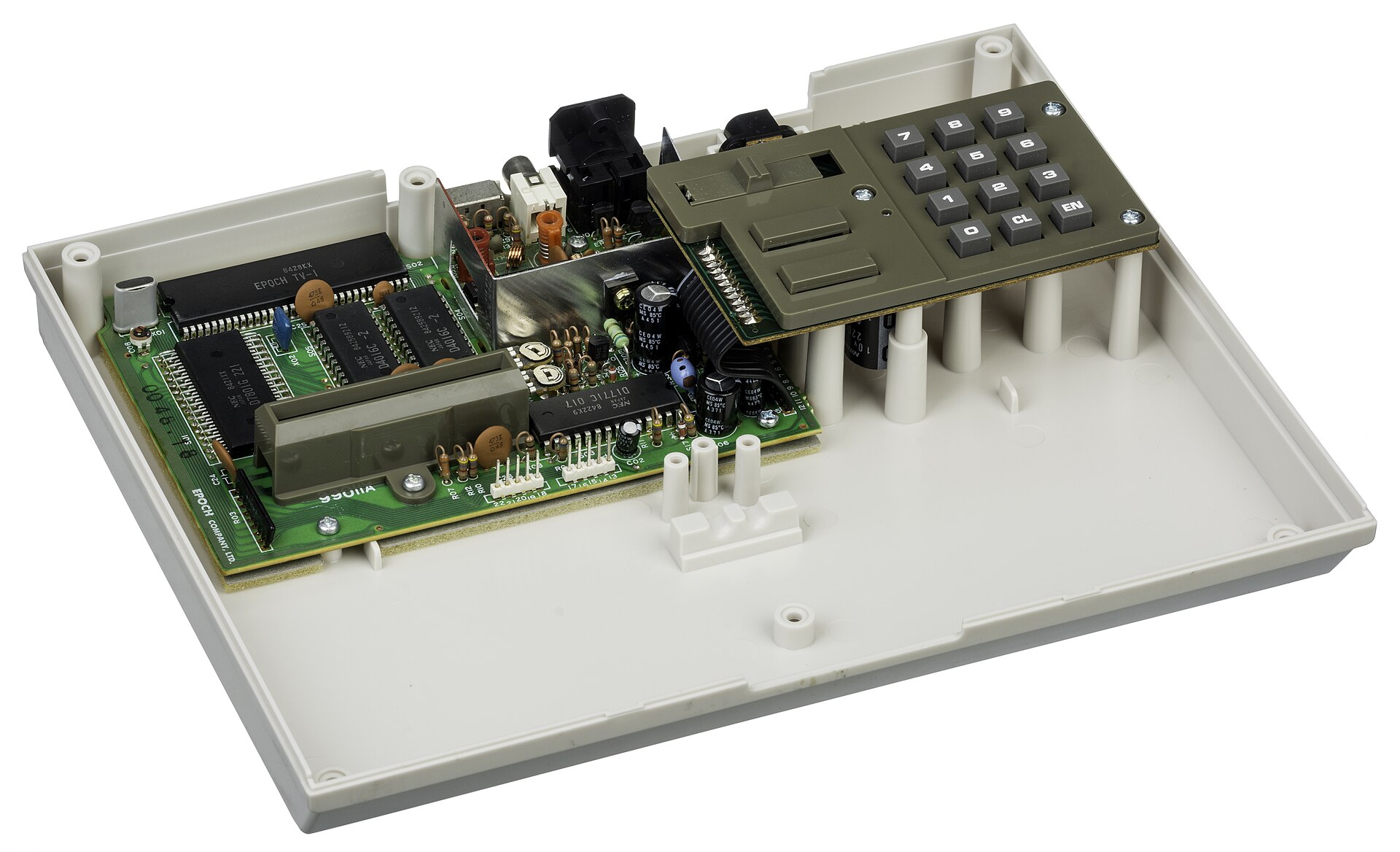
The Super Cassette Vision, opened. Photo by Evan-Amos (Vanamo Media), public domain.
Identification
| Field | Value |
|---|---|
| Manufacturer | Epoch (Japan) — distributed in France by Yeno |
| Year | 1984 |
| CPU | NEC μPD7801 @ 4 MHz |
| Sound | NEC μPD1771C @ 6 MHz |
| Video crystal | 14.318181 MHz (NTSC) · 13.4 MHz (PAL) |
| NTSC timing | 456 × 262, 192 × 222 visible |
| PAL timing | 456 × 294 |
| Media | cartridge |
Three separate crystals
Unlike the Intellivision, where everything comes from the colorburst, the Super Cassette Vision has three independent clocks: 4 MHz for the CPU, 6 MHz for the sound, and the video crystal.
→ A picture fault therefore implicates neither the CPU nor the sound, and the other way round. That is a diagnostic advantage.
Expected clocks — measurement table ✅
| Component | Expected clock | Role |
|---|---|---|
| μPD7801 | 4 MHz | Main CPU |
| μPD1771C | 6 MHz | sound |
The video crystal is verified, the rest is not
MAME annotates the NTSC version “Clock verified. TODO: Verify rest of the parameters” — the 14.318181 MHz crystal is confirmed, but the resolution, the margins and the line count are not.
And for the PAL version it is “TODO: Verify clock and video parameters”: there, even the clock is to be confirmed.
→ The scan figures given here are therefore indications, not measurement references.
An uncommon processor
NEC's μPD7801 is neither a Z80 nor a 6502: it is an in-house microcontroller from the 78K family. You meet it almost nowhere else in video games.
What that means in repair
No easy replacement, little documentation, and nothing transferable from the methods used on the Z80 or 6502 consoles of the same period.
Common faults
| Symptom | Probable cause | Next step |
|---|---|---|
| No picture | video crystal or the video stage | Independent of the CPU and the sound |
| No sound | μPD1771C or its 6 MHz crystal | A crystal separate from the CPU's |
| Will not start | μPD7801 or its 4 MHz crystal | A processor with no common replacement |
| Cartridge not read | connector contacts | Isopropyl alcohol, never an abrasive |
| PAL picture shifted | ⚠️ unverified parameters | Compare against another PAL machine, not a published figure |
Procedure — a dead console, step by step ✅
What this adds
Ordered for a console, not for an arcade board: what kills these is almost never the CPU. It is, in real order, the power supply, the capacitors, the drive or the cartridge slot, and only then the logic. → PCB diagnosis
1. The power supply. Two cases, depending on the machine. External brick: ⚠️ read the marking on the machine, next to the socket, and check the adapter against it — voltage and polarity. A centre-negative machine fed centre-positive loses its fuse, sometimes its regulator; do not trust a third-party label or a generic tip. Internal supply (the machine plugs straight into the wall): mains is inside the shell. Unplug, wait, and confirm the large capacitors are discharged before touching the board. Either way, measure under load: a failing supply holds its voltage until it is asked for current.
2. The fuse. Many of these machines have one right behind the socket — it is the part designed to die. Test it in continuity, out of circuit. A fuse that blows again is a short, not a fuse problem.
3. Capacitors. On most machines of this age this is the default suspect rather than a last resort — leaking SMD electrolytics eat the tracks underneath before they give any other sign. ⚠️ Not all of them are like that: some carry very few and are not recapped on principle. Read what this page says about it before reaching for the iron. → Recap
4. The cartridge connector. Cartridge contacts with isopropyl alcohol, never an abrasive eraser: it takes the gold plating off and the problem comes back worse. On the machine side, inspect the slot pins — splayed, bent or oxidised — and check continuity between slot and board.
5. Video output. Isolate the machine from the display: another cable, another TV, another input. A sizeable share of "dead consoles" are a dead cable, or a display that will not lock onto what this machine outputs — see the video section of this page for what that is.
6. Still nothing. Now, and only now, the logic: rails on the board, reset, clock, bus. → PCB diagnosis
Repair (technician)
- Three separate clock domains: that is what makes diagnosis clean on this machine.
- The μPD7801 is the hard part: uncommon and poorly documented.
- Do not trust the published video parameters, especially in PAL — MAME itself gives them as unverified.
→ Methods: PCB diagnosis · Recap
Modernisation & mods
- No battery, no suicide.
- ⚠️ Do not host ROMs — method only.
Photos / assets
(To take: the main board with the μPD7801 and the μPD1771C, the three crystals, and a cartridge — the French Yeno version if you meet one.)
Sources & attribution
Text (synthesised here; sources listed for attribution):
- MAME —
src/mame/epoch/scv.cpp(BSD-3-Clause / GPL): the μPD7801 at 4 MHz, the μPD1771C at 6 MHz; NTSC timing 456 × 262 (192 × 222 visible) on a 14.318181 MHz ÷ 2 crystal, annotated “Clock verified. TODO: Verify rest of the parameters”; the PAL variant on 13.4 MHz ÷ 2 with 294 lines, annotated “TODO: Verify clock and video parameters” — https://github.com/mamedev/mame/blob/master/src/mame/epoch/scv.cpp
Image:
-
super-cassette-vision-ouverte.jpg— Evan-Amos, Public domain — https://commons.wikimedia.org/wiki/File%3ASuper-Cassette-Vision-Open-FR.jpg

Review & corrections
How this space is used
Spotted a wrong value, an outdated procedure, a chip reference that does not match your board? Say so here, with what you observed (model, board revision, serial number, measurement). Every report is cross-checked against a source before anything changes — an unverifiable correction is published as “reported by …, not cross-checked” rather than silently applied.
Reading is open to everyone; posting requires signing in with Discord. Reports from the wiki's declared reviewers are handled first; anyone else's are read too, but go through a human before anything is changed.