Nintendo Game & Watch
Nintendo's first handhelds (1980-1991), and an object repaired unlike anything else in this wiki: no ROM to save, no memory to preserve — a segment LCD, and a machine designed to stay powered on for good.
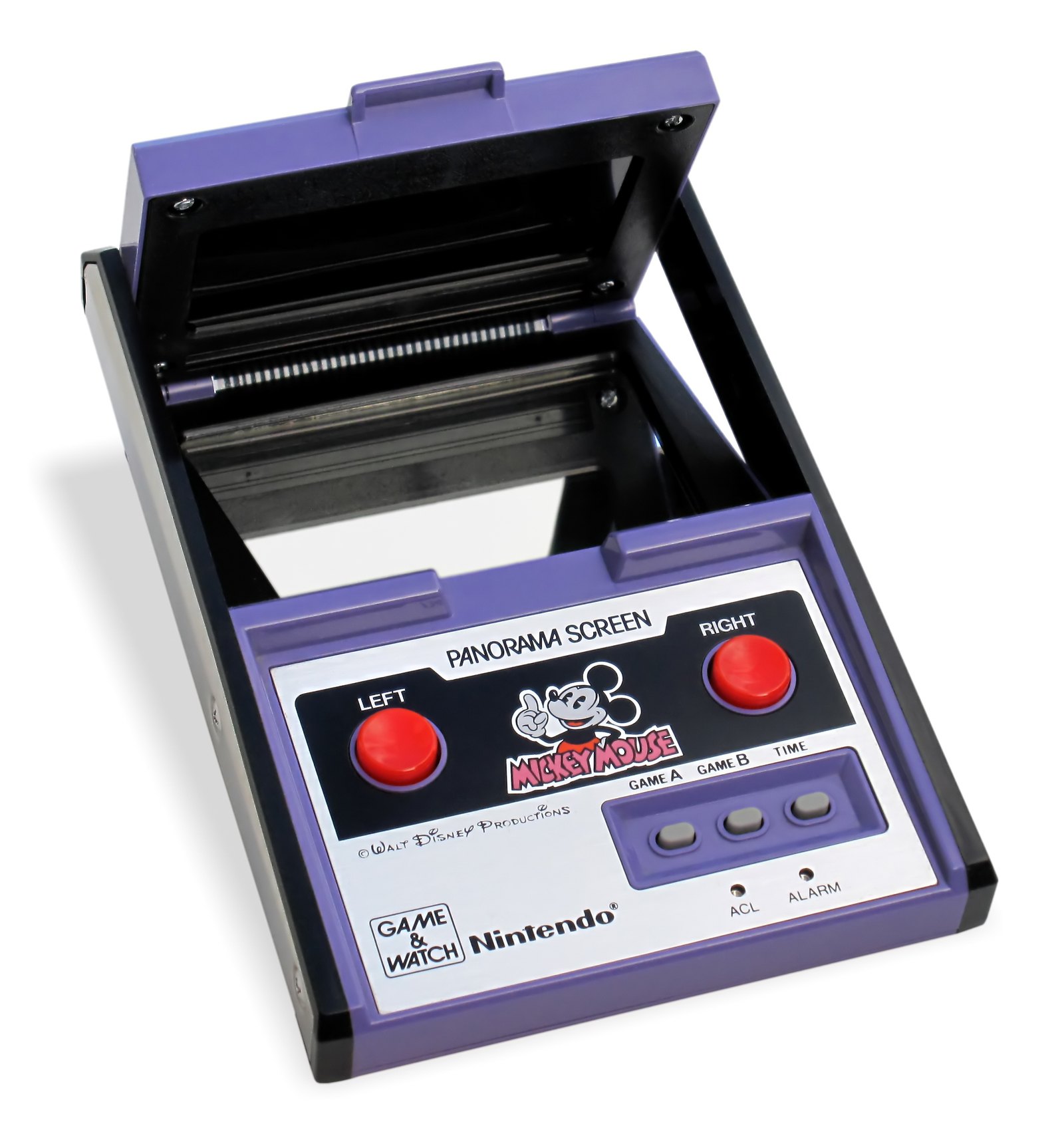
Identification
| Field | Value |
|---|---|
| Manufacturer | Nintendo |
| Years | 1980-1991 |
| Core | Sharp SM5xx family — microcontroller with ROM and LCD driver built in |
| Display | fixed-segment LCD, screen-printed — no pixels |
| Power | button cells |
| Save | ⚠️ none — see below |
One microcontroller, and that is all
There is no “board” to speak of: the SM5xx holds the processor, the game ROM and the LCD driver. Around it there is only a screen, a buzzer, some contacts and the cells.
The direct consequence: almost no fault here is electronic.
⚠️ No RTC, no memory — and that is deliberate
This is what MAME's driver underlines, and it changes how you see the object.
They were meant never to be switched off
Most of these games are meant to stay powered on. There is neither a backed-up clock nor non-volatile memory: cutting the power loses everything — the displayed time as much as the high scores.
Which makes sense: a Game & Watch was also a watch and an alarm clock. You did not switch it off, you changed the cell before it died.
→ For preservation that means there is nothing to save inside the machine. All the content sits in the microcontroller's ROM, fixed at the factory.
The screen, the only real failure point
Missing segments: the contact, not the chip
On a segment LCD the classic defects are segments that no longer appear or part of the screen going dark. The cause is almost always the contact between the glass and the board — an aged conductive (zebra) strip, or insufficient pressure.
That is not a microcontroller fault, and it is not fixed with an iron: it is reassembled, cleaned and re-compressed.
The screen has no replacement
The glass is screen-printed for that game: its segments draw that title's characters precisely. A broken panel cannot be replaced by anything — except by one from another example of the same game.
What MAME preserves, and how
The segments are recreated in SVG
Since there are no pixels to capture, the display is reconstructed from an SVG file describing each segment's shape. The printed background is a matter of external artwork.
In other words: preserving a Game & Watch means preserving a ROM and a drawing — not just code.
The driver covers around 175 machines from the SM5xx family, Game & Watch and related handhelds (including the Tiger R-Zone, handled separately).
Common faults
| Symptom | Probable cause | Next step |
|---|---|---|
| Missing or faint segments | glass/board contact (zebra strip) | Strip, clean, re-compress — no soldering iron |
| Screen entirely dead | cells or their contacts | Contact corrosion before anything else |
| Nothing responds | oxidised button contacts | Rubber contacts and carbon traces |
| No sound | buzzer or its joint | Independent of the display |
| Time and scores lost | normal — no non-volatile memory | See the box |
Repair (technician)
- Start with the contacts, not the electronics. Cells, buttons, screen strip: that is where nearly every fault is.
- The microcontroller is irreplaceable — it holds the game. If it is dead, so is the machine.
- The glass is irreplaceable too, and specific to the title.
- No recap: these machines have virtually no electrolytics.
→ Methods: PCB diagnosis
Modernisation & mods
- No backup battery, no suicide — but no memory either.
- ⚠️ Do not host ROMs — method only.
Photos / assets
(To take: the inside opened with the SM5xx and the zebra strip, a screen-printed panel close up, and the cell contacts.)
Sources & attribution
Text (synthesised here; sources listed for attribution):
- MAME —
src/mame/handheld/hh_sm510.cpp(BSD-3-Clause / GPL, driver by hap and Henrik Algestam, thanks to Sean Riddle, Igor, Lee Robson and Milan Galcik): the Sharp SM5xx family, around 175 machines covered, the rzone.cpp child driver for the Tiger R-Zone; the LCD screen graphics are provided by an internal SVG file, the background being external artwork; and the note that most of these games are meant to stay powered on 24/7, with no RTC and no NVRAM — quitting the emulator is akin to removing the battery — https://github.com/mamedev/mame/blob/master/src/mame/handheld/hh_sm510.cpp
Image:
-
game-and-watch-mickey.jpg— Geekfield, CC BY-SA 3.0 — https://commons.wikimedia.org/wiki/File:Nintendo_Game_%26_Watch_Mickey_Mouse.jpg

Review & corrections
How this space is used
Spotted a wrong value, an outdated procedure, a chip reference that does not match your board? Say so here, with what you observed (model, board revision, serial number, measurement). Every report is cross-checked against a source before anything changes — an unverifiable correction is published as “reported by …, not cross-checked” rather than silently applied.
Reading is open to everyone; posting requires signing in with Discord. Reports from the wiki's declared reviewers are handled first; anyone else's are read too, but go through a human before anything is changed.