NEC PC Engine / TurboGrafx-16
NEC + Hudson console (1987, PC Engine in Japan; TurboGrafx-16 in the US, 1989). An 8-bit CPU but 16-bit graphics, games on HuCard. Two preservation points: the recap (the SMD models, especially the Duo, leak) and the RGB mod (no clean RGB stock).
Identification
| Field | Value |
|---|---|
| Manufacturer | NEC / Hudson |
| Release | 1987 (JP), 1989 (US) |
| Generation | 4th (8/16-bit) |
| Media | HuCard (+ CD via add-on, see CD/Duo) |
| Native video output | Composite / RF — RGB via mod |
| Region | HuCard JP ≠ US (pinout/orientation) |
Architecture
| Block | Chip | Clock | Role |
|---|---|---|---|
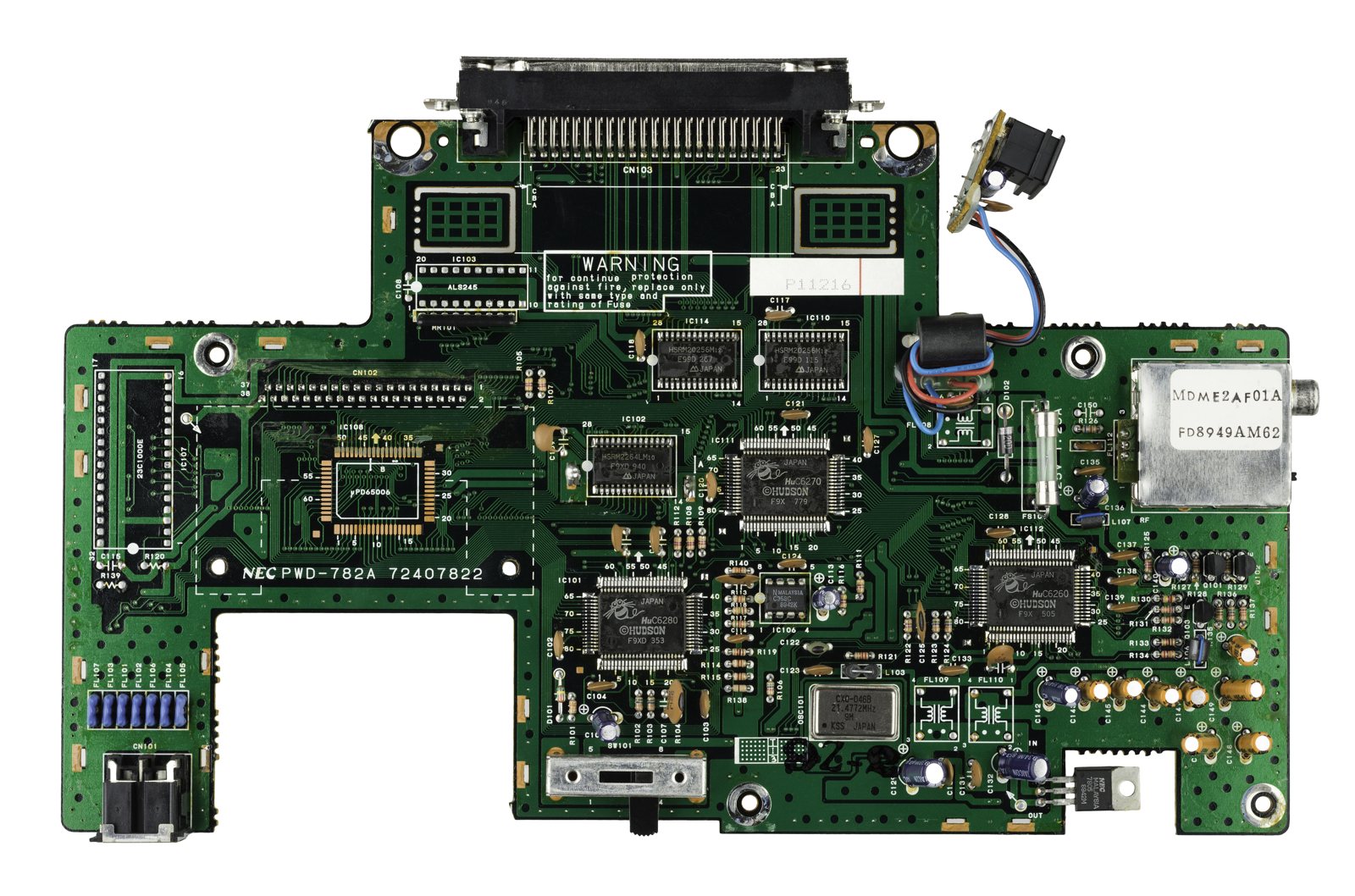
| CPU | Hudson HuC6280 (modified 65C02 core) | ~7.16 MHz | integrates a 6-voice PSG (wavetable) + timer + I/O |
| Video (VDC) | HuC6270 | 482×242 max, 64 sprites, up to 481 colours on screen | |
| Video (VCE) | HuC6260 | colour encoder, 512 palette | |
| Memory | 8 KB work + 64 KB VRAM | ||
| Media | HuCard (thin card) — TurboChip in the US |
Despite its 8-bit CPU, the 16-bit video bus and the VDC make it a machine closer to 16-bit for display (hence "TurboGrafx-16" in export).
Models (PC Engine family)
PC Engine (white) · CoreGrafx I/II (AV out instead of RF) · TurboGrafx-16 (US) · Shuttle (budget, no expansion port) · SuperGrafx (enhanced) · GT / TurboExpress (handheld) · LT (clamshell screen) · Duo (built-in CD, see the dedicated page).
- SuperGrafx (1989): a 2nd VDC + VPC (plane mixer) — more powerful but only ~5 dedicated games (Ghouls'n Ghosts, Aldynes, Daimakaimura…), PC Engine backward-compatible.
- GT / TurboExpress: the handheld PC Engine (same HuCards as the console) — LCD screen, battery-hungry, frequent IPS/recap mods.
Peripherals
- Controller: the TurboTap / Multitap hub goes to 5 players (Bomberman). Avenue Pad 6 pads (6 buttons, for games that use it, e.g. Street Fighter II′ CE), turbo pads.
- A mouse, a tablet, and the CD-ROM² drive (see the dedicated page).
Common faults
| Symptom | Likely cause | Lead |
|---|---|---|
| Degraded sound/video, corrosion (CoreGrafx/Duo) | Leaking SMD capacitors | Recap |
| HuCard not read | Connector contacts | Cleaning |
| No image | Power, VCE, contacts | Diagnosis |
| Dull RF image | Non-RGB output | RGB mod |
Procedure — a dead console, step by step ✅
What this adds
Ordered for a console, not for an arcade board: what kills these is almost never the CPU. It is, in real order, the power supply, the capacitors, the drive or the cartridge slot, and only then the logic. → PCB diagnosis
1. The power supply. Two cases, depending on the machine. External brick: ⚠️ read the marking on the machine, next to the socket, and check the adapter against it — voltage and polarity. A centre-negative machine fed centre-positive loses its fuse, sometimes its regulator; do not trust a third-party label or a generic tip. Internal supply (the machine plugs straight into the wall): mains is inside the shell. Unplug, wait, and confirm the large capacitors are discharged before touching the board. Either way, measure under load: a failing supply holds its voltage until it is asked for current.
2. The fuse. Many of these machines have one right behind the socket — it is the part designed to die. Test it in continuity, out of circuit. A fuse that blows again is a short, not a fuse problem.
3. Capacitors. On most machines of this age this is the default suspect rather than a last resort — leaking SMD electrolytics eat the tracks underneath before they give any other sign. ⚠️ Not all of them are like that: some carry very few and are not recapped on principle. Read what this page says about it before reaching for the iron. → Recap
4. The cartridge connector. Cartridge contacts with isopropyl alcohol, never an abrasive eraser: it takes the gold plating off and the problem comes back worse. On the machine side, inspect the slot pins — splayed, bent or oxidised — and check continuity between slot and board.
5. Video output. Isolate the machine from the display: another cable, another TV, another input. A sizeable share of "dead consoles" are a dead cable, or a display that will not lock onto what this machine outputs — see the video section of this page for what that is.
6. Still nothing. Now, and only now, the logic: rails on the board, reset, clock, bus. → PCB diagnosis
Popular mods — what to buy, where, procedures
Sourcing
No PC Engine section on ConsoleMods → info from established community knowledge (RetroRGB, Console5 for recap). Soldering: 🟢 none · 🟡 · 🟠 · 🔴.
Video — from RF/composite to RGB
- The PCE only outputs RF/composite stock → an RGB mod for a clean image: you tap the analog RGB generated by the VCE (HuC6260) and amplify it to a SCART. Premade RGB boards exist (much simpler than DIY). → RGB & SCART.
- HDMI: after the RGB mod, a RAD2x (SCART→HDMI line-doubler cable) or an internal digital kit.
What's established about the PCE RGB mod (community knowledge — no CC source)
The HuC6260 (VCE) converts the palette's digital RGB to analog via three 3-bit DACs (one per R/G/B channel). A documented build:
- R/G/B amp: a THS7314 (3-channel video amp) brings R/G/B to SCART level.
-
Sync: the sync signal comes out of the HuC6260 and is available on expansion-port pin 22C (nothing in between) — handy to grab it without soldering to the chip; otherwise an LM1881 (sync separator) recreates a clean CSYNC.
-
Composite: present stock (can feed the LM1881 as a sync source).
⚠️ The exact HuC6260 R/G/B pins depend on the model (white PC Engine, CoreGrafx, Duo, SuperGrafx, US TurboGrafx) and live in community illustrated schematics (shmups "THS AMP based RGB" threads, 8bitplus) — not copied here for lack of an open-licensed source, and we don't invent a pin number (a wrong one = no picture). The safest route is a premade RGB board for your model, or the schematic cited in Sources.
Play your library — flashcart
- Turbo EverDrive Pro (Krikzz) — HuCard + CD on SD, plug-and-play 🟢. Where: Krikzz, Stone Age Gamer.
- CD models (CD-ROM²/Duo): Super SD System 3 (Terraonion) replaces CD + BIOS + RAM with SD → see CD/Duo (⚠️ mandatory recap on these SMD units).
Reliability
- Preventive recap on SMD models (especially Duo/CD; Console5 lists). Emulation: Mednafen/Beetle PCE (accurate), MAME.
Region JP ≠ US (mirrored pinout)
Japanese HuCards and US TurboChips share the same hardware but have a mirrored pinout (a deliberate reversal) → a card won't fit the other console without an adapter (Kisado…). Not encryption — just a mechanical key.
Photos / assets
(To add: PC Engine vs TurboGrafx, HuCard, internal board.)
Advanced repair
Recap (period electrolytics) + HuCard slot contacts; RGB output via a mod. Methods: Recap · PCB fault-finding · Traces & vias.
Archived manufacturer documentation ✅
Manufacturer documentation archived locally. ⚠️ These are owner's and reference manuals, not service manuals: they give the specifications, the connectors and the expected behaviour, but not the schematics or troubleshooting voltages.
- TurboGrafx-16 — PDF
Status
Manufacturer documents with no explicit licence, kept for preservation (machines out of production for decades).
Sources & attribution
- Wikipedia — TurboGrafx-16 — CC-BY-SA — https://en.wikipedia.org/wiki/TurboGrafx-16
- ConsoleMods / Console5 — PC Engine (recap, RGB) — to reference
- PCE RGB mod (VCE HuC6260 = 3 R/G/B DACs, THS7314 3-channel amp, sync from HuC6260 on expansion pin 22C / LM1881) — community knowledge, no CC licence — https://shmups.system11.org/viewtopic.php?t=67437 · https://8bitplus.co.uk/projects/nec-pc-engine-interface-unit-rgb-mod/
Image:
-
pc-engine-board.jpg— Evan-Amos, public domain — https://commons.wikimedia.org/wiki/File:NEC-TurboGrafx-16-Motherboard-Top.jpg

Review & corrections
How this space is used
Spotted a wrong value, an outdated procedure, a chip reference that does not match your board? Say so here, with what you observed (model, board revision, serial number, measurement). Every report is cross-checked against a source before anything changes — an unverifiable correction is published as “reported by …, not cross-checked” rather than silently applied.
Reading is open to everyone; posting requires signing in with Discord. Reports from the wiki's declared reviewers are handled first; anyone else's are read too, but go through a human before anything is changed.