Sega Hikaru
Sega's high-end 3D in 1999: a NAOMI evolution that doubles everything (two SH-4s, two AICAs, doubled RAM/VRAM) and was the first arcade board capable of Phong shading. Born to render the fire/water of Brave Firefighters. Expensive, few games, rare hardware — emulation (Demul) is the key to preservation.
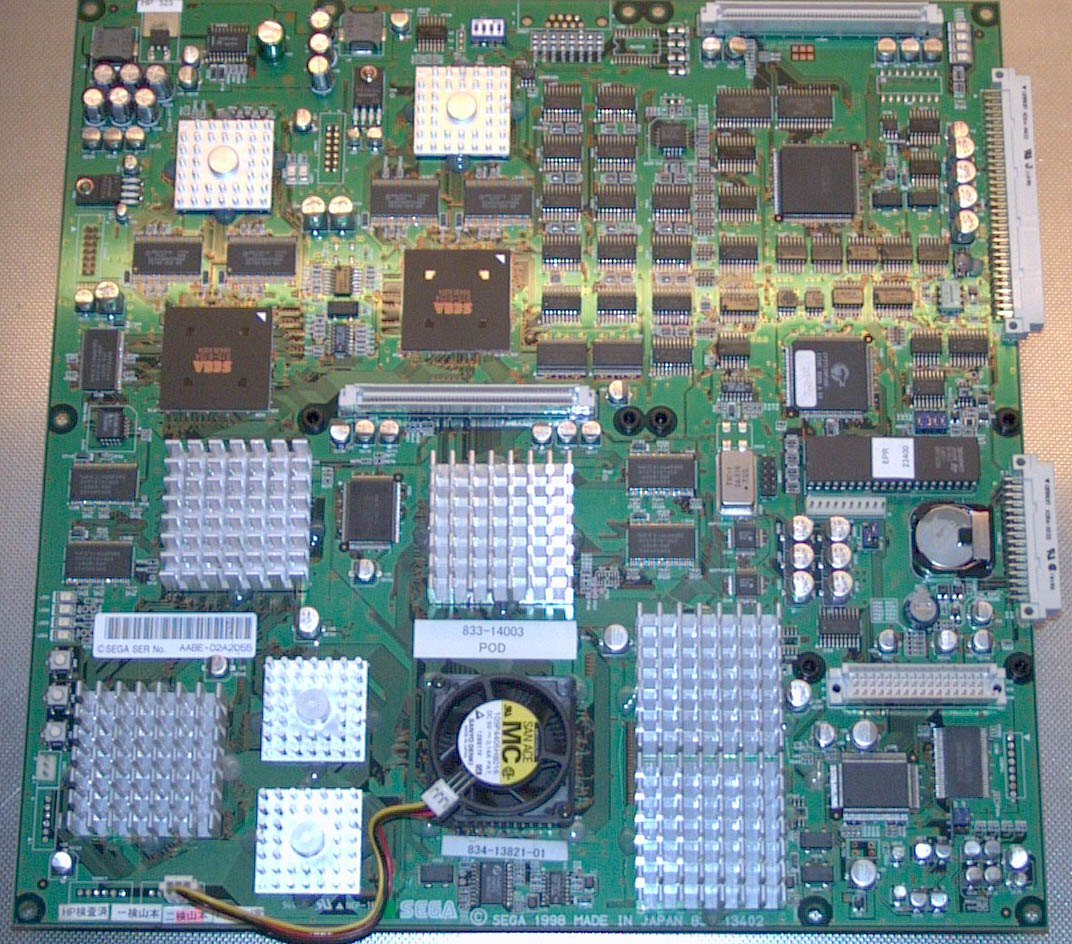
Identification
| Field | Value |
|---|---|
| Manufacturer | Sega |
| Year | 1999 (Brave Firefighters) |
| Type | high-end 3D (between NAOMI and NAOMI 2) |
| Media | ROM board |
| I/O | JVS |
| Resolution | 640×480 |
Architecture
| Block | Chip | Clock | Role |
|---|---|---|---|
| CPU ×2 | Hitachi SH-4 | 200 MHz | ~360 MIPS / 1.4 GFLOPS; geometry + game |
| GPU | custom Sega | Phong shading (an arcade first), light/particle effects | |
| Sound ×2 | ARM7 + Yamaha AICA | 45 MHz | 64 ADPCM voices (double the NAOMI sound) |
| Memory | doubled RAM/VRAM vs NAOMI | ||
| Media | ROM board |
The Hikaru doubles most of the NAOMI's components and adds Phong shading — developed by Sega specifically to render the fire, water and particles of Brave Firefighters, beyond the original NAOMI. High cost → a small catalogue.
Notable games
Brave Firefighters (1999, first game), Airline Pilots / Aero Dancing, Planet Harriers, Cyber Troopers Virtual-On Force, Star Wars Racer Arcade, NASCAR Arcade, Get Bass 2… (about ten titles).
Faults & repair
| Symptom | Likely cause | Lead |
|---|---|---|
| No image / corrupt 3D | SH-4 / custom GPU / RAM | Block-by-block diagnosis; rare customs |
| No sound (one channel) | one of the 2 AICAs / ARM7 | Sound-stage diagnosis |
| ROM board not read | contacts | Cleaning |
| Reboots | PSU capacitors | Recap |
| Dead controls | JVS I/O / harness | JVS diagnosis |
Rare and expensive hardware → priority on saving dumps and software preservation.
Modernisation & mods
The common ground for every JAMMA board
Video, power, control panel and upscalers depend on the cabinet rather than the board: everything is centralised in Modernising a cabinet. To run the board outside a cabinet (at home, on a display): supergun.
- Storage 🟡: the game lives in EPROM/mask ROM on the board. Changing or restoring a game means reprogramming the EPROMs (and, for a mask ROM, using a pinout adapter) → EPROM method.
- Media preservation: replacing the original storage, multicarts, ODEs and modern options by family → PCB preservation hub.
- Scan rate 📺: ~31.72 kHz / 60.1 Hz — high resolution (VGA class), ⚠️ you need a 31 kHz / tri-sync monitor; a 15 kHz chassis is incompatible → tri-sync and upscalers.
(Computed from the MAME sources —
sega/hikaru.cpp— pixel clock ÷ htotal.) - FPGA / emulation: see the Emulation & FPGA section below.
Repair (technician)
- Rare custom GPU (dual SH-4, geometry): corrupt 3D = video RAM + buffers first, the custom last (a very rare donor — a niche platform).
- Sound: 2× ARM7 + AICA (64 voices) — diagnose the sound stage.
- ROM board: contacts → clean. Capacitors: recap PSU + audio.
→ Methods: PCB fault-finding · Recap · EPROM · Traces & vias
Procedure — a dead board, step by step ✅
What this adds
The general method lives in PCB diagnosis. This is its application to this platform: the same order, but with the values actually expected here, so you do not have to go back and forth.
Tools: multimeter, oscilloscope (or frequency counter), current-limited bench supply, desoldering braid. → Tooling
If the board is still in a cabinet
A CRT holds its charge with the machine unplugged. → CRT safety
1. Inspection, power off. Corrosion, cut tracks, oxidised EPROM legs, leaking SMD capacitors, dubious earlier repairs.
2. The connector, before anything else. A large share of "dead boards" are a contact problem, not a fault. Clean the contacts with isopropyl alcohol and reseat — not with an abrasive eraser on a gold edge, which takes the plating off and brings the problem back worse. It costs two minutes and settles the question.
3. Power, measured on the board. Aim for +5.0 V measured as close as possible to where power reaches the board — not at the PSU output: the drop is in the loom, and that is exactly what makes a board boot on the bench and not in the cabinet. Where you probe depends on this board's connector — JAMMA edge, JVS loom or a proprietary harness — plenty of makers kept one long after JAMMA arrived — see Identification above. → Wiring Check −5 V and +12 V too if the sound stage uses them. Suspected short: bring it up current-limited and find the hot spot.
4. /RESET. It must release after power-up. Held low = the CPU never starts. A 1–2 Hz loop is not the reset circuit, it is the watchdog: the CPU is crashing at boot, so look at the bus, not at the reset.
5. Clocks. There is no measurement table for this platform — MAME's sources yield nothing usable for it. Any frequency quoted under Architecture on this page serves as a marker; otherwise compare against a working board rather than against a number: an invented value condemns healthy parts. → PCB diagnosis
6. Bus. Activity on the main CPU's address lines tells you whether it is running or frozen. Frozen with good clocks and good reset → work RAM, bus buffers, ROMs.
7. It boots but the picture or the sound is wrong — that is another job: see Common faults on this page, then signal tracing.
Emulation & FPGA
- Emulation: historically very hard; Demul is the reference emulator (the only one supporting the Hikaru; near-complete support in recent builds). No FPGA core (2× SH-4 + custom GPU, out of budget).
Lineage
Between the NAOMI (1998) and the NAOMI 2 (2000). Same sound family (AICA) as the NAOMI/Dreamcast. Contemporary with the last Model 3 games.
Photos / assets
(To add: Hikaru board, dual SH-4, ROM board, JVS I/O.)
Sources & attribution
- Sega Retro / Video Games Museum — Sega Hikaru (2× SH-4 @ 200 MHz, Phong shading, 2× AICA 64 voices, 640×480, games) — https://www.video-games-museum.com/en/sys/128-hikaru
- Sega Retro — Brave Firefighters (first Hikaru game, fire/water motivation) — https://segaretro.org/Brave_Firefighters
- MAME / Demul — Hikaru emulation (
braveff& co.) — https://github.com/mamedev/mame
Image:
-
hikaru-carte.jpg— uploaded by Mikel to Sega Retro (site CC BY 4.0; ⚠️ the file carries no individual licence) — https://segaretro.org/File:Hikaru_mainPCB.jpg

Review & corrections
How this space is used
Spotted a wrong value, an outdated procedure, a chip reference that does not match your board? Say so here, with what you observed (model, board revision, serial number, measurement). Every report is cross-checked against a source before anything changes — an unverifiable correction is published as “reported by …, not cross-checked” rather than silently applied.
Reading is open to everyone; posting requires signing in with Discord. Reports from the wiki's declared reviewers are handled first; anyone else's are read too, but go through a human before anything is changed.