Namco converts (System 2 / 11 / 12…)
At Namco, conversion almost always hits a hardware protection: a custom MCU (System 1/2) or a per-game KEYCUS chip (System 11/12, PlayStation-based). These platforms are hard to convert — the value is mostly in the understanding and preservation (MiSTer/MAME).
| Platform | Base | Protection | Convertibility |
|---|---|---|---|
| System 1 / 2 | 2× 68000 + MCU | custom MCU (C65/C68…) | 🟠 hard (MCU) |
| System 11 | PlayStation (R3000A) | per-game KEYCUS (C4xx) | 🔴 very hard |
| System 12 | improved PlayStation | KEYCUS CPLD (MACH211) | 🔴 very hard |
| System 10 | PlayStation | NAND + dongle | 🔴 |
| System 246/256 | PlayStation 2 | dongle + DVD/HDD | 🔴 (dongle) |
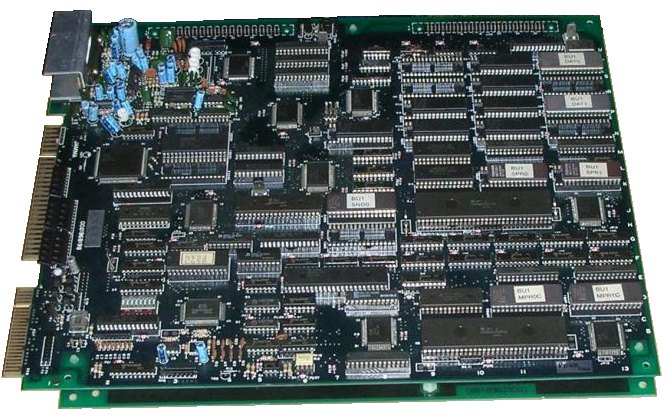
System 1 / 2 (68000 + MCU)
- Two 68000 (master/slave) + a custom MCU (e.g. C68, Mitsubishi-based) handling I/O and part of the logic/protection.
- Converting = reprogram the target game's EPROMs and have the compatible MCU (or its firmware). The rare Namco customs complicate everything.
- Well documented in MAME (MCU dumps), less so on the "home convert" side.
Program EPROM, game by game (System 1 / System 2)
Size → EPROM: 64 KB → 27C512 · 128 KB → 27C010. (Source: MAME namco/namcos1.cpp,
namco/namcos2.cpp. Board views: System 1 · System 2.)
- System 1: banked 6809 program in 27C512 / 27C010 (
mainromregion), + the C117 MMU and an MCU (light protection). Games: Dragon Spirit, Pac-Mania, Galaga '88, Splatterhouse, Blast Off, Tank Force, World Court, Bakutotsu Kijuutei… - System 2: 2× 68000 (master + slave, each with its own EPROMs) + a C68 MCU (protection — the key to conversion). The table below gives the master program:
| Game (System 2) | Program EPROM (master) |
|---|---|
| Assault | 2× 27C512 |
| Final Lap | 2× 27C512 |
| Marvel Land | 2× 27C512 |
| Mirai Ninja | 2× 27C512 |
| Golly! Ghost! | 2× 27C512 |
| Metal Hawk | 2× 27C010 |
| Ordyne | 2× 27C010 |
| Phelios | 2× 27C010 |
| Rolling Thunder 2 | 2× 27C010 |
| Cosmo Gang the Video | 2× 27C010 |
| Steel Gunner | 2× 27C010 |
| Suzuka 8 Hours | 2× 27C010 |
| Burning Force | 2× 27C010 |
| Dirt Fox | 2× 27C010 |
| Final Lap 2 / 3 | 2× 27C010 |
| Super World Stadium | 2× 27C010 |
System 2 = the C68 MCU governs conversion
Every System 2 has a C68 MCU (often with a game-specific external data EPROM). Reburning the master program is not enough: you also need the C68 / its ROM for the right game, plus the slave program and the graphics. See preservation below.
System 11 / 12: the architecture (PlayStation-based)
| Block | System 11 | System 12 |
|---|---|---|
| CPU | R3000A (PS1) | R3000A +50% |
| GPU | CXD8538Q + 2 MB VRAM | improved PS1 GPU |
| Sound | C76 (M37702) + C352 (32-voice PCM) | H8/3002 + C352 |
| Media | banked ROM (no CD) | motherboard flash + ROM board |
| Protection | per-game KEYCUS | KEYCUS (MACH211 CPLD) |
- The CPU/video board ("COH", top board) is interchangeable between games.
- The ROM board (game data) is title-specific: swapping it to another game won't boot (different graphics data and KEYCUS).
The wall: the KEYCUS
- Each game has a KEYCUS (authentication coprocessor): the CPU must run a precise unlock sequence to access the ROMs. On System 12, the KEYCUS also does lockout (blocks ROM access until the sequence is played).
- System 11: 8 known KEYCUS (C406, C409, C410, C411, C430, C431, C432, C442, C443) — all implemented and verified in the MiSTer core.
- System 12: KEYCUS = MACH211 CPLD (PLCC44, 64 macrocells).
→ A real conversion requires neutralising the KEYCUS (program patch) and handling the varied ROM boards (different chip count/type per game). It's very hard for most people.
The program (flash) & region
- The program lives in fine-pitch flash on the motherboard (typically 2E / 2J, sometimes 2L / 2P, under the CPU board).
- A region change = reprogram these flash → fine SMD soldering.
🎮 Which per-game KEYCUS / ROM board? → Namco 11/12 KEYCUS reference (14 S11 + 47 S12, from MAME).
🎮 Next generation (PS3-based): Namco System 357 / 369 (Tekken 6 / Tekken Tag 2) — HDD+dongle, retail PS3 motherboard conversion, full tutorial.
System 10 / 246 / 256 (preservation, not really "converting")
- System 10: PlayStation, data in NAND + a protection dongle.
- System 246 / 256: PS2-based, game on DVD/HDD + a hardware dongle — without the right dongle, no boot. Preservation tied to the dongle and the media's condition. See System 246.
Preservation (the main contribution)
Most Namco work is on the emulation/FPGA side: dumping the MCUs (System 1/2) and implementing the KEYCUS (System 11 on MiSTer, System 12 on MAME). That's what will eventually enable de-protected conversions — still rare on real hardware.
Before / after
- System 2: reprogram EPROM + compatible MCU → another game (hard).
- System 11/12: without neutralising the KEYCUS, no conversion; the realistic route stays emulation (MiSTer/MAME) until a clean hardware kit exists.
Where to read more
- MAME — drivers
namcos2/namcos11/namcos12(MCU, KEYCUS) — https://github.com/mamedev/mame - MiSTer — System 11 core (KEYCUS implemented) — https://github.com/XelaNotPu/SYSTEM11_MiSTer
- Repair/convert discussions: Arcade-Projects — https://www.arcade-projects.com/
- Wikipedia — Namco System 11 and System 12 — https://en.wikipedia.org/wiki/Namco_System_11_and_System_12
Sources & attribution
- Wikipedia / MiSTer — System 11/12 (COH, C76/H8, C352, KEYCUS C4xx / MACH211) — https://github.com/XelaNotPu/SYSTEM11_MiSTer
- MAME — Namco drivers (System 2/11/12) — https://github.com/mamedev/mame
-
Internal page: Namco System 2 · System 246 Image:
-
namco-burning-force.jpg— Robivy64, public domain, Wikimedia Commons — https://commons.wikimedia.org/wiki/File:Burning_force_pcb.PNG

Review & corrections
How this space is used
Spotted a wrong value, an outdated procedure, a chip reference that does not match your board? Say so here, with what you observed (model, board revision, serial number, measurement). Every report is cross-checked against a source before anything changes — an unverifiable correction is published as “reported by …, not cross-checked” rather than silently applied.
Reading is open to everyone; posting requires signing in with Discord. Reports from the wiki's declared reviewers are handled first; anyone else's are read too, but go through a human before anything is changed.