Interton VC 4000 (and the 1292 family)
A 1978 European console sold under a dozen different names — and that is the whole preservation interest: working out which machine you are holding means looking past the label.
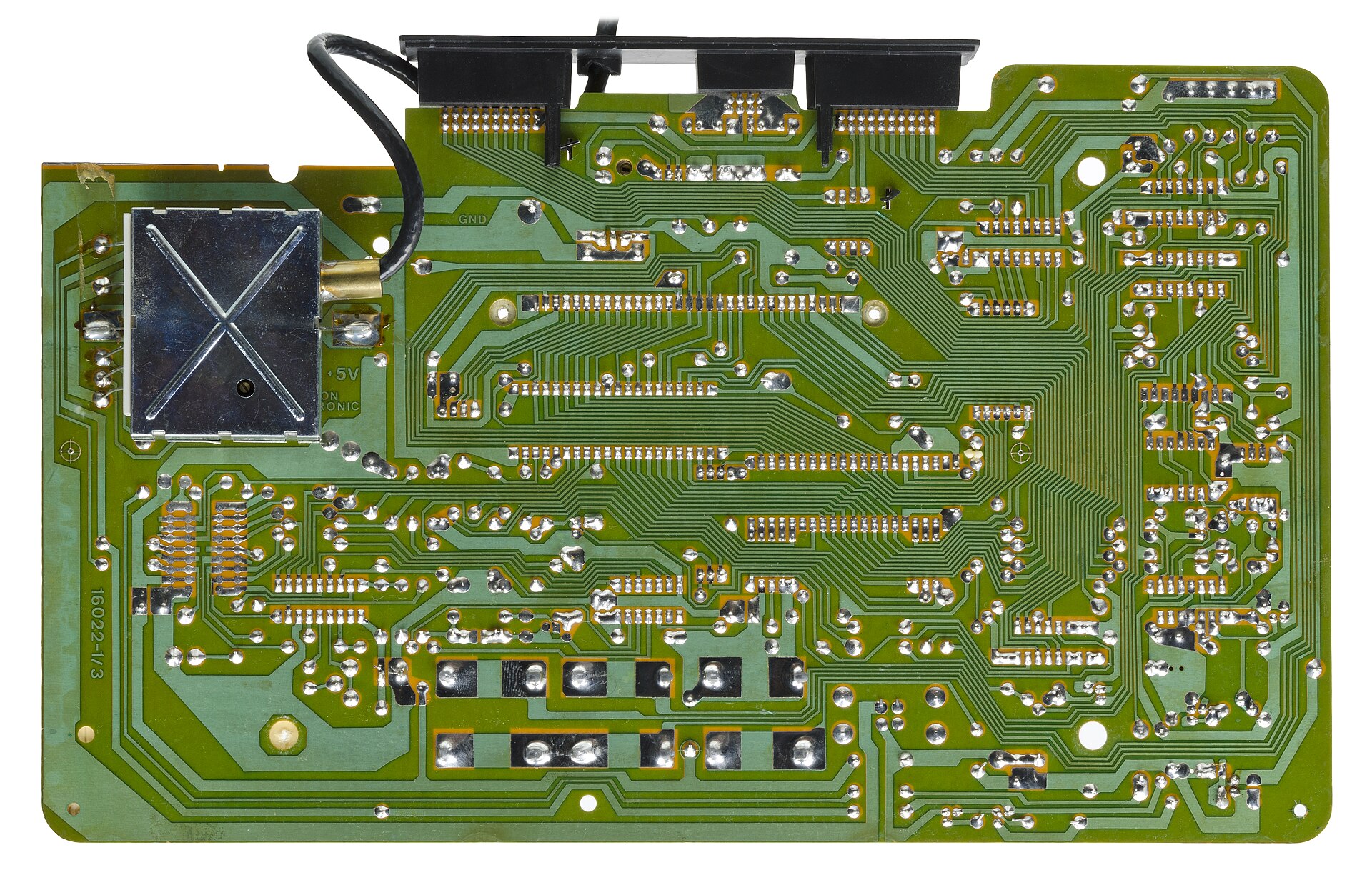
The Interton VC 4000 board, solder side. Photo by Evan-Amos (Vanamo Media), public domain.
Identification
| Field | Value |
|---|---|
| Makers | Interton (Germany) and many European rebadgers |
| Years | 1976-1979 |
| CPU | Signetics S2650 @ ~887 kHz (3,546,875 ÷ 4) |
| Video / I/O | PVI 2636 — also supplies the chip select signals |
| Media | cartridge |
The exact clock is not settled
MAME uses 3,546,875 ÷ 4 ≈ 886.7 kHz, but the code keeps an alternative value of 865,000 Hz in a comment, with three possible derivations: 3.55 MHz ÷ 4, 3.58 MHz ÷ 3 or 4.43 MHz ÷ 3.
In other words, the real frequency probably depends on the model, and none of the four is established as correct for all. Measuring between 865 and 887 kHz therefore indicates nothing wrong.
One machine, a dozen names
This is the platform's peculiarity.
| Name | Year |
|---|---|
| 1292 Advanced Programmable Video System | 1976 |
| 1392 APVS | 1976 |
| Interton VC 4000 | 1978 |
| Super Play Computer 4000 | 1979 |
| CX 3000 TC | 1979 |
| TVC 4000 | 1979 |
| MPU 1000 · MPU 2000 | 1979 |
Identify the machine, not the brand
These devices share the same electronic base, distributed across Europe under different brands depending on the country. A part, a method or a cartridge valid on one has a good chance of being valid on the others — but the case does not say so.
→ Faced with an unknown console using an S2650 and a PVI 2636, you are very probably in this family.
The PVI 2636 does two jobs
Video and memory decoding at once
The 2636 does not stop at the display: MAME records that it also supplies the chip select signals, memory mapping being done in two steps.
In repair that means a tired 2636 does not merely produce a wrong picture — it can also prevent memory access, and therefore prevent booting.
Common faults
| Symptom | Probable cause | Next step |
|---|---|---|
| Will not boot | PVI 2636 (memory select) or the S2650 | The 2636 does both jobs — see the box |
| No picture, machine running | PVI 2636 | Same chip, other function |
| “Wrong” clock | possibly nothing | ⚠️ the frequency varies by model |
| Cartridge not read | connector contacts | Isopropyl alcohol, never an abrasive |
Procedure — a dead console, step by step ✅
What this adds
Ordered for a console, not for an arcade board: what kills these is almost never the CPU. It is, in real order, the power supply, the capacitors, the drive or the cartridge slot, and only then the logic. → PCB diagnosis
1. The power supply. Two cases, depending on the machine. External brick: ⚠️ read the marking on the machine, next to the socket, and check the adapter against it — voltage and polarity. A centre-negative machine fed centre-positive loses its fuse, sometimes its regulator; do not trust a third-party label or a generic tip. Internal supply (the machine plugs straight into the wall): mains is inside the shell. Unplug, wait, and confirm the large capacitors are discharged before touching the board. Either way, measure under load: a failing supply holds its voltage until it is asked for current.
2. The fuse. Many of these machines have one right behind the socket — it is the part designed to die. Test it in continuity, out of circuit. A fuse that blows again is a short, not a fuse problem.
3. Capacitors. On most machines of this age this is the default suspect rather than a last resort — leaking SMD electrolytics eat the tracks underneath before they give any other sign. ⚠️ Not all of them are like that: some carry very few and are not recapped on principle. Read what this page says about it before reaching for the iron. → Recap
4. The cartridge connector. Cartridge contacts with isopropyl alcohol, never an abrasive eraser: it takes the gold plating off and the problem comes back worse. On the machine side, inspect the slot pins — splayed, bent or oxidised — and check continuity between slot and board.
5. Video output. Isolate the machine from the display: another cable, another TV, another input. A sizeable share of "dead consoles" are a dead cable, or a display that will not lock onto what this machine outputs — see the video section of this page for what that is.
6. Still nothing. Now, and only now, the logic: rails on the board, reset, clock, bus. → PCB diagnosis
Repair (technician)
- Identify the family before the brand. The name on the case does not say which machine it is.
- The 2636 is the critical part: video and memory decoding. A boot failure implicates it as much as the CPU.
- Signetics' S2650 has no common replacement — an uncommon processor, contemporary with the 6502 and Z80 but far less widespread.
- Do not trust a published frequency: four values are in circulation.
→ Methods: PCB diagnosis · Recap
Modernisation & mods
- No battery, no suicide.
- ⚠️ Do not host ROMs — method only.
Photos / assets
(To take: the board with the S2650 and the PVI 2636, and above all several differently branded cases side by side — that is this page's subject.)
Sources & attribution
Text (synthesised here; sources listed for attribution):
- MAME —
src/mame/interton/vc4000.cpp(BSD-3-Clause / GPL): S2650 at 3,546,875 ÷ 4, with the alternative 865,000 Hz value kept in a comment and its three possible derivations (3.55 ÷ 4, 3.58 ÷ 3, 4.43 ÷ 3); the note that the PVI 2636 supplies the chip select signals, memory mapping being done in two steps; and the family's machine list with years — 1292 APVS and 1392 APVS (1976), VC 4000 (1978), Super Play Computer 4000, CX 3000 TC, TVC 4000, MPU 1000 and MPU 2000 (1979) — https://github.com/mamedev/mame/blob/master/src/mame/interton/vc4000.cpp
Image:
-
vc4000-carte.jpg— Evan-Amos, Public domain — https://commons.wikimedia.org/wiki/File%3AInterton-Electronic-VC-4000-Motherboard-Bottom-Flat.jpg

Review & corrections
How this space is used
Spotted a wrong value, an outdated procedure, a chip reference that does not match your board? Say so here, with what you observed (model, board revision, serial number, measurement). Every report is cross-checked against a source before anything changes — an unverifiable correction is published as “reported by …, not cross-checked” rather than silently applied.
Reading is open to everyone; posting requires signing in with Discord. Reports from the wiki's declared reviewers are handled first; anyone else's are read too, but go through a human before anything is changed.