Micronique Hector
A French micro of the 1980s — but its story starts in the United States and ends in France after three bankruptcies. The range covers nine machines, from the 1979 Interact to the 1985 Hector MX.
Identification
| Field | Value |
|---|---|
| Manufacturer | Micronique (France) |
| Origin | Interact Family Computer (Interact Electronics, Ann Arbor, Michigan) |
| Years | 1979-1985 |
| CPU | I8080 (Interact) · Z80 (Hector) |
| Media | tape · floppy (Disc2, mini Disc) |
⚠️ The clocks change from model to model
This is the measurement point on this range: three different CPU frequencies.
| Model | Year | CPU | Clock |
|---|---|---|---|
| Interact Family Computer | 1979 | I8080 | 2 MHz |
| Victor | 1980 | Z80 | 5 MHz |
| Hector 1 | 1983 | Z80 | 1.75 MHz |
| Hector 2HR / 2HR+ | 1983 | Z80 | 5 MHz |
| Hector HRX + Disc2 | 1984 | Z80 | 5 MHz |
| Hector HRX + mini Disc | 1985 | Z80 | 5 MHz |
| Hector MX 40c + Disc2 | 1985 | Z80 | 5 MHz |
| Hector MX 80c + Disc2 | 1985 | Z80 | 5 MHz |
Disk expansions — two quite distinct controllers. ⚠️ No machine in the driver combines the two:
| Expansion | Logic |
|---|---|
| Disc2 | Z80 at 4 MHz + a μPD765A at 8 MHz controller |
| mini Disc | FD1793 at 1 MHz, with no second processor |
A Hector 1 does not run at an HRX's speed
1.75 MHz on a Hector 1 against 5 MHz on an HRX: measuring without knowing the model means nothing. And the original Interact is not even a Z80 but an 8080.
A story with three bankruptcies
Why the same machine carries so many names
The MAME driver traces the chain: the Interact Family Computer is designed by Interact Electronics in Ann Arbor, Michigan. The company collapses just after launch. The liquidator, Protecto, sells some; MicroVideo the rest, then carries on developing — before folding in turn two years later. Lambda Systems' French clone eventually collapses too: Micronique then buys the stock and the rights of all three companies.
Meanwhile the French company Lambda Systems sells a clone called the Victor Lambda — before collapsing in turn. Micronique then buys the stock and the rights of all three companies, and it is from this line that the Hector range is born.
What the emulation does not do — know this before comparing
The driver states its own limits, machine by machine:
- the keyboard does not work on the HRX + Disc2, the MX 40c and the HRX + mini Disc — they load the tape fine, but the keys do not respond;
- the MX 80c is declared not compatible;
- the Hector 2HR, 2HR+ and Victor can load and run Interact and Hector 1 tapes.
These are the emulator's limits, not the machines'. But they rule out using it as a reference on those models.
Common faults
| Symptom | Likely cause | Lead |
|---|---|---|
| Won't start | CPU or its crystal | ⚠️ 8080 or Z80 by model, three clocks |
| Floppy unreadable (Disc2) | Z80 4 MHz or the μPD765A | The expansion has its own logic |
| Floppy unreadable (mini Disc) | FD1793 | A different controller, no second Z80 |
| No sound, or wrong sound | sound stage | ⚠️ every machine carries "imperfect sound" in MAME (all nine) |
Repair (technician)
- Identify the model before measuring anything. This is the wiki's range with the widest spread: 2 MHz, 1.75 MHz or 5 MHz depending on the machine.
- The disk expansion is a machine inside the machine: its own Z80 at 4 MHz. A floppy fault is not necessarily a computer fault.
- Sound is flagged imperfect in emulation on all nine machines: do not use it as a reference to judge a real sound stage.
→ Methods: PCB diagnosis · Recap
Procedure — a dead computer, step by step ✅
What this adds
Ordered for a home computer: what kills these is its power supply, its battery, its capacitors, its socketed RAM and its keyboard — roughly in that order, and well before the CPU. → PCB diagnosis
1. The power supply — measured before it is plugged in. This is the one step not to swap around. On a machine of this age a supply does not simply stop: a 5 V regulator that fails high puts 7, 9, 12 V onto the bus and takes the RAM and the custom chips with it. Measure every rail off the machine, under a dummy load if you can, and only then plug it in.
2. The battery, if it has one. Any RTC or backup cell soldered to a board is a future leak. If yours has one and it has never been changed, take it out before it takes the tracks with it. → Backup batteries
3. Capacitors. Recap is the default on these machines, not a last resort — and on the supply first, since that is what protects everything else. → Recap
4. RAM, on its sockets. These machines were built to be repaired: the RAM, and often the logic, sit in sockets. Reseat everything first — thirty years of oxide is a classic no-boot. Then swap chips: a bad RAM chip usually gives a repeatable pattern of garbage or a screen frozen at a fixed character.
5. The keyboard. A console does not have one; a computer's is a wear part. A membrane keyboard fails as whole dead rows or columns — that is the membrane, not the machine. A mechanical one wants its contacts cleaning, not replacing. Check this page: the failure mode is often documented per model.
6. Storage — tape or disk. Both often come down to the same things: a dirty head, and for tape the azimuth and a belt turned to tar. ⚠️ On the floppy side, check whether the mechanism actually has a belt before looking for one: many do, but some drives are direct drive, and hunting a belt that isn't there means stripping a drive for nothing. A machine that boots but loads nothing is a drive fault, not a logic fault — do not go looking on the board for it.
7. Video output. RF, composite, RGB or a dedicated monitor, depending on the machine (see Identification). Test with something else before you conclude: a period modulator and a modern TV disagree far more often than either is broken.
8. Still nothing. Now the logic: rails on the board, reset, clock, bus. → PCB diagnosis
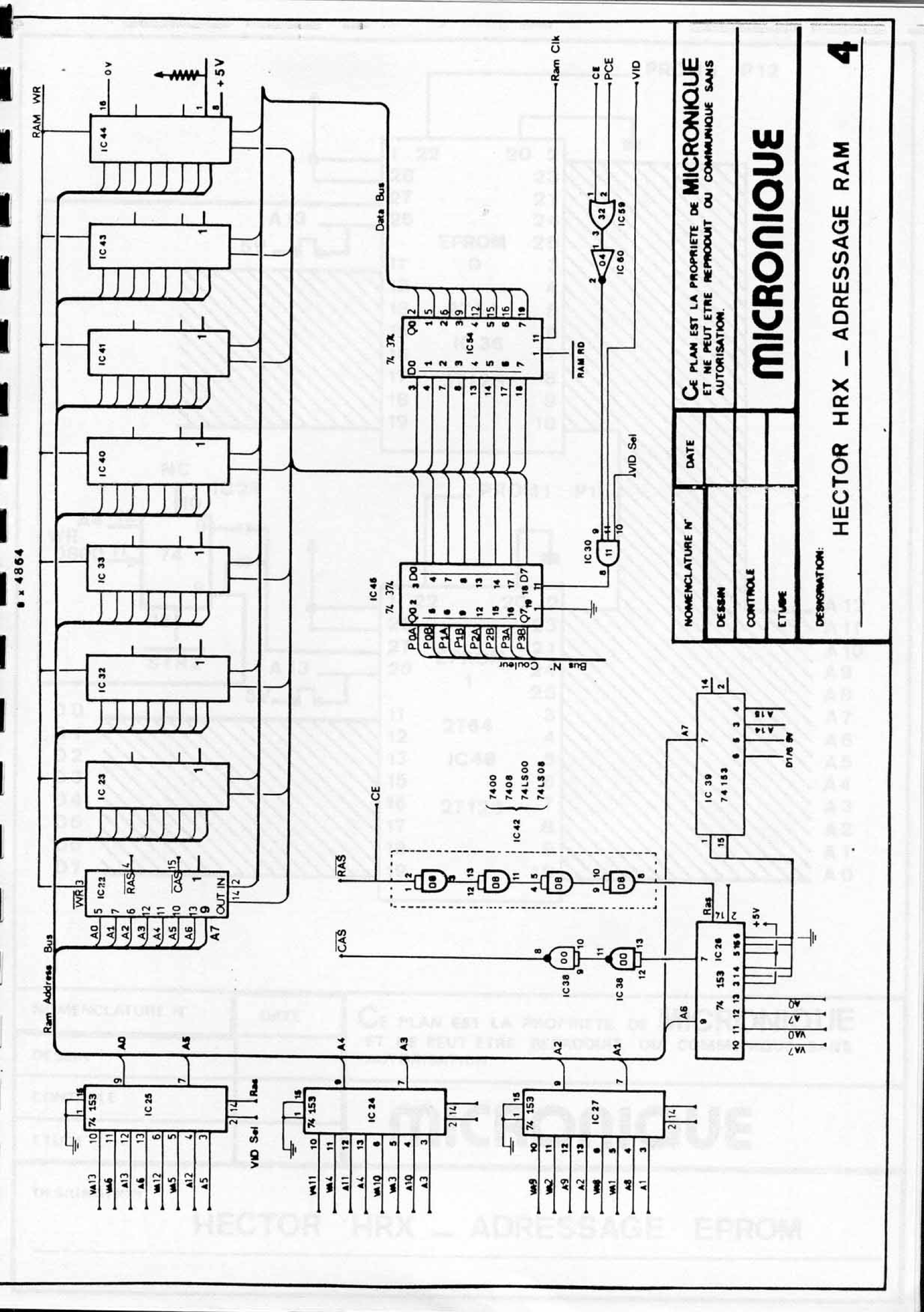
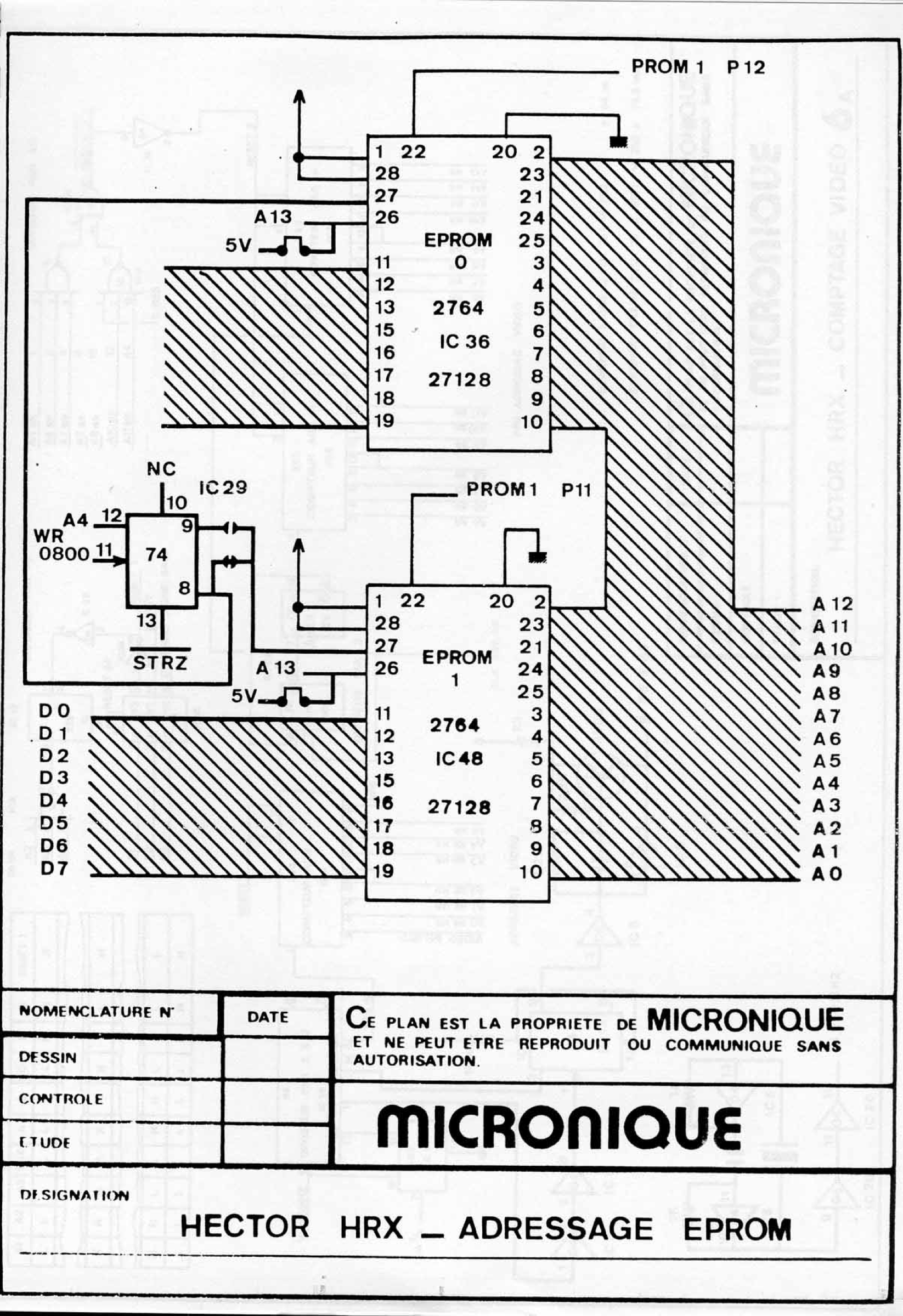
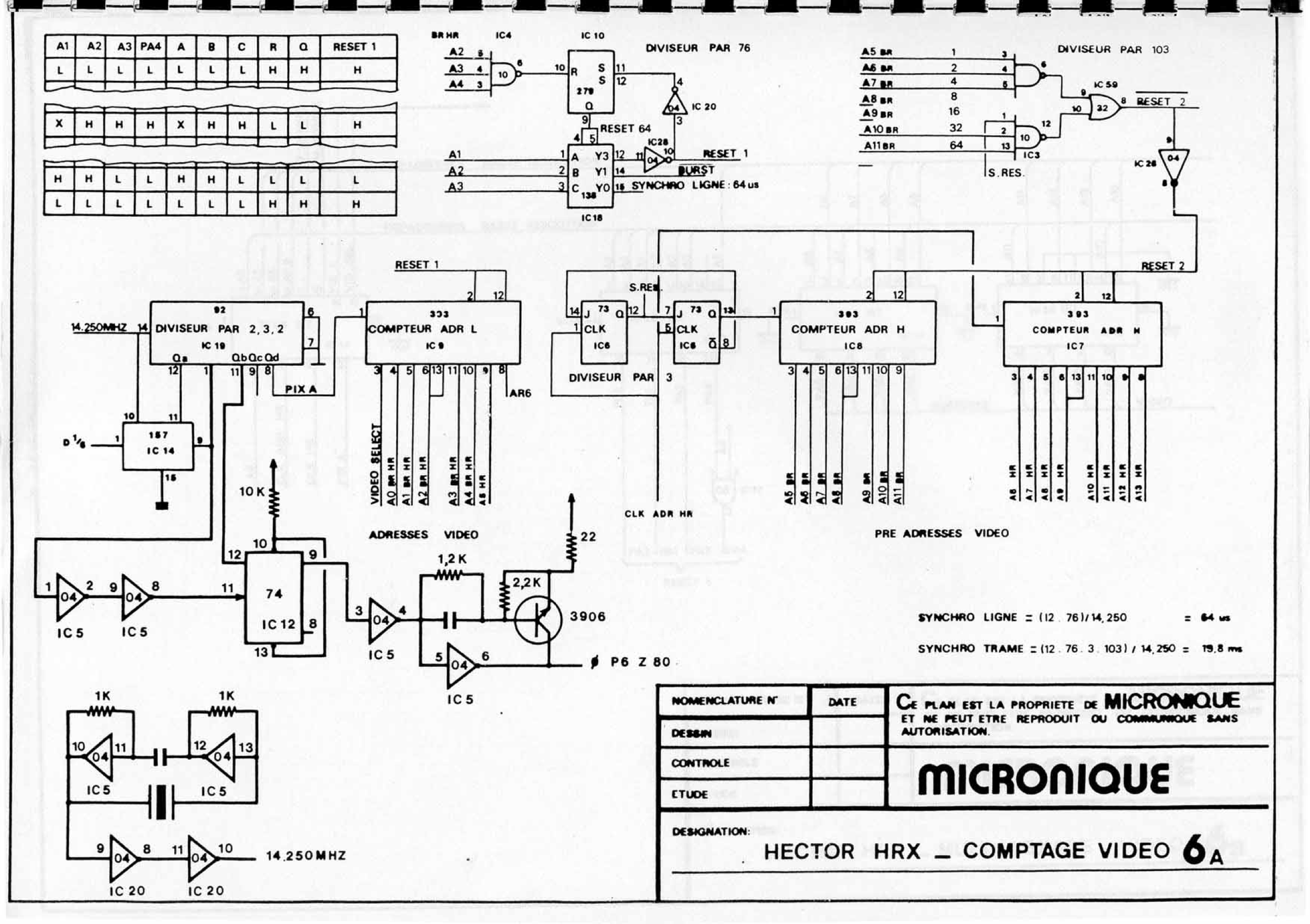
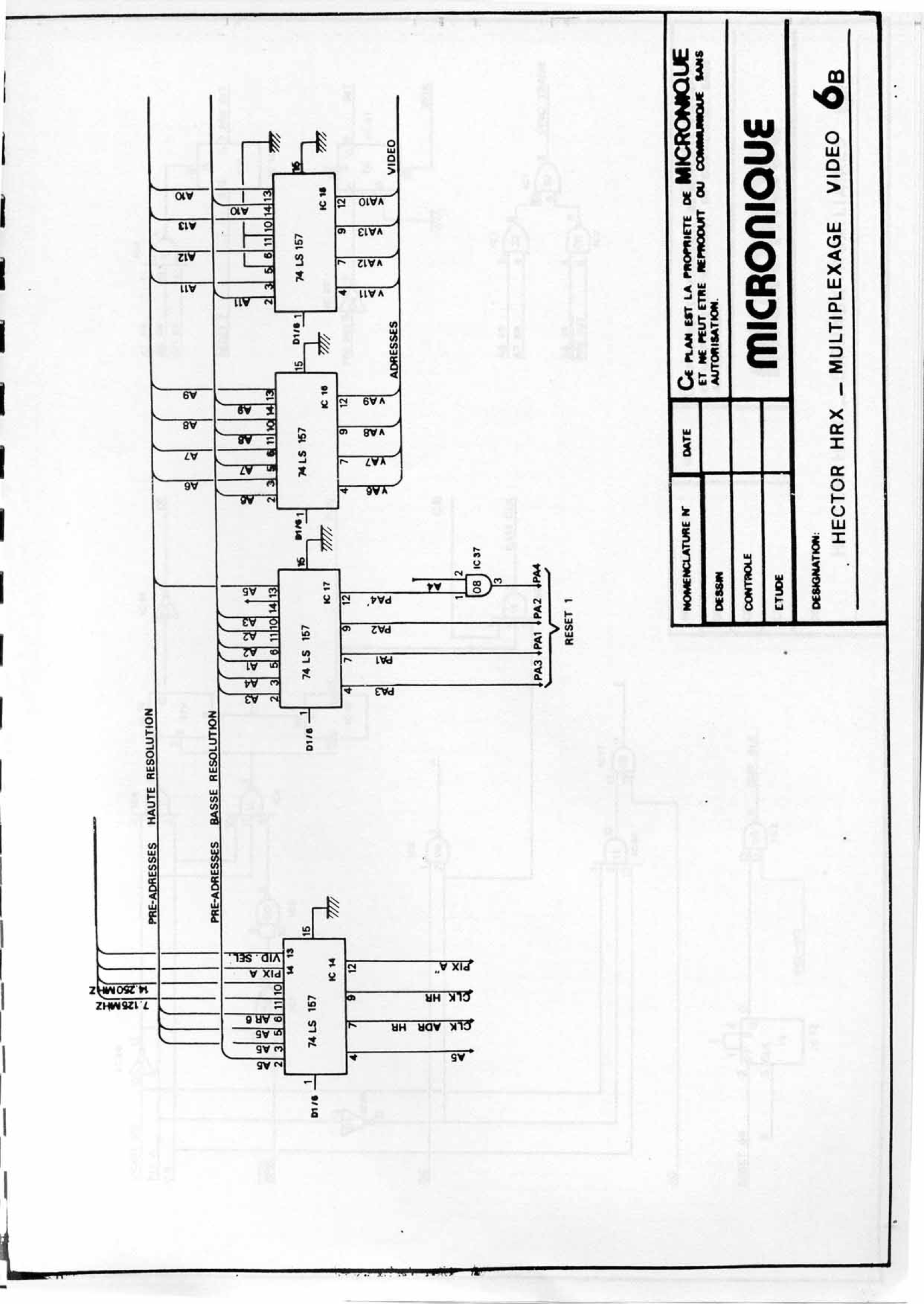
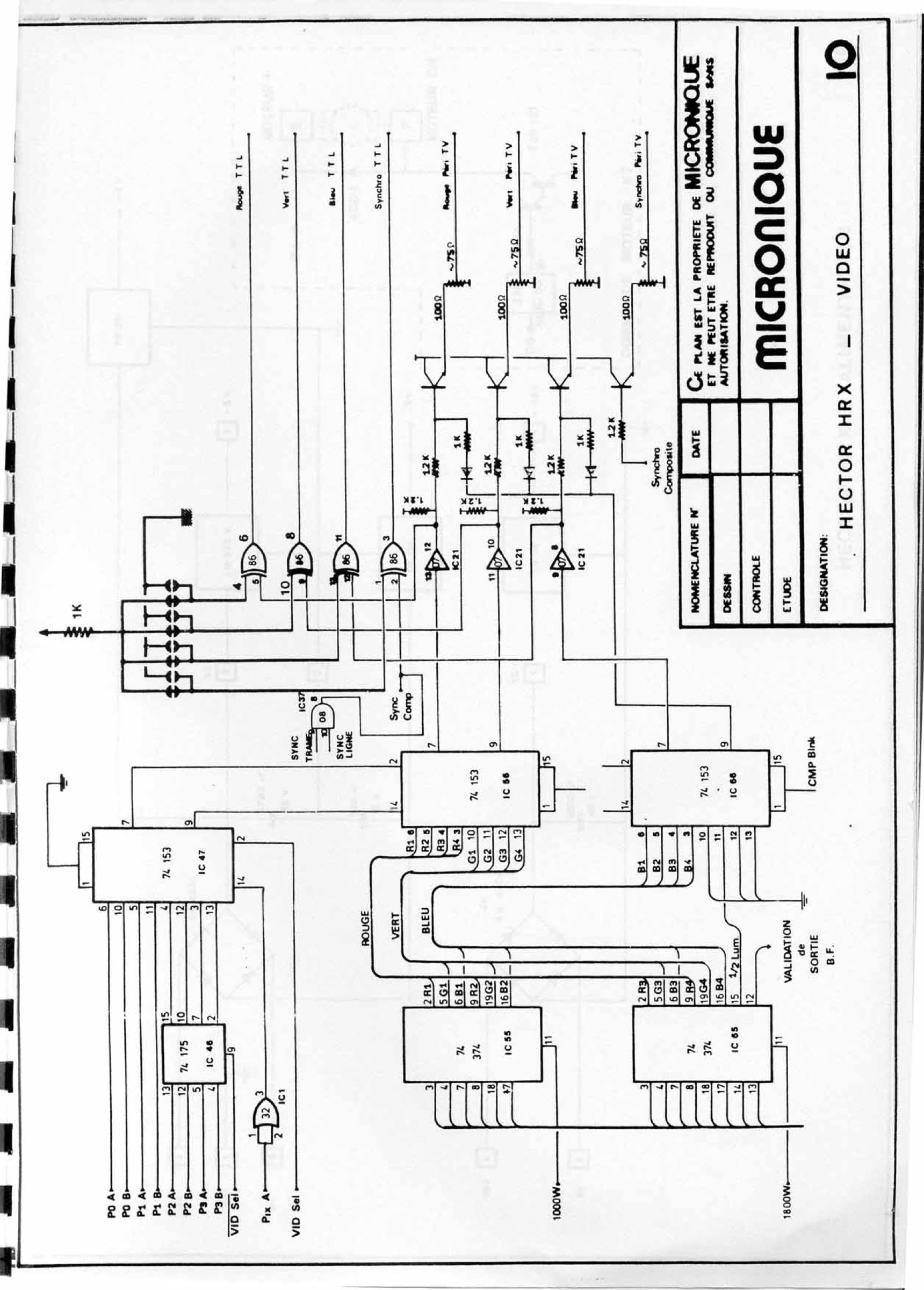
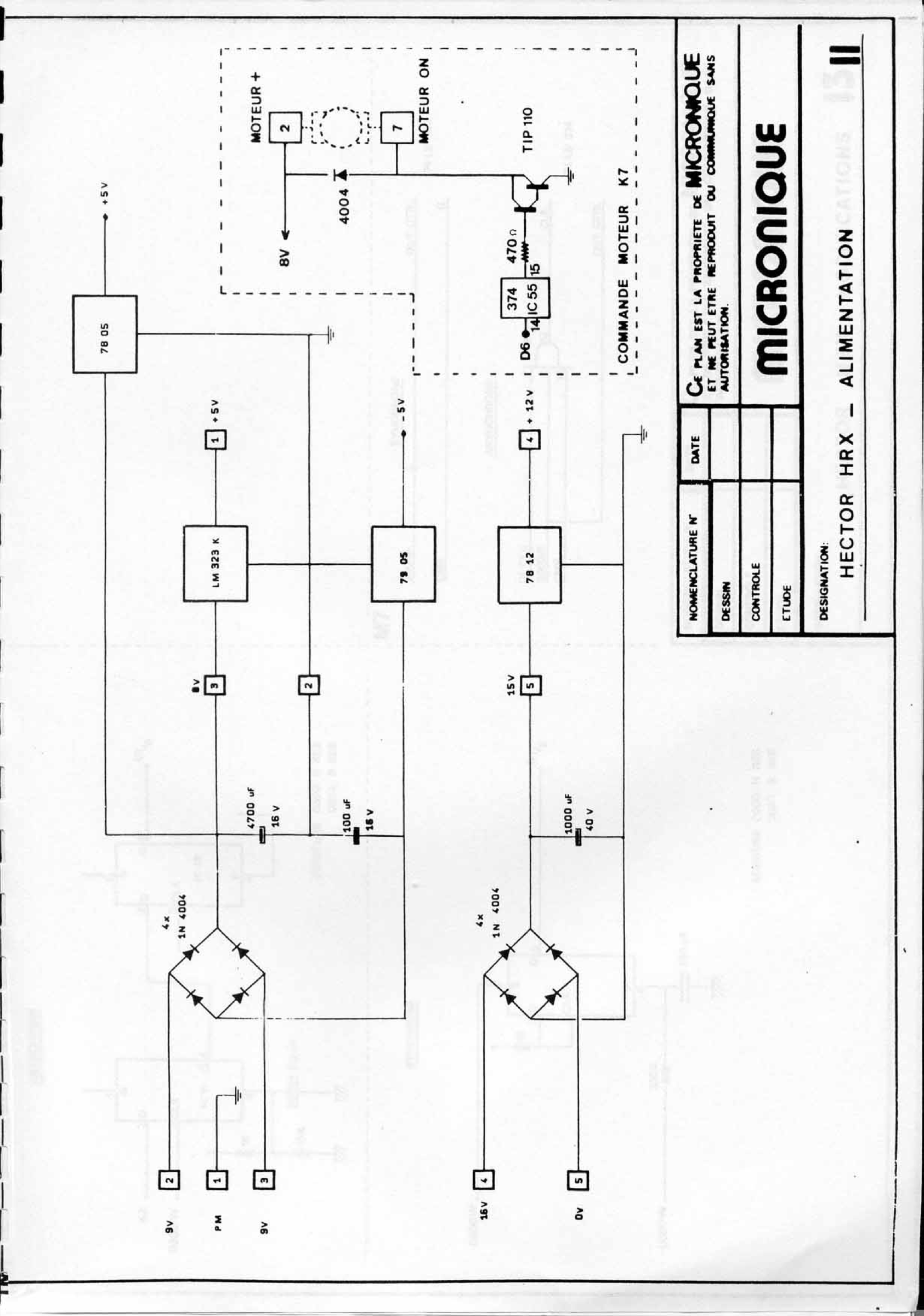
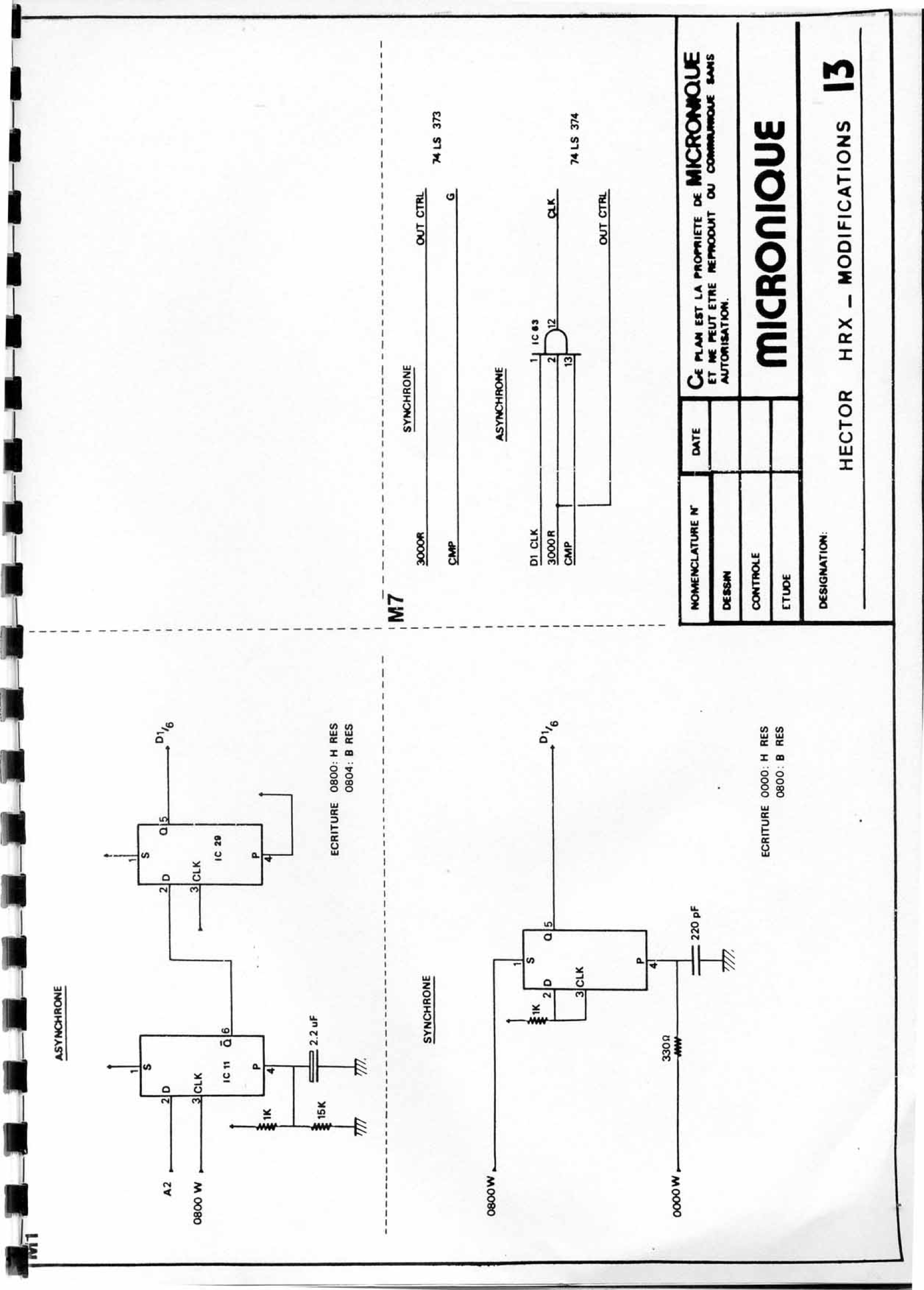
Archived schematics ✅
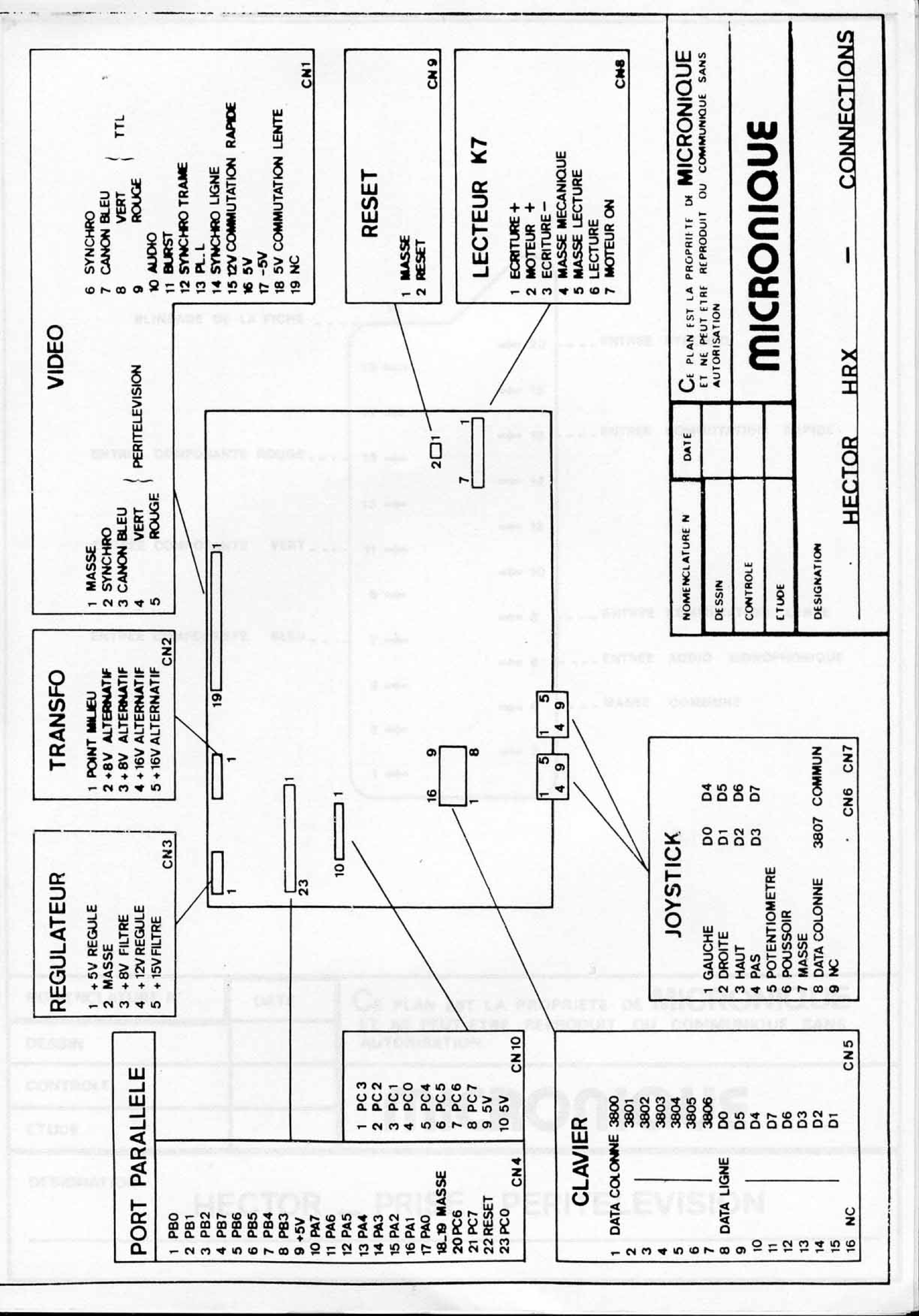
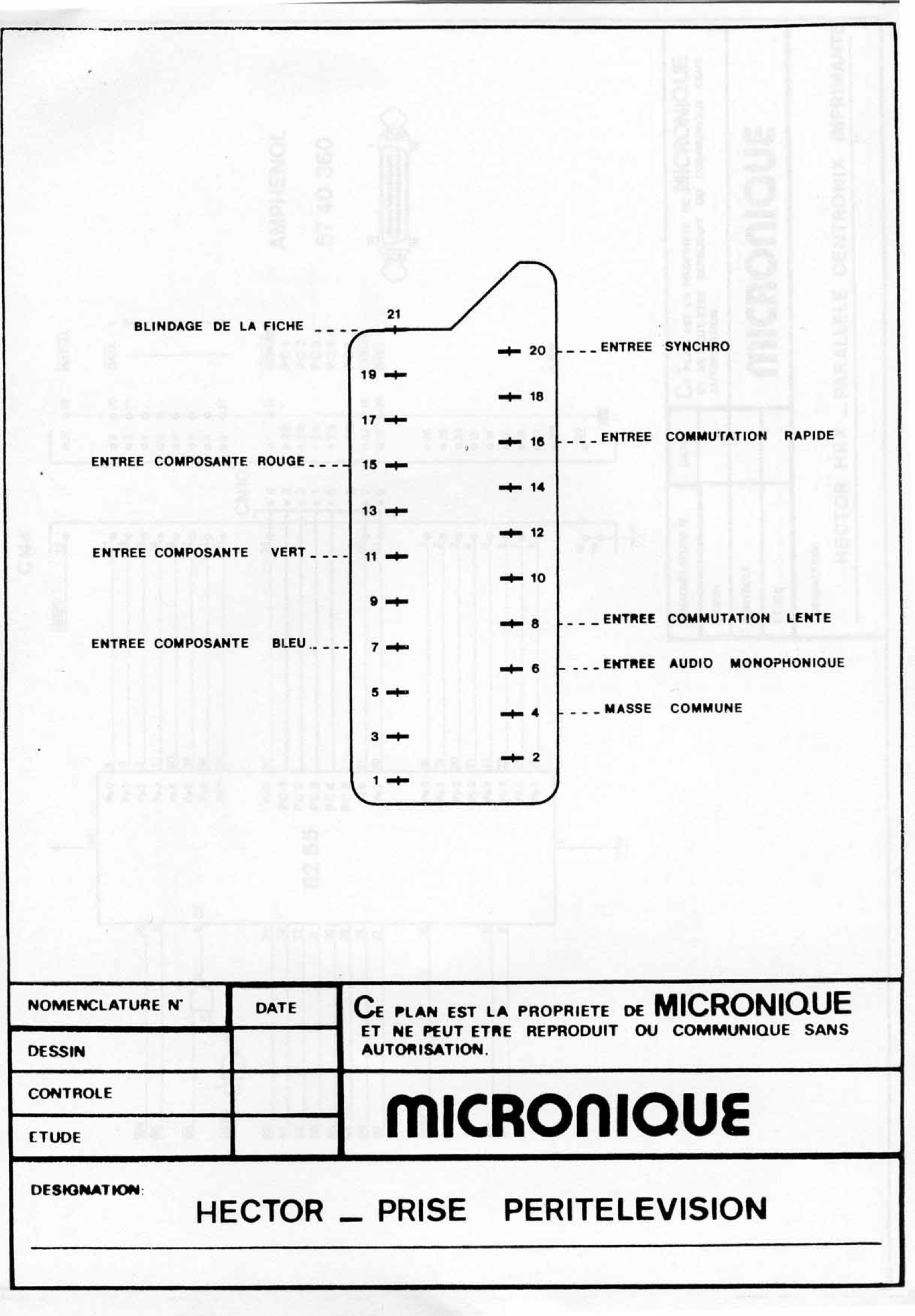
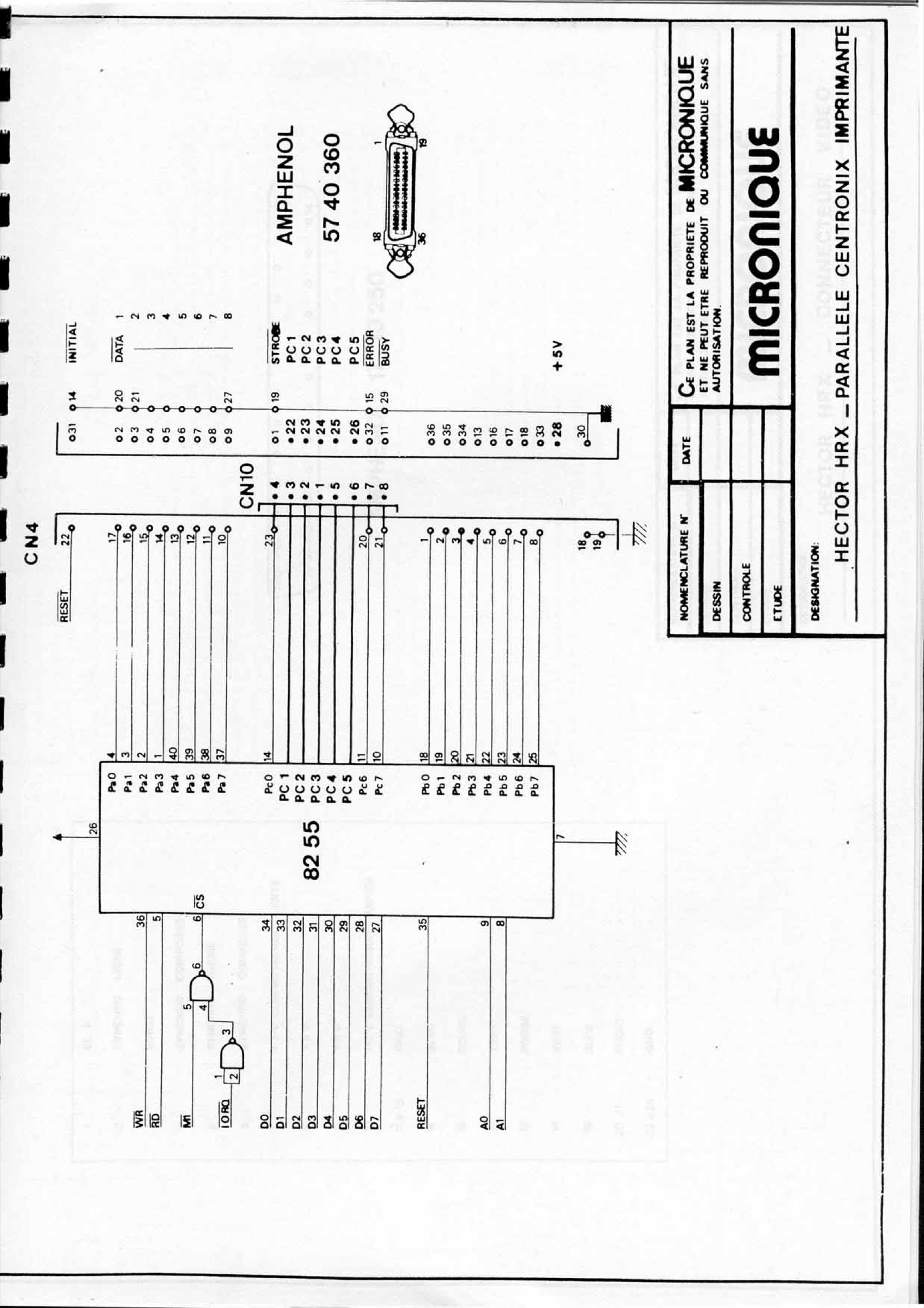
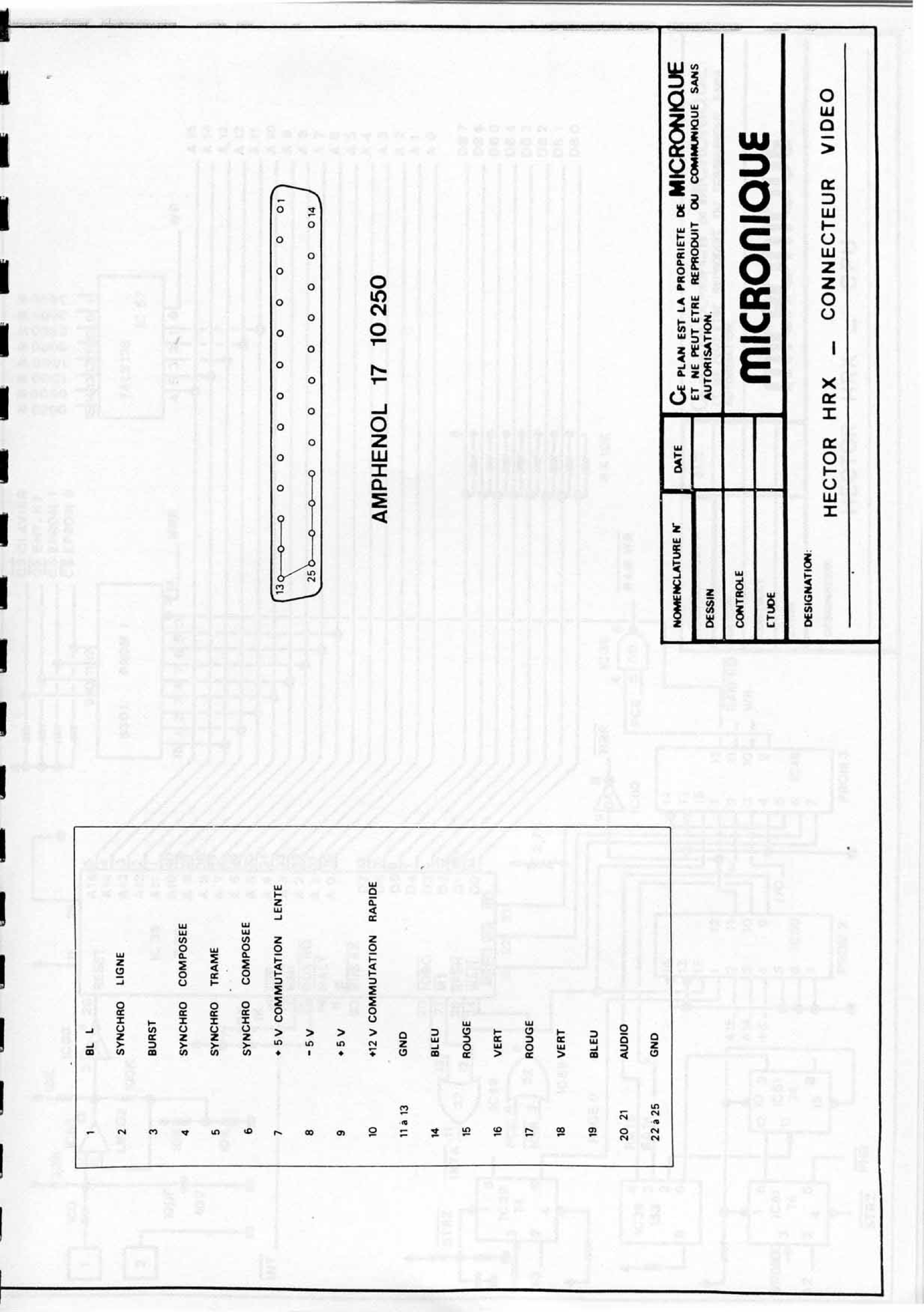
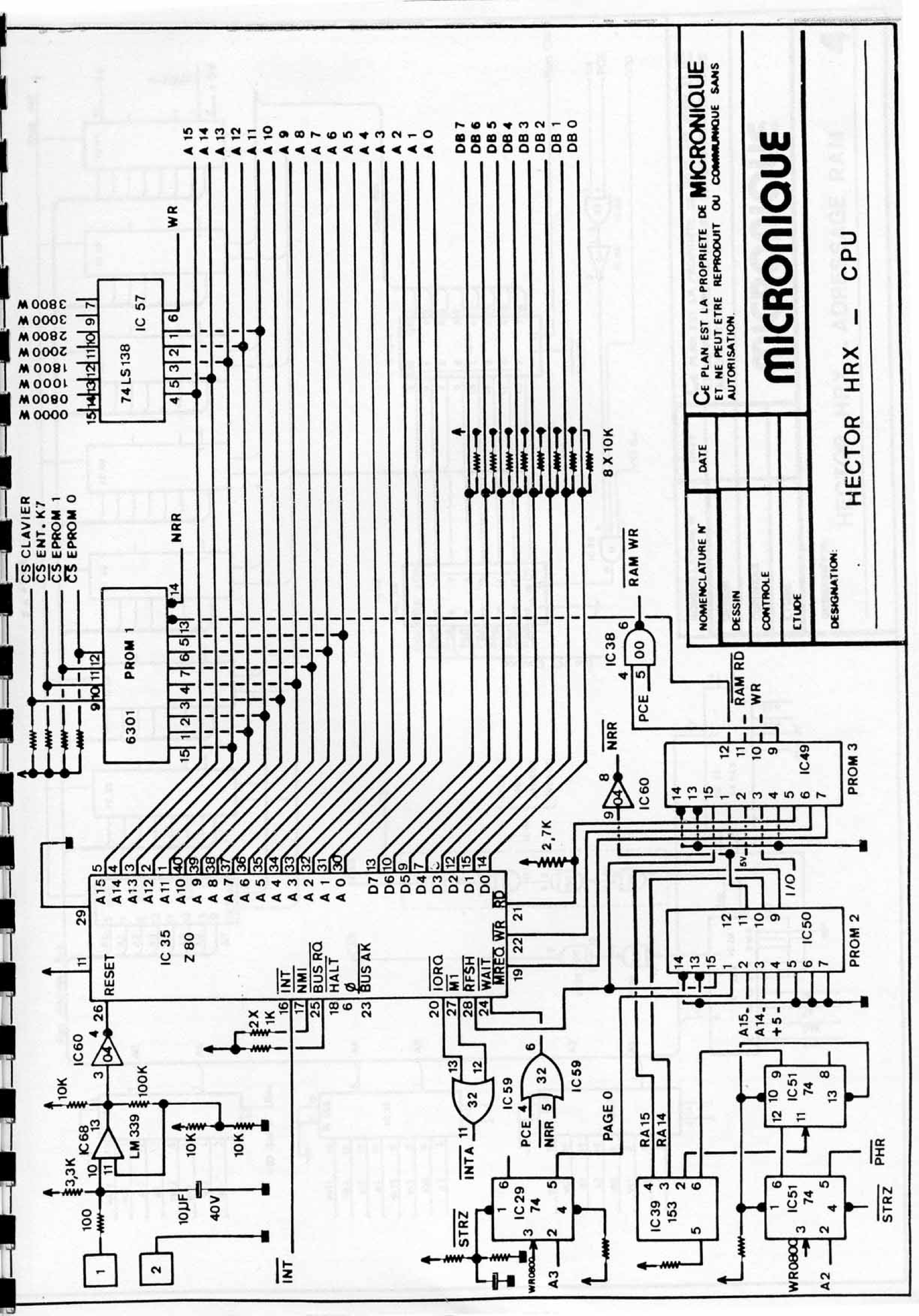
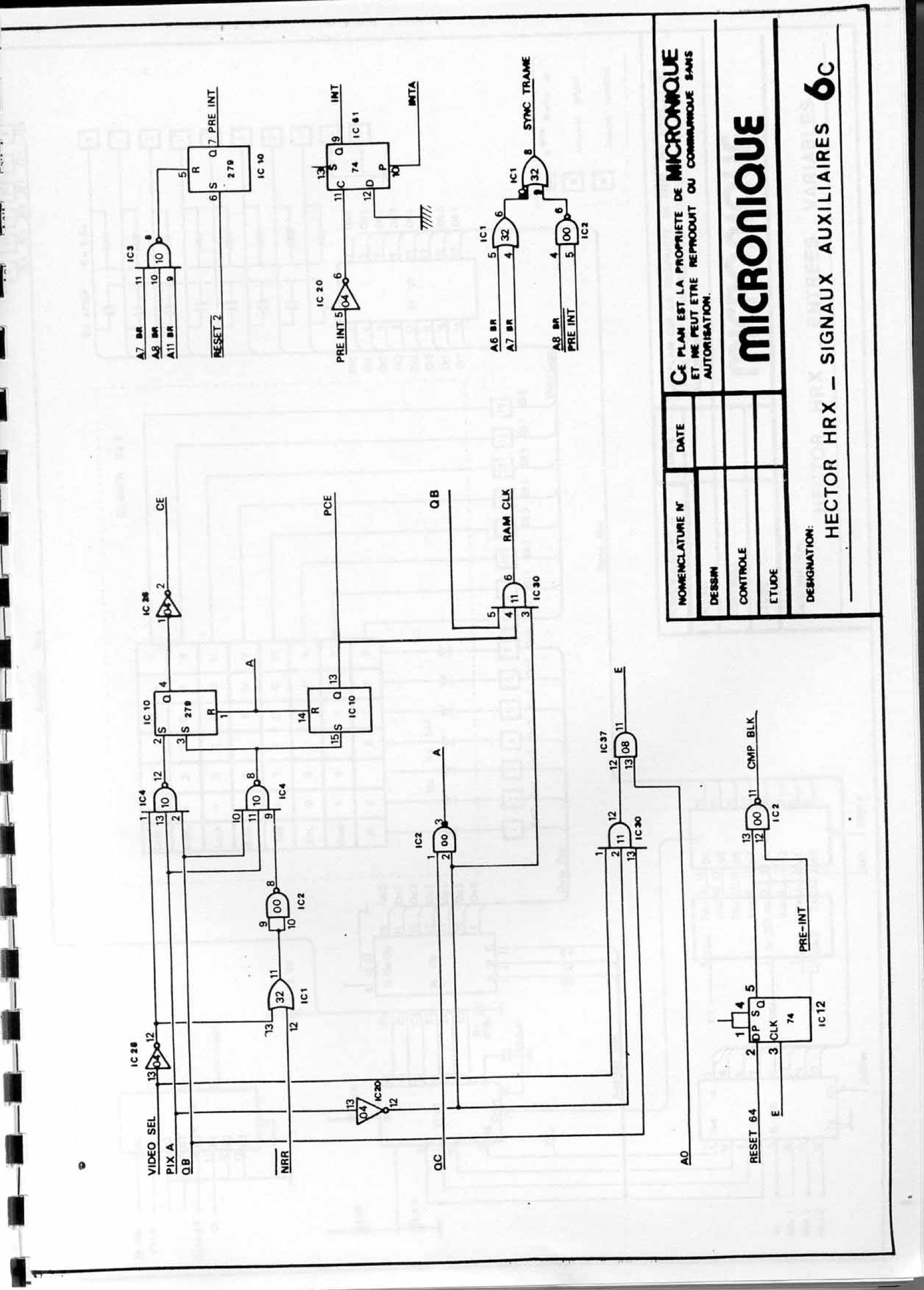
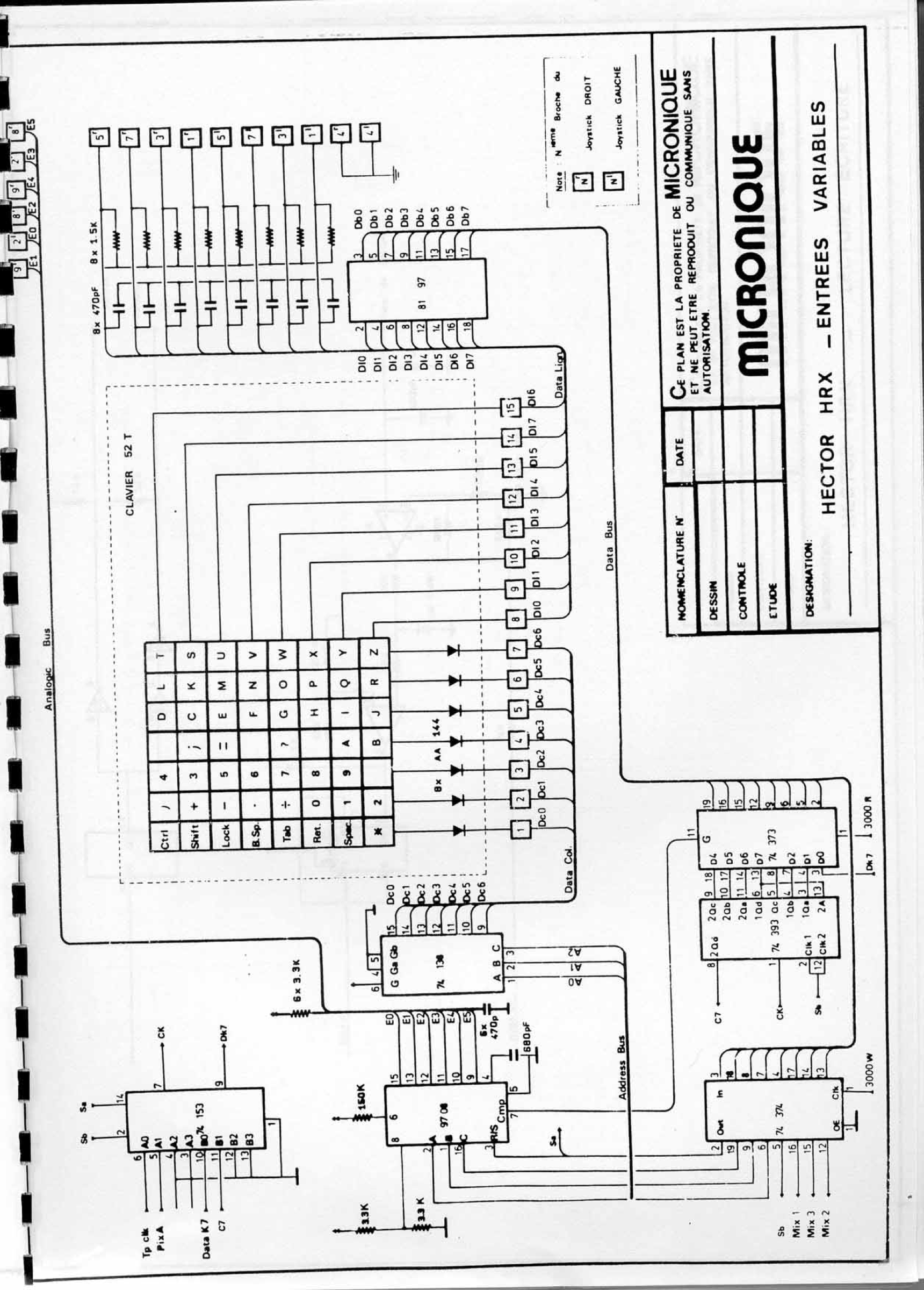
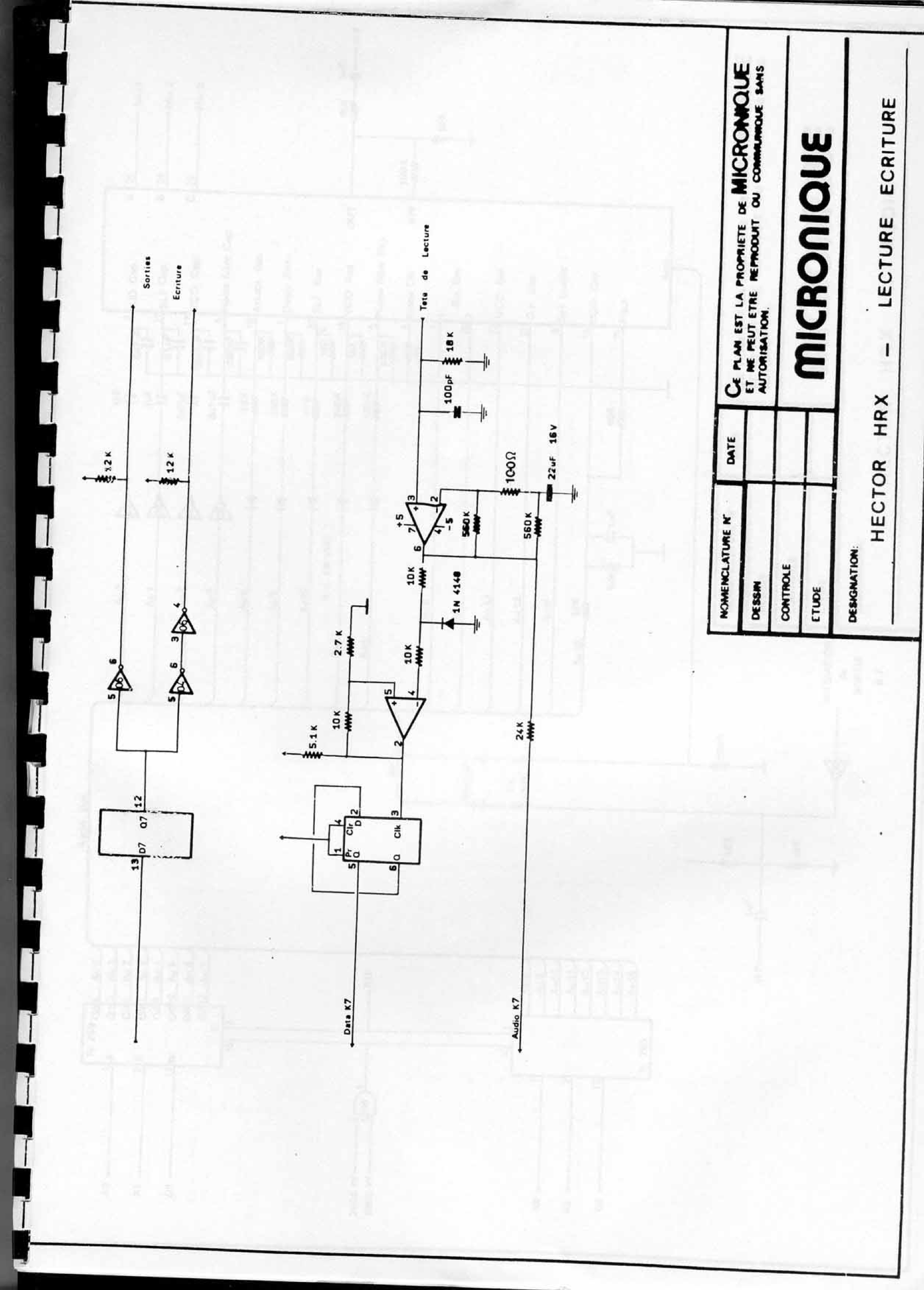
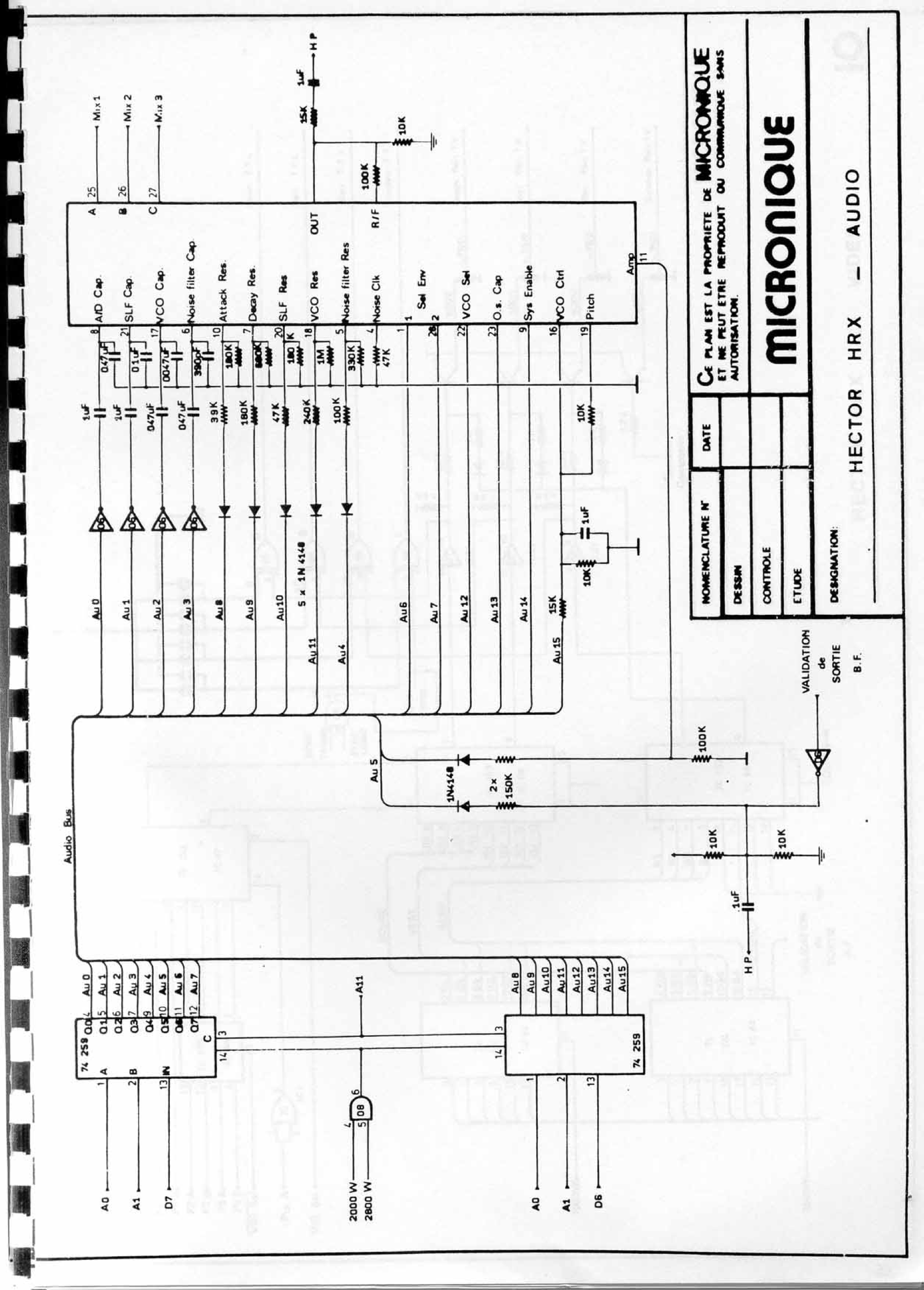
The Hector HRX technical schematics, page by page — cover and 18 plates.
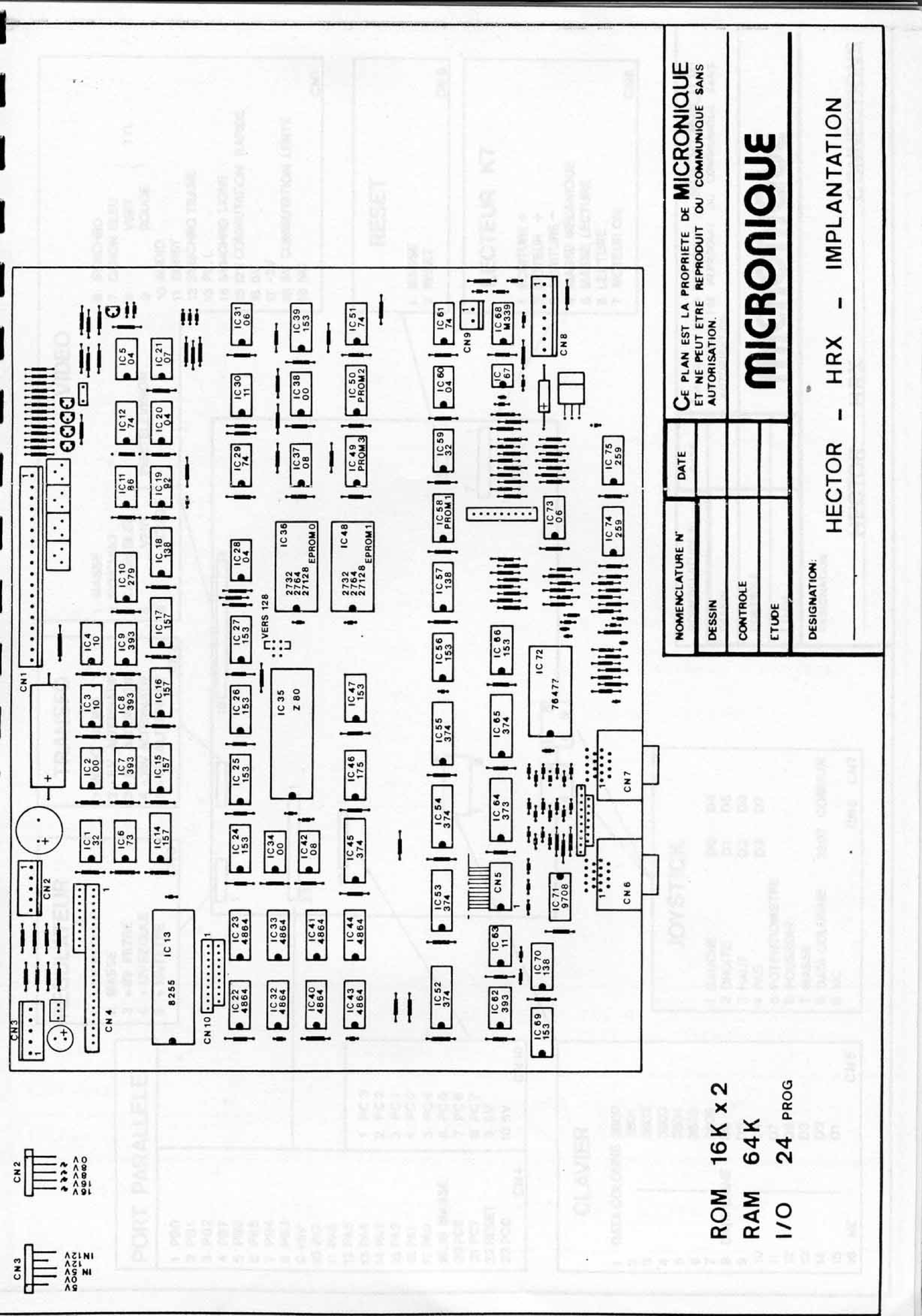
Hector HRX — 19 plates
Provenance
Undocumented origin in the collection these schematics came from: no author and no licence is stated there.
Sources & attribution
- MAME —
src/mame/hec2hrp/hec2hrp.cpp(BSD-3-Clause, driver by JJ Stacino): the full genealogy — Interact Electronics of Ann Arbor, the company's collapse just after launch, the liquidation by Protecto, the takeover by MicroVideo and its demise two years later, the Victor Lambda clone by Lambda Systems; the nine machine entries with their years; the I8080 at 2 MHz (Interact), Z80 at 1.75 MHz (Hector 1) and Z80 at 5 MHz (HRX) clocks; the Disc2's Z80 at 4 MHz and the mini Disc's FD1793 at 1 MHz; and the "imperfect sound" flag on all nine — https://github.com/mamedev/mame/blob/master/src/mame/hec2hrp/hec2hrp.cpp
Review & corrections
How this space is used
Spotted a wrong value, an outdated procedure, a chip reference that does not match your board? Say so here, with what you observed (model, board revision, serial number, measurement). Every report is cross-checked against a source before anything changes — an unverifiable correction is published as “reported by …, not cross-checked” rather than silently applied.
Reading is open to everyone; posting requires signing in with Discord. Reports from the wiki's declared reviewers are handled first; anyone else's are read too, but go through a human before anything is changed.